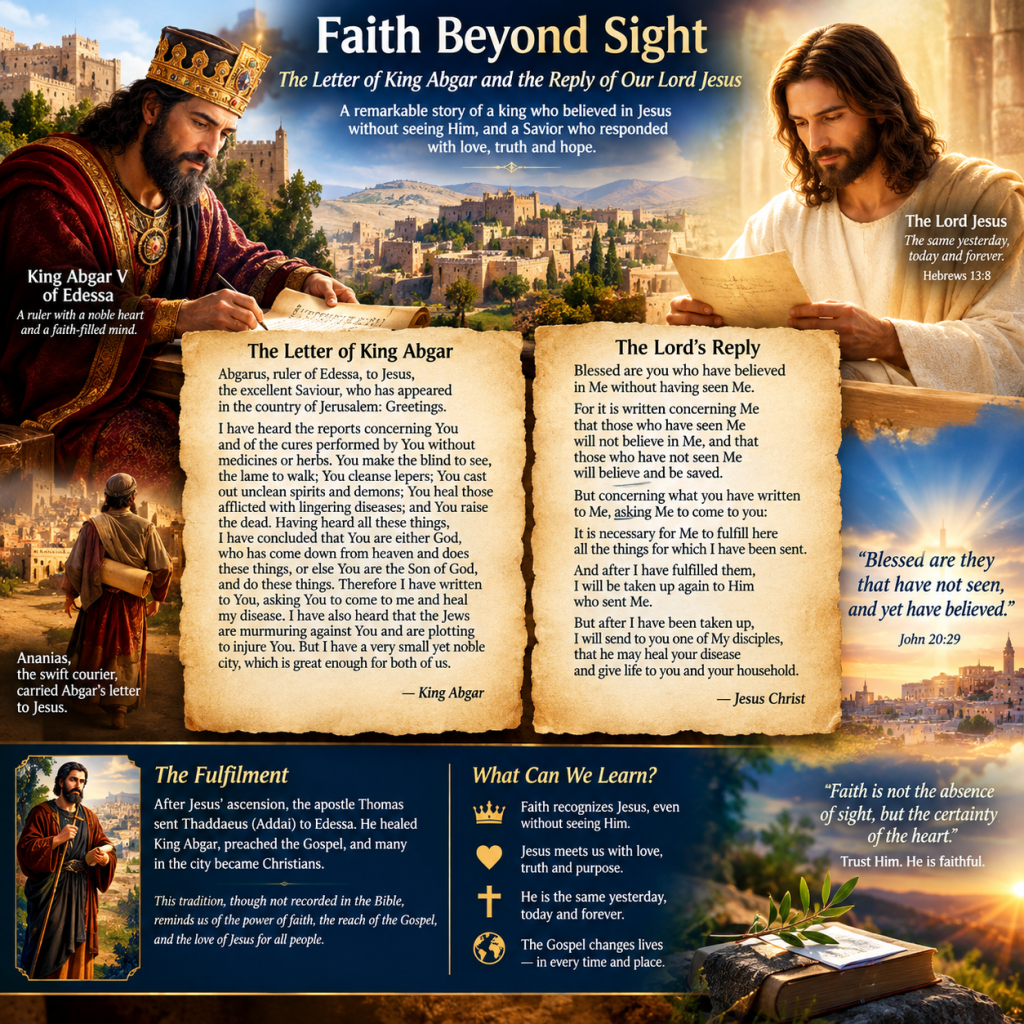
The Letter of King Abgar and the Reply of Our Lord Jesus
There are moments in history when a story reaches across centuries and speaks directly to the human heart. One such story is the ancient tradition concerning King Abgar V of Edessa and our Lord Jesus Christ. A king who had never seen Jesus heard about His mighty works. He heard that the blind received sight, the lame walked, the lepers were cleansed, demons were cast out, the sick were healed, and even the dead were raised.
Abgar believed what he had heard. And he wrote to Jesus. His letter was not simply a request for healing. It was an extraordinary expression of faith in the One whom he had never seen.
The King’s Letter
According to the account preserved by the early Christian historian Eusebius, King Abgar addressed Jesus as “the excellent Saviour.” He had heard about the miracles Jesus performed and came to a remarkable conclusion: either Jesus was God who had come down from heaven, or He was the Son of God. Abgar then asked Jesus to come to Edessa and heal him.
Abgar had not seen Jesus with his physical eyes. He had never watched Jesus perform a miracle. He had never sat among the crowds listening to Him teach. Yet he believed. His faith began with what he had heard about Jesus. That reminds us of the words of the Apostle Paul: “So then faith cometh by hearing, and hearing by the word of God” (Romans 10:17). Abgar’s physical eyes had never seen Christ, but his heart had begun to recognize Him.
The Reply of the Lord Jesus
The traditional account states that Jesus sent a reply to King Abgar. The message begins with words of extraordinary spiritual significance: “Blessed are you who have believed in Me without having seen Me.” Those words immediately bring to mind the words spoken by the risen Christ to Thomas: “Blessed are they that have not seen, and yet have believed” (John 20:29).
What a profound connection. Thomas had seen the risen Lord. Abgar, according to the tradition, had not. Yet both stories point toward the same great truth: faith does not require physical sight. The Christian faith says, “Believe in Christ, trust His Word, and walk with Him—even when you cannot see what lies ahead.” We cannot see tomorrow. We cannot see every answer to our prayers. We cannot always understand why God permits certain things to happen. But we can still trust the One who holds tomorrow.
Jesus Did Not Come to Edessa—But He Had a Greater Purpose
Abgar invited Jesus to come to his city. But according to the traditional reply, Jesus explained that He had a divine work to accomplish first. He had been sent for a purpose. He would fulfil the work given to Him and then return to the One who sent Him. Sometimes we ask God, “Lord, come into this situation and change it according to my desire.” But God’s answer may be, “Trust Me. I am accomplishing something greater than you can presently see.”
Jesus did not simply respond according to Abgar’s request. He remained faithful to the Father’s purpose. The Lord had come into the world for something infinitely greater than one king’s healing. He came to seek and save the lost. He came to give His life as a ransom for many. He came to reconcile sinners to God. He came to accomplish the work of salvation.
According to the tradition, Jesus promised that after His ascension He would send one of His disciples to Abgar. The disciple would come to him and bring healing. The tradition identifies that disciple as Thaddaeus, also known as Addai, who was associated with the apostle Thomas in the Edessan tradition. Jesus Himself would not come physically to Edessa at that time, but His work would continue through His messenger. No longer would the physical presence of Jesus be limited to one geographical location. The Gospel would go out as His disciples carried His message, empowered by the Holy Spirit. Consequently, the name of Jesus would travel from city to city, nation to nation, and generation to generation.
Faith Without Sight
The most powerful part of the Abgar story is not really the king’s illness. It is not even the letter. It is faith. A king heard about Jesus and believed. He had not seen the Lord, yet he trusted Him. Centuries later, we stand in a similar position. We have not physically walked beside Jesus in Galilee. We did not stand at the empty tomb. We did not touch the wounds in His hands as Thomas did. Yet we are called to believe. The Apostle Peter expresses this beautifully: “Whom having not seen, ye love; in whom, though now ye see him not, yet believing, ye rejoice with joy unspeakable and full of glory” (1 Peter 1:8).
That is the mystery and beauty of Christian faith. We have not seen Him with our physical eyes. Yet we love Him. We speak to Him. We trust Him. We worship Him. We call upon His name. And we wait for the day when faith will become sight. “Blessed are they that have not seen, and yet have believed” (John 20:29).
You might be praying for things you cannot see yet. You might be waiting for an answer. You might be walking through a quiet season where God feels silent. You might be asking, “Lord, where are You?” Remember King Abgar. He had not seen Jesus, but he believed. And remember the Apostle Thomas. He struggled to believe until he saw the risen Christ. Remember what Jesus said: “Blessed are they that have not seen, and yet have believed.” Faith does not mean pretending that difficulties do not exist. Faith means believing that God is greater than what we can see.
What will we do with what we have heard about Jesus? Abgar heard about Christ and responded with faith. We have something even greater. We have the testimony of Scripture. We have the Gospel. We know of His birth, His ministry, His crucifixion, His resurrection, His ascension, and His promise to return. We know His words: “I am the way, the truth, and the life” (John 14:6). The question is: Do we believe Him?
One day we shall see the King. And until that day, let us walk by faith, let us keep believing, keep praying, keep trusting, and keep seeking Christ. “For we walk by faith, not by sight” (2 Corinthians 5:7).
 The Truth
Leave a comment