Tag: faith

  • THE BEATITUDES — WALKING IN THE HEART OF CHRIST

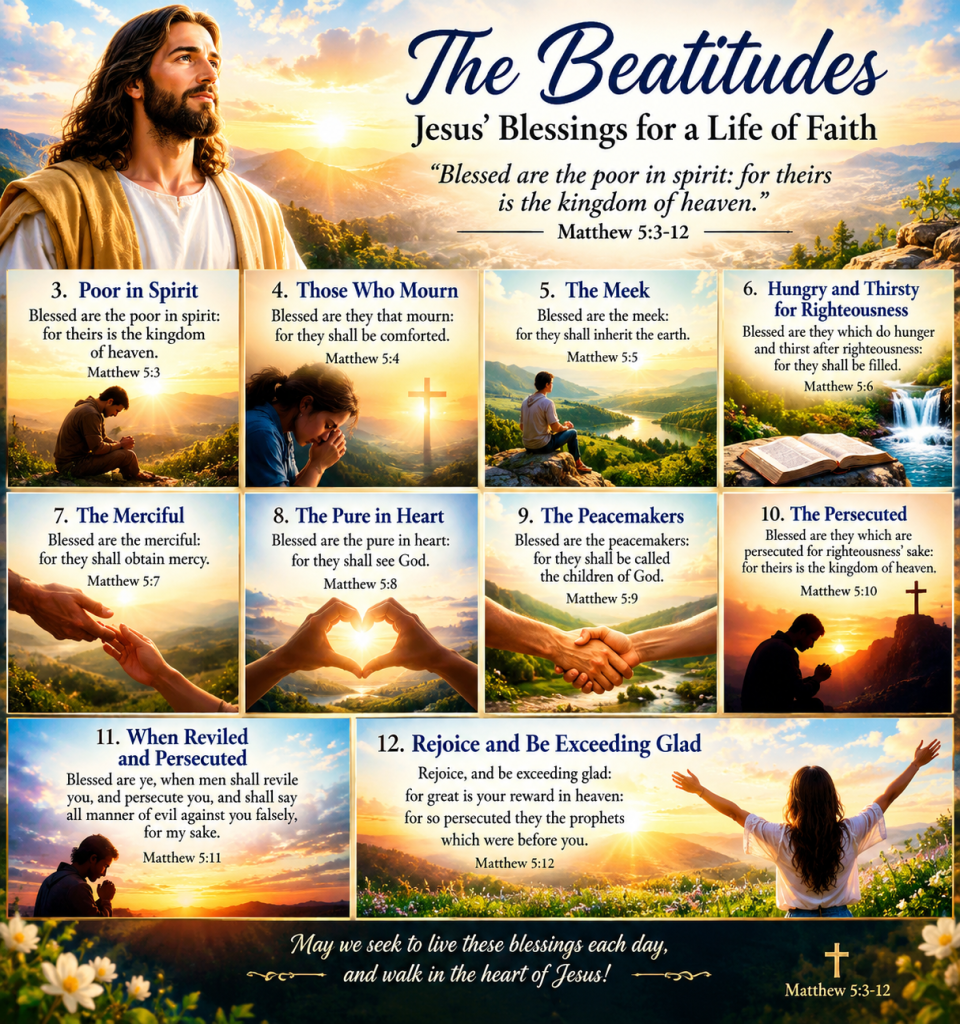
    1. “Blessed are the poor in spirit: for theirs is the kingdom of heaven” (Matthew 5:3).

    To be poor in spirit means to recognize our complete dependence upon God. It is humility before Him, knowing that we need His grace and cannot rely on ourselves.

    2. “Blessed are they that mourn: for they shall be comforted” (Matthew 5:4).

    This speaks of those who grieve deeply, including sorrow over sin and the brokenness of the world. God promises His comfort to the hurting and repentant heart.

    3. “Blessed are the meek: for they shall inherit the earth” (Matthew 5:5).

    Meekness is not weakness. It is strength brought under God’s control responding with gentleness, humility, and self-control rather than pride or revenge.

    4. “Blessed are they which do hunger and thirst after righteousness: for they shall be filled” (Matthew 5:6).

    Just as the body longs for food and water, the believer should deeply desire to live rightly before God. Jesus promises that those who genuinely seek righteousness will be spiritually satisfied.

    5. “Blessed are the merciful: for they shall obtain mercy” (Matthew 5:7).

    Mercy means showing compassion, forgiveness, and kindness to others, especially when they have fallen short. Those who extend mercy reflect God’s own merciful character.

    6. “Blessed are the pure in heart: for they shall see God” (Matthew 5:8).

    A pure heart seeks God sincerely, without hypocrisy or divided devotion. Lord Jesus points us toward an inner life that is clean, sincere, and devoted to Him.

    7. “Blessed are the peacemakers: for they shall be called the children of God” (Matthew 5:9).

    Peacemakers do more than avoid conflict. They actively seek reconciliation, forgiveness, and harmony. They reflect the character of God, who calls people into peace with Himself and one another.

    8. “Blessed are they which are persecuted for righteousness’ sake: for theirs is the kingdom of heaven” (Matthew 5:10).

    Following righteousness can sometimes bring rejection or suffering. Lord Jesus reminds His followers that faithfulness to God has eternal significance, even when it is costly.

    9. “Blessed are ye, when men shall revile you, and persecute you” (Matthew 5:11).

    When people insult, falsely accuse, or mistreat believers because of their faith in Christ, Lord Jesus tells them not to abandon Him. Their identity and reward are found in Him, not in human approval.

    10. “Rejoice, and be exceeding glad: for great is your reward in heaven” (Matthew 5:12).

    Lord Jesus calls His followers to rejoice even in suffering for His sake. The focus shifts from present hardship to the eternal reward with God. The prophets before them also endured persecution for their faithfulness.

    The Beatitudes describe a Christ-centered way of living that reflects His heart. Starting with humility, recognizing our need for God, they guide us to be gentle, merciful, pure, and peaceful, finding joy and comfort in Him even through trials.

  • WHO SHALL DWELL IN THY HOLY HILL?

    “LORD, who shall abide in thy tabernacle? who shall dwell in thy holy hill?” (Psalm 15:1)

    King David is not asking about a physical address. He is asking about fellowship with the living God.

    Who can come near Him?

    Who can remain in His presence?

    What kind of life does God desire from those who call upon His name?

    “He that walketh uprightly” (Psalm 15:2).

    God is concerned not merely with what we say, but with how we walk.

    To walk uprightly does not mean that a person has never fallen. It means that his heart is turned toward God and that he desires to walk in truth.

    The upright person does not deliberately make peace with sin. When he discovers sin in his heart, he brings it before God. When he is corrected, he listens. When he falls, he gets up.

    King David continues: “and worketh righteousness…” (Psalm 15:2)

    Righteousness is not merely something we profess with our lips. It must become visible in our lives.

    True faith means doing what is right even when no one is watching, because we live and walk before God, not for human applause. 

    God desires truth not only on our lips but within our hearts. He desires a heart without deception, a heart that does not need to maintain one appearance before people and another before God.

    “He that backbiteth not with his tongue, nor doeth evil to his neighbour, nor taketh up a reproach against his neighbour” (Psalm 15:3).

    A person can worship God with his lips and yet wound another person with those same lips.

    Words hold the ultimate power to either build lives up or tear them down.

    King David says:

    “In whose eyes a vile person is contemned; but he honoureth them that fear the LORD” (Psalm 15:4).

    We  often admire people because of wealth, power, influence, appearance, status, or popularity.

    But God looks differently.

    The person who fears the Lord may have little recognition in this world and yet be precious in the sight of God.

    “He that sweareth to his own hurt, and changeth not” (Psalm 15:4)

    God desires people whose word can be trusted.

    This is integrity. A person of integrity does not keep his promise only when it is comfortable. He who walks with God learns that faithfulness is more valuable than convenience.

    “He that putteth not out his money to usury, nor taketh reward against the innocent” (Psalm 15:5).

    God cares about how we treat those who are vulnerable.

    Our relationship with God cannot be separated from our relationship with people. A heart that truly desires God’s presence must learn to love righteousness and reject exploitation.

    “He that doeth these things shall never be moved”(Psalm 15:5).

    The world, people, and circumstances constantly change, and earthly possessions or approval easily disappear. However, someone who builds their life upon God and walks in His ways gains a foundation that external shifts cannot take away.

    Ultimately, the greatest blessing we can experience is God Himself. While the world around us remains in constant flux, true peace is found in dwelling in His presence and walking in His ways. By taking the time to hear His voice and deeply know His heart, we gain the spiritual strength needed to remain faithful through every season of change.

  • GO YE INTO ALL THE WORLD

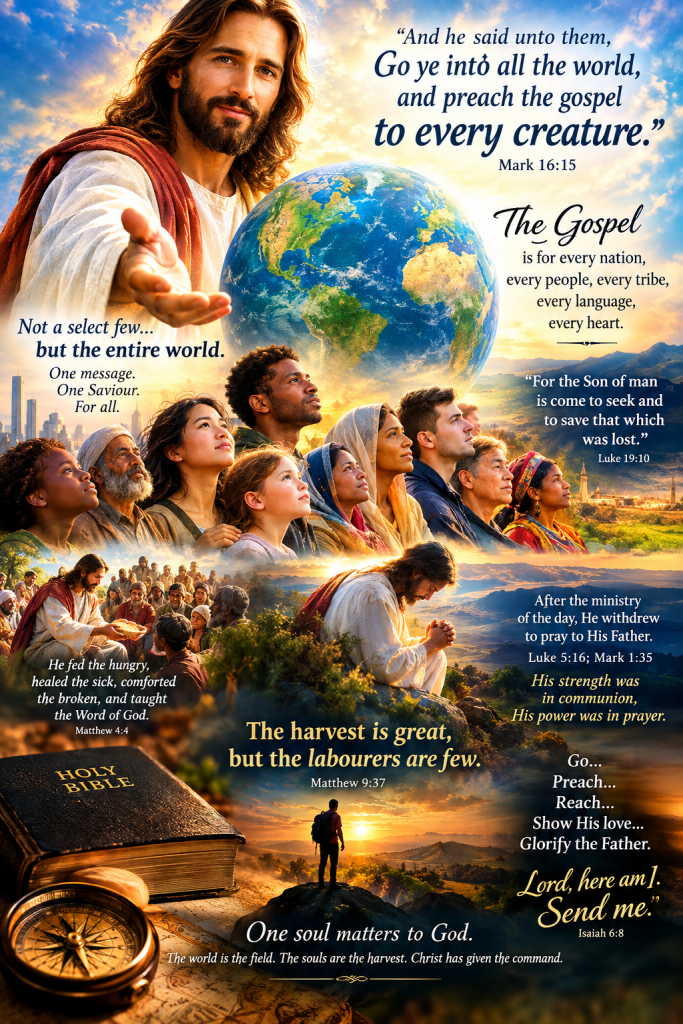
    “And he said unto them, Go ye into all the world, and preach the gospel to every creature”

    (Mark 16:15).

    The mission given by our Lord Jesus Christ is not confined to a particular nation, community, congregation, family, or select group of people. Our vision must reach beyond the boundaries we can see. Our target must be the entire world.

    The Gospel is for every creature.

    There are souls everywhere who are searching for hope, longing for peace, carrying wounds that nobody can see, and walking through darkness without knowing where to turn. Some may never enter a church. Some may never open a Bible. Some may never hear a sermon from a pulpit.

    But they can encounter Christ through a word spoken in love, a life lived in obedience, a helping hand, a testimony, a message, or someone who is willing to carry the Gospel beyond familiar boundaries.

    The Lord Jesus did not come into this world merely to reach a comfortable few. He came to seek and to save that which was lost. 

    “For the Son of man is come to seek and to save that which was lost” (Luke 19:10).

    Christ’s eyes were always upon souls

    The earthly ministry of our Lord Jesus Christ gives us a pattern that cannot be ignored.

    He went among the people. He saw the multitudes. He listened to the broken. He touched the rejected. He welcomed the forgotten. He taught those who were hungry for truth. He comforted those who were grieving. He healed the sick and strengthened the weak.

    He did not see people merely according to their social position, wealth, reputation, or status.

    He saw souls.

    When He looked upon the multitude, He was moved with compassion. “But when he saw the multitudes, he was moved with compassion on them, because they fainted, and were scattered abroad, as sheep having no shepherd” (Matthew 9:36).

    When we look at the world, do we see only people or do we see souls that Christ loves?

    He fed both body and soul. Lord Jesus cared about people’s physical needs, but He never neglected their spiritual needs.

    He fed the hungry, yet He also taught them the Word of God. He healed the sick, yet He called people to repentance and faith. He comforted the brokenhearted, yet He directed them toward the Father.

    The Lord Jesus said: “Man shall not live by bread alone, but by every word that proceedeth out of the mouth of God” (Matthew 4:4).

    Food can sustain the body for a day. The Word of God can lead a soul toward eternal life.

    He glorified the Father. Throughout His earthly ministry, Lord Jesus continually directed attention to His Father. He did not seek His own glory. His life was an offering of obedience.

    Whatever work God has placed before us, our ultimate purpose should not be to make our own name great. It should be to glorify His Name.

    Our ministry, our words, our gifts, our resources, our time, and even our daily conduct should point people toward Christ. 

    The hidden strength behind His public ministry was a life of prayer. After ministering to the multitudes, Lord Jesus often withdrew from the crowds to seek His Father. “And he withdrew himself into the wilderness, and prayed” (Luke 5:16). 

    “And in the morning, rising up a great while before day, he went out, and departed into a solitary place, and there prayed” (Mark 1:35).

    The One who had spent the day teaching, healing, comforting, travelling, answering questions, and ministering to people still made time to be alone with the Father. His public strength was connected to His private communion with God.

    We cannot effectively carry God’s message to the world while neglecting our own relationship with God. Before we speak to people about the Father, we must learn to spend time speaking with the Father.

    The Lord Jesus looked at the multitudes and said:

    The harvest is great but the labourers are few.

    The world is still full of souls. Our responsibility is not necessarily to stand before thousands.

    We may begin with one person. One soul matters to God.

    One encouraging word may prevent someone from giving up. One testimony may awaken faith. One act of kindness may open a heart. One Scripture may remain in someone’s mind for years. One person who faithfully shares Christ may become the instrument through which another person encounters the Gospel.

    We must therefore never underestimate what God can do through a willing servant.

    Let us not make the Gospel smaller than Christ made it.

    We must look beyond just our neighborhood, friends, those who already agree with us, or those who are easy to reach.

    The Gospel crosses borders, languages, cultures, and social boundaries because the love of Christ is not confined by the boundaries created by humanity.

    Are we willing to go?

    The world does not merely need more religious words. It needs people whose lives demonstrate that they have encountered Christ.

    We are called to go, speak, serve, love, pray, encourage, teach, and testify.

    Prophet Isaiah heard the voice of the Lord:

    “Whom shall I send, and who will go for us?”

    And he answered:

    “Lord, here am I. Send me” (Isaiah 6:8).

  • FAITH BEYOND SIGHT

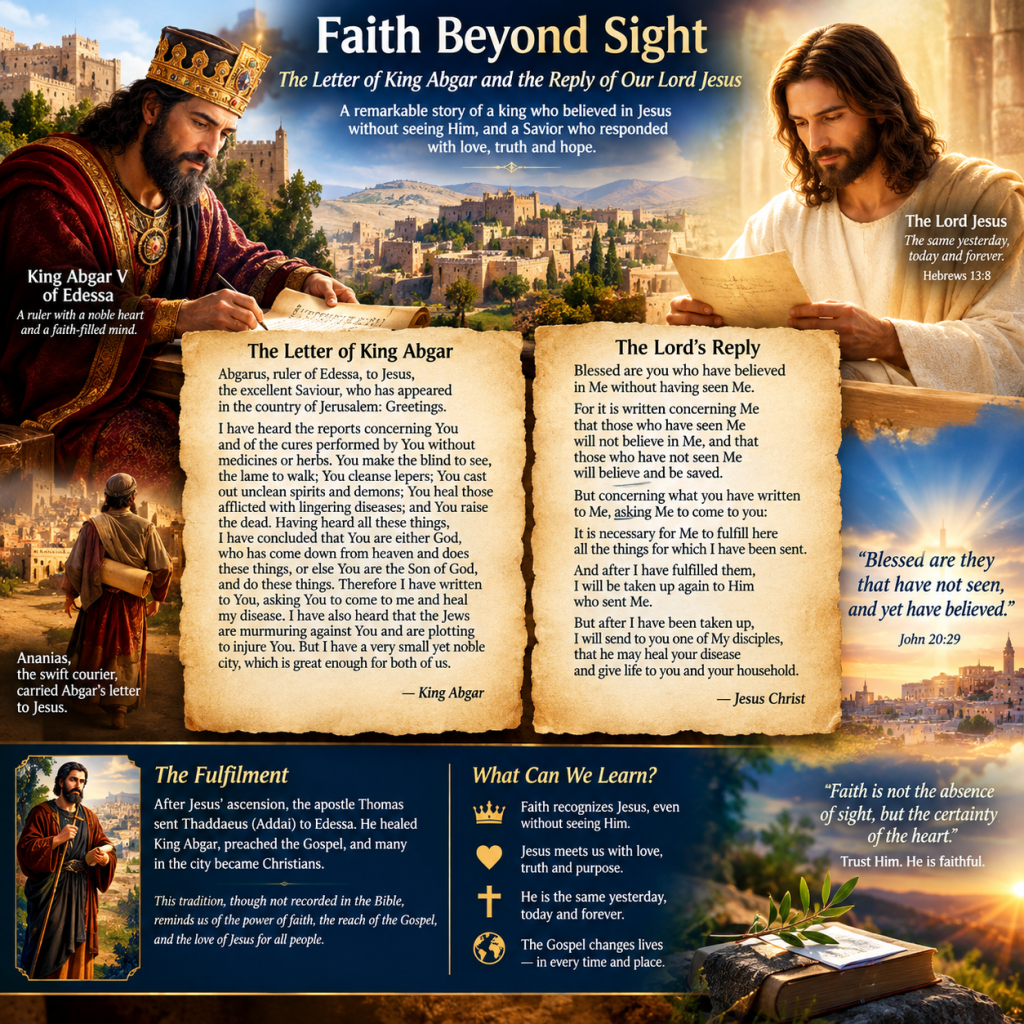
    The Letter of King Abgar and the Reply of Our Lord Jesus

    There are moments in history when a story reaches across centuries and speaks directly to the human heart. One such story is the ancient tradition concerning King Abgar V of Edessa and our Lord Jesus Christ. A king who had never seen Jesus heard about His mighty works. He heard that the blind received sight, the lame walked, the lepers were cleansed, demons were cast out, the sick were healed, and even the dead were raised.

    Abgar believed what he had heard. And he wrote to Jesus. His letter was not simply a request for healing. It was an extraordinary expression of faith in the One whom he had never seen.

    The King’s Letter

    According to the account preserved by the early Christian historian Eusebius, King Abgar addressed Jesus as “the excellent Saviour.” He had heard about the miracles Jesus performed and came to a remarkable conclusion: either Jesus was God who had come down from heaven, or He was the Son of God. Abgar then asked Jesus to come to Edessa and heal him.

    Abgar had not seen Jesus with his physical eyes. He had never watched Jesus perform a miracle. He had never sat among the crowds listening to Him teach. Yet he believed. His faith began with what he had heard about Jesus. That reminds us of the words of the Apostle Paul: “So then faith cometh by hearing, and hearing by the word of God” (Romans 10:17). Abgar’s physical eyes had never seen Christ, but his heart had begun to recognize Him.

    The Reply of  the Lord Jesus

    The traditional account states that Jesus sent a reply to King Abgar. The message begins with words of extraordinary spiritual significance: “Blessed are you who have believed in Me without having seen Me.” Those words immediately bring to mind the words spoken by the risen Christ to Thomas: “Blessed are they that have not seen, and yet have believed” (John 20:29).

    What a profound connection. Thomas had seen the risen Lord. Abgar, according to the tradition, had not. Yet both stories point toward the same great truth: faith does not require physical sight. The Christian faith says, “Believe in Christ, trust His Word, and walk with Him—even when you cannot see what lies ahead.” We cannot see tomorrow. We cannot see every answer to our prayers. We cannot always understand why God permits certain things to happen. But we can still trust the One who holds tomorrow.

    Jesus Did Not Come to Edessa—But He Had a Greater Purpose

    Abgar invited Jesus to come to his city. But according to the traditional reply, Jesus explained that He had a divine work to accomplish first. He had been sent for a purpose. He would fulfil the work given to Him and then return to the One who sent Him. Sometimes we ask God, “Lord, come into this situation and change it according to my desire.” But God’s answer may be, “Trust Me. I am accomplishing something greater than you can presently see.”

    Jesus did not simply respond according to Abgar’s request. He remained faithful to the Father’s purpose. The Lord had come into the world for something infinitely greater than one king’s healing. He came to seek and save the lost. He came to give His life as a ransom for many. He came to reconcile sinners to God. He came to accomplish the work of salvation.

    According to the tradition, Jesus promised that after His ascension He would send one of His disciples to Abgar. The disciple would come to him and bring healing. The tradition identifies that disciple as Thaddaeus, also known as Addai, who was associated with the apostle Thomas in the Edessan tradition. Jesus Himself would not come physically to Edessa at that time, but His work would continue through His messenger. No longer would the physical presence of Jesus be limited to one geographical location. The Gospel would go out as His disciples carried His message, empowered by the Holy Spirit. Consequently, the name of Jesus would travel from city to city, nation to nation, and generation to generation.

    Faith Without Sight

    The most powerful part of the Abgar story is not really the king’s illness. It is not even the letter. It is faith. A king heard about Jesus and believed. He had not seen the Lord, yet he trusted Him. Centuries later, we stand in a similar position. We have not physically walked beside Jesus in Galilee. We did not stand at the empty tomb. We did not touch the wounds in His hands as Thomas did. Yet we are called to believe. The Apostle Peter expresses this beautifully: “Whom having not seen, ye love; in whom, though now ye see him not, yet believing, ye rejoice with joy unspeakable and full of glory” (1 Peter 1:8).

    That is the mystery and beauty of Christian faith. We have not seen Him with our physical eyes. Yet we love Him. We speak to Him. We trust Him. We worship Him. We call upon His name. And we wait for the day when faith will become sight. “Blessed are they that have not seen, and yet have believed” (John 20:29).

    You might be praying for things you cannot see yet. You might be waiting for an answer. You might be walking through a quiet season where God feels silent. You might be asking, “Lord, where are You?” Remember King Abgar. He had not seen Jesus, but he believed. And remember the Apostle Thomas. He struggled to believe until he saw the risen Christ. Remember what Jesus said: “Blessed are they that have not seen, and yet have believed.” Faith does not mean pretending that difficulties do not exist. Faith means believing that God is greater than what we can see.

    What will we do with what we have heard about Jesus? Abgar heard about Christ and responded with faith. We have something even greater. We have the testimony of Scripture. We have the Gospel. We know of His birth, His ministry, His crucifixion, His resurrection, His ascension, and His promise to return. We know His words: “I am the way, the truth, and the life” (John 14:6). The question is: Do we believe Him?

    One day we shall see the King. And until that day, let us walk by faith, let us keep believing, keep praying, keep trusting, and keep seeking Christ. “For we walk by faith, not by sight” (2 Corinthians 5:7).

  • HAVE UNDERSTANDING AND DISCERNMENT

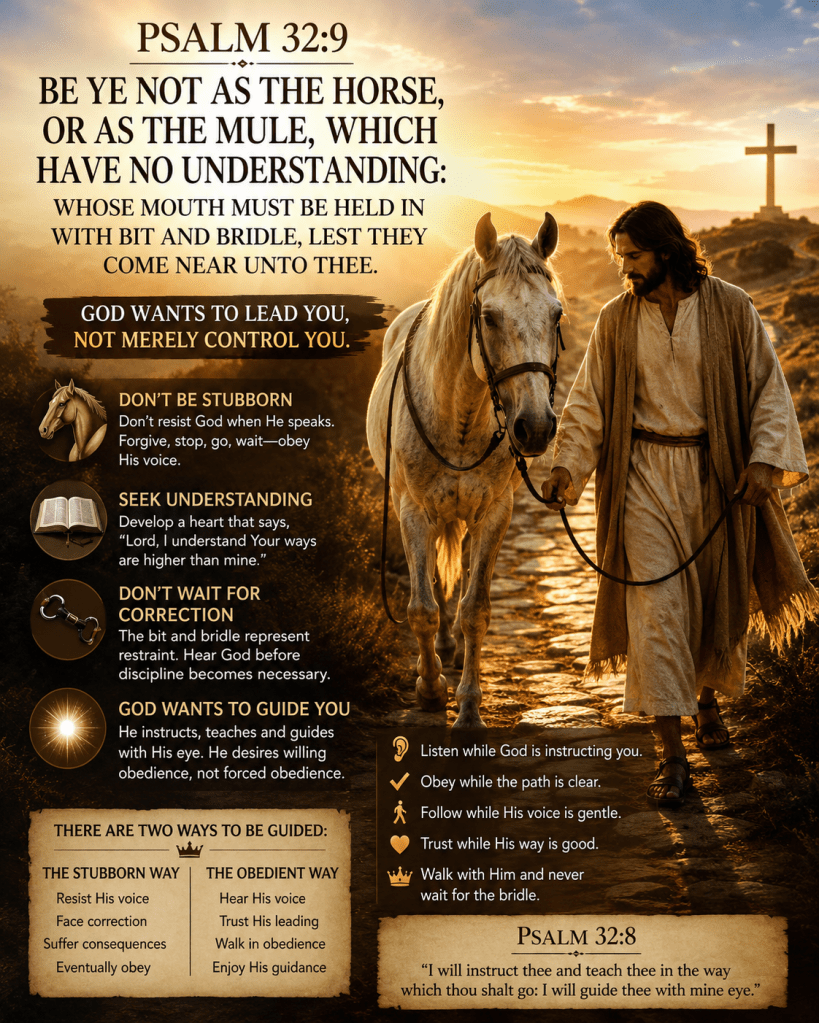
    Be ye not as the horse, or as the mule, which have no understanding: whose mouth must be held in with bit and bridle, lest they come near unto thee.” (Psalm 32:9)

    Do not make God force you to do what is right. A horse or mule does not naturally understand where its master wants it to go. Therefore, the rider uses a bit and bridle to control and direct the animal. God does not want us to live like that spiritually. He wants us to have understanding hearts to listen when He speaks, recognize His direction, and obey Him willingly.

    Let’s not be stubborn, but be obedient to Him and sensitive to God’s voice.

    A stubborn person may know what God is asking but continually resist Him. When God says forgive, we hold onto resentment. When He says stop, we continue. When He says go, we refuse. When He says wait, we rush ahead.

    The problem is not that God has failed to guide us. The problem is that we are refusing to be guided.

    Do not wait until God has to restrain you. Listen while He is instructing you.

    Don’t wait for a painful consequence to teach you what obedience could have taught you peacefully.

    Don’t wait until every door closes before you realize God told you not to enter.

    Don’t wait until you fall before you decide to listen.

    Have understanding. Have discernment.

    Be teachable. Be sensitive to God’s voice.

  • GODLY LIFE

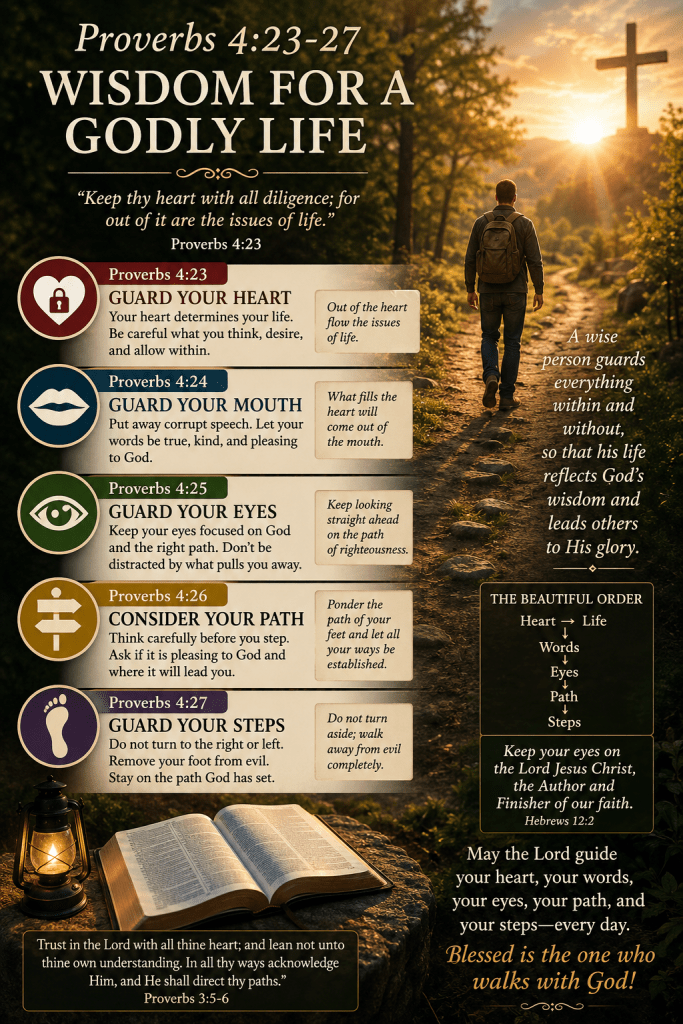
    What begins in the heart can eventually determine the direction of your entire life.

    Guard what is within you. Guard your heart.

    Guard what comes out of you. Guard your words. Guard what you look upon. Guard your eyes. Consider where you are going. Watch your path.

    Do not allow your feet to turn toward evil. Guard your steps. Remove your foot from evil. Move away from it. Sometimes the wisest spiritual decision is not to fight temptation while standing beside it, but to walk away from it altogether.

    And above everything, keep your eyes upon the Lord Jesus Christ, because the safest path is the path that leads us toward Him.

  • ANOINTED AND SET APART

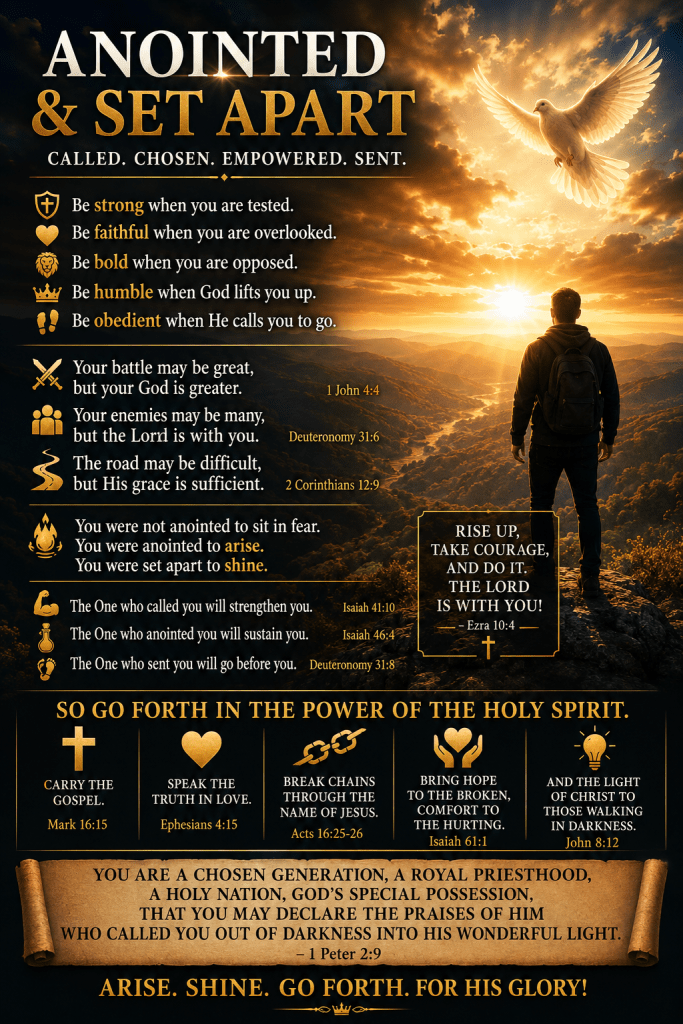
    Rise up, holy generation!

    You are not forgotten. You are not insignificant. You are not here by accident.

    God has called you, chosen you, and set you apart for His purpose. His hand is upon your life. The Holy Spirit has been given to empower you, not merely to speak about Christ, but to live for Christ, stand for Christ, and shine His light in a world growing darker by the day.

    The Lord says in Isaiah 61:1

    “The Spirit of the Lord GOD is upon me; because the LORD hath anointed me.”

    That anointing is not for your glory. It is for His glory. It is not given so that you may exalt yourself, but so that you may lift up the name of Jesus.

    When others are losing hope, you must carry hope.

    When others are walking in darkness, you must shine His light.

    When others are bound, you must proclaim liberty through Christ.

    When others are afraid, you must stand in faith.

    Jesus said, “Ye shall receive power, after that the Holy Ghost is come upon you: and ye shall be witnesses unto me.” (Acts 1:8).

    Therefore, do not shrink back. Do not be ashamed. Do not allow the world to silence the voice God has placed within you.

    Be strong when you are tested.

    Be faithful when you are overlooked.

    Be bold when you are opposed.

    Be humble when God lifts you up.

    Be obedient when He calls you to go.

    Your battle may be great, but your God is greater.

    Your enemies may be many, but the Lord is with you.

    The road may be difficult, but His grace is sufficient.

    You were not anointed to sit in fear. You were anointed to arise.

    You were not set apart to blend into the darkness. You were set apart to shine.

    So go forth in the power of the Holy Spirit. Carry the Gospel. Speak the truth in love. Break chains through the name of Jesus.

  • THE UNKNOWN

    Theological seminaries, Bible colleges, and universities will not teach you to know the Unknown.

    The priest and the pastor will teach high-level spirituality only if they have encountered the Unknown.

    The revelation of the Unknown is revealed by the Spirit of the Unknown.

    “And afterward, I will pour out my Spirit on all people. Your sons and daughters will prophesy, your old men will dream dreams, your young men will see visions” (Joel 2:28). This prophecy is directly addressed to common believers. It is not addressed to any pastor, priest, clergy member, or prophet.

    Our Lord Jesus promised that when the Spirit of Truth comes, He will guide all the believers into all truth and tell them what is yet to come.

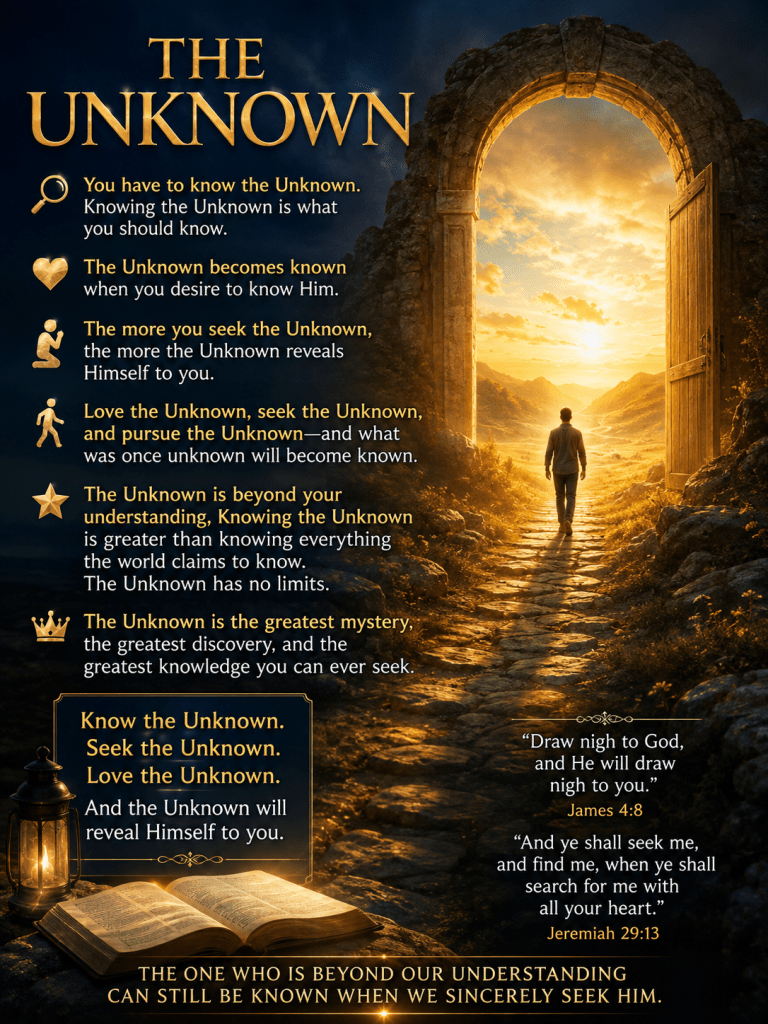
    You have to know the Unknown.

    Knowing the Unknown is what you should know.

    The Unknown becomes known when you desire to know Him.

    The more you seek the Unknown, the more the Unknown reveals Himself to you.

    Love the Unknown, seek the Unknown, and pursue the Unknown, and what was once unknown will become known.

    The Unknown is beyond your understanding, Knowing the Unknown is greater than knowing everything the world claims to know.

    The Unknown has no limits.

    The Unknown is the greatest mystery, the greatest discovery, and the greatest knowledge you can ever seek.

    Know the Unknown.

    Seek the Unknown.

    Love the Unknown.

    And the Unknown will reveal Himself to you.

    The One who is beyond our understanding can still be known when we sincerely seek Him.

  • THE LORD KEEPS CRYING

    The Sinner Keeps Practicing Sin

    Drunks keep drinking.

    Smokers keep smoking.

    Liars keep lying.

    Thieves keep stealing.

    Cheaters keep cheating.

    Haters keep hating.

    Gossips keep gossiping.

    Boasters keep boasting.

    Murderers keep killing.

    Adulterers keep committing adultery.

    Fornicators keep committing fornication.

    Lustful keep lusting.

    Covetous keep coveting.

    Greedy keep grabbing.

    Idolaters keep worshipping idols.

    Blasphemers keep blaspheming.

    Swindlers keep deceiving.

    Fraudsters keep defrauding.

    False witnesses keep giving false testimony.

    Slanderers keep slandering.

    Backbiters keep backbiting.

    Witches keep practicing witchcraft.

    Sorcerers keep practicing sorcery.

    Proud keep exalting themselves.

    Arrogant keep boasting about themselves.

    Envious keep envying.

    Jealous keep being jealous.

    Angry keep raging.

    Wrathful keep fighting.

    Quarrellers keep quarreling.

    Contentious keep provoking.

    Rebellious keep rebelling.

    Disobedient keep disobeying.

    Ungrateful keep complaining.

    Hypocrites keep pretending.

    False teachers keep deceiving.

    False prophets keep prophesying falsely.

    Lovers of money keep chasing riches.

    Lovers of pleasure keep pursuing pleasure.

    Lovers of self keep serving themselves.

    The unforgiving keep refusing to forgive.

    The merciless keep showing no mercy.

    The faithless keep rejecting faith.

    The worldly keep loving the world.

    The wicked keep doing wickedness.

    The unrighteous keep practicing unrighteousness.

    The immoral keep practicing immorality.

    The corrupt keep corrupting.

    The dishonest keep deceiving.

    The idle keep wasting their time.

    The rebellious keep resisting God.

    The stubborn keep hardening their hearts.

    The scoffers keep mocking.

    The proud keep refusing correction.

    The foolish keep despising wisdom.

    The wicked keep plotting evil.

    Those who hate God keep rejecting God.

    Sin becomes a practice when the heart refuses to repent.

    Our Lord keeps crying. His heart keeps bleeding. Judas crucified Him once. We have crucified Him countless times.

    But whoever turns from sin, repents, and comes to Jesus Christ can be forgiven, cleansed, and made new.

    “If we confess our sins, he is faithful and just to forgive us our sins, and to cleanse us from all unrighteousness.” (1 John 1:9)

    “Therefore if any man be in Christ, he is a new creature: old things are passed away; behold, all things are become new.” (2 Corinthians 5:17)

  • SEEK HIM FIRST

    When you are troubled, you seek guidance from friends, discuss your problems with relatives, and sometimes with neighbours and colleagues, until the situation becomes worse. But the Word of God says, “Cast thy burden upon the LORD, and he shall sustain thee.” (Psalm 55:22).

    Whenever someone is sick, you rush to the physician; you trust him for deliverance from sickness. Yet the Lord says, “I am the LORD that healeth thee.” (Exodus 15:26)

    You surrender to every whisper that seems to guide you and run from one place to another seeking answers. Meanwhile, your Heavenly Father silently watches you. He is waiting for you to turn to Him, for He is your refuge and your very present help in trouble.

    The Word of God says, “Trust in the LORD with all thine heart; and lean not unto thine own understanding.” (Proverbs 3:5). “In all thy ways acknowledge him, and he shall direct thy paths.” (Proverbs 3:6).

    Your Heavenly Father is saddened when you seek the world first, leaving the One who truly knows your every need and has the power to lead you through every problem. He Himself says, “But seek ye first the kingdom of God, and his righteousness; and all these things shall be added unto you.” (Matthew 6:33).

    Consultation, guidance, and wisdom are freely available from Him. The Bible says, “If any of you lack wisdom, let him ask of God, that giveth to all men liberally.” (James 1:5).

    When you need deliverance, He says, “Call upon me in the day of trouble: I will deliver thee.” (Psalm 50:15).

    Yet you do not consider Him as your own. You treat Him like a stranger, ignoring Him and seeking everyone and everything else first, until the situation becomes too difficult and the problem grows worse.

    But He has not abandoned you. He is still waiting.

    “Behold, I stand at the door, and knock.” (Revelation 3:20).

    Open the door. Turn to Him first. Seek Him first. Trust Him first. For the One you keep searching for in the world is already standing beside you, waiting for you to call upon His name.