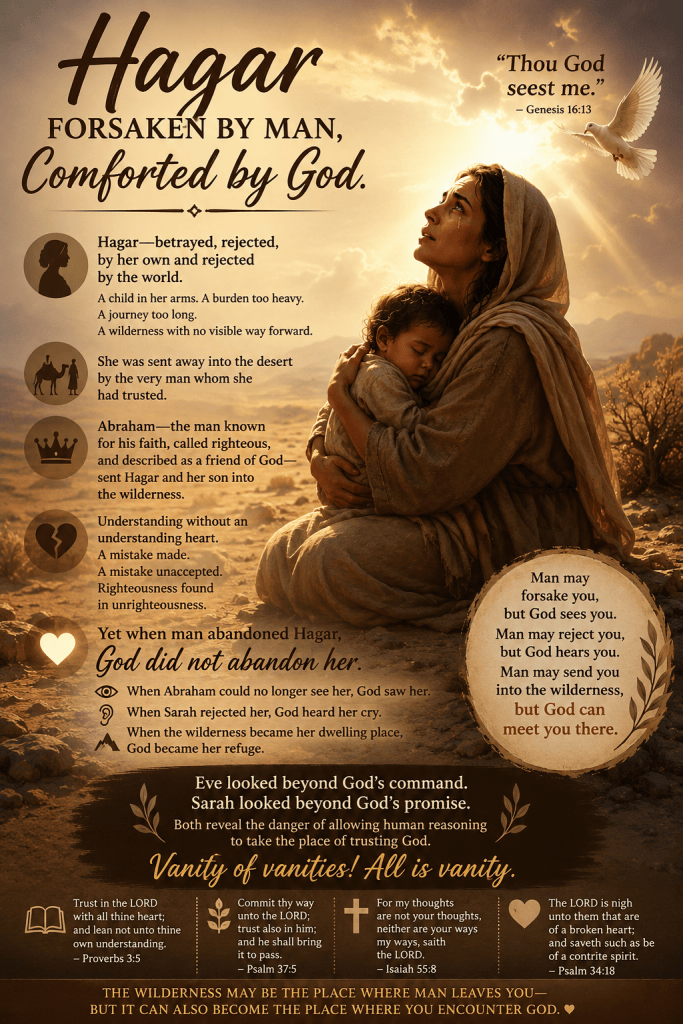
Hagar—betrayed, rejected by her own, and rejected by the world.
A child in her arms.
A burden too heavy.
A journey too long.
A wilderness with no visible way forward.
She was sent away into the desert by the very man whom she had trusted.
Abraham—the man known for his faith, called righteous, and described as a friend of God—sent Hagar and her son into the wilderness.
Understanding without an understanding heart.
A mistake made.
A mistake unaccepted.
Righteousness found in unrighteousness.
Yet when man abandoned Hagar, God did not abandon her.
When Abraham could no longer see her, God saw her.
When Sarah rejected her, God heard her cry.
When the wilderness became her dwelling place, God became her refuge.
Human words, human decisions, and human actions can have consequences far beyond what a person initially sees.
The words of Sarah remind us of the words of Eve. Eve’s disobedience brought consequences upon humanity, while Sarah’s decision concerning Hagar and Ishmael brought consequences that continued through generations.
Eve looked beyond God’s command.
Sarah looked beyond God’s promise.
Both reveal the danger of allowing human reasoning to take the place of trusting God.
Vanity of vanities! All is vanity.
For when human wisdom replaces divine wisdom,
when human decisions replace divine direction,
and when human understanding replaces faith in God,
the consequences can reach far beyond what the human heart can foresee.
But Hagar’s story does not end in the wilderness.
The God who sees also hears.
The God who hears also answers.
The God who allows the wilderness to come is also the God who meets us there.
Man may forsake you, but God sees you.
Man may reject you, but God hears you.
Man may send you into the wilderness, but God can meet you there.
“Thou God seest me” (Genesis 16:13).
The wilderness may be the place where man leaves you but it can also become the place where you encounter God.
John Mark
 The Truth
Leave a comment