Tag: Victorious King.

  • FAITH BEYOND SIGHT

    The Letter of King Abgar and the Reply of Our Lord Jesus

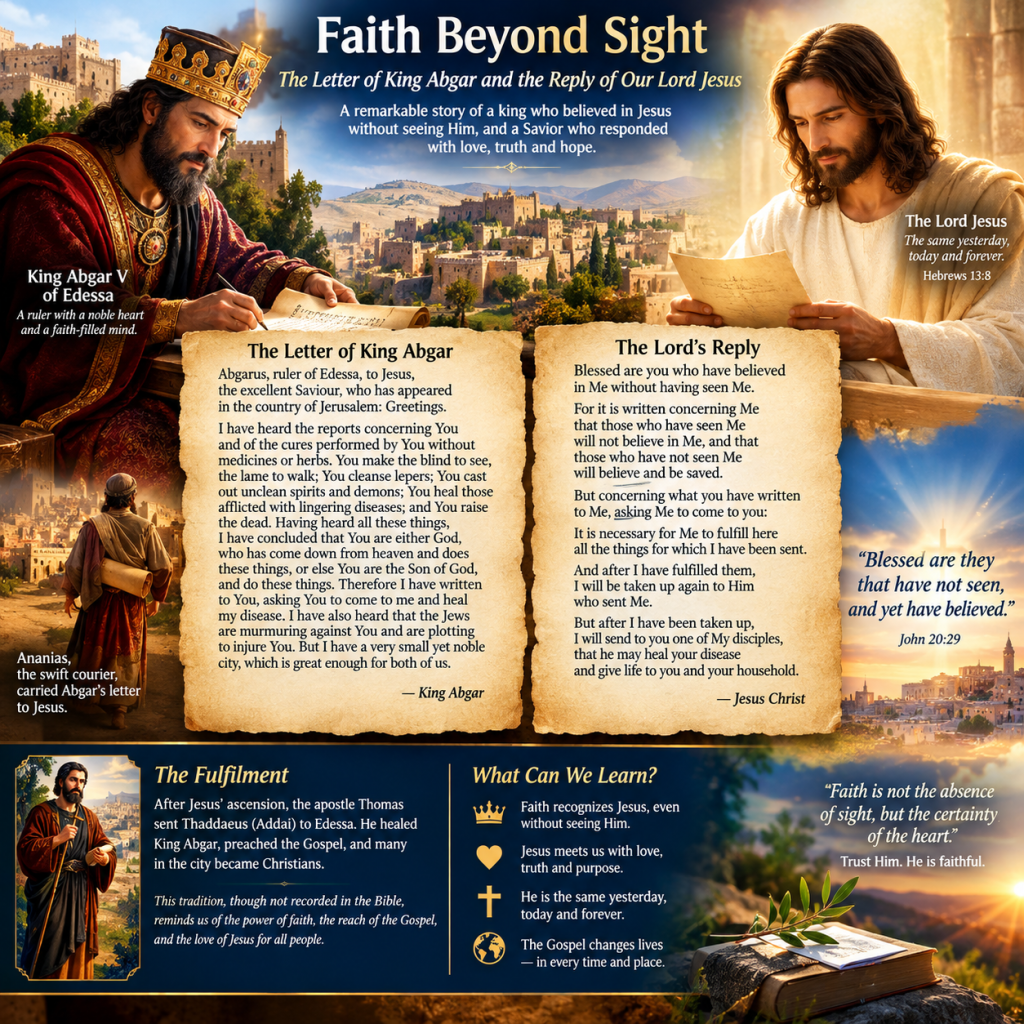
    There are moments in history when a story reaches across centuries and speaks directly to the human heart. One such story is the ancient tradition concerning King Abgar V of Edessa and our Lord Jesus Christ. A king who had never seen Jesus heard about His mighty works. He heard that the blind received sight, the lame walked, the lepers were cleansed, demons were cast out, the sick were healed, and even the dead were raised.

    Abgar believed what he had heard. And he wrote to Jesus. His letter was not simply a request for healing. It was an extraordinary expression of faith in the One whom he had never seen.

    The King’s Letter

    According to the account preserved by the early Christian historian Eusebius, King Abgar addressed Jesus as “the excellent Saviour.” He had heard about the miracles Jesus performed and came to a remarkable conclusion: either Jesus was God who had come down from heaven, or He was the Son of God. Abgar then asked Jesus to come to Edessa and heal him.

    Abgar had not seen Jesus with his physical eyes. He had never watched Jesus perform a miracle. He had never sat among the crowds listening to Him teach. Yet he believed. His faith began with what he had heard about Jesus. That reminds us of the words of the Apostle Paul: “So then faith cometh by hearing, and hearing by the word of God” (Romans 10:17). Abgar’s physical eyes had never seen Christ, but his heart had begun to recognize Him.

    The Reply of  the Lord Jesus

    The traditional account states that Jesus sent a reply to King Abgar. The message begins with words of extraordinary spiritual significance: “Blessed are you who have believed in Me without having seen Me.” Those words immediately bring to mind the words spoken by the risen Christ to Thomas: “Blessed are they that have not seen, and yet have believed” (John 20:29).

    What a profound connection. Thomas had seen the risen Lord. Abgar, according to the tradition, had not. Yet both stories point toward the same great truth: faith does not require physical sight. The Christian faith says, “Believe in Christ, trust His Word, and walk with Him—even when you cannot see what lies ahead.” We cannot see tomorrow. We cannot see every answer to our prayers. We cannot always understand why God permits certain things to happen. But we can still trust the One who holds tomorrow.

    Jesus Did Not Come to Edessa—But He Had a Greater Purpose

    Abgar invited Jesus to come to his city. But according to the traditional reply, Jesus explained that He had a divine work to accomplish first. He had been sent for a purpose. He would fulfil the work given to Him and then return to the One who sent Him. Sometimes we ask God, “Lord, come into this situation and change it according to my desire.” But God’s answer may be, “Trust Me. I am accomplishing something greater than you can presently see.”

    Jesus did not simply respond according to Abgar’s request. He remained faithful to the Father’s purpose. The Lord had come into the world for something infinitely greater than one king’s healing. He came to seek and save the lost. He came to give His life as a ransom for many. He came to reconcile sinners to God. He came to accomplish the work of salvation.

    According to the tradition, Jesus promised that after His ascension He would send one of His disciples to Abgar. The disciple would come to him and bring healing. The tradition identifies that disciple as Thaddaeus, also known as Addai, who was associated with the apostle Thomas in the Edessan tradition. Jesus Himself would not come physically to Edessa at that time, but His work would continue through His messenger. No longer would the physical presence of Jesus be limited to one geographical location. The Gospel would go out as His disciples carried His message, empowered by the Holy Spirit. Consequently, the name of Jesus would travel from city to city, nation to nation, and generation to generation.

    Faith Without Sight

    The most powerful part of the Abgar story is not really the king’s illness. It is not even the letter. It is faith. A king heard about Jesus and believed. He had not seen the Lord, yet he trusted Him. Centuries later, we stand in a similar position. We have not physically walked beside Jesus in Galilee. We did not stand at the empty tomb. We did not touch the wounds in His hands as Thomas did. Yet we are called to believe. The Apostle Peter expresses this beautifully: “Whom having not seen, ye love; in whom, though now ye see him not, yet believing, ye rejoice with joy unspeakable and full of glory” (1 Peter 1:8).

    That is the mystery and beauty of Christian faith. We have not seen Him with our physical eyes. Yet we love Him. We speak to Him. We trust Him. We worship Him. We call upon His name. And we wait for the day when faith will become sight. “Blessed are they that have not seen, and yet have believed” (John 20:29).

    You might be praying for things you cannot see yet. You might be waiting for an answer. You might be walking through a quiet season where God feels silent. You might be asking, “Lord, where are You?” Remember King Abgar. He had not seen Jesus, but he believed. And remember the Apostle Thomas. He struggled to believe until he saw the risen Christ. Remember what Jesus said: “Blessed are they that have not seen, and yet have believed.” Faith does not mean pretending that difficulties do not exist. Faith means believing that God is greater than what we can see.

    What will we do with what we have heard about Jesus? Abgar heard about Christ and responded with faith. We have something even greater. We have the testimony of Scripture. We have the Gospel. We know of His birth, His ministry, His crucifixion, His resurrection, His ascension, and His promise to return. We know His words: “I am the way, the truth, and the life” (John 14:6). The question is: Do we believe Him?

    One day we shall see the King. And until that day, let us walk by faith, let us keep believing, keep praying, keep trusting, and keep seeking Christ. “For we walk by faith, not by sight” (2 Corinthians 5:7).

  • THE SERVANT OF CHRIST

    “For do I now persuade men, or God? or do I seek to please men? for if I yet pleased men, I should not be the servant of Christ” (Galatians 1:10).

    The Apostle Paul is essentially asking: “Who is the Master of my life—God or people?” He had been criticized because the Gospel he preached was not designed to make people comfortable. He therefore makes his position unmistakably clear: his responsibility was not to alter God’s message in order to gain people’s approval. If the Apostle Paul had made his preaching softer, changed the truth, or compromised the Gospel simply because people might reject him, then he would no longer be acting as a faithful servant of Christ.

    The Bible teaches us to speak the truth in love, show kindness, live peaceably with others, and treat people with humility and respect. We should never sacrifice God’s truth merely to obtain human approval. There will be moments when doing what is right before God makes someone unhappy with us. The servant has one ultimate Master. A servant cannot have two masters when their instructions conflict. Stand for truth, obey God. If following Christ means losing someone’s approval, we must remember: human approval is temporary, but God’s approval is eternal.

    The Lord Jesus Himself said: “For they loved the praise of men more than the praise of God” (John 12:43). That is a serious warning. We can become so concerned about what people think of us that we gradually become afraid to do what God has called us to do.

    There is freedom in not living for people’s approval. When you constantly try to please people, you can become a prisoner of their opinions:
    You bloom like a flower in the warmth of their praise,
    Then wither away under a critical gaze.
    Anchored and safe in acceptance’s harbor,
    But tossed by rejection into doubt and disorder.

    When your heart becomes settled in Christ, the restless whispers of the world fade away, and you can rise to declare:

    My identity does not come from people’s applause.

    My calling does not come from people’s approval.

    My worth does not come from people’s opinions.

    The Apostle Paul was willing to stand alone. He had something more valuable than popularity: he had a divine commission. He knew that the Gospel was not his invention. Therefore, he could not change it simply to make people happy. This is especially important for anyone who teaches, preaches, writes about the Bible, or shares their faith. We must ask ourselves: “Am I saying this because God has given me truth to speak, or because I want people to praise me?” That question can search the heart deeply.

    A servant of Christ should have courage without arrogance, truth without cruelty, conviction without pride, and boldness with love. The Apostle Paul himself said: “Speaking the truth in love” (Ephesians 4:15). So the Christian’s goal is not to please people at the expense of truth, nor to hurt people in the name of truth. The goal is to please God, speak the truth, walk in love, and remain humble.

    Do not allow the desire to be accepted by people to make you disobedient to God. Doing what is right does not always make you popular. Telling the truth can cause others to misunderstand you. Following Jesus means you walk a narrow path that not everyone likes. You do not live to get praise from others; you live to serve Christ. Listen to God’s quiet whisper. Ask Him to guide your steps and keep your heart faithful. “Lord, what do You want me to do?” Then, whatever the cost, obey Him.

    The ultimate response of a true servant of Christ is: “Lord Jesus, above every human voice, I choose to please You.”

  • THE VINE TREE

    The Lord gives Prophet Ezekiel a picture of the vine tree. He asks whether the wood of a vine is useful like the wood of other trees.

    Vine wood is not suitable for making something strong or useful. Its particular purpose is to bear fruit.

    The Lord says:

    “What is the vine tree more than any tree, or than a branch which is among the trees of the forest?” (Ezekiel 15:2)

    And then: “Behold, it is cast into the fire for fuel; the fire devoureth both the ends of it, and the midst of it is burned. Is it meet for any work?” (Ezekiel 15:4)

    You had been chosen and given a special relationship with God, but had turned away from Him and were not producing the fruit He desired.

    A vine is valuable because it produces fruit. If it refuses to fulfil its purpose, its wood has very little use.

    God does not merely call us to carry His name outwardly. He desires fruit in our lives—obedience, righteousness, faithfulness, love, repentance and holiness.

    Lord Jesus said in John 15:8:

    “Herein is my Father glorified, that ye bear much fruit; so shall ye be my disciples.”

    Ezekiel 15 speaks of the vine that fails to fulfil its purpose; John 15 speaks of abiding in Christ and bearing much fruit.

    We have received tremendous privileges from God. But privilege without faithfulness does not protect a person from judgment.

    The Lord says: “And I will set my face against them; they shall go out from one fire, and another fire shall devour them; and ye shall know that I am the LORD, when I set my face against them” (Ezekiel 15:7).

    This is a serious warning. Being associated with God’s people, knowing Scripture, attending worship, or having a Christian identity is not the same as walking faithfully with God.

    God looks at the fruit of our lives.

    God does not reject everyone who fails.” Rather, it is a solemn call to examine ourselves and return to God.

    When we discover that our lives are not producing the fruit God desires, the right response is not pride or despair.

    It is: “Lord Jesus, search my heart. Remove what is displeasing to You. Prune me, cleanse me, and help me abide in You so that my life may bear fruit for Your glory.”

    “Abide in me, and I in you. As the branch cannot bear fruit of itself, except it abide in the vine; no more can ye, except ye abide in me.
    I am the vine, ye are the branches: He that abideth in me, and I in him, the same bringeth forth much fruit: for without me ye can do nothing” (John 15:4,5).

    God did not call us merely to occupy space in His vineyard. He called us to bear fruit.

    A branch does not produce fruit by struggling independently from the vine. It produces fruit by remaining connected to the vine.

    And Lord Jesus says: “I am the true vine, and my Father is the husbandman” (John 15:1).

    Do not merely carry the name of the Vine—abide in the True Vine.

    Do not merely appear alive—bear fruit.

    Do not merely receive God’s blessings—walk in obedience.

    Do not merely hear His Word—let His Word transform your life.

    The Lord is looking for fruit, not merely leaves. When we remain in Christ, the One who is the True Vine, He Himself supplies what we need to bear fruit. 

    “By their fruits ye shall know them” (Matthew 7:20).

  • GOD’S CORRECTION IS A SIGN OF HIS LOVE

    Sometimes God allows us to experience correction, discipline, or difficult seasons—not because He has abandoned us, but because He loves us too much to leave us unchanged.

    A loving father corrects his child because he sees what the child cannot yet see. In the same way, our heavenly Father knows the road ahead of us. His correction may not always feel pleasant, but it is designed to shape our character, strengthen our faith, and bring our hearts back into His ways.

    God’s discipline is not rejection; it is preparation.

    When the Lord corrects you, do not harden your heart. Sometimes the very thing we call a burden is the instrument God uses to remove pride, disobedience, impatience, or self-reliance from our lives.

    Keep His commandments.

    Walk in His ways.

    Fear and honour Him.

    Obedience is not merely knowing God’s Word—it is choosing to walk according to it, even when our own desires tell us to go another way.

    “For whom the Lord loveth he chasteneth”(Hebrews 12:6).

    “My son, despise not the chastening of the LORD; neither be weary of his correction” (Proverbs 3:11).

    So, when God corrects you, don’t run away from Him—run toward Him.

    When He closes a door, trust Him.

    When He exposes something in your heart, surrender it.

    When He redirects your steps, follow Him.

    When He disciplines you, remember that His hand is still a Father’s hand.

    The greatest blessing is not simply that God gives us what we want. The greater blessing is that He changes us into the people He wants us to become.

    His correction produces wisdom.

    His discipline produces maturity.

    His commandments produce a righteous path.

    And His love never stops guiding His children.

    When God corrects you, He is not throwing you away, He is shaping you for His purpose.

    “To obey is better than sacrifice” (1 Samuel 15:22).

    Keep walking with Him, keep listening to His voice, and keep your heart surrendered to Him.

    The Father who corrects you is the Father who loves you.

  • THERE IS NO OTHER GOD WHO CAN DELIVER

    When thou walkest through the fire, thou shalt not be burned; neither shall the flame kindle upon thee” (Isaiah 43:2).

    There are moments in life when the fire becomes so intense that human strength cannot save us, human wisdom cannot rescue us, and human connections cannot deliver us. But it is precisely in those moments that God reveals who He truly is.

    Shadrach, Meshach, and Abednego were thrown into a blazing furnace because they refused to bow before an idol. They did not know how God would deliver them—but they knew God was able to deliver them.

    Their faith was not based on the absence of fire. Their faith was based on the presence of God in the fire.

    They declared: “Our God whom we serve is able to deliver us from the burning fiery furnace” (Daniel 3:17).

    And when they entered the furnace, they were not alone. The king looked into the fire and saw a fourth man walking with them.

    What the enemy intended to destroy became the place where God displayed His glory. The fire did not consume them. It only burned the ropes that bound them.

    Sometimes God does not keep you from entering the fire; He enters the fire with you.

    Your trial may be painful, but God has not abandoned you.

    Your situation may look impossible, but God is still sovereign.

    Your enemies may think your story is finished, but God has the final word.

    Nebuchadnezzar himself had to acknowledge what he had witnessed: “There is no other God that can deliver after this sort” (Daniel 3:29).

    Never measure the power of God by the size of your problem. The greater the furnace, the greater the testimony when God brings you through it.

    The God who delivered the three Hebrew men is still God today. He is the God who makes a way where there seems to be no way. He is the God who can turn a furnace into a testimony, a trial into a testimony of faith, and a place of suffering into a place where His presence is revealed.

    Do not bow to the pressure. Do not compromise your faith to escape the fire. Do not worship what the world worships just because everyone else is doing it.

    Stand for God. And if you must walk through the fire, walk through it knowing this:

    You may enter the fire with chains, but you will come out with freedom.

    You may enter the fire being tested, but you will come out with a testimony.

    You may enter the fire alone in the eyes of men, but you will never enter it alone in the presence of God.

    There is no God like our God. There is no deliverer like our Deliverer. There is no fire hot enough to defeat the God who walks with His children through the flames.

    The fire may be real—but so is the God who stands with you in it.

  • TEARS TODAY ; HOPE TOMORROW

    “My tears have been my meat day and night, while they continually say unto me, Where is thy God?” (Psalm 42:3)

    When we are experiencing deep sorrow, loneliness, and spiritual anguish,  tears become like our daily food and we cannot escape the grief.

    Suffering does not only come from within; people around us also question our faith.

    “Where is thy God?”

    That question can be extremely painful when someone is already going through a difficult season. It is almost as though the circumstances are being used as evidence against God’s presence.

    Such questions does not mean that God has abandoned us.

    Sometimes we may cry because we cannot see what God is doing.

    Sometimes we may pray and seemingly receive no answer.

    Sometimes people may look at our situation and say, “Where is your God now?”

    But the silence of God is not the absence of God.

    God may be working in places we cannot yet see.

    “Weeping may endure for a night, but joy cometh in the morning” (Psalm 30:5).

    Don’t allow what you see around you to determine what you believe about the God you cannot yet see.

    Your tears may be real, but God is real too.

    Your battle may be real, but God’s faithfulness is greater.

    Your night may be long, but God has not forgotten you.

    “Why art thou cast down, O my soul? and why art thou disquieted in me? hope thou in God: for I shall yet praise him for the help of his countenance” (Psalm 42:5).

    Though pain is heavy now, your voice will rise in praise.
    Though paths are hidden now, your trust will find His ways.
    Though sleep claims quiet now, your soul will worship still.
    Though dawn is silent now, your heart will hope His will.

    Be not discouraged. when your soul feels cast down, speak to it as the psalmist did:

    “My soul, hope in God. This is not the end of my story. I shall yet praise Him.”

  • DO NOT BE LUKEWARM — BE ON FIRE FOR CHRIST

    “I know thy works, that thou art neither cold nor hot: I would thou wert cold or hot. So then because thou art lukewarm, and neither cold nor hot, I will spue thee out of my mouth” (Revelation 3:15,16).

    These are the words of  our Lord Jesus Christ, who knows the condition of our hearts. He sees what people cannot see. He knows our works, our motives, our devotion, our compromises, and what happens inside us when nobody is watching.

    Lord Jesus does not desire a faith that is merely outward, a Christianity that speaks about Him on Sunday but forgets Him throughout the week. He does not want a heart that is divided between Christ and the world.

    Lukewarmness is dangerous because it can look like faith while lacking genuine surrender.

    A lukewarm heart says:

    “I want Jesus, but I also want the world.”

    “I will obey God when it is convenient.”

    “I will follow Christ, but I will not surrender everything.”

    But Lord Jesus said, “Thou shalt love the Lord thy God with all thy heart, and with all thy soul, and with all thy mind” (Matthew 22:37).

    God wants your entire heart.

    There may have been a time when you prayed with passion, worshipped with tears, loved God’s Word, and eagerly obeyed His voice.

    But slowly, distractions came.

    Prayer became occasional.

    The Word became neglected.

    Worship became routine.

    Sin became comfortable.

    The voice of the world became louder than the voice of God.

    The fire did not disappear in one moment, it became weaker little by little.

    Guard the fire God has placed within you. “Quench not the Spirit” (1Thessalonians 5:19).

    A person who is cold knows that they are far away. But lukewarmness can deceive a person into believing that everything is fine.

    You can attend church and still be far from Christ.

    You can know Scripture and still refuse obedience.

    You can speak religious words and still have an unchanged heart.

    You can have the appearance of godliness while denying its power. “Having a form of godliness, but denying the power thereof” (2 Timothy 3:5).

    God is not looking merely at what we appear to be. He is looking at who we truly are.

    Our Lord Jesus says in Revelation 3:19, “As many as I love, I rebuke and chasten: be zealous therefore, and repent.”

    His correction is not rejection. His rebuke is a call back to Himself.

    If your fire has grown cold, return.

    If your prayer life has weakened, return.

    If you have compromised with sin, repent.

    If the world has captured your attention, turn your eyes back to Lord Jesus.

    If your heart has become lukewarm, ask the Holy Spirit to ignite it again.

    Give your Lord everything.

    Do not settle for a faith that merely survives.

    Be passionate in prayer.

    Be faithful in obedience.

    Be hungry for God’s Word.

    Be courageous in your witness.

    Be humble in your service.

    Be holy in your living.

    Be completely surrendered to Christ.

    Apostle Paul wrote in Romans 12:11 “Not slothful in business; fervent in spirit; serving the Lord.”

    The world does not need another lukewarm Christian.

    It needs believers whose lives declare: “Don’t merely carry the name of Christ; carry His fire.”

    Lord Jesus is asking each one of us:

    “Where is your heart?”

    Do not ignore His voice.

    Do not postpone repentance.

    Do not allow your spiritual fire to die.

    Choose Christ.

    Choose surrender.

    Choose obedience.

    Choose holiness.

    Choose to burn brightly for Jesus.

    “Be zealous therefore, and repent” (Revelation 3).

  • THE RIGHTEOUS LIFE

    The righteous shall flourish like the palm tree”(Psalm 92:12).

    Righteousness begins with a right relationship with God. The righteous person is not someone who claims to be perfect; rather, he is someone who trusts God, walks in His ways, loves His truth, and seeks to obey Him.

    The righteous will be established. “The righteous shall be in everlasting remembrance” (Psalm 112:6).

    He shall be like a tree planted by the rivers of water”(Psalm 1:3). God does not merely want you to survive every storm. He wants you rooted so deeply in Him that the storm cannot uproot you.

    They that wait upon him shall not be ashamed”(Psalm 25:3).

    There may be seasons when you wonder, “Lord, where are You?”

    Keep trusting.

    There may be moments when others question your faith.

    Keep standing.

    There may be times when obedience seems to cost you something.

    Keep walking.

    God has never disappointed the person who genuinely places his trust in Him.

    Lord Jesus said: “I am come that they might have life, and that they might have it more abundantly” (John 10:10).

    When your life is surrendered to God, what He places in your hands can become a blessing to others.

    Your wisdom can feed someone.

    Your testimony can encourage someone.

    Your prayers can strengthen someone.

    Your kindness can restore someone.

    Your experience can guide someone.

    Your faith can give someone hope.

    God blesses us not merely to increase what we possess, but so that our lives can become channels through which His goodness reaches others.

    A life that feeds others is a life with purpose.

    You don’t need to be famous to feed people.

    You can feed someone with the Word of God.

    You can feed someone with encouragement.

    You can feed someone with compassion.

    You can feed someone with wisdom.

    You can feed someone with prayer.

    Lord Jesus told Peter: “Feed my sheep.” (John 21:17)

    God does not establish a person merely so that he can stand; He establishes him so that others can find shelter, strength, and nourishment through his life.

    A life that God can use to nourish others becomes a life of tremendous significance.

  • CHOSEN, LOVED, AND CALLED

    “For thou art an holy people unto the LORD thy God: the LORD thy God hath chosen thee to be a special people unto himself, above all people that are upon the face of the earth.

    The LORD did not set his love upon you, nor choose you, because ye were more in number than any people; for ye were the fewest of all people.” (Deuteronomy 7:6,7).

    You are a holy people unto the LORD, set apart for God’s purposes. It is not simply about being different from others outwardly. God wants your heart, your life, your worship, and your obedience to be devoted to Him.

    When God calls someone His own, He also calls that person to live for Him. God’s calling should make us humble, not arrogant. Being chosen is not a cause for pride, but for gratitude and obedience.

    God says, “I did not love you because you were impressive.” You were not chosen because you had greater strength, wealth, influence, or numbers. God’s love is not based upon worldly significance; it is not measured by human importance.

    You do not have to be powerful, famous, wealthy, or admired by everyone for God to love you. The Apostle Paul writes in 1 Corinthians 1:27, “God hath chosen the weak things of the world to confound the things which are mighty.”

    God wants us to understand that the glory belongs to Him, not to us. When God uses the small, the weak, the overlooked, or the seemingly insignificant, His power becomes unmistakable.

    God does not choose according to the world’s measurement of worth. The world may ask: How important are you? How many people know you? How successful are you? How much do you possess?

    But God looks at things differently.

    He can take one obedient person and accomplish something far greater than what many people could accomplish through human strength.

    So, if you ever feel small, overlooked, rejected, or insignificant, remember that God chooses what the world considers insignificant precisely so that His glory, not human greatness, will be revealed.

    Being few does not mean being forgotten. Being small does not mean being useless. Being overlooked by people does not mean being overlooked by God.

    You are not forgotten because you are small. You are not worthless because people overlook you. You are not unloved because the world does not recognize you.

    God’s love is greater than human recognition.

    John Mark

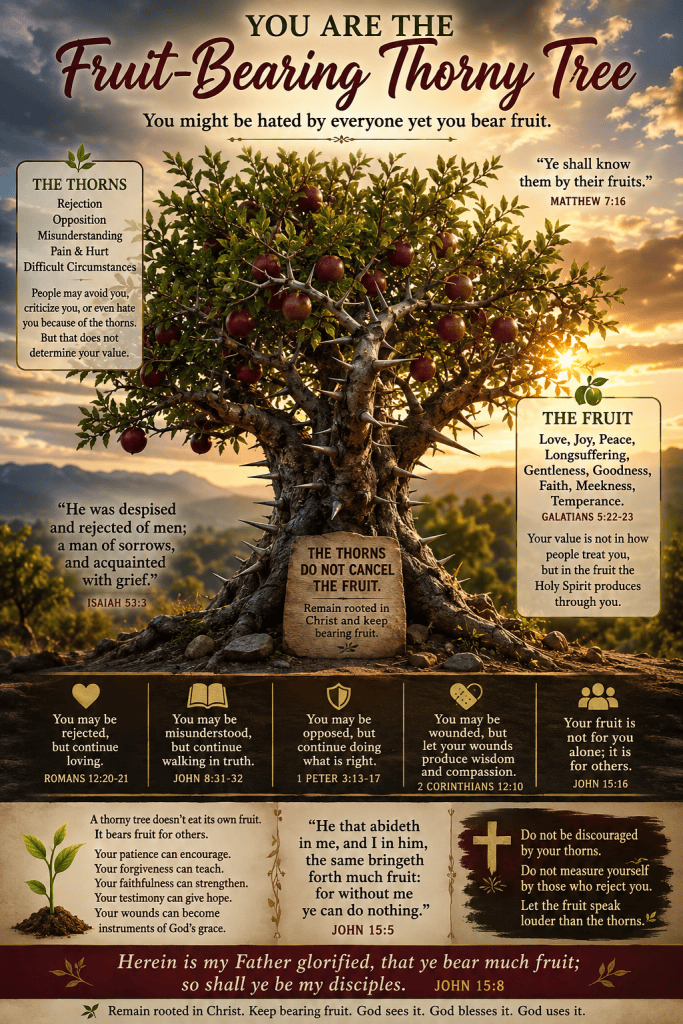
  • YOU ARE THE FRUIT- BEARING THORNY TREE

    The thorns represent the pain, rejection, opposition, misunderstanding, or difficult circumstances surrounding your life. A thorny tree is not an attractive or comfortable thing to approach. People may avoid it, criticize it, or even hate it because of its thorns.

    Yet you bear fruit.

    The tree’s value is not determined by how people treat it. It is determined by the fruit it produces.

    Lord Jesus said: “Ye shall know them by their fruits” (Matthew 7:16).

    And apostle Paul describes the fruit produced by the Spirit: “The fruit of the Spirit is love, joy, peace, longsuffering, gentleness, goodness, faith, meekness, temperance” (Galatians 5:22,23).

    You may experience rejection, but continue loving.

    You may be misunderstood, but continue walking in truth.

    You may be opposed, but continue doing what is right.

    You may be wounded, but do not stop producing good fruit.

    The thorns do not cancel the fruit.

    A person can have thorns around them without becoming thorny within them.

    People may hurt you but you don’t have to become hateful.

    People may reject you but you don’t have to reject everyone.

    People may speak against you but you don’t have to answer evil with evil.

    People may fail to recognize your fruit but God sees it.

    Our Lord Jesus Himself experienced rejection:

    “He was despised and rejected of men; a man of sorrows, and acquainted with grief” (Isaiah 53:3).

    Yet His life produced the greatest fruit the world has ever known.

    You might be hated by everyone.

    Lord Jesus warned His followers that obedience to Him can bring opposition:

    “And ye shall be hated of all men for my name’s sake: but he that endureth to the end shall be saved” (Matthew 10:22).

    Do not measure your calling by people’s acceptance of you.

    Sometimes obedience to God will make you unpopular.

    Sometimes standing for truth will cost you relationships.

    Sometimes doing what is right will leave you misunderstood.

    But rejection does not mean you have failed God.

    Your patience can encourage someone who is suffering.

    Your forgiveness can teach someone mercy.

    Your faithfulness can strengthen someone who is weak.

    Your testimony can give hope to someone who thinks there is no way forward.

    Your wounds, when surrendered to Christ, can become places from which wisdom, compassion, and spiritual fruit emerge.

    Apostle Paul says in 2 Corinthians 12:10: “For when I am weak, then am I strong.”

    Do not be discouraged by your thorns.

    Do not measure yourself by those who reject you.

    Remain rooted in Christ.

    Keep bearing fruit.

    Let the fruit speak louder than the thorns.

    Our Lord said,  “He that abideth in me, and I in him, the same bringeth forth much fruit” (John 15:5). 

    You may have to endure pain, rejection, and opposition, but do not allow the thorns around your life to prevent the Holy Spirit from producing beautiful fruit through your life.

    The goal is not to prove that you are a good tree to people. The goal is to remain rooted in Christ and allow Him to produce good fruit through you. 

    “Herein is my Father glorified, that ye bear much fruit; so shall ye be my disciples” (John 15:8).

    John Mark