Tag: trust God

  • THE LIVING TABERNACLE

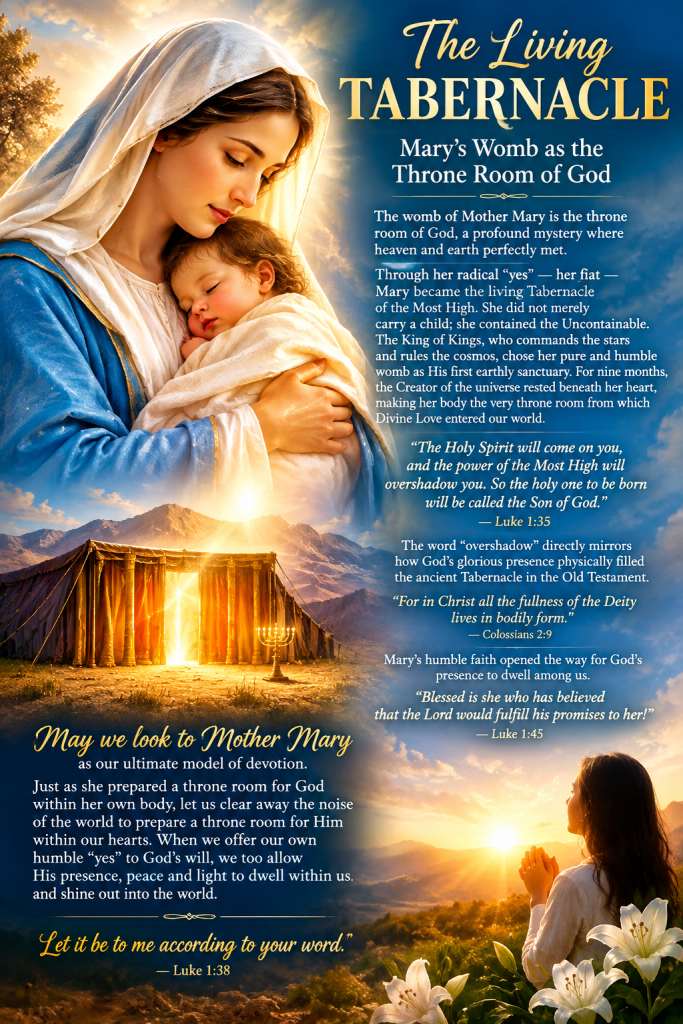
    The Living Tabernacle: Mary’s Womb as the Throne Room of God

    “For with God nothing shall be impossible” ( Luke 1:37).

    The Womb of Mother Mary is the throne room of God, a profound mystery where heaven and earth perfectly met.

    Through her radical “yes” and her fiat, Mary became the living Tabernacle of the Most High. She did not merely carry a child; she contained the Uncontainable.

    The King of Kings, who commands the stars and rules the cosmos, chose her pure and humble womb as His first earthly sanctuary. For nine months, the Creator of the universe rested beneath her heart, making her body the very throne room from which Divine Love entered our world.

    This reality fulfills the beautiful announcement given to her by the Angel Gabriel:

    “The Holy Spirit will come on you, and the power of the Most High will overshadow you. So the holy one to be born will be called the Son of God” (Luke 1:35).

    The word “overshadow” directly mirrors how God’s glorious presence physically filled the ancient Tabernacle in the Old Testament. In Mary, God came to dwell not in a tent, but in human flesh:

    “For in Christ all the fullness of the Deity lives in bodily form” (Colossians 2:9).

    This sacred truth reminds us of the incredible dignity of the human person and the power of surrender. God did not choose a grand, earthly palace of marble and gold for His throne; He chose the quiet, hidden, and faithful womb of a humble young woman, prompted by her deep faith:

    “Blessed is she who has believed that the Lord would fulfill his promises to her!” ( Like 1:45)

    May we look to Mother Mary as our ultimate model of devotion. Just as she prepared a throne room for God within her own body, let us clear away the noise of the world to prepare a throne room for Him within our hearts. When we offer our own humble “yes” to God’s will, we too allow His presence, peace, and light to dwell within us and shine out into the world.
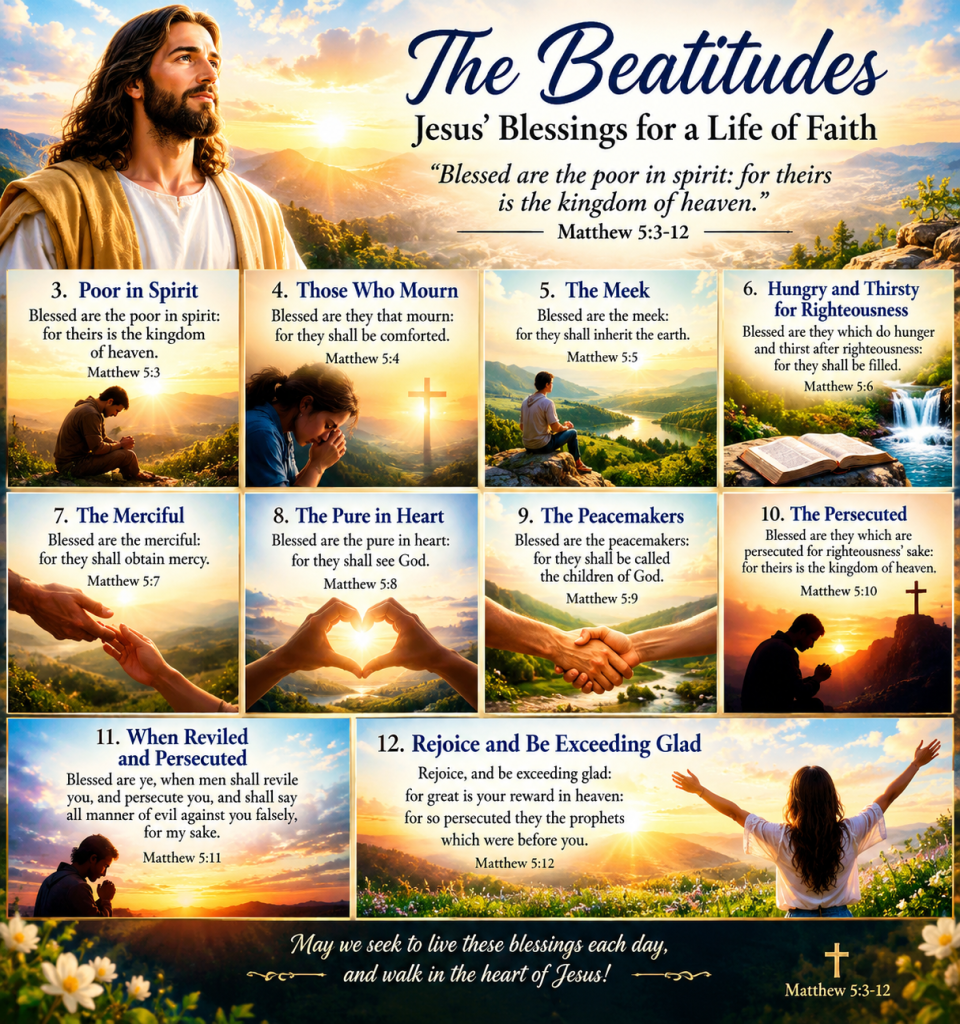
  • THE BEATITUDES — WALKING IN THE HEART OF CHRIST

    1. “Blessed are the poor in spirit: for theirs is the kingdom of heaven” (Matthew 5:3).

    To be poor in spirit means to recognize our complete dependence upon God. It is humility before Him, knowing that we need His grace and cannot rely on ourselves.

    2. “Blessed are they that mourn: for they shall be comforted” (Matthew 5:4).

    This speaks of those who grieve deeply, including sorrow over sin and the brokenness of the world. God promises His comfort to the hurting and repentant heart.

    3. “Blessed are the meek: for they shall inherit the earth” (Matthew 5:5).

    Meekness is not weakness. It is strength brought under God’s control responding with gentleness, humility, and self-control rather than pride or revenge.

    4. “Blessed are they which do hunger and thirst after righteousness: for they shall be filled” (Matthew 5:6).

    Just as the body longs for food and water, the believer should deeply desire to live rightly before God. Jesus promises that those who genuinely seek righteousness will be spiritually satisfied.

    5. “Blessed are the merciful: for they shall obtain mercy” (Matthew 5:7).

    Mercy means showing compassion, forgiveness, and kindness to others, especially when they have fallen short. Those who extend mercy reflect God’s own merciful character.

    6. “Blessed are the pure in heart: for they shall see God” (Matthew 5:8).

    A pure heart seeks God sincerely, without hypocrisy or divided devotion. Lord Jesus points us toward an inner life that is clean, sincere, and devoted to Him.

    7. “Blessed are the peacemakers: for they shall be called the children of God” (Matthew 5:9).

    Peacemakers do more than avoid conflict. They actively seek reconciliation, forgiveness, and harmony. They reflect the character of God, who calls people into peace with Himself and one another.

    8. “Blessed are they which are persecuted for righteousness’ sake: for theirs is the kingdom of heaven” (Matthew 5:10).

    Following righteousness can sometimes bring rejection or suffering. Lord Jesus reminds His followers that faithfulness to God has eternal significance, even when it is costly.

    9. “Blessed are ye, when men shall revile you, and persecute you” (Matthew 5:11).

    When people insult, falsely accuse, or mistreat believers because of their faith in Christ, Lord Jesus tells them not to abandon Him. Their identity and reward are found in Him, not in human approval.

    10. “Rejoice, and be exceeding glad: for great is your reward in heaven” (Matthew 5:12).

    Lord Jesus calls His followers to rejoice even in suffering for His sake. The focus shifts from present hardship to the eternal reward with God. The prophets before them also endured persecution for their faithfulness.

    The Beatitudes describe a Christ-centered way of living that reflects His heart. Starting with humility, recognizing our need for God, they guide us to be gentle, merciful, pure, and peaceful, finding joy and comfort in Him even through trials.

  • STANDING FIRM IN THE PROMISES OF GOD

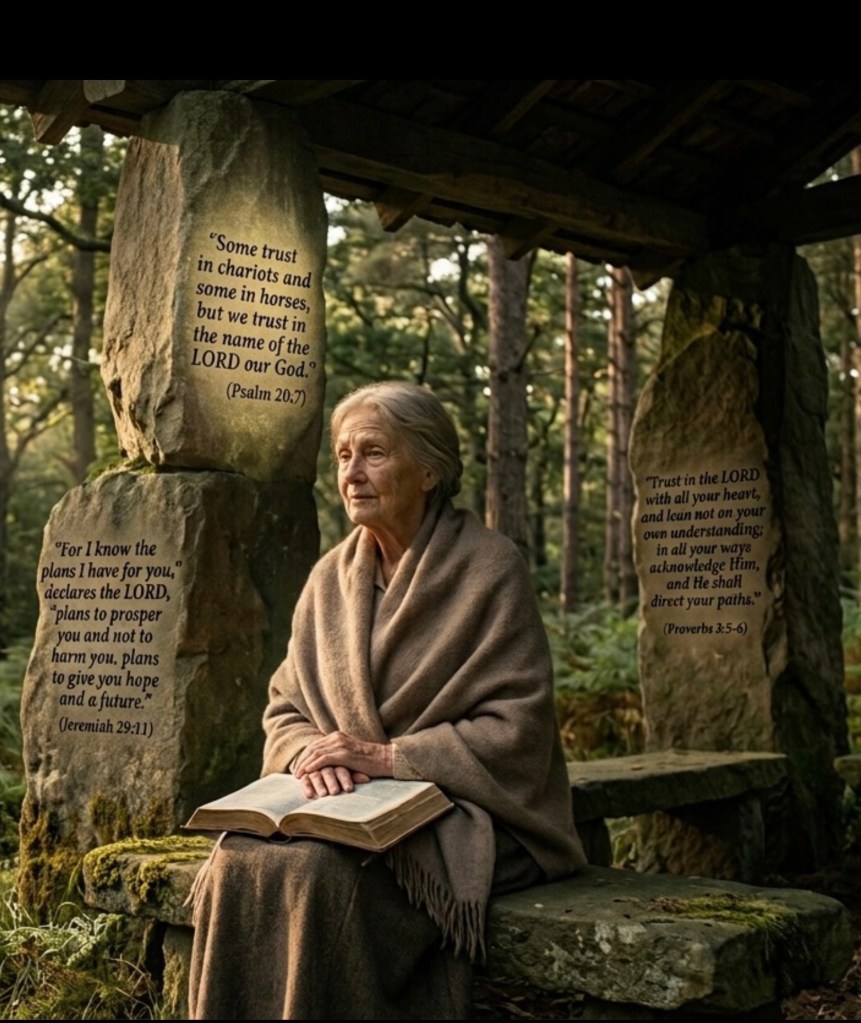
    “Some trust in chariots and some in horses, but we trust in the name of the LORD our God” (Psalm 20:7).

    Psalm 20 is an important prayer for a king before battle. It was written for a time when chariots and horses were not just concepts, they were real, and they were charging.

    The Chariots and Horses represent human power. In the ancient world, they were the most terrifying and sophisticated weapons of war. They were symbolic of military might, wealth, and national security. They are everything that the world counts as powerful and dependable.

    In our own lives, the chariots and horses are different, but their function is the same. They are the things we love to cling to for security: our health, our wealth, our influence, our knowledge, our technology. These are not inherently bad things; they are gifts and tools.

    The danger is that we begin to love the gift more than the Giver, and we build our foundation on something that, in the end, cannot sustain us.

    The Prophet Isaiah warns, “Woe to those who go down to Egypt for help and rely on horses, who trust in the abundance of their chariots and in the great strength of their horsemen, but do not look to the Holy One of Israel” (Isaiah 31:1).

    For all their strength, chariots and horses cannot give peace to a restless soul. They cannot mend a broken heart. And they can disappear in an instant.

    Turn to the name of the LORD our God.

    To trust in the “name of the LORD” is to trust in: His Power, as the Creator of the universe. His Character, as the faithful, unchanging, and merciful God who keeps His promises (Exodus 34:6). The unique covenant name, Yahweh (the LORD), which reminds us that He is the “I AM WHO I AM” (Exodus 3:14) – the ever-present, self-sustaining God who is always there, and always for us.

    This trust is not a superficial positive thinking. It is an intentional, deep-seated reliance. It is the wisdom to say, “Even if everything I own and every plan I have fails, my foundation is secure.”It is the humble act of acknowledging that our human strength has limits, but God’s strength has none.

    It’s the heart behind the powerful declaration of Isaiah 40:29: “He gives strength to the weary and increases the power of the weak.”

    It is not just for the good times. It is a battle cry for the moments of overwhelming fear. When your own strength is gone, and the “chariots” of your life seem broken, you can still whisper, “I trust in the name of the LORD my God.”

    And in that trust, you find a hidden power. You discover that you can stand when everything around you is falling. You find a security that is not of this world. As promised in Proverbs 18:10: “The name of the LORD is a strong tower; the righteous run into it and are safe.”

    Where is your trust built? What is the thing you are most afraid of losing? Is it your “chariot” or is it your “strong tower”?

    You do not need to choose between being prepared and having faith. You are allowed to have “horses.” But the Psalmist calls you to a higher love, to a love that places its primary hope in the One who will never fail you, even when all the world’s power falls. It is a wisdom that brings a peace that passes understanding.

    God does not care about fast horses or strong fighters; instead, God loves people who respect him and trust his steady love. 

    “His pleasure is not in the strength of the horse, nor His delight in the legs of the warrior; the LORD delights in those who fear Him, who put their hope in His unfailing love” ( Psalm 147:10, 11).

    “They cried unto thee, and were delivered: they trusted in thee, and were not confounded” (Psalm 22:5).

  • BENEATH THE WINGS OF GRACE

    “Keep me as the apple of Your eye; hide me under the shadow of Your wings” (Psalm 17:8).

    During a period of intense trial and opposition,  King David penned this verse, which is one of the most tender, powerful, and reassuring declarations of divine love and protection in the entire Bible.

    “Keep me as the apple of Your eye.” The  pupil is one of the most vital, delicate, and sensitive parts of the human body.

     Just as your eyelid reflexively blinks to shield your eye from the slightest particle or harm, God actively guards you with the same instinctual, instant protection.

     You are central to His vision. You are not an afterthought or lost in the crowd; God’s gaze is focused on you with immense value, tenderness, and love (Zechariah 2:8).

    “Hide me under the shadow of Your wings.”

     A mother bird gathers her young under her broad, strong wings to shield them from predators, harsh weather, or scorching heat.

     A place of physical proximity, you have to be right next to God to stay within His shadow. It implies total intimacy and refuge. While the danger outside may still rage, beneath His wings there is stillness, comfort, and ultimate security.

    God does not protect us out of mere duty; He protects us out of deep affection. You are cherished like the most delicate part of His eye and sheltered with the fierce, protective love of a parent bird over its young. Step out of the storm and rest in the safety of His presence.

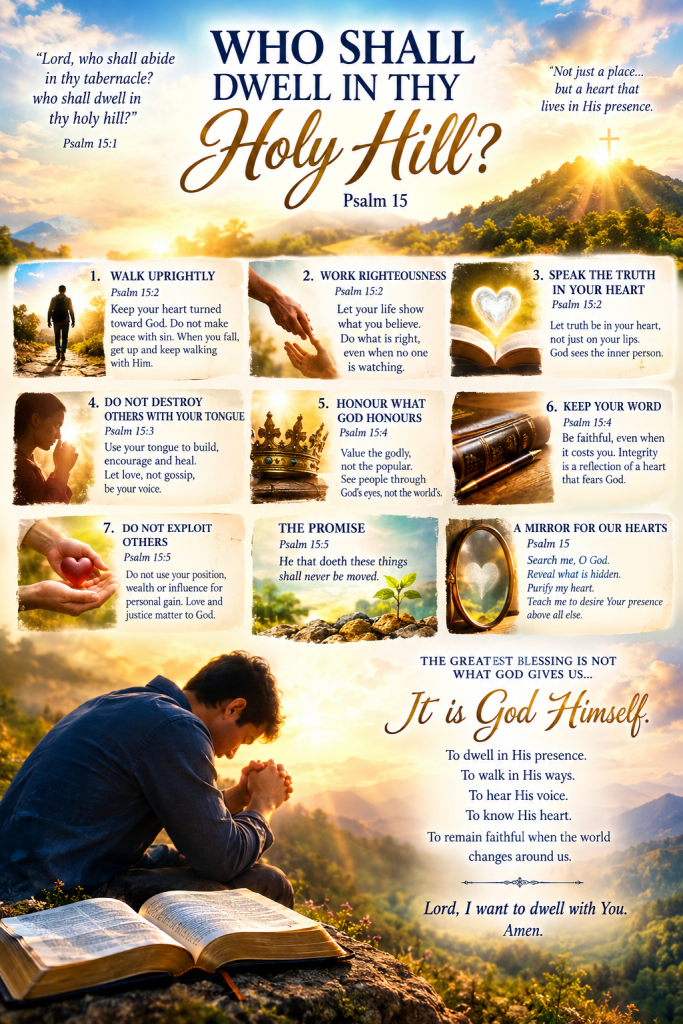
  • WHO SHALL DWELL IN THY HOLY HILL?

    “LORD, who shall abide in thy tabernacle? who shall dwell in thy holy hill?” (Psalm 15:1)

    King David is not asking about a physical address. He is asking about fellowship with the living God.

    Who can come near Him?

    Who can remain in His presence?

    What kind of life does God desire from those who call upon His name?

    “He that walketh uprightly” (Psalm 15:2).

    God is concerned not merely with what we say, but with how we walk.

    To walk uprightly does not mean that a person has never fallen. It means that his heart is turned toward God and that he desires to walk in truth.

    The upright person does not deliberately make peace with sin. When he discovers sin in his heart, he brings it before God. When he is corrected, he listens. When he falls, he gets up.

    King David continues: “and worketh righteousness…” (Psalm 15:2)

    Righteousness is not merely something we profess with our lips. It must become visible in our lives.

    True faith means doing what is right even when no one is watching, because we live and walk before God, not for human applause. 

    God desires truth not only on our lips but within our hearts. He desires a heart without deception, a heart that does not need to maintain one appearance before people and another before God.

    “He that backbiteth not with his tongue, nor doeth evil to his neighbour, nor taketh up a reproach against his neighbour” (Psalm 15:3).

    A person can worship God with his lips and yet wound another person with those same lips.

    Words hold the ultimate power to either build lives up or tear them down.

    King David says:

    “In whose eyes a vile person is contemned; but he honoureth them that fear the LORD” (Psalm 15:4).

    We  often admire people because of wealth, power, influence, appearance, status, or popularity.

    But God looks differently.

    The person who fears the Lord may have little recognition in this world and yet be precious in the sight of God.

    “He that sweareth to his own hurt, and changeth not” (Psalm 15:4)

    God desires people whose word can be trusted.

    This is integrity. A person of integrity does not keep his promise only when it is comfortable. He who walks with God learns that faithfulness is more valuable than convenience.

    “He that putteth not out his money to usury, nor taketh reward against the innocent” (Psalm 15:5).

    God cares about how we treat those who are vulnerable.

    Our relationship with God cannot be separated from our relationship with people. A heart that truly desires God’s presence must learn to love righteousness and reject exploitation.

    “He that doeth these things shall never be moved”(Psalm 15:5).

    The world, people, and circumstances constantly change, and earthly possessions or approval easily disappear. However, someone who builds their life upon God and walks in His ways gains a foundation that external shifts cannot take away.

    Ultimately, the greatest blessing we can experience is God Himself. While the world around us remains in constant flux, true peace is found in dwelling in His presence and walking in His ways. By taking the time to hear His voice and deeply know His heart, we gain the spiritual strength needed to remain faithful through every season of change.

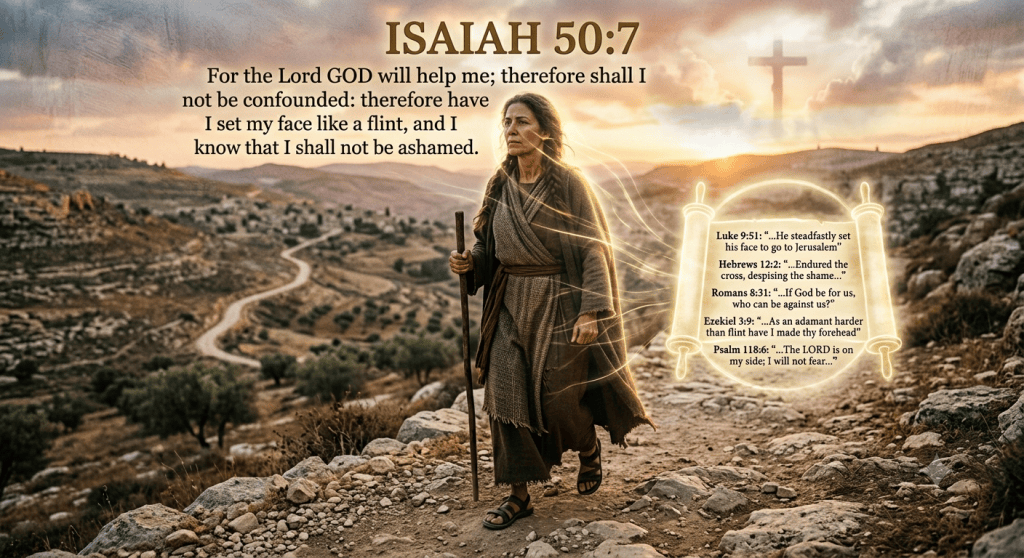
  • FACE LIKE FLINT

    Life frequently brings moments where your purpose is tested, your motives are questioned, or the road ahead looks steep and lonely. In those seasons, human willpower eventually fatigues but holy conviction does not.

    Setting your face like flint is not about being cold, rigid, or stubborn toward people; it is about being entirely uncompromising regarding your direction in God. 

    Stop measuring your journey against the noise, criticism, or doubts of the crowd.

    Realise that if God has called you to step forward, His strength will sustain every step you take.

     Circumstances may test you today, but God’s promises guarantee that your story does not end in defeat.

    Whatever trial, goal, or calling lies before you today, fix your gaze forward. Let your trust in God make your resolve harder than any obstacle in your path.

    “Therefore, my beloved brethren, be ye stedfast, unmovable, always abounding in the work of the Lord, forasmuch as ye know that your labour is not in vain in the Lord” ( 1 Corinthians 15:58).

     “Cast not away therefore your confidence, which hath great recompence of reward. For ye have need of patience, that, after ye have done the will of God, ye might receive the promise” (Hebrews 10:35, 36).

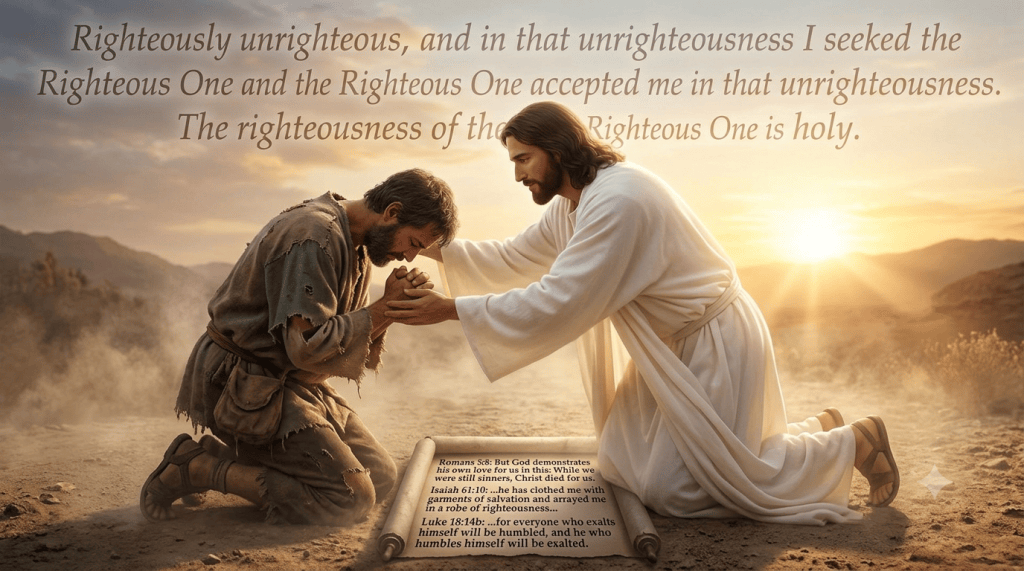
  • RIGHTEOUSLY UNRIGHTEOUS

    In the dust where my footfall faltered,

    In the shadow of a fractured grace,

    I brought a heart I could not alter,

    To stand before the Holy Face.

    Righteously unrighteous, bent and broken,

    Cloaked in the truth of my own decay,

    With no grand plea or polished token,

    I walked the dark toward the light of day.

    I sought the One who holds the suns,

    Whose purity no fault can stain,

    And found the arms of the Righteous One

    Open to gather my guilt and pain.

    Not after the wash, not after the mend,

    But deep in the mire where I used to lie,

    The Holy bowed down to call me friend,

    And answered my frail, unworthy cry.

    Now wrapped in a light I did not earn,

    Where mercy and holiness tightly twine,

    I rest in the grace for which I yearned—

    His holy righteousness, forever mine.

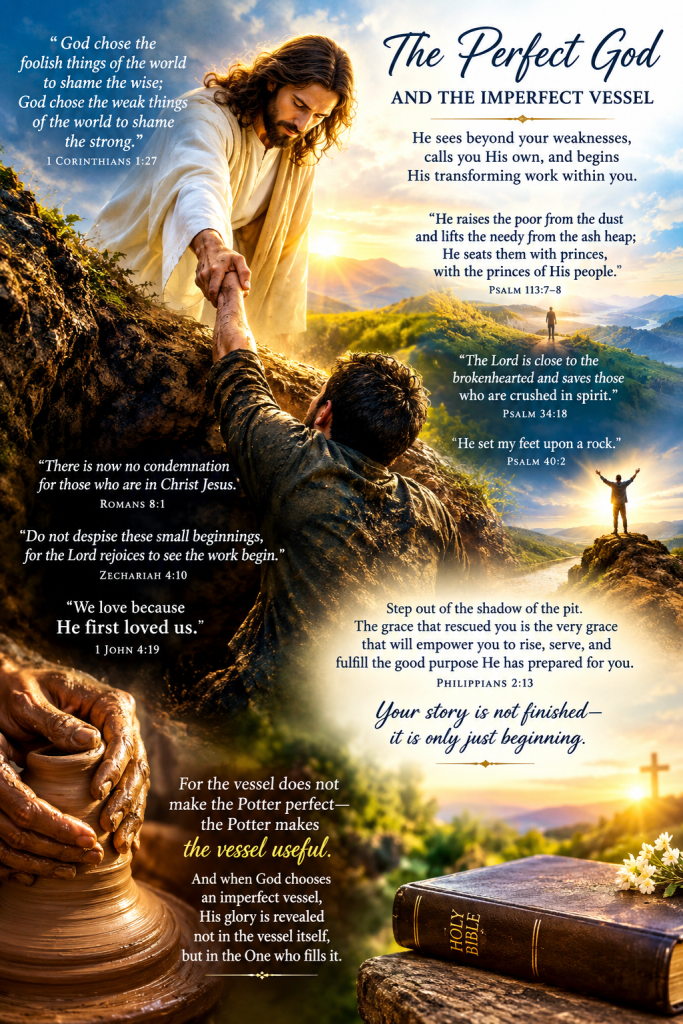
  • THE PERFECT GOD AND THE IMPERFECT VESSEL

    The perfect God, whose throne is established in holiness and light, has chosen the imperfect to serve the All-Perfect One.

    As the Apostle Paul writes, “God chose the foolish things of the world to shame the wise; God chose the weak things of the world to shame the strong” (1 Corinthians 1:27).

    You may feel inadequate, fragile, and unworthy, yet in His divine mercy, He sees beyond your weaknesses, calls you His own, and begins His transforming work within you.

    He is the God who stoops down to the lowest places. Long before you knew how to reach for Him, “He raises the poor from the dust and lifts the needy from the ash heap; He seats them with princes, with the princes of His people” (Psalm 113:7–8).

    You may have felt buried beneath the weight of your own limitations, trapped in a pit of pain and despair. Even when your voice failed and you could not cry out, His eyes never left you. “The Lord is close to the brokenhearted and saves those who are crushed in spirit” (Psalm 34:18). He saw every hidden tear, every silent struggle, and reached deep into the mire to pull you out, setting your feet upon a rock (Psalm 40:2).

    Within your soul burns a quiet desire to do greater things for Him, to offer a life of purpose, power, and glory to His name. Yet you look back and feel as though you have not done enough. Do not let condemnation weigh heavily on your heart, for “there is now no condemnation for those who are in Christ Jesus” (Romans 8:1). God does not measure your worth by the greatness of your past achievements, but He delights in a heart that turns toward Him in faith and obedience. “Do not despise these small beginnings, for the Lord rejoices to see the work begin” (Zechariah 4:10).

    You love Him deeply, yet you often feel that you have not fully expressed that love, held back by fear, hesitation, or the weight of your own unworthiness. But remember this: “We love because He first loved us” (1 John 4:19). Your love for Him, even when expressed through quiet obedience and unspoken longing, is precious before Him. He is not asking you to become flawless before you serve Him; He asks for a willing and surrendered heart.

    “For it is God who works in you to will and to act in order to fulfill His good purpose” (Philippians 2:13).

    The hands that lifted you from the pit have not released you. The God who found you in your brokenness is the same God who can use your life for His glory.

    Do not wait until you feel worthy. Do not wait until you feel strong. Come as you are, surrender what you have, and let Him do through you what you could never accomplish by your own strength.

    For the vessel does not make the Potter perfect, but the Potter makes the vessel useful.

    And when God chooses an imperfect vessel, His glory is revealed not in the vessel itself, but in the One who fills it.

  • THE BATTLE WITHIN

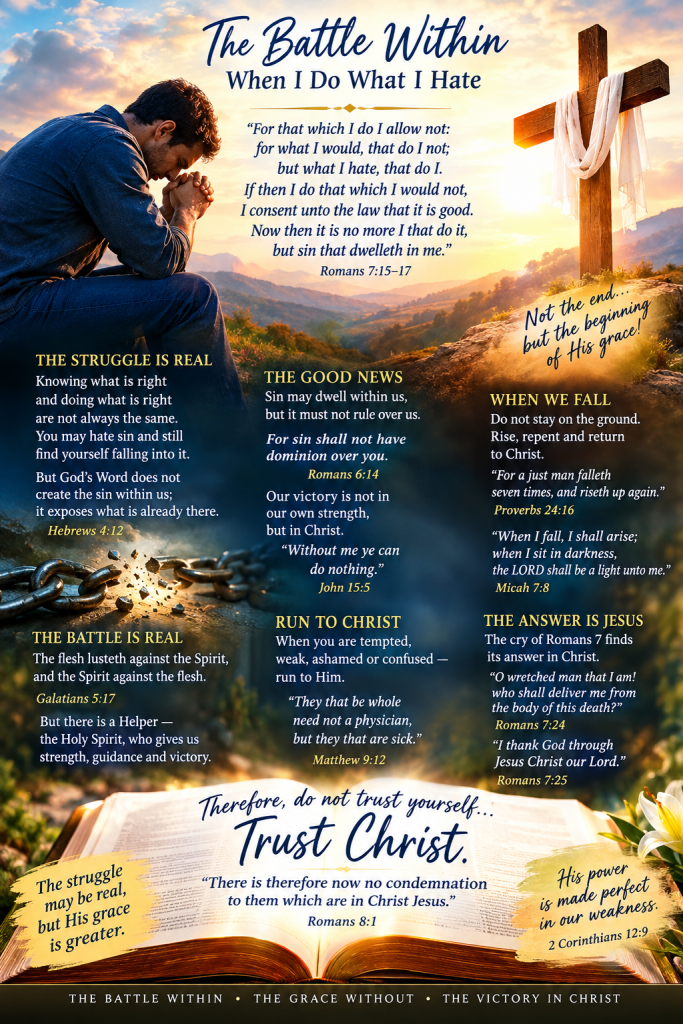
    There is a battle that cannot always be seen by human eyes. It is not fought with swords, armies, or earthly weapons. It is fought within the heart of man.

    The Apostle Paul speaks with remarkable honesty in Romans 7:15–17: “What I would, that do I not; but what I hate, that do I.”

    These words reveal something every believer must understand: knowing the will of God and obeying the will of God are not always the same thing.

    A person may know what is right and still struggle to do it. He may hate sin and yet find himself falling into temptation. He may desire holiness and still discover weakness within himself.

    The Apostle Paul says: “If then I do that which I would not, I consent unto the law that it is good.”

    The problem is not God’s law. God’s commandment is good because God is good. “Wherefore the law is holy, and the commandment holy, and just, and good” (Romans 7:12). God’s Word does not create the sin within us; it exposes what is already there. Hebrews 4:12 declares: “For the word of God is quick, and powerful, and sharper than any twoedged sword.” When God’s Word enters our hearts, it shows us not merely what we want others to see, but who we truly are before God.

    The Apostle Paul says: “What I hate, that do I.” He acknowledges his weakness with humility, and that is where spiritual healing begins. He who comes before God and says, “Lord, search me, reveal me, cleanse me, and change me,” has opened his heart to the work of grace. King David prayed: “Search me, O God, and know my heart: try me, and know my thoughts” (Psalm 139:23). True spirituality is bringing our struggles into the presence of God.

    The Apostle Paul says: “Sin that dwelleth in me.” In Romans 6:14, he later declares: “For sin shall not have dominion over you.” We are not strong enough to defeat sin. Christ is stronger than the sin that is fighting against us. Lord Jesus said: “Without me ye can do nothing” (John 15:5). Our victory does not come from trusting our own strength. It comes from abiding in Christ.

    Are you struggling with sin or making peace with it?

    If you have sinned, then you must repent. You must return to Christ. “For a just man falleth seven times, and riseth up again” (Proverbs 24:16). “When I fall, I shall arise; when I sit in darkness, the LORD shall be a light unto me” (Micah 7:8).

    You may have been experiencing a painful struggle, making you wonder whether you truly belong to God and why you are still fighting this battle. The Christian life involves warfare. Galatians 5:17 says: “For the flesh lusteth against the Spirit, and the Spirit against the flesh.” But the Holy Spirit works within us, teaching us, correcting us, strengthening us, and leading us toward holiness. Therefore, when you recognize the battle within, do not run away from God, but run toward Him. When you face weakness, temptation, or moments of doubt and shame, turn immediately to Christ for strength.

    Do not hide from the Physician. Go to the Physician. Lord Jesus said: “They that be whole need not a physician, but they that are sick” (Matthew 9:12).

    The Lord Jesus Christ is more real than our weaknesses. His grace outlasts our failures, His mercy covers our shame, and His power is greater than any temptation. Whenever we stumble, His strong hand is always ready to lift us back up. Therefore, do not trust yourself, but trust the Living Christ.

    The Lord told the Apostle Paul: “My grace is sufficient for thee: for my strength is made perfect in weakness” (2 Corinthians 12:9).

    Abide in Christ. “There is therefore now no condemnation to them which are in Christ Jesus” (Romans 8:1).

    For the battle is not ultimately won by the strength of the man who fights. It is won by the grace of the Christ who lives in him.

  • HONOUR ONE ANOTHER

    “I therefore, the prisoner of the Lord, beseech you that ye walk worthy of the vocation wherewith ye are called, With all lowliness and meekness, with longsuffering, forbearing one another in love; Endeavouring to keep the unity of the Spirit in the bond of peace” (Ephesians 4:2-4).

    Human life possesses an inherent dignity that cannot be measured by status or achievement, because every person is created in the image of God (Genesis 1:27). Therefore, how we treat others reflects our true relationship with God.

    We cannot genuinely love God while harboring hatred or speaking maliciously against those made in His image.

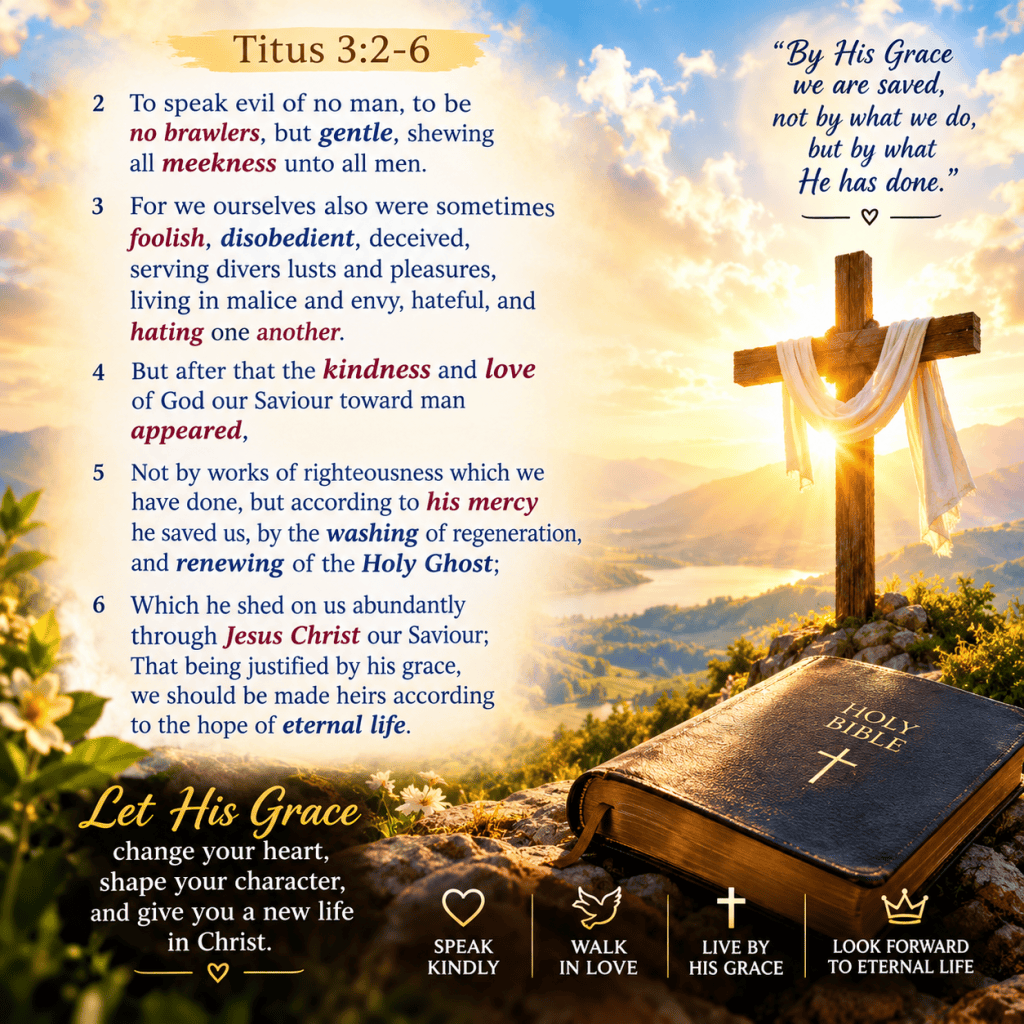
    Our words and emotions carry immense power to build up or destroy. Uncontrolled anger, pride, jealousy, and neglect frequently ruin families, break friendships, and prevent reconciliation. Yet Scripture calls us to be slow to anger, quick to seek forgiveness, and guarded against bitterness. Before judging or despising others, we must remember our own past failures and foolishness. We were not saved by our own righteousness, but by God’s abundant mercy and grace. Because the ground at the foot of the cross is level, we have no basis for spiritual superiority. The grace we have received from Christ must become the grace we extend to others.

    True discipleship is demonstrated through humility, kindness, and active forgiveness. “Death and life are in the power of the tongue” (Proverbs 18:21).

    Pride deadens relationships; genuine peace requires the strength to say, “I was wrong.”

    “By this shall all men know that ye are my disciples, if ye have love one to another” (John 13:35).

    The grace that saves us must ultimately change us. Let your life reflect the gentleness, mercy, and love that God has shown to you.