Tag: LORD JESUS CHRIST.

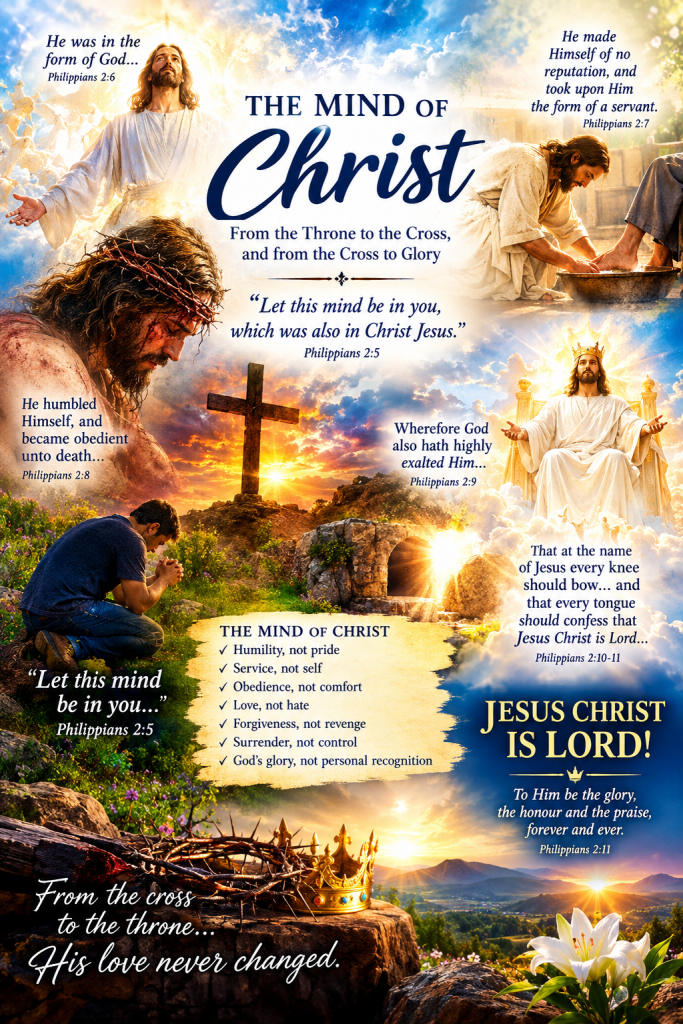
  • THE MIND OF CHRIST

    “Let this mind be in you, which was also in Christ Jesus” (Philippians 2:5).

    Philippians 2:5–11 reveals the heart of Christ: the One who was equal with God chose to humble Himself, took the form of a servant, endured the cross, and was exalted by the Father above every name.

    The Apostle Paul tells us that Christ Jesus, “being in the form of God, thought it not robbery to be equal with God” (Philippians 2:6).

    The Lord Jesus did not begin His existence in Bethlehem, Bethlehem was not the beginning of Christ. He came from glory. The One who lay in a manger was the One through whom all things were created.

    The Apostle John declares: “In the beginning was the Word, and the Word was with God, and the Word was God” (John 1:1). And: “All things were made by him; and without him was not any thing made that was made” (John 1:3).

    The Creator who spoke light into existence, shaped the heavens, and receives the worship of angels humbled Himself to become a servant and endure the piercing darkness of the cross.

    Philippians 2:7 says: “But made himself of no reputation, and took upon him the form of a servant.”

    True greatness is not about status or power, but about humility, serving others, and obeying God.

    True greatness is demonstrated not by being served or claiming glory, but by humbling oneself to serve others and give one’s life as a ransom, just as Jesus Christ did.

    Philippians 2:8 says: “And being found in fashion as a man, he humbled himself.” He humbled Himself. Nobody forced Him. Love led Him. He knew what awaited Him. He knew about rejection. He knew about betrayal. He knew about the scourging. He knew about the crown of thorns. He knew about the nails. He knew about Calvary. And yet He continued.

    Why? Because He loved us.

    “Greater love hath no man than this, that a man lay down his life for his friends” (John 15:13).

    At the cross, we see the terrible seriousness of sin, but we also see the immeasurable greatness of God’s love. The cross says to the sinner: “Your sin is serious.” But the cross also says: “You are loved.”

    He humbled himself, and became obedient unto death, even the death of the cross.

    True Christian humility demands active obedience to God, calling followers to surrender their pride, plans, comfort, and reputation just as the Lord Jesus did all the way to the cross.

    But the example of Christ stands before us: Obedience to God must be greater than our desire for comfort. The Lord Jesus Christ prayed in Gethsemane “Not my will, but thine, be done” (Luke 22:42).

    The Cross was not the end. Human eyes could look at Calvary and see defeat. But heaven saw obedience. The grave appeared to be the end. But resurrection was coming. The cross looked like humiliation. But exaltation was coming.

    Philippians 2:9 declares: “Wherefore God also hath highly exalted him, and given him a name which is above every name.”

    God sees and remembers every act of humble, unseen obedience, and He will ultimately exalt those whom the world overlooks.

    The Lord Jesus taught: “Whosoever shall humble himself shall be exalted” (Matthew 23:12).

    Philippians 2:10–11 gives us one of the most majestic declarations in Scripture: “That at the name of Jesus every knee should bow, of things in heaven, and things in earth, and things under the earth; And that every tongue should confess that Jesus Christ is Lord, to the glory of God the Father.”

    One day, every person and power in all creation will bow and confess that Lord Jesus Christ  is the one true King.

    Despite the world’s rejection of the Lord Jesus Christ, His unshakable lordship calls us not just to admire Him, but to surrender our lives and follow His example of humility, love, and obedience.

    The Christian life is not simply saying: “Jesus is Lord.” It is allowing the Lord Jesus to become the pattern of our lives. In moments of pride, hurt, or hardship, looking to Christ provides the ultimate pattern for humility, obedience, and endurance.

    He descended before He was exalted. He served before He was glorified. He suffered before He was crowned. He obeyed before the Father highly exalted Him.

    The Apostle Paul outlines the ultimate trajectory of Jesus Christ, who descended from divine glory to the humility of the cross before being exalted to everlasting Lordship over all creation.

    THE LORD JESUS CHRIST: He is not merely a teacher. He is not merely a prophet. He is not merely an example. He is Lord. The One who humbled Himself will reign forever. The One who wore the crown of thorns will wear the crown of glory. The One who was rejected by men will be confessed by every tongue. The One whose hands were pierced will rule with all authority.

    Let Christ’s mind, heart, humility, obedience, and love shape your thoughts, desires, relationships, decisions, and actions.

    Your prayers, tears, and quiet service are never wasted because God sees everything. Keep serving, obeying, and looking to Jesus. The Christ who humbled Himself is now highly exalted and He sees your faithfulness.

    And the day is coming when every knee shall bow and every tongue shall confess:

    JESUS CHRIST IS LORD!
  • THE GOD OF THE IMMEASURABLE

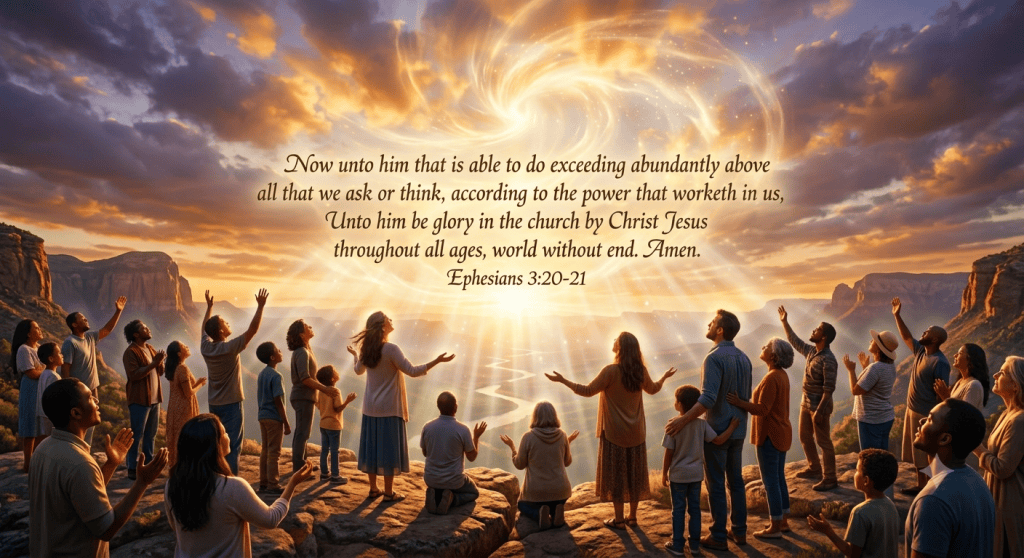
    “Now unto him that is able to do exceeding abundantly above all that we ask or think, according to the power that worketh in us,
    Unto him be glory in the church by Christ Jesus throughout all ages, world without end. Amen” (Ephesians 3:20, 21).

    The Apostle Paul emphasizes that God’s capacity to act far exceeds human comprehension. Whatever you pray for or even dream up, God’s ability to respond surpasses it. Human expectations are limited by a finite perspective, but divine resources and willingness are infinite.

    This infinite power is not distant or remote; it operates actively within the life of the believer. The same power that raised Christ from the dead is at work within believers, changing hearts, renewing minds, and granting spiritual endurance.

    God chooses to manifest His immense strength through human vessels.

    God’s glory is made visible in Christ Jesus. The Lord Jesus is the ultimate manifestation of God’s character, love, and redemption. And in the Church, the collective body of believers reflects God’s wisdom and power to the world, when living out unity, love, and faith.

    God’s glory extends through every generation of believers. The ultimate purpose of creation and salvation is an unending cycle of praise and glory to God throughout eternity.

    Trust God beyond personal limitations. Prayer is not about convincing God to act within human expectations, but aligning with an all-powerful God who is already at work internally to accomplish far more than human imagination can fathom.

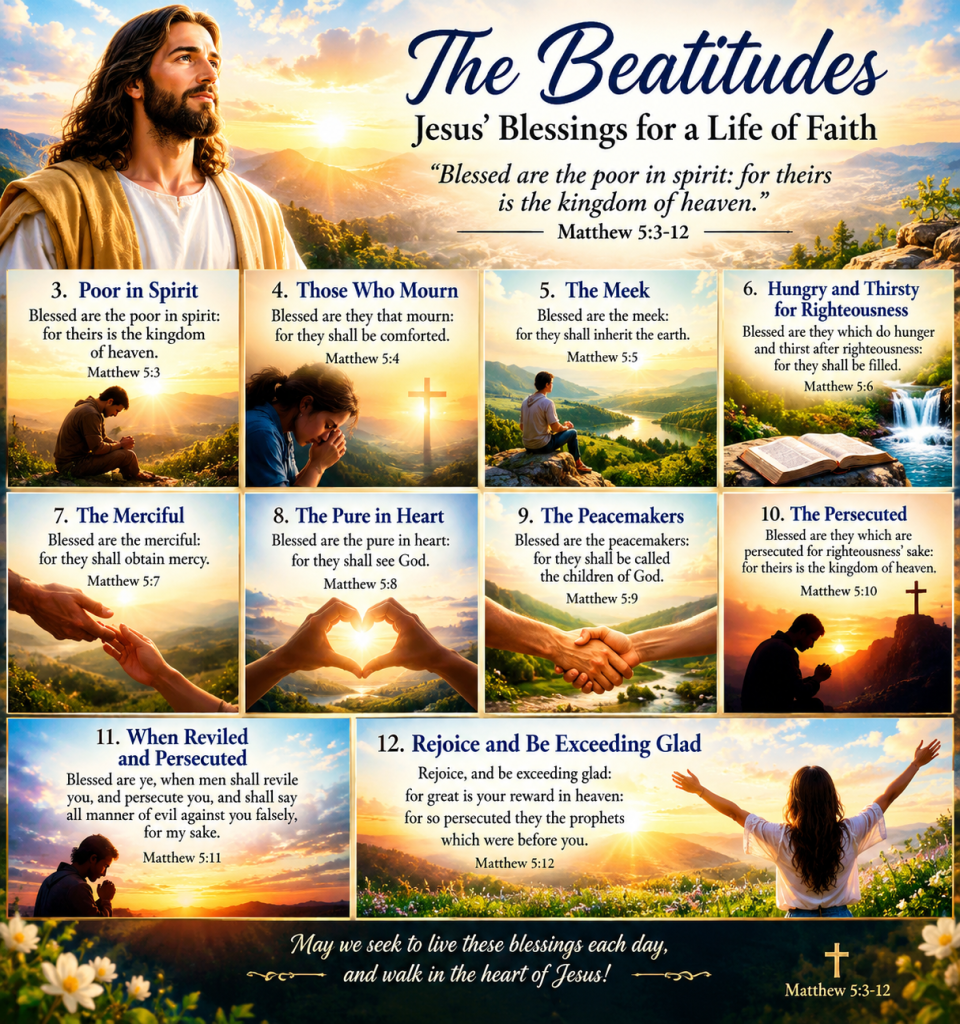
  • THE BEATITUDES — WALKING IN THE HEART OF CHRIST

    1. “Blessed are the poor in spirit: for theirs is the kingdom of heaven” (Matthew 5:3).

    To be poor in spirit means to recognize our complete dependence upon God. It is humility before Him, knowing that we need His grace and cannot rely on ourselves.

    2. “Blessed are they that mourn: for they shall be comforted” (Matthew 5:4).

    This speaks of those who grieve deeply, including sorrow over sin and the brokenness of the world. God promises His comfort to the hurting and repentant heart.

    3. “Blessed are the meek: for they shall inherit the earth” (Matthew 5:5).

    Meekness is not weakness. It is strength brought under God’s control responding with gentleness, humility, and self-control rather than pride or revenge.

    4. “Blessed are they which do hunger and thirst after righteousness: for they shall be filled” (Matthew 5:6).

    Just as the body longs for food and water, the believer should deeply desire to live rightly before God. Jesus promises that those who genuinely seek righteousness will be spiritually satisfied.

    5. “Blessed are the merciful: for they shall obtain mercy” (Matthew 5:7).

    Mercy means showing compassion, forgiveness, and kindness to others, especially when they have fallen short. Those who extend mercy reflect God’s own merciful character.

    6. “Blessed are the pure in heart: for they shall see God” (Matthew 5:8).

    A pure heart seeks God sincerely, without hypocrisy or divided devotion. Lord Jesus points us toward an inner life that is clean, sincere, and devoted to Him.

    7. “Blessed are the peacemakers: for they shall be called the children of God” (Matthew 5:9).

    Peacemakers do more than avoid conflict. They actively seek reconciliation, forgiveness, and harmony. They reflect the character of God, who calls people into peace with Himself and one another.

    8. “Blessed are they which are persecuted for righteousness’ sake: for theirs is the kingdom of heaven” (Matthew 5:10).

    Following righteousness can sometimes bring rejection or suffering. Lord Jesus reminds His followers that faithfulness to God has eternal significance, even when it is costly.

    9. “Blessed are ye, when men shall revile you, and persecute you” (Matthew 5:11).

    When people insult, falsely accuse, or mistreat believers because of their faith in Christ, Lord Jesus tells them not to abandon Him. Their identity and reward are found in Him, not in human approval.

    10. “Rejoice, and be exceeding glad: for great is your reward in heaven” (Matthew 5:12).

    Lord Jesus calls His followers to rejoice even in suffering for His sake. The focus shifts from present hardship to the eternal reward with God. The prophets before them also endured persecution for their faithfulness.

    The Beatitudes describe a Christ-centered way of living that reflects His heart. Starting with humility, recognizing our need for God, they guide us to be gentle, merciful, pure, and peaceful, finding joy and comfort in Him even through trials.

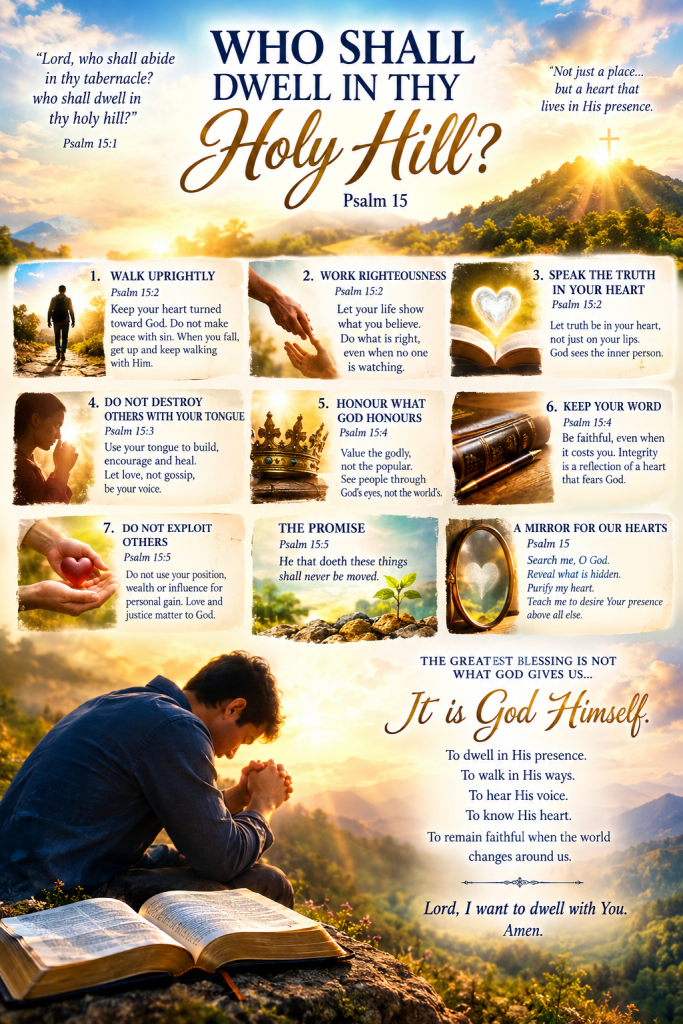
  • WHO SHALL DWELL IN THY HOLY HILL?

    “LORD, who shall abide in thy tabernacle? who shall dwell in thy holy hill?” (Psalm 15:1)

    King David is not asking about a physical address. He is asking about fellowship with the living God.

    Who can come near Him?

    Who can remain in His presence?

    What kind of life does God desire from those who call upon His name?

    “He that walketh uprightly” (Psalm 15:2).

    God is concerned not merely with what we say, but with how we walk.

    To walk uprightly does not mean that a person has never fallen. It means that his heart is turned toward God and that he desires to walk in truth.

    The upright person does not deliberately make peace with sin. When he discovers sin in his heart, he brings it before God. When he is corrected, he listens. When he falls, he gets up.

    King David continues: “and worketh righteousness…” (Psalm 15:2)

    Righteousness is not merely something we profess with our lips. It must become visible in our lives.

    True faith means doing what is right even when no one is watching, because we live and walk before God, not for human applause. 

    God desires truth not only on our lips but within our hearts. He desires a heart without deception, a heart that does not need to maintain one appearance before people and another before God.

    “He that backbiteth not with his tongue, nor doeth evil to his neighbour, nor taketh up a reproach against his neighbour” (Psalm 15:3).

    A person can worship God with his lips and yet wound another person with those same lips.

    Words hold the ultimate power to either build lives up or tear them down.

    King David says:

    “In whose eyes a vile person is contemned; but he honoureth them that fear the LORD” (Psalm 15:4).

    We  often admire people because of wealth, power, influence, appearance, status, or popularity.

    But God looks differently.

    The person who fears the Lord may have little recognition in this world and yet be precious in the sight of God.

    “He that sweareth to his own hurt, and changeth not” (Psalm 15:4)

    God desires people whose word can be trusted.

    This is integrity. A person of integrity does not keep his promise only when it is comfortable. He who walks with God learns that faithfulness is more valuable than convenience.

    “He that putteth not out his money to usury, nor taketh reward against the innocent” (Psalm 15:5).

    God cares about how we treat those who are vulnerable.

    Our relationship with God cannot be separated from our relationship with people. A heart that truly desires God’s presence must learn to love righteousness and reject exploitation.

    “He that doeth these things shall never be moved”(Psalm 15:5).

    The world, people, and circumstances constantly change, and earthly possessions or approval easily disappear. However, someone who builds their life upon God and walks in His ways gains a foundation that external shifts cannot take away.

    Ultimately, the greatest blessing we can experience is God Himself. While the world around us remains in constant flux, true peace is found in dwelling in His presence and walking in His ways. By taking the time to hear His voice and deeply know His heart, we gain the spiritual strength needed to remain faithful through every season of change.

  • THE UNSHAKABLE REIGN

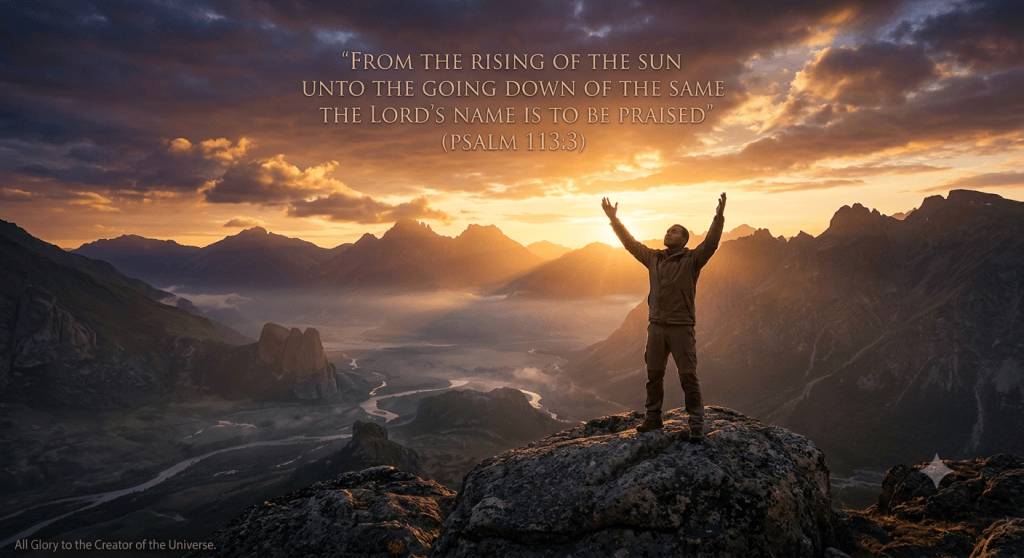
    “From the rising of the sun unto the going down of the same the LORD’s name is to be praised”(Psalm 113:3).

    Earthly power has an expiration date. Presidents, prime ministers, kings, and emperors wield a borrowed authority that is bound by borders, broken by time, and cut short by the grave. When human leaders receive honor, it is merely for an office they temporarily occupy.

    The Creator’s claim to glory knows no such limits. His praise spans “from the rising of the sun unto the going down of the same”, stretching across every timezone and filling every corner of space without pause.

    While human rulers beg for the support of citizens, lean on advisors, and fight over resources to keep their thrones, God’s authority is absolute and underived. Everything in this universe needs a cause, a fuel, or a maker to exist. But God exists from everlasting to everlasting (Psalm 90:2). He is uncaused. He relies on nothing.

    He is not measured by a standard of goodness or truth, He is the source and definition of them. He guards strict justice while holding out deep mercy, patience, and grace to His creation. From the smallest subatomic particle to the largest spinning galaxy, all things hang in continuous, breathless dependence upon Him.

    Earthly empires rise and fall like the tide, but the Kingdom of God remains unshaken. In a world of shifting allegiances and fragile leadership, human power is ultimately eclipsed by the One who needs no throne, fears no successor, and answers to no court. To Him alone belongs the honor that never fades.

    “Now unto the King eternal, immortal, invisible, the only wise God, be honour and glory for ever and ever. Amen” (1 Timothy 1:17).

    “The LORD shall reign for ever, even thy God, O Zion, unto all generations. Praise ye the LORD”(Psalm 146:10).

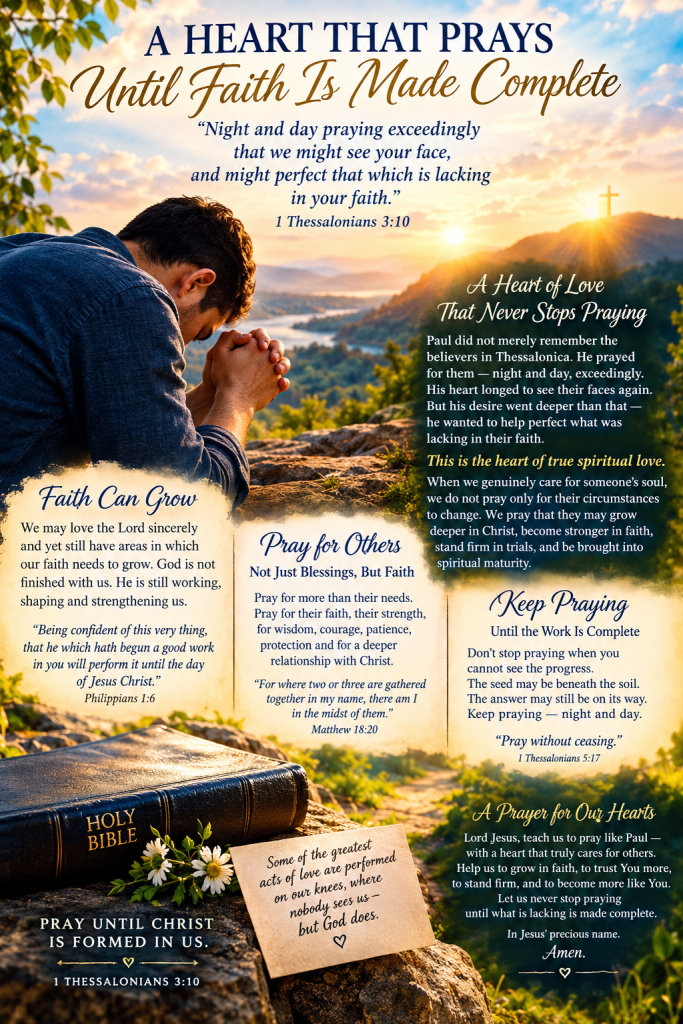
  • A HEART THAT PRAYS

    “Night and day praying exceedingly that we might see your face, and might perfect that which is lacking in your faith” (1 Thessalonians 3:10).

    The Apostle Paul prayed for the believers night and day, exceedingly. His heart longed to see their faces again. But his desire went deeper than simply meeting them. He wanted to help perfect what was lacking in their faith.

    When we genuinely care for someone’s soul, we do not pray only for their comfort, prosperity, success, or happiness. We pray that they may grow deeper in Christ, become stronger in faith, stand firm in trials, and be brought into spiritual maturity.

    Even with sincere love for God, our faith grows gradually through our doubts, fears, and delayed answers, and He remains patient with us instead of abandoning us.

    The Apostle Paul’s prayers were not casual, as he prayed exceedingly night and day. They were not quickly spoken and forgotten; instead, the spiritual condition of these souls had become a true burden upon his heart.

    We bring our loved ones before God’s throne of grace. We pray when the world is awake, and we pray when the world is asleep. We pray when we have answers, and we pray when we have none.

    When our hands cannot reach someone, our prayers still can. Distance cannot stop prayer. Silence cannot stop prayer. Closed doors cannot stop prayer. Even when we cannot see the work God is doing, we can still kneel before Him and ask Him to keep going.

    Christianity is a relationship, a life being transformed by Christ.

    Are you growing closer to Jesus, is your faith becoming stronger, are you standing when the storm comes, and is Christ being formed in you?

    Perhaps you notice shortcomings in your life, wish your faith were stronger, face ongoing battles, or still struggle to trust God in certain areas.

    Do not despair. God is still working.

    “Being confident of this very thing, that he which hath begun a good work in you will perform it until the day of Jesus Christ” (Philippians 1:6).

    The same God who began the work is able to continue it because your weaknesses and unfinished places do not surprise or frighten Him, and your journey is not over as He still wants to teach you, strengthen you, and lead you into deeper faith.

    The greatest blessing is becoming more like Christ.

    God often works through one believer to strengthen another.

    Never underestimate the power of your words, presence, and silent prayers to become God’s instrument in bringing someone safely through a storm.

    Keep praying through every struggle, wandering, weak faith, unchanged circumstance, or silent heaven because prayer is trusting God rather than our own ability to change someone.

    Prayer is trusting God to do what we cannot do.

    And sometimes the answer to our prayer begins long before we can see

    As followers of the Lord Jesus Christ, we are called to trust Him, obey Him, endure with Him, walk with Him, and become more like Him.

    Pray as the Apostle Paul prayed with a heart that truly cares for the souls of others.

    When we cannot do anything else for someone, let us remember that we can always pray.

    Some of the greatest acts of love are performed on our knees, where nobody sees us but God does.

    “Night and day praying exceedingly” (Thessalonians 3:10).

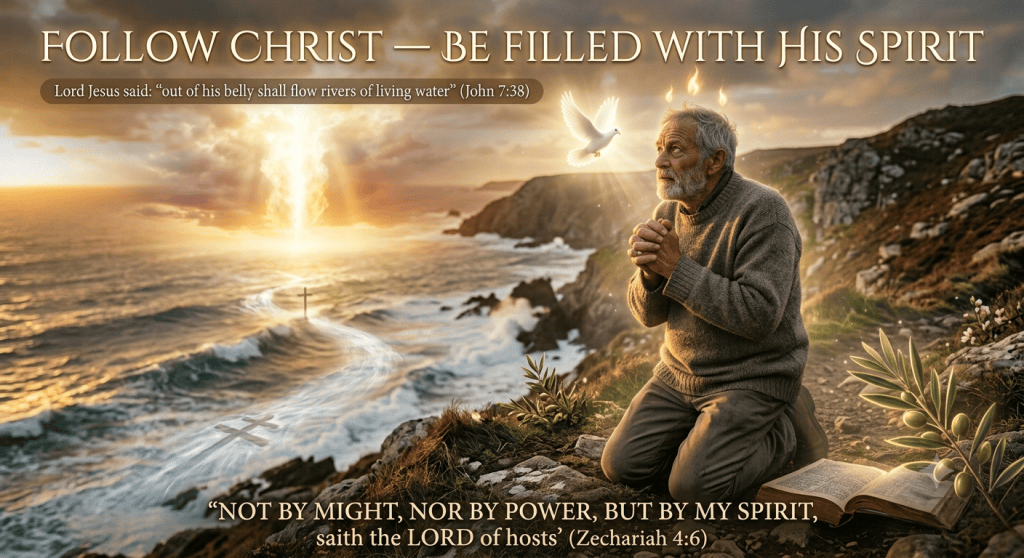
  • FOLLOW CHRIST — BE FILLED WITH HIS SPIRIT

    Christians are called to follow Christ not merely in name, but in life, in obedience, in holiness, and in the power of the Holy Spirit.

    The Lord Jesus Himself was baptized in water, and the Holy Spirit descended upon Him. The Scripture says: “And the Holy Ghost descended in a bodily shape like a dove upon him” (Luke 3:22).

    If we call ourselves followers of Christ, we must earnestly seek to walk in the footsteps of Christ.

    When Israel passed through the Red Sea, the Apostle Paul described it as a figure of baptism: “And were all baptized unto Moses in the cloud and in the sea” (1 Corinthians 10:2).

    Their passage through the waters marked a separation from the life they had known in Egypt. They were moving forward into a new journey under the leadership of God.

    Then God manifested His presence among them. At Mount Sinai, the glory and fire of the Lord were revealed. And throughout their wilderness journey, God did not leave His people without direction: “And the LORD went before them by day in a pillar of a cloud, to lead them the way; and by night in a pillar of fire, to give them light” (Exodus 13:21)

    Cloud by day. Fire by night.

    God did not merely bring His people out, He desired to lead them.

    In the same way, receiving the Holy Spirit is not merely about having an experience. The Holy Spirit comes to dwell in you, to teach, guide, comfort, convict, strengthen, and lead you into the truth.

    The Lord Jesus said: “And I will pray the Father, and he shall give you another Comforter, that he may abide with you for ever” (John 14:16).

    And in John 16:13: “Howbeit when he, the Spirit of truth, is come, he will guide you into all truth.”

    The Holy Spirit is the Spirit of God.

    The Apostle Paul writes: “Now if any man have not the Spirit of Christ, he is none of his.” (Romans 8:9).

    If you are not filled with the Spirit of God, you don’t belong to Him.

    Water baptism has profound biblical meaning. It testifies to repentance, identification with Christ, the death of the old life, and the beginning of a new life: “Therefore we are buried with him by baptism into death: that like as Christ was raised up from the dead by the glory of the Father, even so we also should walk in newness of life” (Romans 6:4).

    The old life must die, and the new life must be lived in Christ. The Holy Spirit is central to that new life.

    The Lord Jesus declared: “Except a man be born of water and of the Spirit, he cannot enter into the kingdom of God” (John 3:5).

    The new birth is the work of God within the heart.

    On the Day of Pentecost, the promise of the Father was manifested with extraordinary power: “And there appeared unto them cloven tongues like as of fire, and it sat upon each of them. And they were all filled with the Holy Ghost” (Acts 2:3–4).

    They were filled with the Holy Spirit, and they began to speak with other tongues as the Spirit gave them utterance.

    Tongues are one of the spiritual gifts mentioned by the Apostle Paul among the manifestations of the Spirit (1 Corinthians 12:8–10). The Holy Spirit gives different gifts to different believers according to His will (1 Corinthians 12:11).

    Therefore, we should not measure the presence of the Holy Spirit merely by one particular manifestation.

    God looks deeper than our outward actions. “For man looketh on the outward appearance, but the LORD looketh on the heart” (1 Samuel 16:7).

    Therefore, do not be satisfied with water baptism alone.

    Do not be satisfied merely because you were baptized as a child. A ceremony cannot substitute for a surrendered heart.

    A person may pass through religious ceremonies and still wander far from God. Israel itself passed through the sea, witnessed God’s mighty works, and yet many later fell into disobedience and unbelief. Apostle Paul warns us to learn from their example (1 Corinthians 10:1–12).

    So let us examine ourselves. Have we truly repented? Have we surrendered our lives to Christ? Are we walking in obedience, seeking the Holy Spirit, and  allowing the Spirit of God to lead us?

    The Scripture says: “As many as are led by the Spirit of God, they are the sons of God” (Romans 8:14). 

    Repentance must be more than words.

    True repentance turns the heart toward God. “Repent ye therefore, and be converted, that your sins may be blotted out” (Acts 3:19).

    Come before the Lord sincerely. Fast, pray, and search your heart. Confess your sins to God. Ask Him to cleanse you, change you, and fill you with His Spirit. Lord Jesus Himself gave this invitation: “If any man thirst, let him come unto me, and drink” (John 7:37).

    And then He gave this extraordinary promise: “He that believeth on me, as the scripture hath said, out of his belly shall flow rivers of living water” (John 7:38).

    If your desire is to serve the Lord and reach souls, ask Him to equip you.

    Say: “Lord Jesus, I do not want merely to speak about You. I want You to use my life. Cleanse me. Teach me. Lead me. Fill me with Your Holy Spirit. Give me wisdom, courage, love, discernment, and every gift You desire to place within me. Make me a vessel for Your glory.”

    Seek the Lord with your whole heart.

    Be filled with His Spirit. Walk in His light.

    Bear His fruit. Carry His love. Obey His voice.

    And let your life become a living testimony that Jesus Christ is Lord.

    “Not by might, nor by power, but by my spirit, saith the LORD of hosts” (Zechariah 4:6).

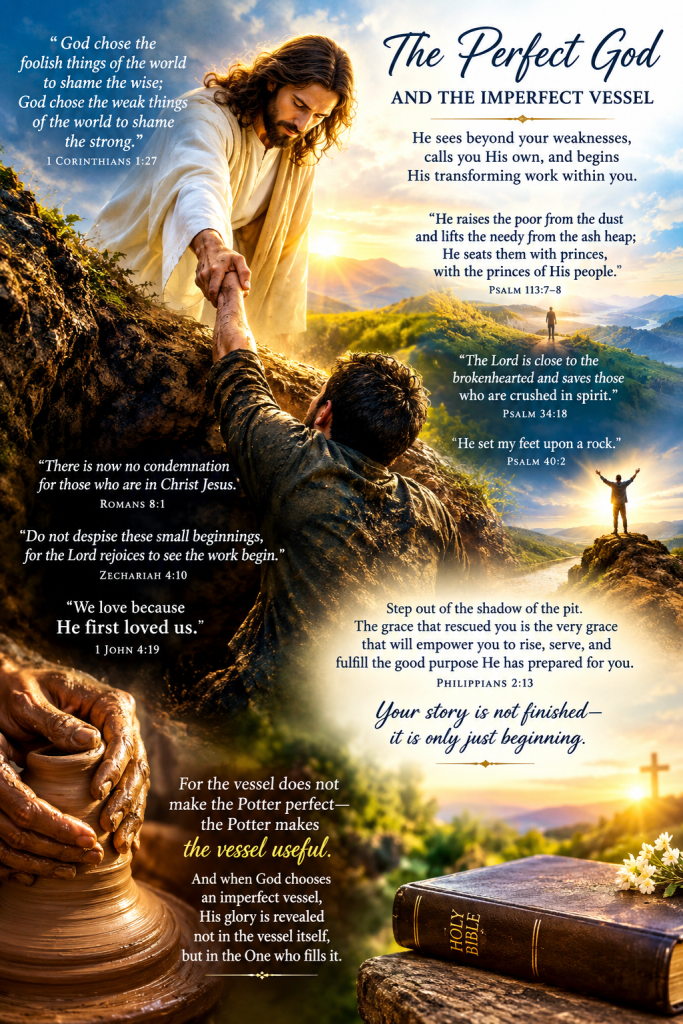
  • THE PERFECT GOD AND THE IMPERFECT VESSEL

    The perfect God, whose throne is established in holiness and light, has chosen the imperfect to serve the All-Perfect One.

    As the Apostle Paul writes, “God chose the foolish things of the world to shame the wise; God chose the weak things of the world to shame the strong” (1 Corinthians 1:27).

    You may feel inadequate, fragile, and unworthy, yet in His divine mercy, He sees beyond your weaknesses, calls you His own, and begins His transforming work within you.

    He is the God who stoops down to the lowest places. Long before you knew how to reach for Him, “He raises the poor from the dust and lifts the needy from the ash heap; He seats them with princes, with the princes of His people” (Psalm 113:7–8).

    You may have felt buried beneath the weight of your own limitations, trapped in a pit of pain and despair. Even when your voice failed and you could not cry out, His eyes never left you. “The Lord is close to the brokenhearted and saves those who are crushed in spirit” (Psalm 34:18). He saw every hidden tear, every silent struggle, and reached deep into the mire to pull you out, setting your feet upon a rock (Psalm 40:2).

    Within your soul burns a quiet desire to do greater things for Him, to offer a life of purpose, power, and glory to His name. Yet you look back and feel as though you have not done enough. Do not let condemnation weigh heavily on your heart, for “there is now no condemnation for those who are in Christ Jesus” (Romans 8:1). God does not measure your worth by the greatness of your past achievements, but He delights in a heart that turns toward Him in faith and obedience. “Do not despise these small beginnings, for the Lord rejoices to see the work begin” (Zechariah 4:10).

    You love Him deeply, yet you often feel that you have not fully expressed that love, held back by fear, hesitation, or the weight of your own unworthiness. But remember this: “We love because He first loved us” (1 John 4:19). Your love for Him, even when expressed through quiet obedience and unspoken longing, is precious before Him. He is not asking you to become flawless before you serve Him; He asks for a willing and surrendered heart.

    “For it is God who works in you to will and to act in order to fulfill His good purpose” (Philippians 2:13).

    The hands that lifted you from the pit have not released you. The God who found you in your brokenness is the same God who can use your life for His glory.

    Do not wait until you feel worthy. Do not wait until you feel strong. Come as you are, surrender what you have, and let Him do through you what you could never accomplish by your own strength.

    For the vessel does not make the Potter perfect, but the Potter makes the vessel useful.

    And when God chooses an imperfect vessel, His glory is revealed not in the vessel itself, but in the One who fills it.

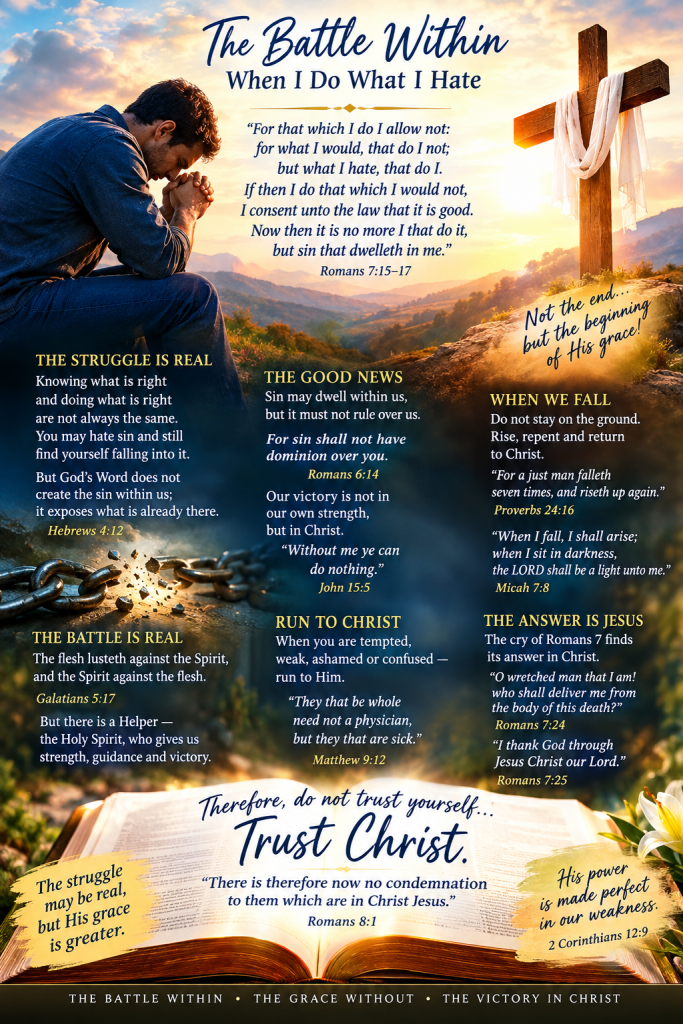
  • THE BATTLE WITHIN

    There is a battle that cannot always be seen by human eyes. It is not fought with swords, armies, or earthly weapons. It is fought within the heart of man.

    The Apostle Paul speaks with remarkable honesty in Romans 7:15–17: “What I would, that do I not; but what I hate, that do I.”

    These words reveal something every believer must understand: knowing the will of God and obeying the will of God are not always the same thing.

    A person may know what is right and still struggle to do it. He may hate sin and yet find himself falling into temptation. He may desire holiness and still discover weakness within himself.

    The Apostle Paul says: “If then I do that which I would not, I consent unto the law that it is good.”

    The problem is not God’s law. God’s commandment is good because God is good. “Wherefore the law is holy, and the commandment holy, and just, and good” (Romans 7:12). God’s Word does not create the sin within us; it exposes what is already there. Hebrews 4:12 declares: “For the word of God is quick, and powerful, and sharper than any twoedged sword.” When God’s Word enters our hearts, it shows us not merely what we want others to see, but who we truly are before God.

    The Apostle Paul says: “What I hate, that do I.” He acknowledges his weakness with humility, and that is where spiritual healing begins. He who comes before God and says, “Lord, search me, reveal me, cleanse me, and change me,” has opened his heart to the work of grace. King David prayed: “Search me, O God, and know my heart: try me, and know my thoughts” (Psalm 139:23). True spirituality is bringing our struggles into the presence of God.

    The Apostle Paul says: “Sin that dwelleth in me.” In Romans 6:14, he later declares: “For sin shall not have dominion over you.” We are not strong enough to defeat sin. Christ is stronger than the sin that is fighting against us. Lord Jesus said: “Without me ye can do nothing” (John 15:5). Our victory does not come from trusting our own strength. It comes from abiding in Christ.

    Are you struggling with sin or making peace with it?

    If you have sinned, then you must repent. You must return to Christ. “For a just man falleth seven times, and riseth up again” (Proverbs 24:16). “When I fall, I shall arise; when I sit in darkness, the LORD shall be a light unto me” (Micah 7:8).

    You may have been experiencing a painful struggle, making you wonder whether you truly belong to God and why you are still fighting this battle. The Christian life involves warfare. Galatians 5:17 says: “For the flesh lusteth against the Spirit, and the Spirit against the flesh.” But the Holy Spirit works within us, teaching us, correcting us, strengthening us, and leading us toward holiness. Therefore, when you recognize the battle within, do not run away from God, but run toward Him. When you face weakness, temptation, or moments of doubt and shame, turn immediately to Christ for strength.

    Do not hide from the Physician. Go to the Physician. Lord Jesus said: “They that be whole need not a physician, but they that are sick” (Matthew 9:12).

    The Lord Jesus Christ is more real than our weaknesses. His grace outlasts our failures, His mercy covers our shame, and His power is greater than any temptation. Whenever we stumble, His strong hand is always ready to lift us back up. Therefore, do not trust yourself, but trust the Living Christ.

    The Lord told the Apostle Paul: “My grace is sufficient for thee: for my strength is made perfect in weakness” (2 Corinthians 12:9).

    Abide in Christ. “There is therefore now no condemnation to them which are in Christ Jesus” (Romans 8:1).

    For the battle is not ultimately won by the strength of the man who fights. It is won by the grace of the Christ who lives in him.

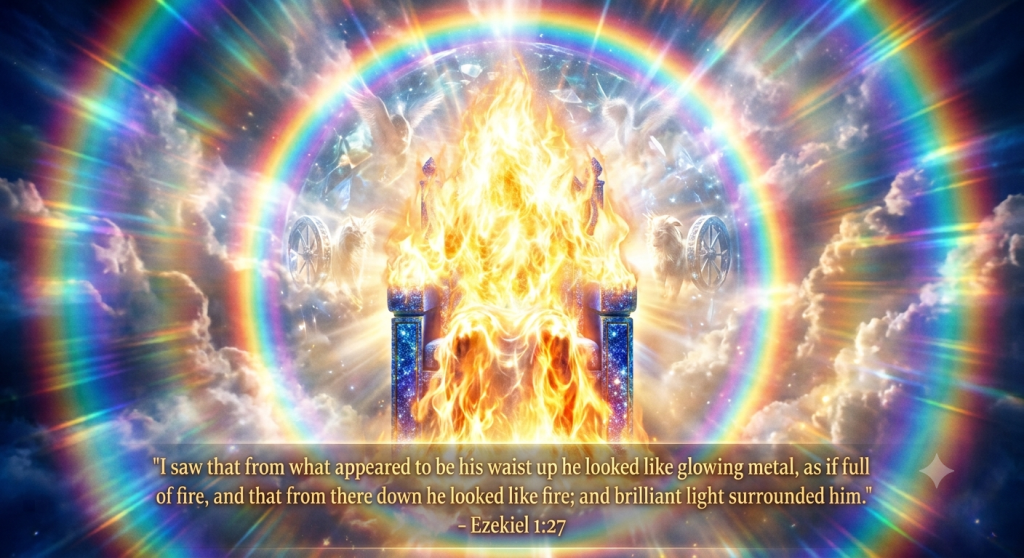
  • THE GLORY OF THE UNSEEN

    The Prophet Ezekiel’s Vision: Fire and Light

    “And I saw as the colour of amber, as the appearance of fire round about within it, from the appearance of his loins even upward, and from the appearance of his loins even downward, I saw as it were the appearance of fire, and it had brightness round about”. (Ezekiel 1:27).

    From His waist upward, He blazed with the gleam of glowing amber, like a brilliant furnace sealed in holiness. From His waist downward, a torrent of liquid fire poured forth, casting an unquenchable radiance into the deep. A magnificent, blinding brightness encircled Him on every side—the terrible, breathtaking glory of the Almighty, before which the heavens tremble and the earth falls facedown in awe.

    “For the LORD thy God is a consuming fire, even a jealous God” (Deuteronomy 4:24).

    “For our God is a consuming fire” ( Hebrews 12:29)

    Our Lord is Omnipotent, Omnipresent and Omniscient.

    Let’s fear God, worship Him sincerely, and lead a holy life.

    We are accountable for every second that we waste.