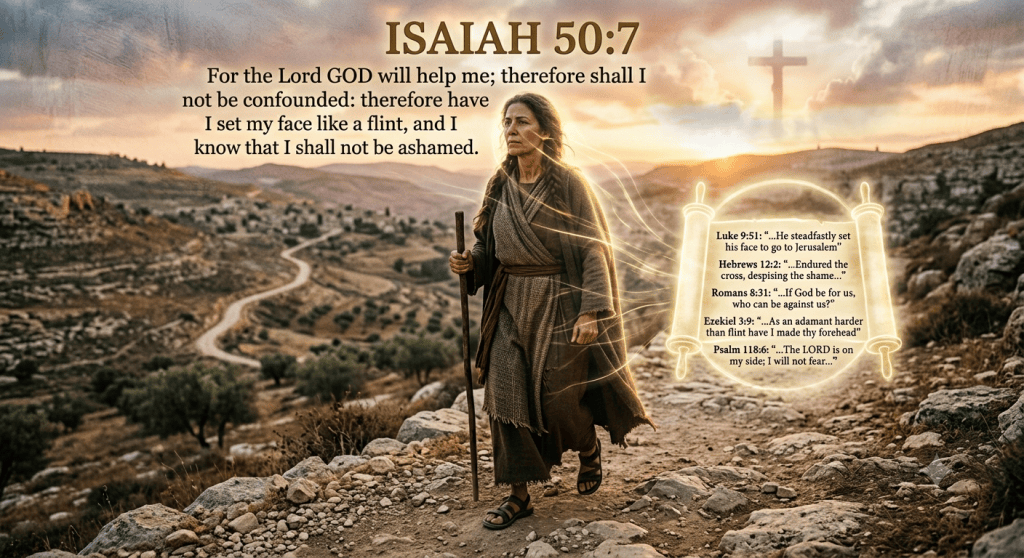
Life frequently brings moments where your purpose is tested, your motives are questioned, or the road ahead looks steep and lonely. In those seasons, human willpower eventually fatigues but holy conviction does not.
Setting your face like flint is not about being cold, rigid, or stubborn toward people; it is about being entirely uncompromising regarding your direction in God.
Stop measuring your journey against the noise, criticism, or doubts of the crowd.
Realise that if God has called you to step forward, His strength will sustain every step you take.
Circumstances may test you today, but God’s promises guarantee that your story does not end in defeat.
Whatever trial, goal, or calling lies before you today, fix your gaze forward. Let your trust in God make your resolve harder than any obstacle in your path.
“Therefore, my beloved brethren, be ye stedfast, unmovable, always abounding in the work of the Lord, forasmuch as ye know that your labour is not in vain in the Lord” ( 1 Corinthians 15:58).
“Cast not away therefore your confidence, which hath great recompence of reward. For ye have need of patience, that, after ye have done the will of God, ye might receive the promise” (Hebrews 10:35, 36).
“From the rising of the sun unto the going down of the same the LORD’s name is to be praised”(Psalm 113:3).
Earthly power has an expiration date. Presidents, prime ministers, kings, and emperors wield a borrowed authority that is bound by borders, broken by time, and cut short by the grave. When human leaders receive honor, it is merely for an office they temporarily occupy.
The Creator’s claim to glory knows no such limits. His praise spans “from the rising of the sun unto the going down of the same”, stretching across every timezone and filling every corner of space without pause.
While human rulers beg for the support of citizens, lean on advisors, and fight over resources to keep their thrones, God’s authority is absolute and underived. Everything in this universe needs a cause, a fuel, or a maker to exist. But God exists from everlasting to everlasting (Psalm 90:2). He is uncaused. He relies on nothing.
He is not measured by a standard of goodness or truth, He is the source and definition of them. He guards strict justice while holding out deep mercy, patience, and grace to His creation. From the smallest subatomic particle to the largest spinning galaxy, all things hang in continuous, breathless dependence upon Him.
Earthly empires rise and fall like the tide, but the Kingdom of God remains unshaken. In a world of shifting allegiances and fragile leadership, human power is ultimately eclipsed by the One who needs no throne, fears no successor, and answers to no court. To Him alone belongs the honor that never fades.
“Now unto the King eternal, immortal, invisible, the only wise God, be honour and glory for ever and ever. Amen” (1 Timothy 1:17).
“The LORD shall reign for ever, even thy God, O Zion, unto all generations. Praise ye the LORD”(Psalm 146:10).
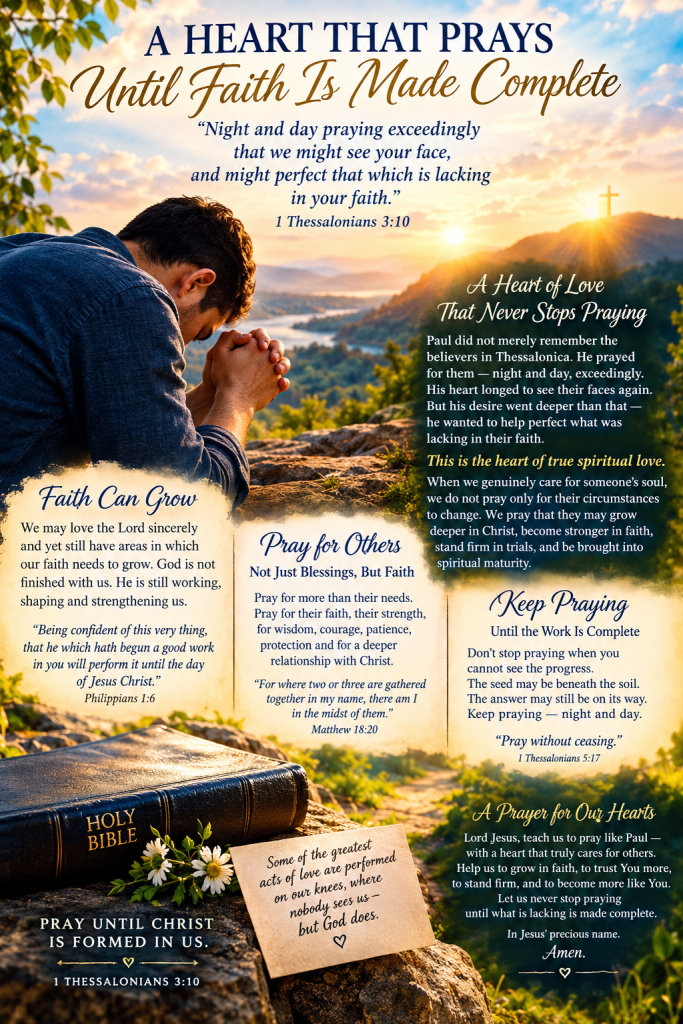
“Night and day praying exceedingly that we might see your face, and might perfect that which is lacking in your faith” (1 Thessalonians 3:10).
The Apostle Paul prayed for the believers night and day, exceedingly. His heart longed to see their faces again. But his desire went deeper than simply meeting them. He wanted to help perfect what was lacking in their faith.
When we genuinely care for someone’s soul, we do not pray only for their comfort, prosperity, success, or happiness. We pray that they may grow deeper in Christ, become stronger in faith, stand firm in trials, and be brought into spiritual maturity.
Even with sincere love for God, our faith grows gradually through our doubts, fears, and delayed answers, and He remains patient with us instead of abandoning us.
The Apostle Paul’s prayers were not casual, as he prayed exceedingly night and day. They were not quickly spoken and forgotten; instead, the spiritual condition of these souls had become a true burden upon his heart.
We bring our loved ones before God’s throne of grace. We pray when the world is awake, and we pray when the world is asleep. We pray when we have answers, and we pray when we have none.
When our hands cannot reach someone, our prayers still can. Distance cannot stop prayer. Silence cannot stop prayer. Closed doors cannot stop prayer. Even when we cannot see the work God is doing, we can still kneel before Him and ask Him to keep going.
Christianity is a relationship, a life being transformed by Christ.
Are you growing closer to Jesus, is your faith becoming stronger, are you standing when the storm comes, and is Christ being formed in you?
Perhaps you notice shortcomings in your life, wish your faith were stronger, face ongoing battles, or still struggle to trust God in certain areas.
Do not despair. God is still working.
“Being confident of this very thing, that he which hath begun a good work in you will perform it until the day of Jesus Christ” (Philippians 1:6).
The same God who began the work is able to continue it because your weaknesses and unfinished places do not surprise or frighten Him, and your journey is not over as He still wants to teach you, strengthen you, and lead you into deeper faith.
The greatest blessing is becoming more like Christ.
God often works through one believer to strengthen another.
Never underestimate the power of your words, presence, and silent prayers to become God’s instrument in bringing someone safely through a storm.
Keep praying through every struggle, wandering, weak faith, unchanged circumstance, or silent heaven because prayer is trusting God rather than our own ability to change someone.
Prayer is trusting God to do what we cannot do.
And sometimes the answer to our prayer begins long before we can see
As followers of the Lord Jesus Christ, we are called to trust Him, obey Him, endure with Him, walk with Him, and become more like Him.
Pray as the Apostle Paul prayed with a heart that truly cares for the souls of others.
When we cannot do anything else for someone, let us remember that we can always pray.
Some of the greatest acts of love are performed on our knees, where nobody sees us but God does.
“Night and day praying exceedingly” (Thessalonians 3:10).
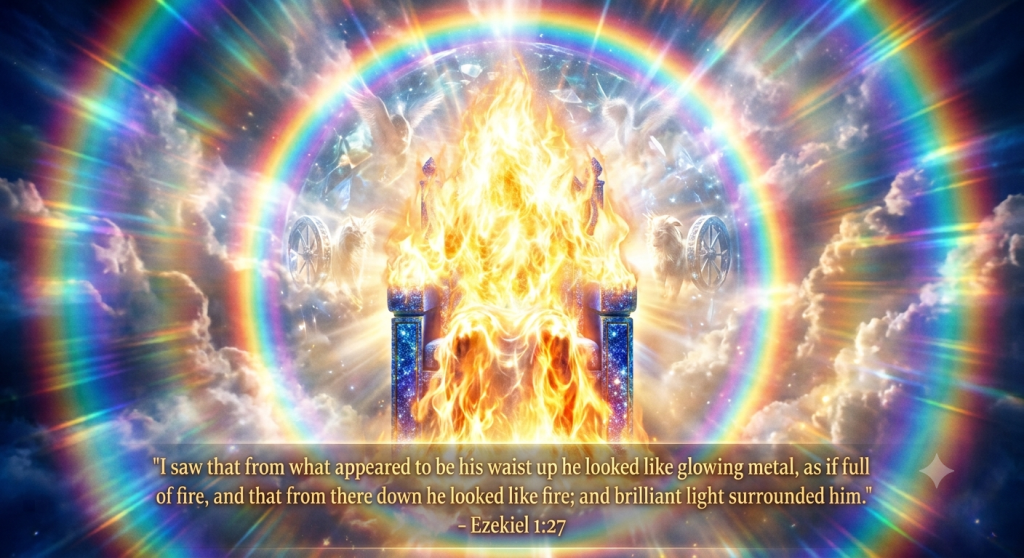
“And I saw as the colour of amber, as the appearance of fire round about within it, from the appearance of his loins even upward, and from the appearance of his loins even downward, I saw as it were the appearance of fire, and it had brightness round about”. (Ezekiel 1:27).
From His waist upward, He blazed with the gleam of glowing amber, like a brilliant furnace sealed in holiness. From His waist downward, a torrent of liquid fire poured forth, casting an unquenchable radiance into the deep. A magnificent, blinding brightness encircled Him on every side—the terrible, breathtaking glory of the Almighty, before which the heavens tremble and the earth falls facedown in awe.
“For the LORD thy God is a consuming fire, even a jealous God” (Deuteronomy 4:24).
“For our God is a consuming fire” ( Hebrews 12:29)
Our Lord is Omnipotent, Omnipresent and Omniscient.
Let’s fear God, worship Him sincerely, and lead a holy life.
We are accountable for every second that we waste.
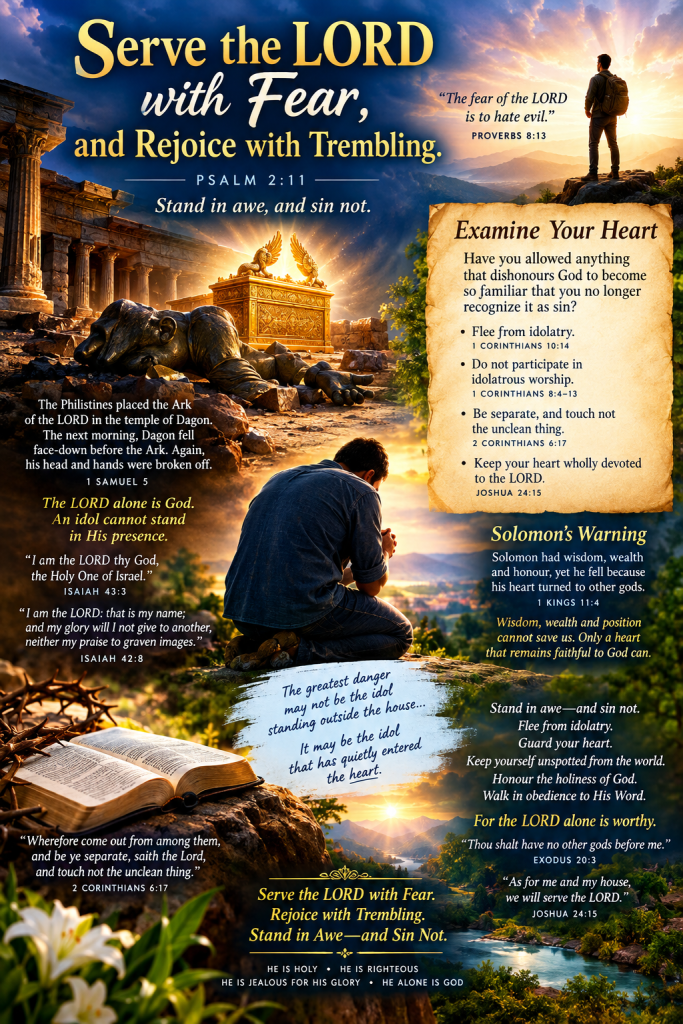
“Serve the LORD with fear, and rejoice with trembling” (Psalm 2:11).
To fear the LORD is not merely to be afraid of Him. It is to stand in awe of His holiness, honour His authority, obey His Word, and tremble at the thought of treating holy things lightly. The presence of God should produce reverence in us, not familiarity that leads to carelessness.
Scripture says: “The fear of the LORD is to hate evil” (Proverbs 8:13).
God is holy, and He calls His people to holiness. Therefore, we must never become so accustomed to sin and idolatry around us that we cease to recognize what is offensive to God.
In 1 Samuel 5, the Philistines defeated Israel and captured the Ark of the Covenant. They carried it to Ashdod and placed it inside the temple of Dagon, their god. In doing so, they attempted to place the symbol of the God of Israel beside the image of their false god as though Dagon had triumphed over the LORD.
But the LORD does not share His glory with idols.
The next morning, Dagon was found fallen face-down before the Ark of the LORD. The Philistines raised their idol and put it back in its place. But the following morning, Dagon had fallen again, this time with his head and hands broken off.
The message was unmistakable: The LORD alone is God. An idol cannot stand in His presence.
The Scripture declares:
“For I am the LORD thy God, the Holy One of Israel”(Isaiah 43:3).
And: “I am the LORD: that is my name: and my glory will I not give to another, neither my praise to graven images” (Isaiah 42:8).
The Ark did not need to defend itself. God Himself demonstrated His supremacy.
Do we tolerate what God commands us to reject?
Have we allowed things that dishonour God to become so familiar that we no longer recognize them as spiritually dangerous? Have we compromised with idolatry, worldly values, or practices that are contrary to God’s Word?
Apostle Paul warns us: “What agreement hath the temple of God with idols?” (2 Corinthians 6:16).
We are called to be the temple of the living God. Therefore Scripture says: “Wherefore come out from among them, and be ye separate, saith the Lord, and touch not the unclean thing” (2 Corinthians 6:17).
Separation from ungodliness does not mean hatred of people. We are commanded to love our neighbour and even our enemies. But loving people does not require us to approve of everything they do.
Lord Jesus Himself said: “If ye love me, keep my commandments” (John 14:15).
King Solomon received extraordinary wisdom from God. Yet wisdom itself could not preserve him when his heart turned away from the LORD.
Scripture records: “For it came to pass, when Solomon was old, that his wives turned away his heart after other gods” (1 Kings 11:4).
His foreign wives turned his heart toward their gods, and Solomon built places for their worship.
A person may possess wisdom, wealth, position and honour, yet still fall if the heart is allowed to depart from God.
Solomon’s tragedy was not that he lacked wisdom. It was that he failed to remain faithful to the God who had given him that wisdom.
Therefore, we must never trust in our knowledge, accomplishments, wealth, or spiritual history. Our confidence must remain in the LORD.
Apostle Paul gives the believer a direct command:
“Wherefore, my dearly beloved, flee from idolatry” (1 Corinthians 10:14).
Apostle Paul says flee. He does not say to become comfortable with it. He strongly warned believers against participating in idolatrous worship or becoming a stumbling block to another person’s conscience
Our hearts belong to God. Stand in awe and sin not
Psalm 2:11 commands us: “Serve the LORD with fear, and rejoice with trembling.”
Scripture says: “Be ye holy; for I am holy” (1 Peter 1:16)
And: “Let us have grace, whereby we may serve God acceptably with reverence and godly fear” (Hebrews 12:28).
“What does the Word of God say?”
Let us therefore examine ourselves before examining everyone else.
Is my heart wholly devoted to the LORD?
Have I permitted anything to take God’s rightful place in my life?
Have wealth, pleasure, relationships, possessions, reputation, power, or worldly approval become idols in my heart?
Am I standing firm in God’s truth, or have I quietly compromised?
The greatest danger may not be the idol standing outside the house. It may be the idol that has quietly entered the heart. Therefore, beloved, stand in awe of the LORD and sin not.
Flee from idolatry. Guard your heart. Keep yourself unspotted from the world. Honour the holiness of God. Walk in obedience to His Word. For the LORD alone is worthy.
“Thou shalt have no other gods before me” (Exodus 20:3).
And let the cry of our hearts always be: “As for me and my house, we will serve the LORD” (Joshua 24:15).
Serve the LORD with fear. Rejoice with trembling.
Stand in awe and sin not.
For He is holy. He is righteous. He is jealous for His glory.
“Ye shall walk after the LORD your God, and fear him, and keep his commandments, and obey his voice, and ye shall serve him, and cleave unto him” (Deuteronomy 13:4).
When you truly love God, you will desire to honour Him. When you honour Him, you will desire to obey Him. And when your heart is turned toward Him, you will begin to recognise His voice.
The Christian life is not merely about knowing about God; it is about walking with God.
We live in a world filled with noise—voices of temptation, pride, hatred, greed, fear, confusion and sin. Every day, countless voices compete for our attention. Yet, in the midst of all that noise, there is another voice—the voice of the One who created us, loves us and calls us to Himself.
We need His guidance. Without the Lord directing our steps, how easily can we lose our way! We cannot successfully navigate this fallen and sinful world by human wisdom alone. We need God to guide our thoughts, our decisions, our relationships, our words and every step of our journey.
The Scripture says:
“In all thy ways acknowledge him, and he shall direct thy paths” (Proverbs 3:6).
Therefore, humble yourself before Him. Hold on to Him. Cleave to Him. Seek His presence before seeking the approval of the world. And when you hold on to God, remember this: He is holding on to you.
God deserves the first place in everything. The first portion belongs to Him. The first part of your day belongs to Him. Your very first thought in the morning is for Him. The first quiet moments of the day are His. The first true wish of your heart turns to Him. God remains the top priority of your life.
Before the world begins speaking to us, let us learn to sit at the feet of Jesus. Before we reach for the things of this world, let us reach for the presence of God. Before we listen to the many voices around us, let us become still enough to hear the voice of our Creator.
“But seek ye first the kingdom of God, and his righteousness” (Matthew 6:33)
How precious it is to begin the day with God!
The world may be sleeping, the streets may be quiet, and everything around us may be still—but the soul that loves God can already be awake in His presence.
When the world is running after everything except God, we should be found at His feet.
Like Mary, who sat at the feet of Jesus and listened to His word, may we learn that there are moments when the most important thing we can do is simply be still and listen.
God is not confined to a particular hour, a particular day, or a particular place. He speaks through the quietness of the heart.
“My sheep hear my voice, and I know them, and they follow me” (John 10:27).
He Is Looking for a Heart That Will Wait.
Hearing God’s voice is not merely about receiving a message. It is about developing a heart that is willing to obey.
God desires a people who will seek Him—not only when they are in trouble, not only when they need a blessing, not only when they need an answer, but because they love Him.
There is something precious about a soul that waits for God simply because it longs for God.
“My soul, wait thou only upon God; for my expectation is from him” (Psalm 62:5).
To wait for God is an expression of love.
When you love someone, you desire their presence. You listen for their voice. You look forward to being with them. So it should be with the Lord.
Seek His face. Seek the Blesser. Seek the Giver.
Come to Him because He is worthy of your love.
Begin each day by saying:
“Lord, before I hear the world, I want to hear You. Before I make my plans, I want to surrender them to You. Before I walk into this day, I want You to walk with me. Guide my steps. Guard my heart. Govern my words. Let me not live this day without You.”
Will you love Him?
The Lord is calling us deeper—not merely into religion, but into relationship; not merely into outward service, but into inward surrender.
He wants a heart that says: “Lord, I am Yours.”
A heart that will listen. A heart that will obey.
A heart that will wait. A heart that will hold fast.
A heart that will follow Him even when the path is difficult.
Seek Him. Wait for Him. Walk after Him. Fear Him. Love Him. Hear His Word. Obey His voice.
Hold fast to Him Keep His commandments.
Serve Him.
This is not merely a command for one moment of life. It is a way of life.
Walk with Him in the morning. Walk with Him at noon. Walk with Him at night. Walk with Him when everything is going well. Walk with Him when everything seems to be falling apart. Walk with Him when you understand. Walk with Him when you do not understand. And when the world becomes dark and confusing, hold on to Him even more tightly.
For the soul that has learned to love God, wait upon God, hear His Word and obey His voice has discovered something the world cannot give.
The greatest victory is not conquering the world around you. The greatest victory is refusing to allow the world to conquer the God-given soul within you.
So, will you begin your day with Him?
Will you wait for Him?
Will you listen?
Will you obey?
Will you love Him—not merely for what He can give you, but simply because He is God and He is worthy of your love?
“Draw nigh to God, and he will draw nigh to you” (James 4:8).
And let God be first. Always. When the world is running after everything except God, we should be found at His feet.
“Speak, LORD; for thy servant heareth” ( 1 Samuel 3:9 ).
“I therefore, the prisoner of the Lord, beseech you that ye walk worthy of the vocation wherewith ye are called, With all lowliness and meekness, with longsuffering, forbearing one another in love; Endeavouring to keep the unity of the Spirit in the bond of peace” (Ephesians 4:2-4).
Human life possesses an inherent dignity that cannot be measured by status or achievement, because every person is created in the image of God (Genesis 1:27). Therefore, how we treat others reflects our true relationship with God.
We cannot genuinely love God while harboring hatred or speaking maliciously against those made in His image.
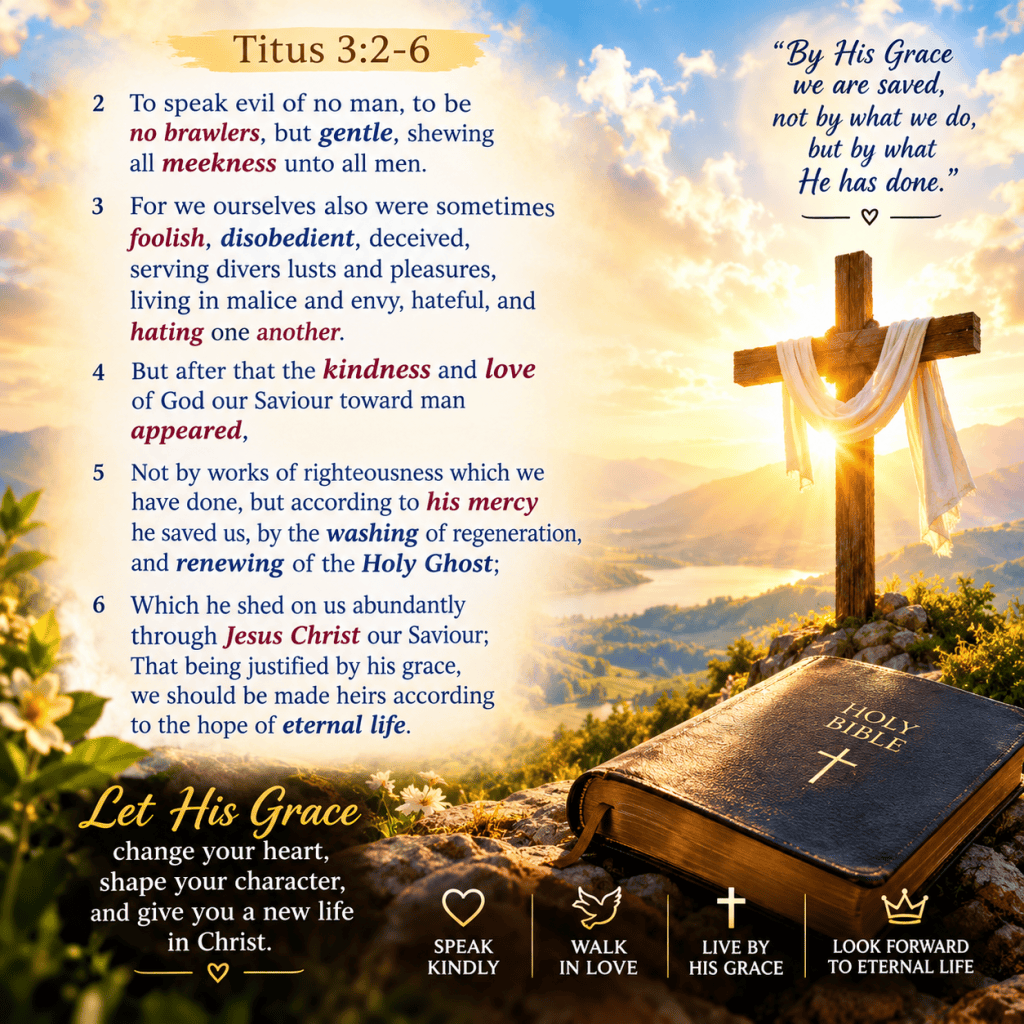
Our words and emotions carry immense power to build up or destroy. Uncontrolled anger, pride, jealousy, and neglect frequently ruin families, break friendships, and prevent reconciliation. Yet Scripture calls us to be slow to anger, quick to seek forgiveness, and guarded against bitterness. Before judging or despising others, we must remember our own past failures and foolishness. We were not saved by our own righteousness, but by God’s abundant mercy and grace. Because the ground at the foot of the cross is level, we have no basis for spiritual superiority. The grace we have received from Christ must become the grace we extend to others.
True discipleship is demonstrated through humility, kindness, and active forgiveness. “Death and life are in the power of the tongue” (Proverbs 18:21).
Pride deadens relationships; genuine peace requires the strength to say, “I was wrong.”
“By this shall all men know that ye are my disciples, if ye have love one to another” (John 13:35).
The grace that saves us must ultimately change us. Let your life reflect the gentleness, mercy, and love that God has shown to you.
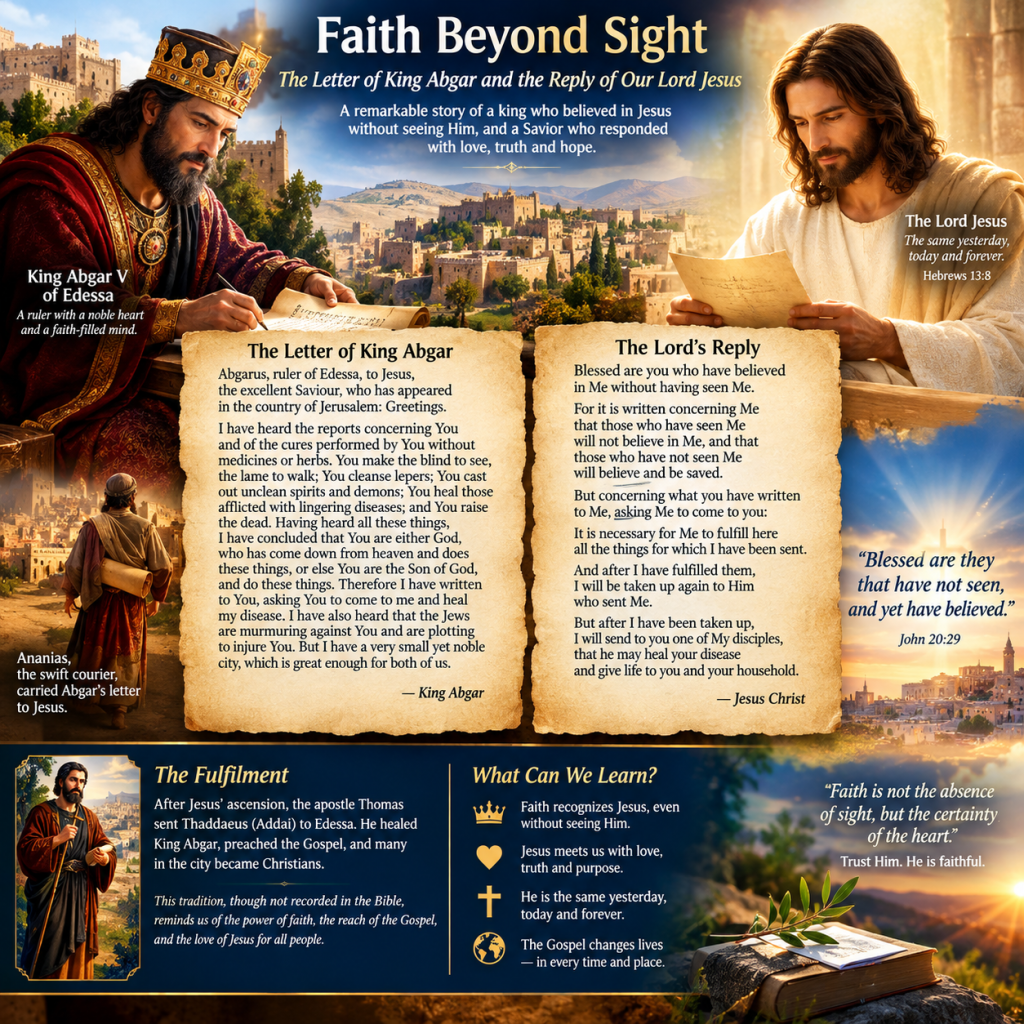
The Letter of King Abgar and the Reply of Our Lord Jesus
There are moments in history when a story reaches across centuries and speaks directly to the human heart. One such story is the ancient tradition concerning King Abgar V of Edessa and our Lord Jesus Christ. A king who had never seen Jesus heard about His mighty works. He heard that the blind received sight, the lame walked, the lepers were cleansed, demons were cast out, the sick were healed, and even the dead were raised.
Abgar believed what he had heard. And he wrote to Jesus. His letter was not simply a request for healing. It was an extraordinary expression of faith in the One whom he had never seen.
The King’s Letter
According to the account preserved by the early Christian historian Eusebius, King Abgar addressed Jesus as “the excellent Saviour.” He had heard about the miracles Jesus performed and came to a remarkable conclusion: either Jesus was God who had come down from heaven, or He was the Son of God. Abgar then asked Jesus to come to Edessa and heal him.
Abgar had not seen Jesus with his physical eyes. He had never watched Jesus perform a miracle. He had never sat among the crowds listening to Him teach. Yet he believed. His faith began with what he had heard about Jesus. That reminds us of the words of the Apostle Paul: “So then faith cometh by hearing, and hearing by the word of God” (Romans 10:17). Abgar’s physical eyes had never seen Christ, but his heart had begun to recognize Him.
The Reply of the Lord Jesus
The traditional account states that Jesus sent a reply to King Abgar. The message begins with words of extraordinary spiritual significance: “Blessed are you who have believed in Me without having seen Me.” Those words immediately bring to mind the words spoken by the risen Christ to Thomas: “Blessed are they that have not seen, and yet have believed” (John 20:29).
What a profound connection. Thomas had seen the risen Lord. Abgar, according to the tradition, had not. Yet both stories point toward the same great truth: faith does not require physical sight. The Christian faith says, “Believe in Christ, trust His Word, and walk with Him—even when you cannot see what lies ahead.” We cannot see tomorrow. We cannot see every answer to our prayers. We cannot always understand why God permits certain things to happen. But we can still trust the One who holds tomorrow.
Jesus Did Not Come to Edessa—But He Had a Greater Purpose
Abgar invited Jesus to come to his city. But according to the traditional reply, Jesus explained that He had a divine work to accomplish first. He had been sent for a purpose. He would fulfil the work given to Him and then return to the One who sent Him. Sometimes we ask God, “Lord, come into this situation and change it according to my desire.” But God’s answer may be, “Trust Me. I am accomplishing something greater than you can presently see.”
Jesus did not simply respond according to Abgar’s request. He remained faithful to the Father’s purpose. The Lord had come into the world for something infinitely greater than one king’s healing. He came to seek and save the lost. He came to give His life as a ransom for many. He came to reconcile sinners to God. He came to accomplish the work of salvation.
According to the tradition, Jesus promised that after His ascension He would send one of His disciples to Abgar. The disciple would come to him and bring healing. The tradition identifies that disciple as Thaddaeus, also known as Addai, who was associated with the apostle Thomas in the Edessan tradition. Jesus Himself would not come physically to Edessa at that time, but His work would continue through His messenger. No longer would the physical presence of Jesus be limited to one geographical location. The Gospel would go out as His disciples carried His message, empowered by the Holy Spirit. Consequently, the name of Jesus would travel from city to city, nation to nation, and generation to generation.
Faith Without Sight
The most powerful part of the Abgar story is not really the king’s illness. It is not even the letter. It is faith. A king heard about Jesus and believed. He had not seen the Lord, yet he trusted Him. Centuries later, we stand in a similar position. We have not physically walked beside Jesus in Galilee. We did not stand at the empty tomb. We did not touch the wounds in His hands as Thomas did. Yet we are called to believe. The Apostle Peter expresses this beautifully: “Whom having not seen, ye love; in whom, though now ye see him not, yet believing, ye rejoice with joy unspeakable and full of glory” (1 Peter 1:8).
That is the mystery and beauty of Christian faith. We have not seen Him with our physical eyes. Yet we love Him. We speak to Him. We trust Him. We worship Him. We call upon His name. And we wait for the day when faith will become sight. “Blessed are they that have not seen, and yet have believed” (John 20:29).
You might be praying for things you cannot see yet. You might be waiting for an answer. You might be walking through a quiet season where God feels silent. You might be asking, “Lord, where are You?” Remember King Abgar. He had not seen Jesus, but he believed. And remember the Apostle Thomas. He struggled to believe until he saw the risen Christ. Remember what Jesus said: “Blessed are they that have not seen, and yet have believed.” Faith does not mean pretending that difficulties do not exist. Faith means believing that God is greater than what we can see.
What will we do with what we have heard about Jesus? Abgar heard about Christ and responded with faith. We have something even greater. We have the testimony of Scripture. We have the Gospel. We know of His birth, His ministry, His crucifixion, His resurrection, His ascension, and His promise to return. We know His words: “I am the way, the truth, and the life” (John 14:6). The question is: Do we believe Him?
One day we shall see the King. And until that day, let us walk by faith, let us keep believing, keep praying, keep trusting, and keep seeking Christ. “For we walk by faith, not by sight” (2 Corinthians 5:7).
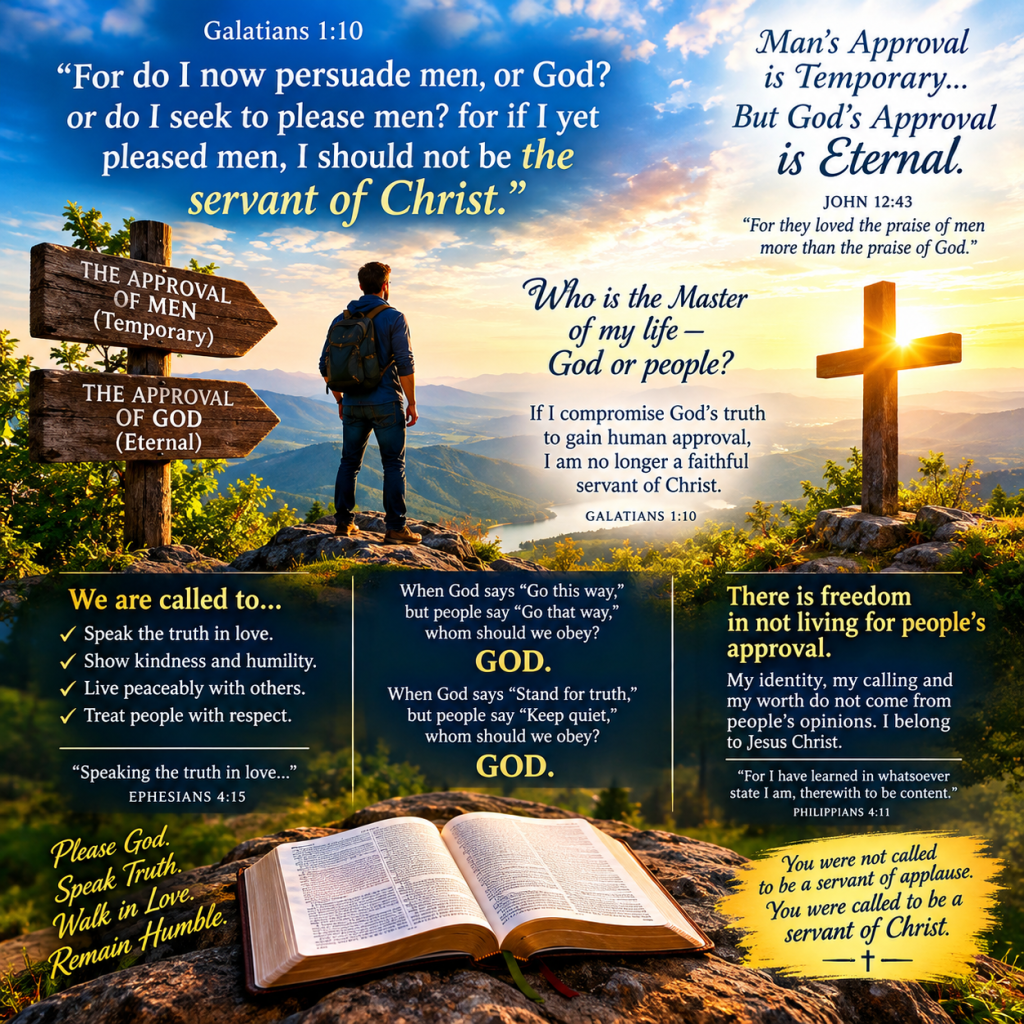
“For do I now persuade men, or God? or do I seek to please men? for if I yet pleased men, I should not be the servant of Christ” (Galatians 1:10).
The Apostle Paul is essentially asking: “Who is the Master of my life—God or people?” He had been criticized because the Gospel he preached was not designed to make people comfortable. He therefore makes his position unmistakably clear: his responsibility was not to alter God’s message in order to gain people’s approval. If the Apostle Paul had made his preaching softer, changed the truth, or compromised the Gospel simply because people might reject him, then he would no longer be acting as a faithful servant of Christ.
The Bible teaches us to speak the truth in love, show kindness, live peaceably with others, and treat people with humility and respect. We should never sacrifice God’s truth merely to obtain human approval. There will be moments when doing what is right before God makes someone unhappy with us. The servant has one ultimate Master. A servant cannot have two masters when their instructions conflict. Stand for truth, obey God. If following Christ means losing someone’s approval, we must remember: human approval is temporary, but God’s approval is eternal.
The Lord Jesus Himself said: “For they loved the praise of men more than the praise of God” (John 12:43). That is a serious warning. We can become so concerned about what people think of us that we gradually become afraid to do what God has called us to do.
There is freedom in not living for people’s approval. When you constantly try to please people, you can become a prisoner of their opinions: You bloom like a flower in the warmth of their praise, Then wither away under a critical gaze. Anchored and safe in acceptance’s harbor, But tossed by rejection into doubt and disorder.
When your heart becomes settled in Christ, the restless whispers of the world fade away, and you can rise to declare:
My identity does not come from people’s applause.
My calling does not come from people’s approval.
My worth does not come from people’s opinions.
The Apostle Paul was willing to stand alone. He had something more valuable than popularity: he had a divine commission. He knew that the Gospel was not his invention. Therefore, he could not change it simply to make people happy. This is especially important for anyone who teaches, preaches, writes about the Bible, or shares their faith. We must ask ourselves: “Am I saying this because God has given me truth to speak, or because I want people to praise me?” That question can search the heart deeply.
A servant of Christ should have courage without arrogance, truth without cruelty, conviction without pride, and boldness with love. The Apostle Paul himself said: “Speaking the truth in love” (Ephesians 4:15). So the Christian’s goal is not to please people at the expense of truth, nor to hurt people in the name of truth. The goal is to please God, speak the truth, walk in love, and remain humble.
Do not allow the desire to be accepted by people to make you disobedient to God. Doing what is right does not always make you popular. Telling the truth can cause others to misunderstand you. Following Jesus means you walk a narrow path that not everyone likes. You do not live to get praise from others; you live to serve Christ. Listen to God’s quiet whisper. Ask Him to guide your steps and keep your heart faithful. “Lord, what do You want me to do?” Then, whatever the cost, obey Him.
The ultimate response of a true servant of Christ is: “Lord Jesus, above every human voice, I choose to please You.”