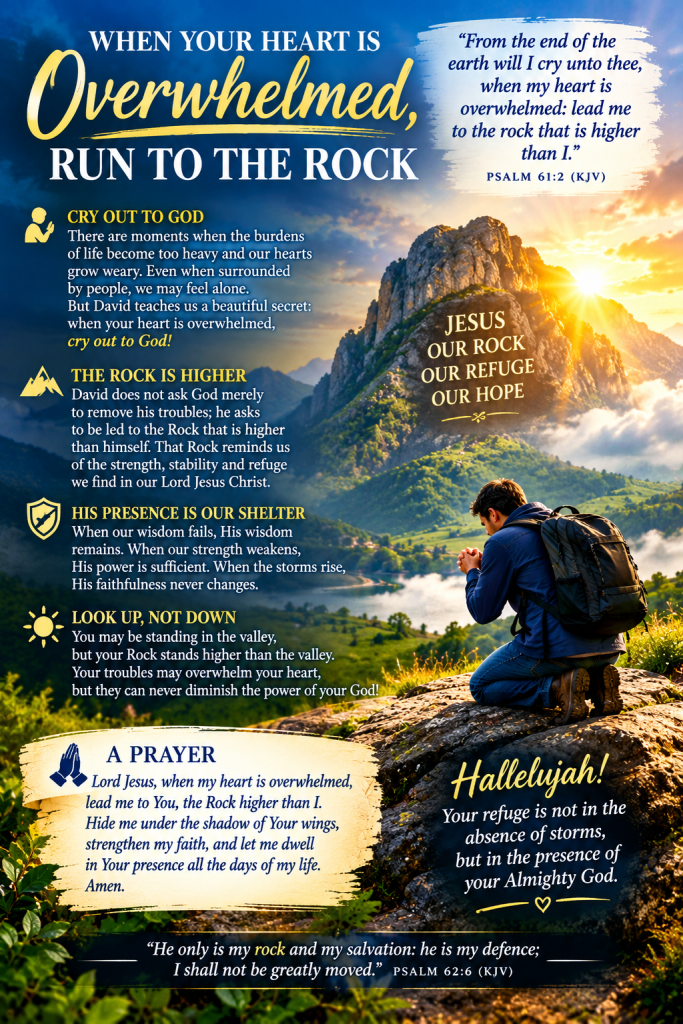
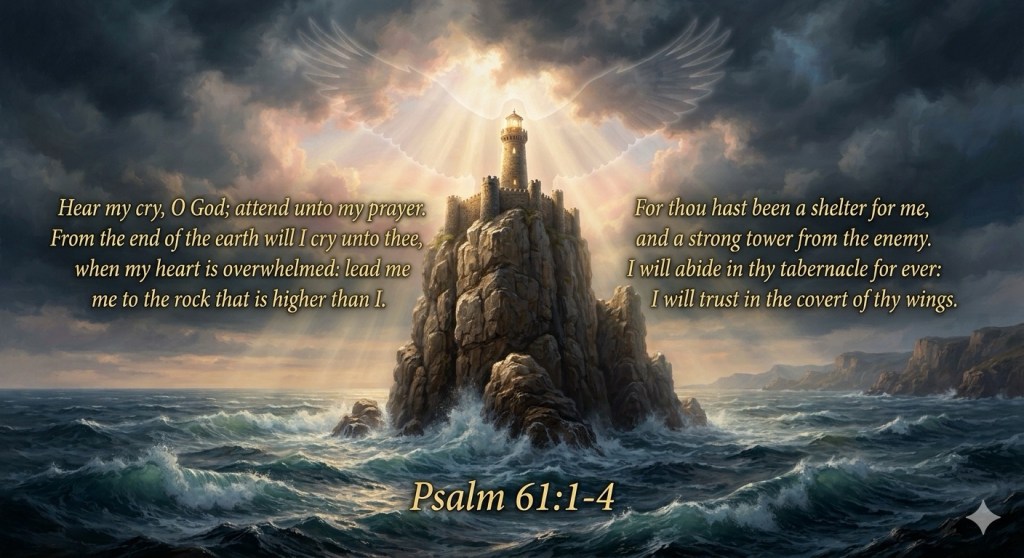
“Lead me to the rock that is higher than I” (Psalm 61:2).
King David wasn’t sitting comfortably on his throne. He was a fugitive, fleeing from his own son Absalom, feeling isolated as if he were at the “end of the earth.” Yet, in the middle of his deepest crisis, David models a brilliant, multi-stage strategy for spiritual survival. He shows us exactly what to do when our hearts are overwhelmed.
He gave God a raw honest cry. God is never offended by your tears or distant from your isolation.
When the burdens of life become too heavy, our hearts grow weary, and our strength seems to disappear. Even when surrounded by people, we may feel alone in our struggles. But David teaches us a beautiful secret: when your heart is overwhelmed, cry out to God!
David does not ask God merely to remove his troubles; he asks to be led to the Rock that is higher than himself. That Rock reminds us of the strength, stability, and refuge we find in our Lord Jesus Christ. When our wisdom fails, His wisdom remains. When our strength weakens, His power is sufficient. When the storms rise, His faithfulness never changes.
God is not only your refuge in times of trouble; He is your shelter from the storm and your safe dwelling place. Do not allow your circumstances to silence your prayers. The very moment you feel you cannot go any further is the moment to lift your eyes towards the One who can carry you.
You may be standing in the valley, but your Rock stands higher than the valley. Your troubles may overwhelm your heart, but they can never diminish the power of your God!
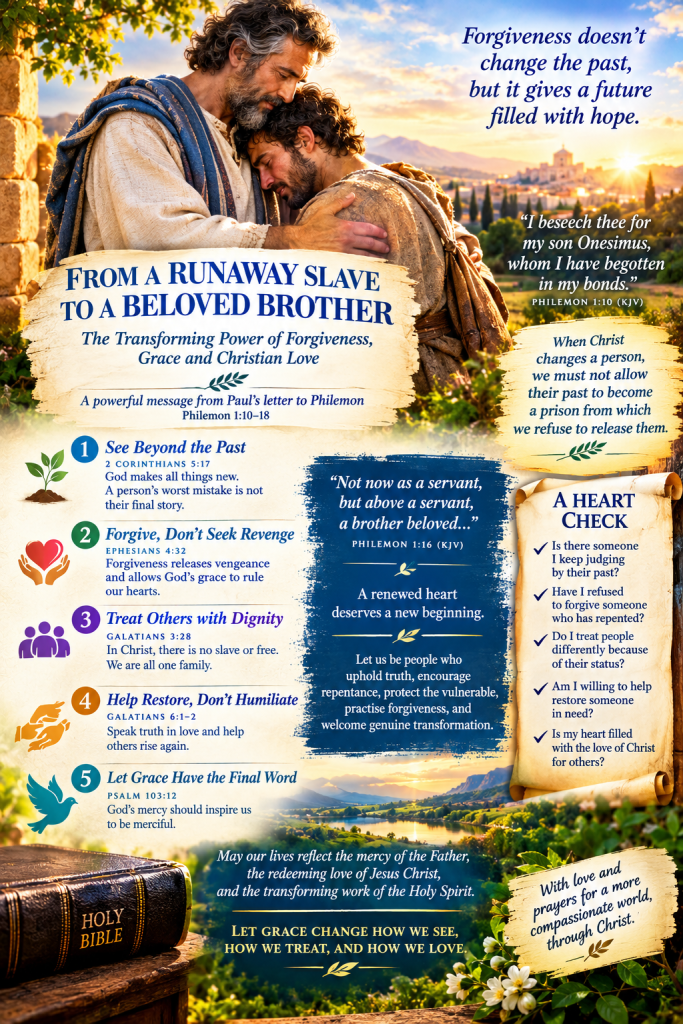
The Apostle Paul wrote to Philemon, it is a message about forgiveness, restoration, dignity, brotherhood, and the transforming power of the Gospel.
The Gospel challenges worldly pride by establishing that all people are equal and deeply valued in Christ,
Onesimus, a man who had been separated from Philemon and was now connected with Paul during his imprisonment. Onesimus had become a Christian through Paul’s ministry. Paul sends him back to Philemon with a heartfelt appeal: receive him differently not merely according to his past, but in the light of what Christ has done in his life.
“I beseech thee for my son Onesimus, whom I have begotten in my bonds” (Philemon 1:10).
The Apostle Paul introduces Onesimus has his own son. In his letter to Philemon, Paul urges him to welcome his runaway servant, Onesimus, not as property, but as an equal, beloved brother in faith.
By offering to personally pay any debts Onesimus owes, the Apostle Paul mirrors the redeeming, sacrificial love of Jesus Christ. Ultimately, true Christian love goes beyond judging the faults of others, it actively seeks to restore, protect dignity, and guide others toward healing.
True Christian fellowship requires gentle restoration rather than permanent condemnation.
“Be kindly affectioned one to another with brotherly love; in honour preferring one another” (Romans 12: 10).
We must never allow worldly status to become more important than the love, dignity, and spiritual unity that we are called to share in Christ.
The greatest test of Christian love is how we treat those who have wronged us.
A person’s past may explain where they have been, but it does not have to determine where they can go with God. Let us never forget: the grace that rescued us is the same grace that can transform another person.
The letter does not tell us explicitly how Philemon ultimately responded, but Paul’s appeal leaves us with a lasting challenge: will we allow the love of Christ to change the way we receive people who have a troubled past?
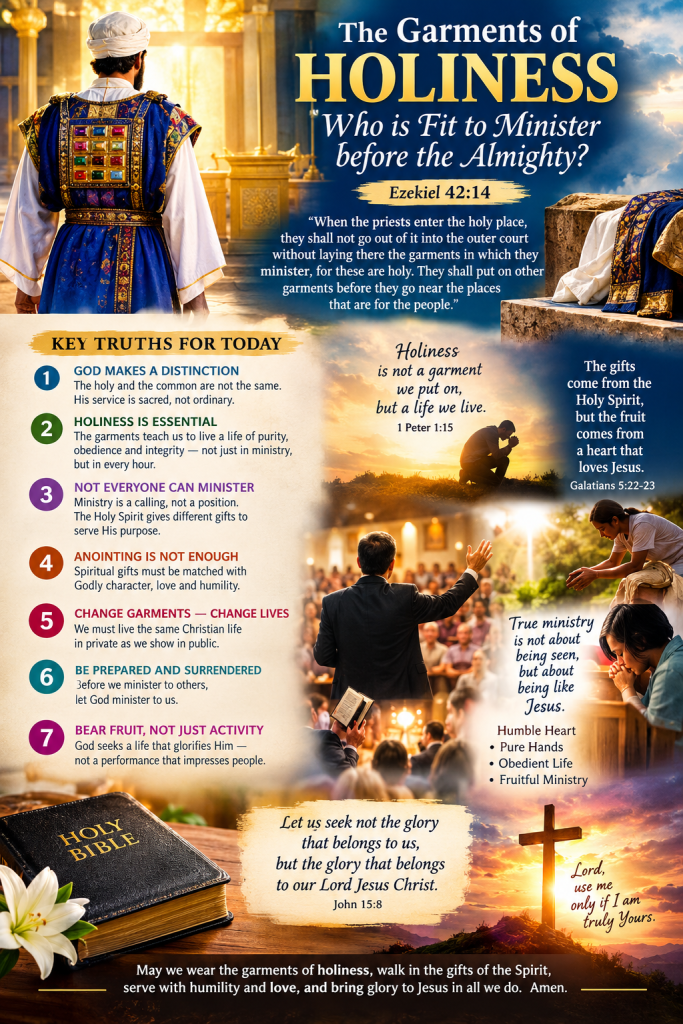
“When the priests enter therein, then shall they not go out of the holy place into the utter court, but there they shall lay their garments wherein they minister; for they are holy; and shall put on other garments, and shall approach to those things which are for the people” (Ezekiel 42:14).
God makes a distinction between the holy and the common.
The Almighty God commanded the priests to wear their sacred garments while ministering in the holy place and to change their garments before approaching the people.
Was God merely concerned about their clothing? Absolutely not! The garments belonged to a ministry that God had set apart for Himself. Their use reminded the priests that they were entering a sacred place to perform sacred duties according to God’s commandments.
The Lord is holy, and His service must never be treated as an ordinary responsibility.
In the Old Testament, the priest did not decide for himself how to approach God. God established the priesthood, prescribed its duties, and gave instructions concerning the garments, sacrifices, and manner of service.
The Lord commanded the prophet Moses: “And thou shalt make holy garments for Aaron thy brother for glory and for beauty” (Exodus 28:2).
Holy garments not merely clothes that distinguished a priest from an ordinary person. They were associated with a sacred calling and a responsibility entrusted by God.
Holiness is a continuous, whole-life commitment to obeying God and reflecting His character in every moment, rather than a temporary performance reserved for Sundays or public ministry.
In 1 Peter 1:15, the Apostle Peter writes: “But as he which hath called you is holy, so be ye holy in all manner of conversation” (1 Peter 1:15).
The true servant of God must seek holiness not merely in the hour of ministry, but in every hour of life. God’s kingdom is not a stage on which everyone competes to be seen. It is a body in which each member serves according to the grace and responsibility entrusted to them.
The Apostle James writes: “Pure religion and undefiled before God and the Father is this, To visit the fatherless and widows in their affliction, and to keep himself unspotted from the world” (James 1:27).
We must not wear one character before the church and another before the world.
Though clothes, responsibilities, and surroundings change, remain committed to Christ and live as His servant at home just as you do in ministry.
True godliness requires matching our everyday conduct with our public ministry, as God desires genuine holiness over performance-based piety.
The same person who worships in the sanctuary must practise patience at home, honesty at work, mercy toward the weak, and humility in ordinary relationships.
The garments of ministry teach us about holiness. Consider the significance of the priests’ garments. Priests wore them only for designated sacred duties and carefully laid them aside afterward; they were not to mix the holy with the common.
The minister of God must understand the difference between being on a platform and being in God’s presence, between possessing a gift and possessing godly character, and between receiving public recognition and being approved by God.
God looks beyond outward appearances. He examines the heart.
“For the LORD seeth not as man seeth; for man looketh on the outward appearance, but the LORD looketh on the heart” (1 Samuel 16:7).
The Apostle Peter describes believers collectively as: “A chosen generation, a royal priesthood, an holy nation, a peculiar people” (1 Peter 2:9).
Under the new covenant, leadership roles vary, but every believer is called to belong to Christ, proclaim His goodness, and follow Him faithfully. Rather than restricting ministry to an elite few, Ezekiel 42:14 shows that true ministry is not self-appointed; it is a divine calling equipped by the Holy Spirit for all believers.
The Lord is able to use imperfect people who humbly submit to Him.
Let the sacred garments of Ezekiel’s priests remind us to walk in our holy calling.
As we leave, let us honor our divine calling by valuing each other’s diverse gifts and living with uncompromising private integrity that matches our public devotion.
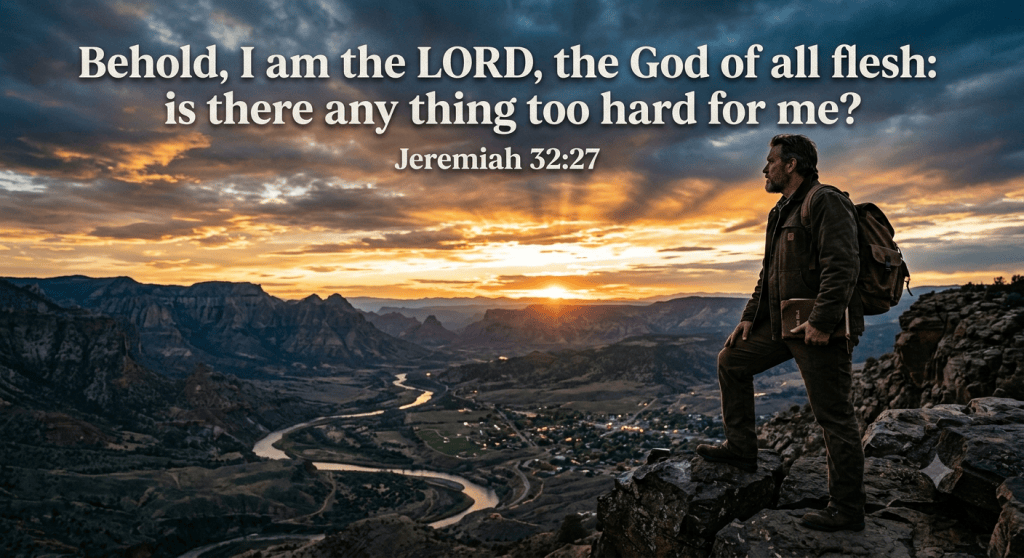
“Behold, I am the LORD, the God of all flesh: is there any thing too hard for me?” (Jeremiah 32:27)
When the prophet Jeremiah received this word, he wasn’t sitting in a quiet sanctuary or enjoying a peaceful life; he was confined in a courtyard while his nation was under siege. Jerusalem was surrounded by the enemy, chaos reigned, and the future looked utterly hopeless.
Yet, right in the middle of a siege, God asked Jeremiah to buy a plot of land, a move that made no logical sense in human terms.
Why buy land in a nation about to be destroyed? God was showing the prophet that human circumstance does not limit Divine Sovereignty. He saw the grief, the uncertainty, and the impossibility of the moment, and He stepped in with a declaration that echoes down through the centuries to us today.
God says to the prophet Jeremiah that He is Yahweh, the self-existent, eternal God who holds the universe together by the power of His word. He is the Creator of every human heart, every breath we take, and every circumstance we face. There is no heart too hard for Him to soften, no body too weak for Him to strengthen, and no situation too complex for Him to untangle. While human weakness makes life’s problems look like towering mountains, God’s almighty presence dissolves those same obstacles like wax.
God poses a rhetorical question: “Is there anything too hard for Me?”
It is a question meant to arrest your doubts. God is inviting you to bring your absolute hardest problem, your deepest sorrow, and your most stubborn impossibility, and lay it side by side with His Almighty Power.
Heaven is silent, yet God remains limitless.The prophet Jeremiah had to buy that field in faith before he saw the restoration. Likewise, God invites you today to step out in faith. Stop measuring God’s ability by your human capacity. Never accept the narrative that you have come to a dead end. When you cannot see a way forward, remember that God does not just find a way, He creates a way.
If you face an impossible mountain today, let the truth of Jeremiah 32:27 settle into your soul: look past your circumstances and fix your eyes upon your Redeemer. He is the God who opens paths through the sea, commands the sunrise, and brings dead things back to life. Nothing in your life is beyond His reach, and no prayer you whisper is beyond His power.
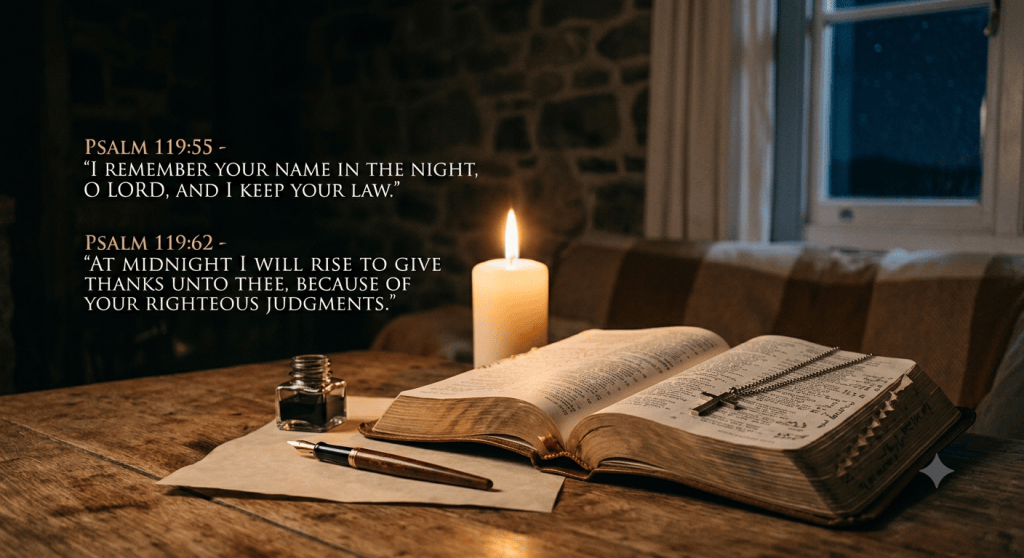
“I remember your name in the night, O Lord, and I keep your law.” (Psalm 119:55).
In the quiet of the night, our deepest emotions surface without the noise of daily distractions. The stillness of midnight was not a burden for the psalmist, but it was a sacred sanctuary for devotion.
When you focus on who God is, your perspective shifts. The night ceases to feel lonely or overwhelming because you are reminded that the Creator of the universe is watching over you. Remembering His character gives you the strength to stand firm and keep His word, even when the path ahead seems unclear.
Remembering God’s name in scripture means anchoring your mind in His full character, past faithfulness, mercy, and sovereign power rather than just recalling a title.
“At midnight I will rise to give thanks unto thee, because of your righteous judgments” (Psalm 119:62).
Slipping out of a warm bed in the middle of the night while the rest of the world sleeps requires a real effort that you intentionally choose to make, serving as an act of pure love and a sacrifice of physical comfort made simply to spend time in God’s presence.
Spending time with God in the quiet hours, when absolutely no one else is watching, builds a deep, private foundation of faith. This hidden intimacy is what will sustain you and give you strength during life’s unexpected storms.
God is our refuge and strength, a very present help in trouble.
Therefore will not we fear, though the earth be removed, and though the mountains be carried into the midst of the sea;
Though the waters thereof roar and be troubled, though the mountains shake with the swelling thereof.
There is a river, the streams whereof shall make glad the city of God, the holy place of the tabernacles of the most High.
God is in the midst of her; she shall not be moved: God shall help her, and that right early.
(Psalm 46: 1-5)
Fear thou not; for I am with thee: be not dismayed; for I am thy God: I will strengthen thee; yea, I will help thee; yea, I will uphold thee with the right hand of my righteousness.
For I the LORD thy God will hold thy right hand, saying unto thee, Fear not; I will help thee.
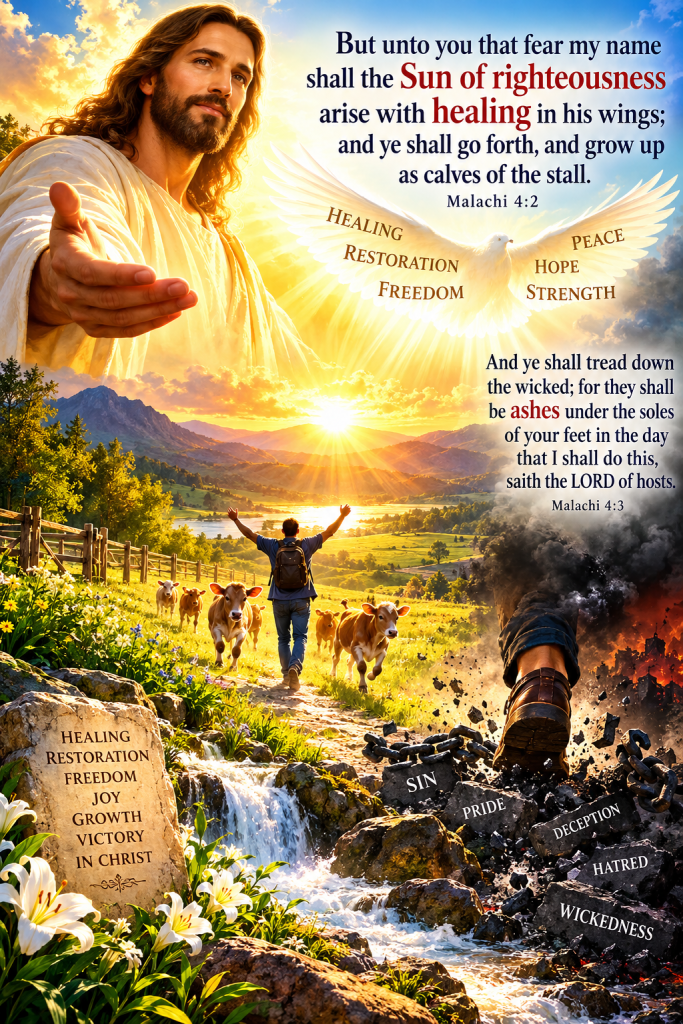
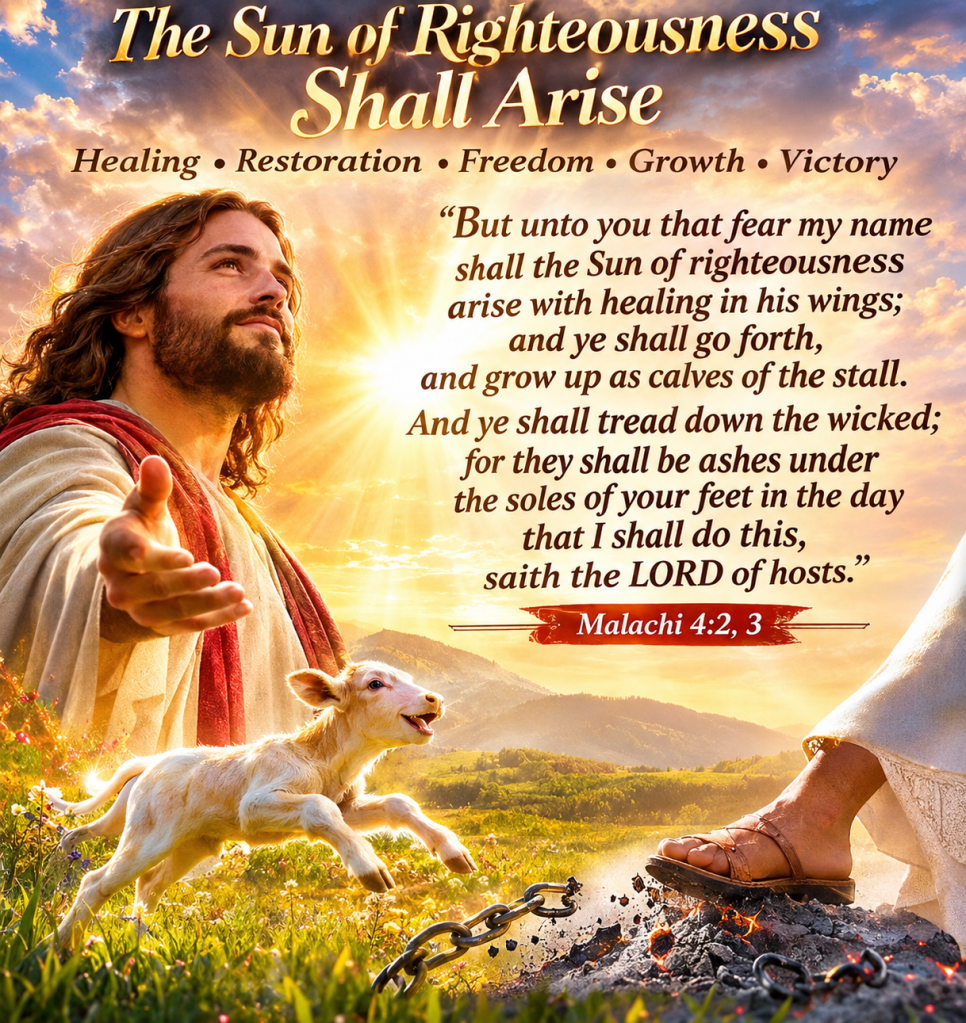
“But unto you that fear my name shall the Sun of righteousness arise with healing in his wings; and ye shall go forth, and grow up as calves of the stall. And ye shall tread down the wicked; for they shall be ashes under the soles of your feet in the day that I shall do this, saith the LORD of hosts” ( Malachi 4:2, 3).
The Lord Jesus declared: “I am the light of the world: he that followeth me shall not walk in darkness, but shall have the light of life” (John 8:12).
When the Sun of Righteousness rises, darkness, despair, sin, and the grave lose their power. Your strength and circumstances may fail you, but God’s faithfulness never will.
Do not mistake a dark season for God’s absence; just as clouds cannot destroy the sun, your current struggles cannot hide His presence or stop His work. Keep your eyes on Lord Jesus, our Light and our Salvation.
The Lord can restore the hidden, unseen wounds of the heart caused by betrayal, rejection, loss, regret, guilt, fear, and disappointment.
Psalm 147:3 declares: “He healeth the broken in heart, and bindeth up their wounds.”
God heals the inner spirit, restores hope and courage, and works alongside medical care to mend every hidden brokenness and burden of the heart.
Your past and the opinions of others do not dictate your future when you turn to God in repentance and faith.
The Lord Jesus said in John 8:36: “If the Son therefore shall make you free, ye shall be free indeed.”
God’s people will experience joyful freedom, renewed strength, and abundant life, much like calves bursting energetically from their stalls after being confined to a narrow space.
A Christian life should not remain spiritually immature forever. We are called to grow in faith, wisdom, holiness, love, and knowledge of our Lord Jesus Christ.
Second Peter 3:18 says: “But grow in grace, and in the knowledge of our Lord and Saviour Jesus Christ.”
Do not be content with merely knowing about Jesus. Seek to know Him more deeply through His Word, prayer, worship, repentance, and obedience.
Let Christ’s light fill your heart, His truth guide your thoughts, and His love shape your actions. May your life prove that His hope cannot be quenched by darkness. The Sun of Righteousness rises, bringing His light as our hope, His grace as our strength, and His victory as our certainty.
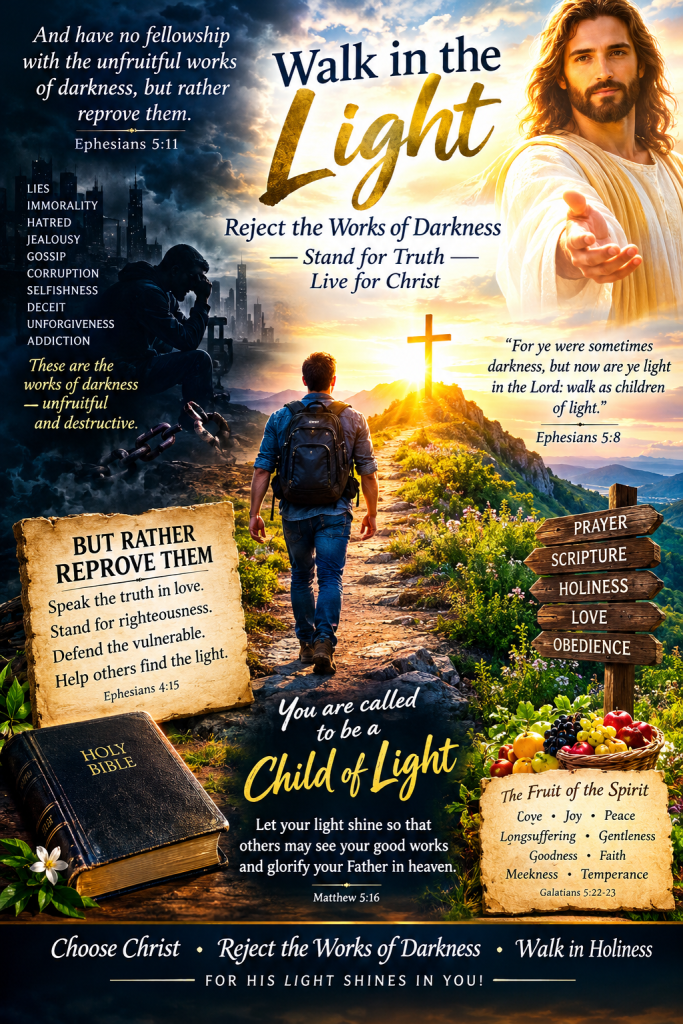
“And have no fellowship with the unfruitful works of darkness, but rather reprove them” (Ephesians 5:11).
Belonging to Jesus means living like Him, rather than letting the subtle traps of sin numb our conscience and pull us into darkness. God’s call to holiness “Be ye holy; for I am holy” in 1 Peter 1: 16 is not meant to steal our joy, but to protect us from the very things that destroy it. Ask yourself today: Do your daily choices draw you closer to Jesus, or are they letting the world pull your heart away?
Sin promises pleasure and freedom but leaves the soul empty, enslaved, and separated from God. Unlike the temporary illusions of darkness, the true Fruit of the Spirit—love, joy, peace, patience, kindness, goodness, faithfulness, gentleness, and self-control (Galatians 5:22–23)—builds lasting righteousness and integrity.
The Apostle Paul warns believers to avoid sinful actions, not the people who commit them. True Christian love means following the Lord Jesus by showing kindness and reaching out to others without compromising your own integrity or participating in their destructive habits. You can love people deeply without approving of or joining in on their sins.
Believers must expose and correct evil not with anger or pride, but through humble, loving, and courageous truth.
Live as a powerful testimony of God’s transforming grace by speaking truth, serving those in need, and keeping your heart pure before Him. Let your daily conduct clearly reflect the fruit of the Spirit rather than the works of darkness. In the end, all earthly status, wealth, and human approval will fade away, leaving only what truly matters: your calling to love God, obey His Word, and walk faithfully before Him.
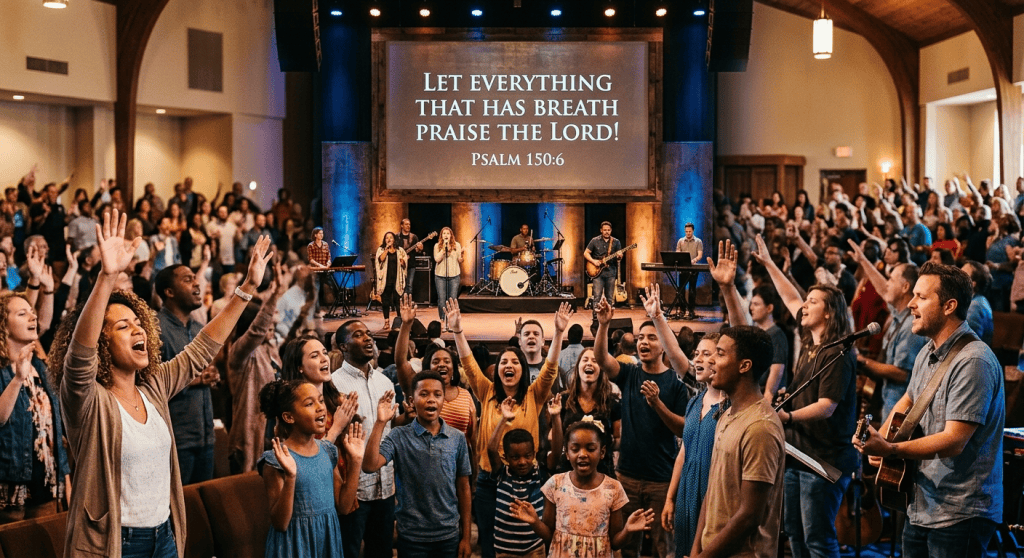
“Let every thing that hath breath praise the LORD. Praise ye the LORD” (Psalm 150:6).
Praise Him as the first light breaks, the birds begin to sing, and you breathe in a brand-new day of grace.
Praise Him in the middle of your work, commutes, classrooms, or chores when responsibilities start demanding your focus.
Praise Him in the heat of the noontime, stepping back to refuel, rest, and reset your heart in the middle of a busy day.
Praise Him when energy dips and the weight of the afternoon grind feels heavy, trusting His strength to carry you through.
Praise Him as the sun goes down, reflecting on how His hand guided you safely through the hours.
Praise Him in the dark when the house is still, casting off anxiety and resting safely under His care.
Praise Him as dead things spring back to life, celebrating fresh starts, restored hope, and planted dreams.
Praise Him in the fullness of bright days, celebrating joy, blessings, and the vibrant fruitfulness around you.
Praise Him as the leaves fall and things change, trusting Him through periods of transition, letting go of the old, and preparing for rest.
Praise Him in the barren or freezing cold, holding fast to faith even when the landscape looks lifeless and spring feels far away.
In every hour of the day and through every changing season of life, praise is our constant anchor.
When we choose to praise Him, whether in the quiet dawn or the midnight hours, in the vibrant warmth of summer or the silent chill of winter, we shift our focus from our temporary circumstances to His eternal faithfulness. Praise transforms our daily routines into sacred moments and anchors our souls through life’s transitions, ensuring that no matter what changes around us, our worship remains steady.
“I will bless the Lord at all times; his praise shall continually be in my mouth” (Psalm 34:1).
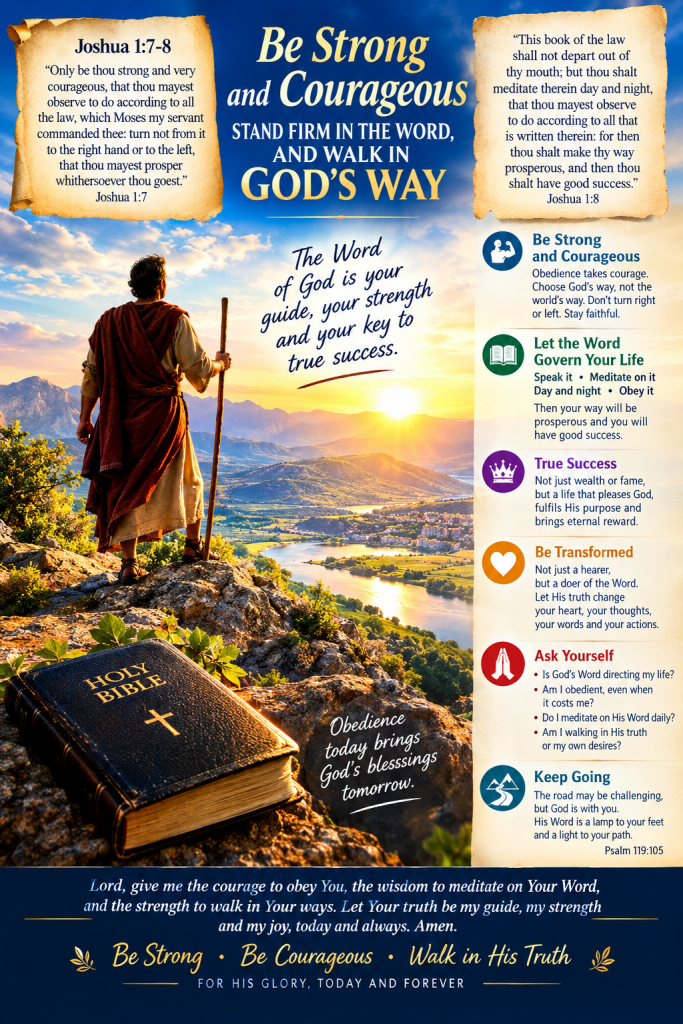
“Only be thou strong and very courageous, that thou mayest observe to do according to all the law, which Moses my servant commanded thee: turn not from it to the right hand or to the left, that thou mayest prosper whithersoever thou goest” (Joshua 1:7).
God commanded Moses’s successor Joshua to be courageous in obedience, not just in battle. True godly courage is the determination to stay faithful to God at any cost. By instructing Joshua not to turn to the right or the left, God teaches us never to alter His truth to fit our personal desires, public opinion, or shifting worldly standards.
The Lord Jesus declared: “Enter ye in at the strait gate: for wide is the gate, and broad is the way, that leadeth to destruction” (Matthew 7:13).
The path of obedience may not always be popular, comfortable, or easy. Be strong enough to obey God, humble enough to accept His correction, and courageous enough to remain faithful when nobody is watching.
“This book of the law shall not depart out of thy mouth; but thou shalt meditate therein day and night, that thou mayest observe to do according to all that is written therein: for then thou shalt make thy way prosperous, and then thou shalt have good success” (Joshua 1:8).
The Word of God must be more than a book we carry in our hands; it must become the truth that governs our hearts, our thoughts, our words, and our decisions. God told Joshua that the Book of the Law must not depart from his mouth. Our words reveal much about what occupies our hearts. If our conversations are constantly filled with bitterness, fear, jealousy, gossip, and complaints, we must examine what is shaping our inner lives.
Joshua 1:8 teaches us to keep God’s Word continually before us. And Psalm 119:11 says: “Thy word have I hid in mine heart, that I might not sin against thee.”
When the Word of God fills your heart, it begins to influence the words you speak, the choices you make, and the way you treat others. Let your mouth become an instrument of truth, encouragement, prayer, and praise, but not an instrument of destruction.
God did not tell Joshua merely to read the Word occasionally. He commanded him to meditate on it day and night. Meditation means giving God’s Word careful attention, reflecting on its meaning, remembering it, praying over it, and considering how to apply it in everyday life.
True spiritual maturity comes from deeply rooting yourself in God’s Word. Like a tree planted by a river, daily meditation provides the nourishment you need to grow fruit and stand firm against life’s storms. You may face disappointment. You may experience rejection. You may walk through seasons when your prayers seem unanswered. But the Word of God can remind you of His character, strengthen your faith, correct your direction, and give you hope to continue.
Knowing God’s Word means actively living out His commands like forgiving, staying humble, and speaking truth, because following Christ promises His presence through hardships, not a life free from them. The Lord Jesus Himself said: “In the world ye shall have tribulation: but be of good cheer; I have overcome the world.” (John 16:33).
True success is walking faithfully with God, growing in holiness, loving others, and staying true to His truth, rather than chasing money, fame, or human approval.
Before making a move, seek God’s wisdom and remember His instruction to guide your actions and speech. When facing temptation, fear, or pride, look to His truth, promises, and humbling Word. Do not hide your sins; instead, confess them and lean on His grace to change. When the future is unclear, do not rush ahead but pray, study Scripture, and trust wise counsel aligned with His truth.
Romans 12:2 teaches believers not to be conformed to this world but to be transformed by the renewing of their minds. Real change happens when you let God’s truth transform your own heart before you try to change others.
Psalm 119:105 declares: “Thy word is a lamp unto my feet, and a light unto my path.”
Trust God for the next step, not just the whole road. The world chases feelings and pride, but God calls you to faith, courage, and obedience in your heart, your home, and your quiet moments. Meditate on it so that you may become more faithful, more humble, more loving, and more obedient.
Rely on God’s strength, stay true to His Word daily, and remember that true success means remaining faithful to Him. Be strong. Be courageous. Hold fast to the Word. Walk in obedience. And never turn away from the path of God’s truth.
Let the Bible be your guide, let obedience be your response, let courage be your testimony, and let Jesus Christ be the Lord of your life.