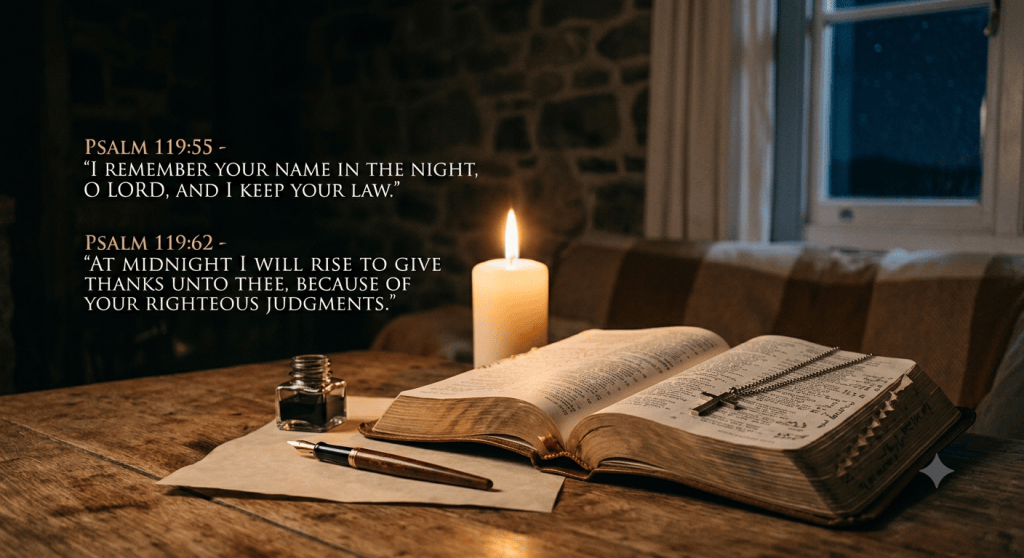
“I remember your name in the night, O Lord, and I keep your law.” (Psalm 119:55).
In the quiet of the night, our deepest emotions surface without the noise of daily distractions. The stillness of midnight was not a burden for the psalmist, but it was a sacred sanctuary for devotion.
When you focus on who God is, your perspective shifts. The night ceases to feel lonely or overwhelming because you are reminded that the Creator of the universe is watching over you. Remembering His character gives you the strength to stand firm and keep His word, even when the path ahead seems unclear.
Remembering God’s name in scripture means anchoring your mind in His full character, past faithfulness, mercy, and sovereign power rather than just recalling a title.
“At midnight I will rise to give thanks unto thee, because of your righteous judgments” (Psalm 119:62).
Slipping out of a warm bed in the middle of the night while the rest of the world sleeps requires a real effort that you intentionally choose to make, serving as an act of pure love and a sacrifice of physical comfort made simply to spend time in God’s presence.
Spending time with God in the quiet hours, when absolutely no one else is watching, builds a deep, private foundation of faith. This hidden intimacy is what will sustain you and give you strength during life’s unexpected storms.
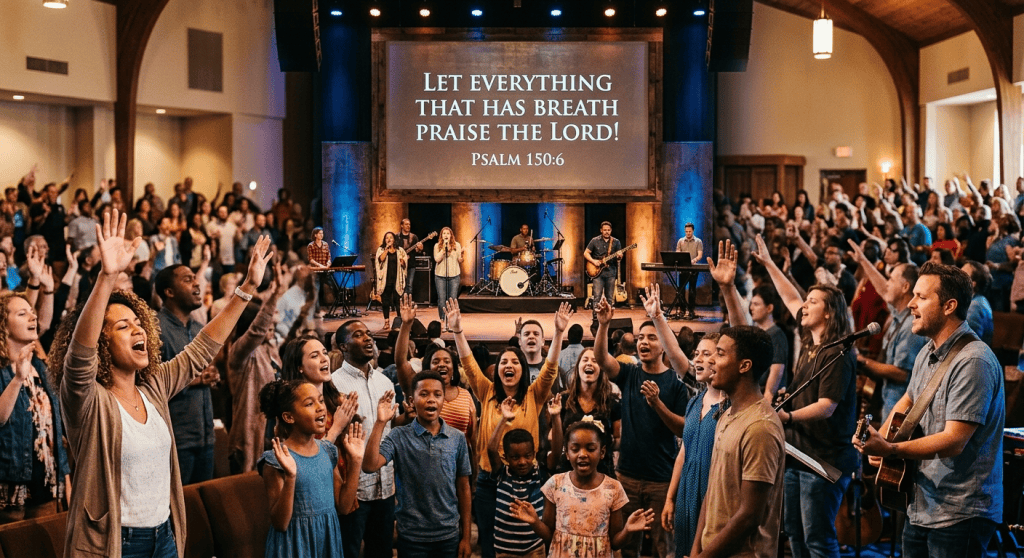
“Let every thing that hath breath praise the LORD. Praise ye the LORD” (Psalm 150:6).
Praise Him as the first light breaks, the birds begin to sing, and you breathe in a brand-new day of grace.
Praise Him in the middle of your work, commutes, classrooms, or chores when responsibilities start demanding your focus.
Praise Him in the heat of the noontime, stepping back to refuel, rest, and reset your heart in the middle of a busy day.
Praise Him when energy dips and the weight of the afternoon grind feels heavy, trusting His strength to carry you through.
Praise Him as the sun goes down, reflecting on how His hand guided you safely through the hours.
Praise Him in the dark when the house is still, casting off anxiety and resting safely under His care.
Praise Him as dead things spring back to life, celebrating fresh starts, restored hope, and planted dreams.
Praise Him in the fullness of bright days, celebrating joy, blessings, and the vibrant fruitfulness around you.
Praise Him as the leaves fall and things change, trusting Him through periods of transition, letting go of the old, and preparing for rest.
Praise Him in the barren or freezing cold, holding fast to faith even when the landscape looks lifeless and spring feels far away.
In every hour of the day and through every changing season of life, praise is our constant anchor.
When we choose to praise Him, whether in the quiet dawn or the midnight hours, in the vibrant warmth of summer or the silent chill of winter, we shift our focus from our temporary circumstances to His eternal faithfulness. Praise transforms our daily routines into sacred moments and anchors our souls through life’s transitions, ensuring that no matter what changes around us, our worship remains steady.
“I will bless the Lord at all times; his praise shall continually be in my mouth” (Psalm 34:1).
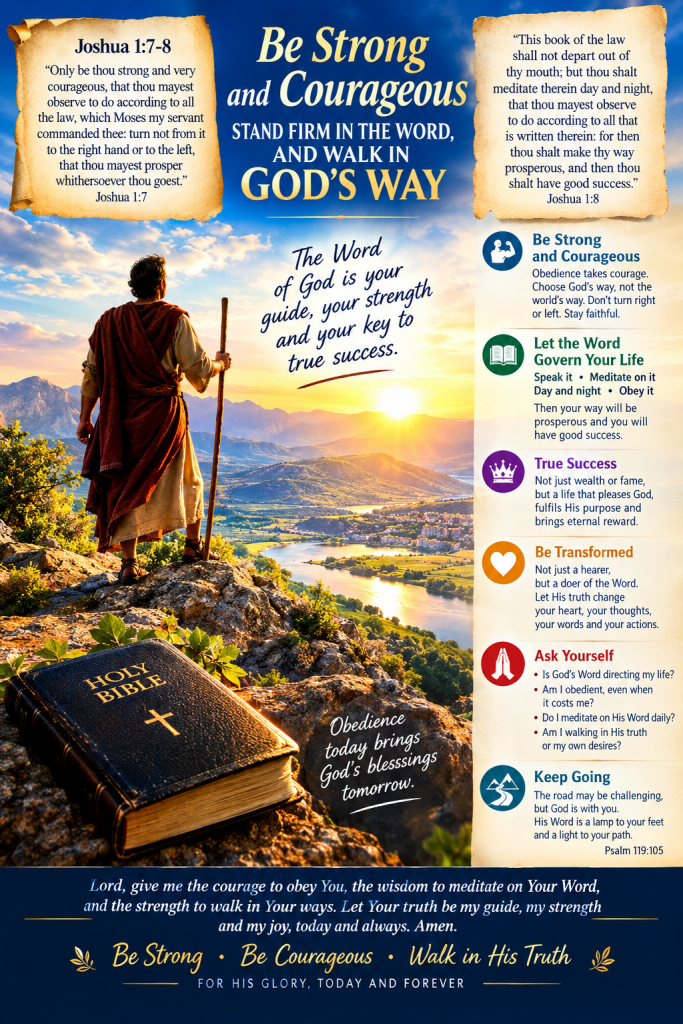
“Only be thou strong and very courageous, that thou mayest observe to do according to all the law, which Moses my servant commanded thee: turn not from it to the right hand or to the left, that thou mayest prosper whithersoever thou goest” (Joshua 1:7).
God commanded Moses’s successor Joshua to be courageous in obedience, not just in battle. True godly courage is the determination to stay faithful to God at any cost. By instructing Joshua not to turn to the right or the left, God teaches us never to alter His truth to fit our personal desires, public opinion, or shifting worldly standards.
The Lord Jesus declared: “Enter ye in at the strait gate: for wide is the gate, and broad is the way, that leadeth to destruction” (Matthew 7:13).
The path of obedience may not always be popular, comfortable, or easy. Be strong enough to obey God, humble enough to accept His correction, and courageous enough to remain faithful when nobody is watching.
“This book of the law shall not depart out of thy mouth; but thou shalt meditate therein day and night, that thou mayest observe to do according to all that is written therein: for then thou shalt make thy way prosperous, and then thou shalt have good success” (Joshua 1:8).
The Word of God must be more than a book we carry in our hands; it must become the truth that governs our hearts, our thoughts, our words, and our decisions. God told Joshua that the Book of the Law must not depart from his mouth. Our words reveal much about what occupies our hearts. If our conversations are constantly filled with bitterness, fear, jealousy, gossip, and complaints, we must examine what is shaping our inner lives.
Joshua 1:8 teaches us to keep God’s Word continually before us. And Psalm 119:11 says: “Thy word have I hid in mine heart, that I might not sin against thee.”
When the Word of God fills your heart, it begins to influence the words you speak, the choices you make, and the way you treat others. Let your mouth become an instrument of truth, encouragement, prayer, and praise, but not an instrument of destruction.
God did not tell Joshua merely to read the Word occasionally. He commanded him to meditate on it day and night. Meditation means giving God’s Word careful attention, reflecting on its meaning, remembering it, praying over it, and considering how to apply it in everyday life.
True spiritual maturity comes from deeply rooting yourself in God’s Word. Like a tree planted by a river, daily meditation provides the nourishment you need to grow fruit and stand firm against life’s storms. You may face disappointment. You may experience rejection. You may walk through seasons when your prayers seem unanswered. But the Word of God can remind you of His character, strengthen your faith, correct your direction, and give you hope to continue.
Knowing God’s Word means actively living out His commands like forgiving, staying humble, and speaking truth, because following Christ promises His presence through hardships, not a life free from them. The Lord Jesus Himself said: “In the world ye shall have tribulation: but be of good cheer; I have overcome the world.” (John 16:33).
True success is walking faithfully with God, growing in holiness, loving others, and staying true to His truth, rather than chasing money, fame, or human approval.
Before making a move, seek God’s wisdom and remember His instruction to guide your actions and speech. When facing temptation, fear, or pride, look to His truth, promises, and humbling Word. Do not hide your sins; instead, confess them and lean on His grace to change. When the future is unclear, do not rush ahead but pray, study Scripture, and trust wise counsel aligned with His truth.
Romans 12:2 teaches believers not to be conformed to this world but to be transformed by the renewing of their minds. Real change happens when you let God’s truth transform your own heart before you try to change others.
Psalm 119:105 declares: “Thy word is a lamp unto my feet, and a light unto my path.”
Trust God for the next step, not just the whole road. The world chases feelings and pride, but God calls you to faith, courage, and obedience in your heart, your home, and your quiet moments. Meditate on it so that you may become more faithful, more humble, more loving, and more obedient.
Rely on God’s strength, stay true to His Word daily, and remember that true success means remaining faithful to Him. Be strong. Be courageous. Hold fast to the Word. Walk in obedience. And never turn away from the path of God’s truth.
Let the Bible be your guide, let obedience be your response, let courage be your testimony, and let Jesus Christ be the Lord of your life.
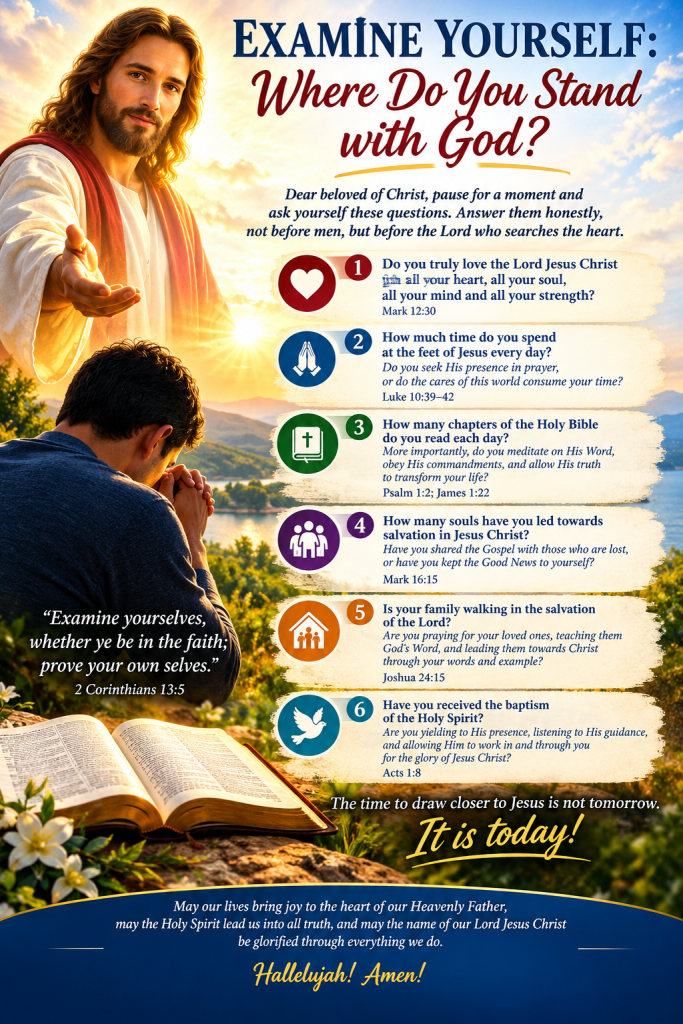
Dear beloved of Christ, pause for a moment and ask yourself these questions. Answer them honestly, not before men, but before the Lord who searches the heart.
Do you truly love the Lord Jesus Christ with all your heart, all your soul, all your mind, and all your strength? (Mark 12:30)
How much time do you spend at the feet of Lord Jesus every day? Do you seek His presence in prayer, or do the cares of this world consume your time? (Luke 10:39–42)
How many chapters of the Holy Bible do you read each day? More importantly, do you meditate on His Word, obey His commandments, and allow His truth to transform your life? (Psalm 1:2; James 1:22)
How many souls have you led towards salvation in the Lord Jesus Christ? Have you shared the Gospel with those who are lost, or have you kept the Good News to yourself? (Mark 16:15)
Is your family walking in the salvation of the Lord? Are you praying for your loved ones, teaching them God’s Word, and leading them towards Christ through your words and example? (Joshua 24:15)
Have you received the baptism of the Holy Spirit? Are you yielding to His presence, listening to His guidance, and allowing Him to work in and through you for the glory of Jesus Christ? (Acts 1:8)
These questions are an invitation to examine your heart before God.
You may read many chapters, yet fail to practise what you read. You may spend hours in prayer, yet struggle to love your neighbour. You may preach to multitudes, yet neglect the people God has placed beside you.
The Lord desires a heart that loves Him, obeys His Word, walks in holiness, bears the fruit of the Holy Spirit, and reflects the character of Lord Jesus Christ.
Let us remember the words of Scripture:
“Examine yourselves, whether ye be in the faith; prove your own selves” (2 Corinthians 13:5).
Today, let each one of us come before the Lord with humility and sincerity. Where we have grown cold, let us return to our first love. Where we have neglected prayer, let us draw near to Him. Where we have failed to share His love, let us become His witnesses. Where our hearts need cleansing, let us repent and receive His mercy.
The time to draw closer to Jesus is not tomorrow. It is today.
May our lives bring joy to the heart of our Heavenly Father, may the Holy Spirit lead us into all truth, and may the name of our Lord Jesus Christ be glorified through everything we do.
None of us can stand before God and claim perfection. We try so hard to patch over our mistakes, clean up our past, and present a flawless face to the world, yet down deep, we know the truth. Our hearts are imperfect, prone to stumbles, and forever in need of grace.
Proverbs 20:9 isn’t meant to bring us shame; it’s meant to bring us freedom.
When we stop pretending we can save ourselves, we open the door for God’s unconditional mercy to step in.
True peace doesn’t come from proving we are spotless, it comes from laying our weary hearts at the altar, bathed in light, and trusting in the One who loves us exactly as we are.
You don’t have to carry the heavy burden of trying to be perfect today. Let His grace be enough.
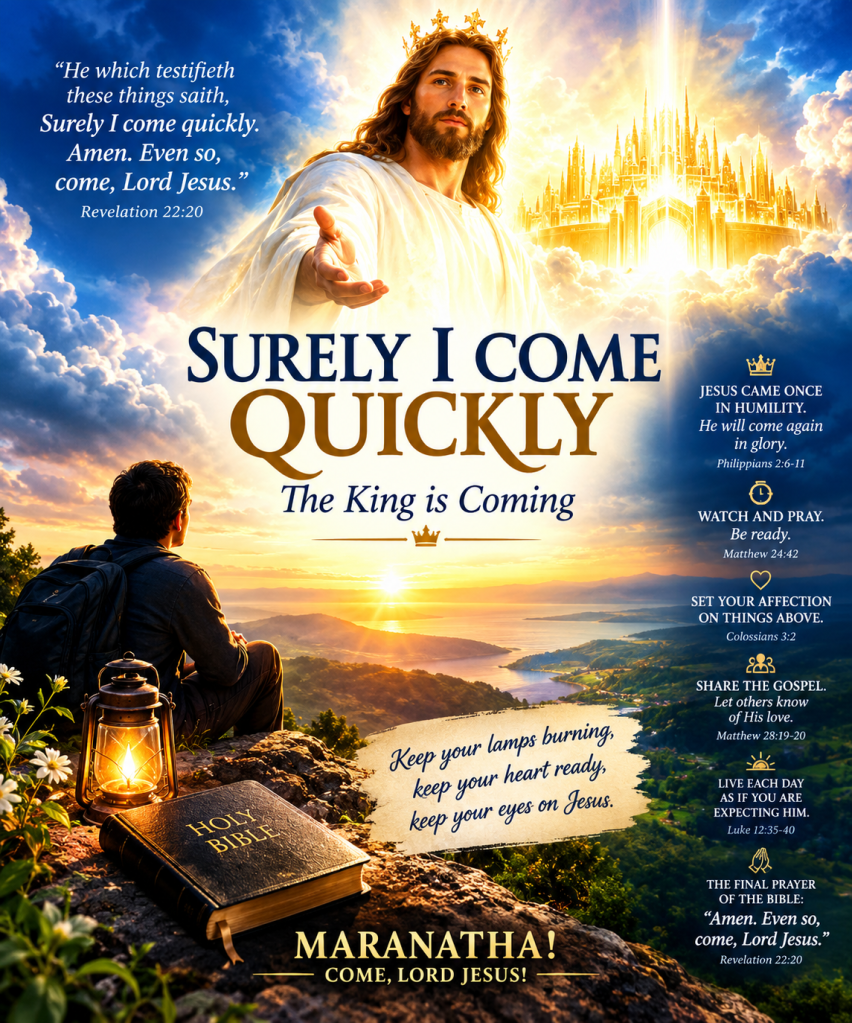
“He which testifieth these things saith, Surely I come quickly. Amen. Even so, come, Lord Jesus”
(Revelation 22:20).
The Bible closes with a promise from the lips of the Lord Jesus Himself: “Surely I come quickly.”
These are the words of the risen Christ, the King of kings and Lord of lords, speaking to His Church and reminding us that history is moving toward a glorious conclusion, the return of the King.
The Lord Jesus came once in humility. He will come again in glory. He came first as the Lamb. He will come again as the King. He came first to bear the crown of thorns. He will come again wearing the crown of glory. He came first to save sinners. He will come again to gather His redeemed people to Himself.
As Scripture declares: “Behold, he cometh with clouds; and every eye shall see him” (Revelation 1:7).
When the Lord Jesus says, “Surely,” there is no uncertainty in His promise. Heaven and earth may pass away, but the word of Christ will never fail.
The Lord Jesus said: “Heaven and earth shall pass away, but my words shall not pass away” (Matthew 24:35).
His promise is more certain than tomorrow’s sunrise. More certain than anything we can see.
The King is coming. The word quickly reminds us that when God’s appointed moment arrives, His coming will not be delayed.
The Apostle Peter reminds us that the apparent delay is not because God has forgotten His promise:
“The Lord is not slack concerning his promise, as some men count slackness” (2 Peter 3:9).
God is patient because He desires people to turn to Him. Therefore, while we wait, we must not become spiritually sleepy.
The Lord Jesus warned: “Watch therefore: for ye know not what hour your Lord doth come” (Matthew 24:42).
The question is not simply, “When will Jesus return?” The deeper question is: “Will He find me ready when He comes?”
The Bride must be ready. The Church is described as the bride awaiting her Bridegroom.
A bride does not prepare because she doubts that the bridegroom is coming. She prepares because she knows he is coming. Likewise, we do not pursue holiness because we are trying to earn Christ’s love.
We pursue holiness because we love the One who is coming for us.
Scripture says: “Let us be glad and rejoice, and give honour to him: for the marriage of the Lamb is come, and his wife hath made herself ready” (Revelation 19:7).
Let our lamps be burning. Let our hearts be awake. Let our garments be clean. Let our faith be alive. Let our love remain burning. Let our eyes remain fixed upon Jesus.
Do not let the world put you to sleep.
The world can make us so occupied with temporary things that we forget eternal things.
We can become consumed with possessions, success, recognition, pleasures, worries, disappointments and the cares of tomorrow.
But everything around us is temporary.
The Lord Jesus is eternal.
Your house is temporary. Your possessions are temporary. Your earthly position is temporary.
Your body is temporary.
But Christ is eternal, His Word is eternal, and the life He promises is eternal.
The Apostle Paul therefore reminds us:
“Set your affection on things above, not on things on the earth” (Colossians 3:2).
Live here but remember that you belong there.
Walk on earth but keep your eyes on heaven.
Work faithfully but remember your eternal reward. Love people but lead them toward Christ. And while you wait for His coming, do not waste your waiting.
What a beautiful way for Scripture to end.
The Lord Jesus says: “Surely I come quickly.”
And the response of His people is: “Amen. Even so, come, Lord Jesus.”
This is not the cry of people who are afraid of Christ’s return. It is the cry of people who love Him.The heart that truly knows Lord Jesus longs to see Him. One day, our waiting will end when faith and prayer become the living presence of the unseen One we have loved, and we finally behold Him face-to-face. And when that glorious moment comes, every earthly sorrow will seem small in the presence of His glory.
There will be no more death. No more crying. No more pain. No more separation.
For: “God shall wipe away all tears from their eyes”(Revelation 21:4).
ARE YOU READY?
The Lord Jesus is coming. Do not be found unprepared. Come to Christ while there is still time. Watch. Pray. Remain faithful.
One day, we will see our King.
And the cry of the redeemed should be:
“Even so, come, Lord Jesus.”
When the world grows darker, remember: The King is coming.
When you feel forgotten, remember: The King is coming.
When righteousness seems to be defeated, remember: The King is coming.
When your heart is weary, remember: The King is coming.
When you are tempted to give up, lift your eyes toward heaven and remember the promise: “Surely I come quickly.”
And let your soul answer: “Amen. Even so, come, Lord Jesus.”
We do not know the day. We do not know the hour.
But we know the One who is coming. His name is Jesus. He is our Saviour. He is our Shepherd. He is our Bridegroom. He is our High Priest. He is our King.
Let us live every day as though we are expecting the sound of the trumpet.
As we wait faithfully for the return of Jesus, let us keep our hearts pure, love one another, and stay ready with our spiritual lamps burning.
“But as for me and my house, we will serve the LORD” (Joshua 24:15).
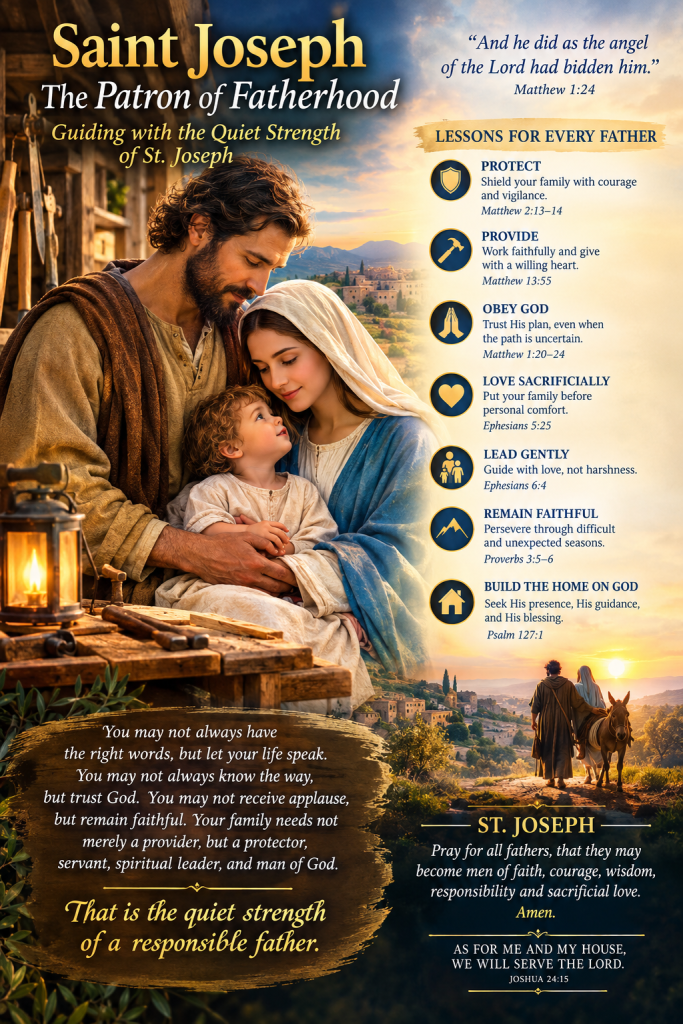
Being a responsible father like St. Joseph means anchoring a family in quiet strength, selfless protection, sacrificial love, and steady, faithful devotion. Scripture introduces Joseph as “a just man” (Matthew 1:19), a man whose righteousness was revealed not through many words, but through his actions, obedience, compassion, and trust in God.
Long before he became the foster-father and guardian of Jesus, Joseph’s profound sense of responsibility was tested when he discovered that Mary was with child. Not understanding the mystery of what God was doing, Joseph nevertheless desired to protect Mary from public disgrace: “Joseph her husband, being a just man, and not willing to make her a public example, was minded to put her away privily” (Matthew 1:19).
But God had a greater purpose. An angel of the Lord appeared to Joseph in a dream and revealed the divine mystery: “Joseph, thou son of David, fear not to take unto thee Mary thy wife: for that which is conceived in her is of the Holy Ghost” (Matthew 1:20).
Joseph did not argue, delay, or demand an explanation. He obeyed. “Then Joseph being raised from sleep did as the angel of the Lord had bidden him, and took unto him his wife” (Matthew 1:24).
Here we see the first great lesson of fatherhood: a godly father listens when God speaks and obeys even when he does not understand everything.
Joseph took Mary into his home, accepting the responsibility God had entrusted to him. He protected her dignity, cared for her needs, and accompanied her on the difficult journey to Bethlehem as she prepared to give birth to the promised Messiah.
And when the child was born, Joseph remained faithful to his God-given responsibility. He became the earthly guardian of the One who is the eternal Son of God.
When an angel warned him of Herod’s murderous intention, Joseph again demonstrated immediate obedience: “Arise, and take the young child and his mother, and flee into Egypt” (Matthew 2:13).
And Scripture tells us: “When he arose, he took the young child and his mother by night, and departed into Egypt” (Matthew 2:14).
There was no complaint recorded. No hesitation. No concern about personal comfort. Joseph simply obeyed.
He uprooted his life in the middle of the night and led Mary and the infant Jesus to safety. In doing so, Joseph teaches fathers that protection sometimes requires sacrifice, inconvenience, courage, and immediate action.
After Herod’s death, Joseph once again received divine direction: “Arise, and take the young child and his mother, and go into the land of Israel” (Matthew 2:20).
Joseph obeyed again and eventually settled with Mary and Jesus in Nazareth.
There, in the quietness of an ordinary home, Joseph fulfilled his vocation. He worked with his hands and provided for the Holy Family. Matthew identifies him as a craftsman or builder (Matthew 13:55). His was not a life of public recognition, but a life of hidden faithfulness.
The Gospel gives us a beautiful glimpse of Jesus growing within the loving care of His earthly family: “And the child grew, and waxed strong in spirit, filled with wisdom: and the grace of God was upon him” (Luke 2:40).
Later, when Jesus was found in the temple, Scripture says: “And he went down with them, and came to Nazareth, and was subject unto them” (Luke 2:51).
Joseph’s life reminds us that great fatherhood is often formed in ordinary places: in the home, at work, and through sacrifice, protection, teaching, and daily faithfulness.
His life proves that true fatherhood does not need applause. It speaks through action more than words.
A father protects, provides, teaches, sacrifices, and prays as he leads his family toward God.
A father’s responsibility is not merely to provide material necessities, but also to care for the physical, emotional, moral, and spiritual well-being of his family.
Scripture gives fathers this solemn responsibility: “And, ye fathers, provoke not your children to wrath: but bring them up in the nurture and admonition of the Lord” (Ephesians 6:4).
A godly father does not lead through fear, domination, or demands, but instead protects, provides for, corrects, and disciplines his family through love, wisdom, patience, example, and prayer ultimately showing them what it means to walk with God through his own life.
Scripture also calls husbands to a sacrificial standard: “Husbands, love your wives, even as Christ also loved the church, and gave himself for it” (Ephesians 5:25).
This is the heart of Christian fatherhood: self-giving love.
Providing for a family is more than fulfilling an obligation. It can become a daily offering of love: the sacrifice of time, energy, comfort, personal ambition, and sometimes even one’s own plans for the good of those entrusted to him.
Every father needs the faith to move forward during uncertainty by trusting God, even when the future remains completely unknown. “Trust in the LORD with all thine heart; and lean not unto thine own understanding”(Proverbs 3:5).
There will be seasons when a father does not know what tomorrow will bring. There may be financial difficulties, family struggles, uncertain decisions, disappointments, or roads he never expected to travel.
In those moments, Joseph’s example speaks silently: Listen to God. Trust God. Obey God. Protect those entrusted to you. Keep moving forward in faith.
A father does not have to be perfect to be faithful. He must be willing to humble himself before God, seek wisdom, repent when he fails, and continue walking faithfully.
Ultimately, the strength of a godly father comes not from himself but from the Lord. “Except the LORD build the house, they labour in vain that build it” (Psalm 127:1).
A father may build walls, provide food, pay bills, teach skills, and protect his family, but only God can truly build a home. Therefore, the greatest inheritance a father can leave his children is not merely wealth or possessions, but a living example of faith.
Let your children see your faith in action: praying, forgiving, serving, and choosing God above all else so they learn to make Him first too.
St. Joseph’s life was largely hidden from the world, yet his faithfulness was precious in the sight of God. He did not preach great sermons recorded in Scripture. He did not perform public miracles. We do not hear a single spoken word from Joseph recorded in the Gospels.
His silence was obedience, his hands were service, his courage was protection, his work was provision, and his faith was leadership.
He became a sanctuary of faithfulness for Mary and the child Jesus.
Build a home where love is strong, faith is alive, prayer is welcomed, forgiveness is practiced, truth is honoured, and Christ is at the centre.
A father’s greatest success is not how loudly the world remembers his name, but how faithfully his family remembers the God he taught them to love.
May every father learn from St. Joseph to become a man of quiet strength, courageous obedience, sacrificial love, humble service, and unwavering faith.
And may every Christian home become what Joseph’s home in Nazareth quietly became: a place where God was honoured, where love was lived, where sacrifice was embraced, where faith was taught, and where the presence of God was cherished above everything else.
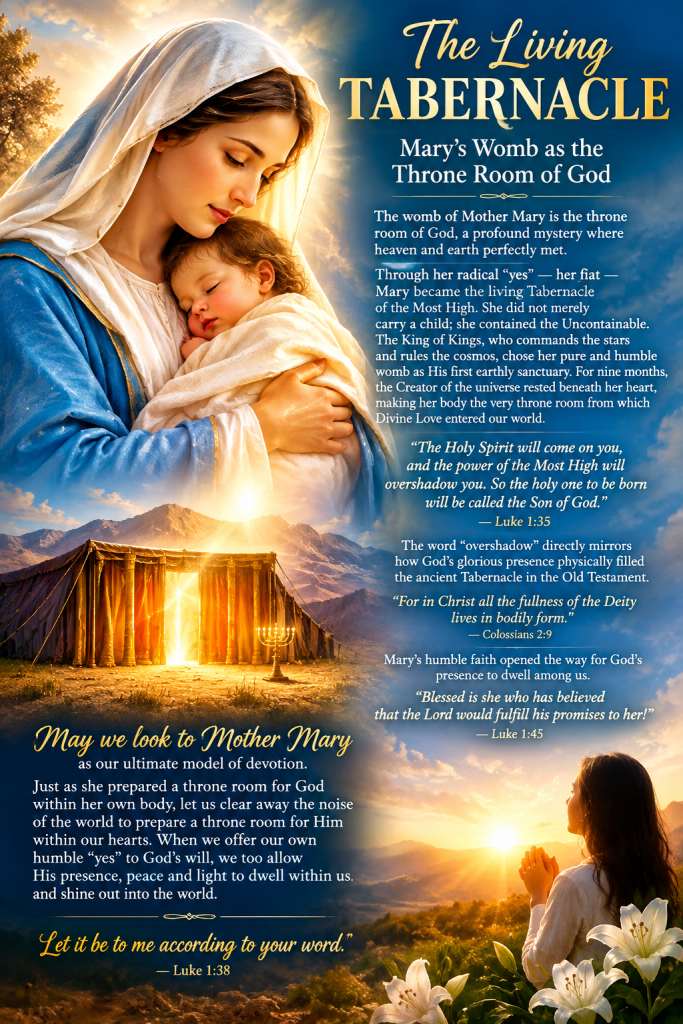
The Living Tabernacle: Mary’s Womb as the Throne Room of God
“For with God nothing shall be impossible” ( Luke 1:37).
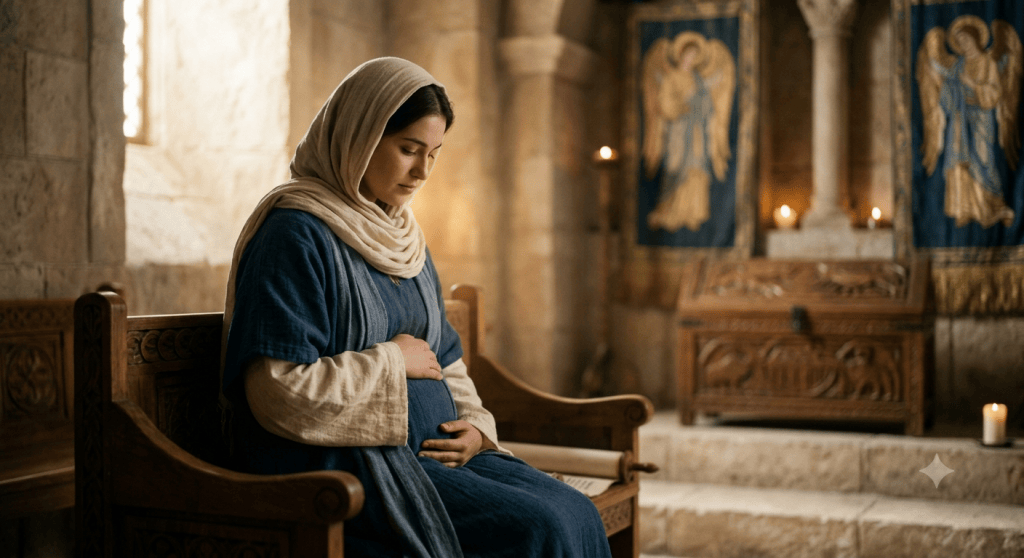
The Womb of Mother Mary is the throne room of God, a profound mystery where heaven and earth perfectly met.
Through her radical “yes” and her fiat, Mary became the living Tabernacle of the Most High. She did not merely carry a child; she contained the Uncontainable.
The King of Kings, who commands the stars and rules the cosmos, chose her pure and humble womb as His first earthly sanctuary. For nine months, the Creator of the universe rested beneath her heart, making her body the very throne room from which Divine Love entered our world.
This reality fulfills the beautiful announcement given to her by the Angel Gabriel:
“The Holy Spirit will come on you, and the power of the Most High will overshadow you. So the holy one to be born will be called the Son of God” (Luke 1:35).
The word “overshadow” directly mirrors how God’s glorious presence physically filled the ancient Tabernacle in the Old Testament. In Mary, God came to dwell not in a tent, but in human flesh:
“For in Christ all the fullness of the Deity lives in bodily form” (Colossians 2:9).
This sacred truth reminds us of the incredible dignity of the human person and the power of surrender. God did not choose a grand, earthly palace of marble and gold for His throne; He chose the quiet, hidden, and faithful womb of a humble young woman, prompted by her deep faith:
“Blessed is she who has believed that the Lord would fulfill his promises to her!” ( Like 1:45)
May we look to Mother Mary as our ultimate model of devotion. Just as she prepared a throne room for God within her own body, let us clear away the noise of the world to prepare a throne room for Him within our hearts. When we offer our own humble “yes” to God’s will, we too allow His presence, peace, and light to dwell within us and shine out into the world.
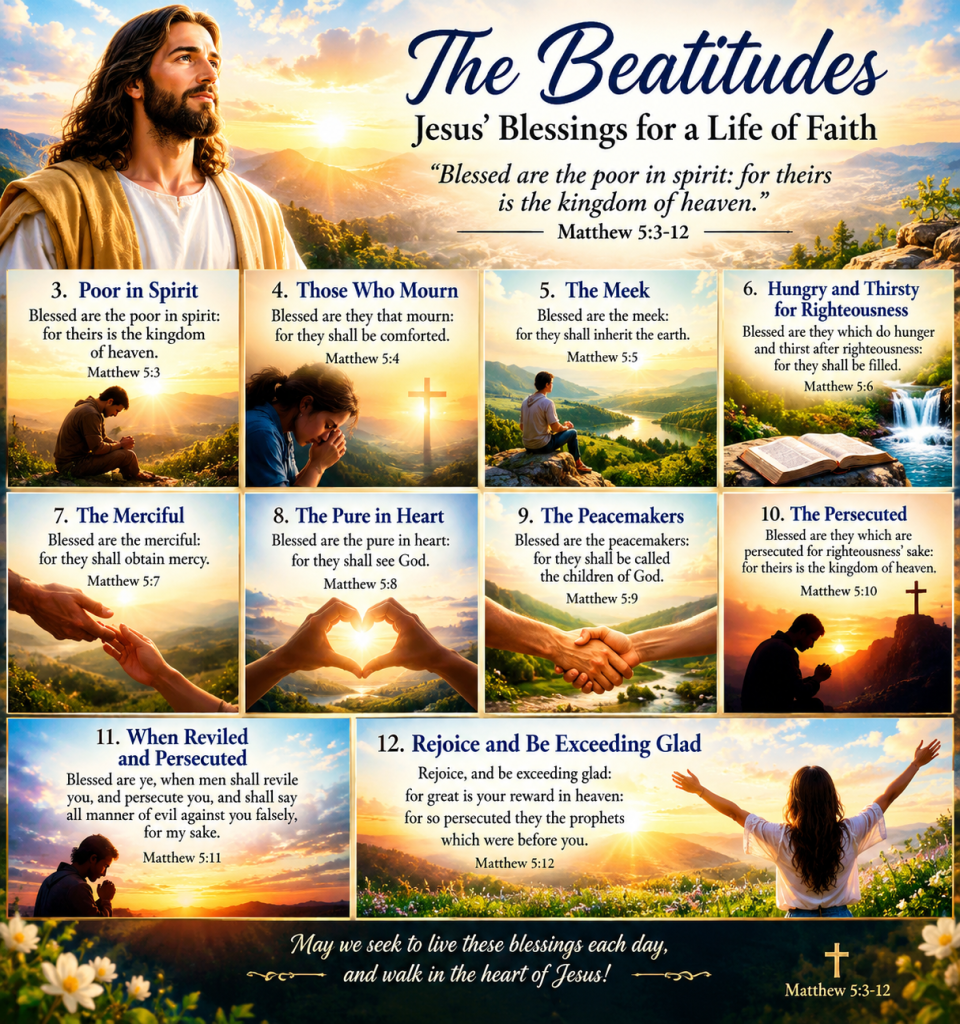
1. “Blessed are the poor in spirit: for theirs is the kingdom of heaven” (Matthew 5:3).
To be poor in spirit means to recognize our complete dependence upon God. It is humility before Him, knowing that we need His grace and cannot rely on ourselves.
2. “Blessed are they that mourn: for they shall be comforted” (Matthew 5:4).
This speaks of those who grieve deeply, including sorrow over sin and the brokenness of the world. God promises His comfort to the hurting and repentant heart.
3. “Blessed are the meek: for they shall inherit the earth” (Matthew 5:5).
Meekness is not weakness. It is strength brought under God’s control responding with gentleness, humility, and self-control rather than pride or revenge.
4. “Blessed are they which do hunger and thirst after righteousness: for they shall be filled” (Matthew 5:6).
Just as the body longs for food and water, the believer should deeply desire to live rightly before God. Jesus promises that those who genuinely seek righteousness will be spiritually satisfied.
5. “Blessed are the merciful: for they shall obtain mercy” (Matthew 5:7).
Mercy means showing compassion, forgiveness, and kindness to others, especially when they have fallen short. Those who extend mercy reflect God’s own merciful character.
6. “Blessed are the pure in heart: for they shall see God” (Matthew 5:8).
A pure heart seeks God sincerely, without hypocrisy or divided devotion. Lord Jesus points us toward an inner life that is clean, sincere, and devoted to Him.
7. “Blessed are the peacemakers: for they shall be called the children of God” (Matthew 5:9).
Peacemakers do more than avoid conflict. They actively seek reconciliation, forgiveness, and harmony. They reflect the character of God, who calls people into peace with Himself and one another.
8. “Blessed are they which are persecuted for righteousness’ sake: for theirs is the kingdom of heaven” (Matthew 5:10).
Following righteousness can sometimes bring rejection or suffering. Lord Jesus reminds His followers that faithfulness to God has eternal significance, even when it is costly.
9. “Blessed are ye, when men shall revile you, and persecute you” (Matthew 5:11).
When people insult, falsely accuse, or mistreat believers because of their faith in Christ, Lord Jesus tells them not to abandon Him. Their identity and reward are found in Him, not in human approval.
10. “Rejoice, and be exceeding glad: for great is your reward in heaven” (Matthew 5:12).
Lord Jesus calls His followers to rejoice even in suffering for His sake. The focus shifts from present hardship to the eternal reward with God. The prophets before them also endured persecution for their faithfulness.
The Beatitudes describe a Christ-centered way of living that reflects His heart. Starting with humility, recognizing our need for God, they guide us to be gentle, merciful, pure, and peaceful, finding joy and comfort in Him even through trials.
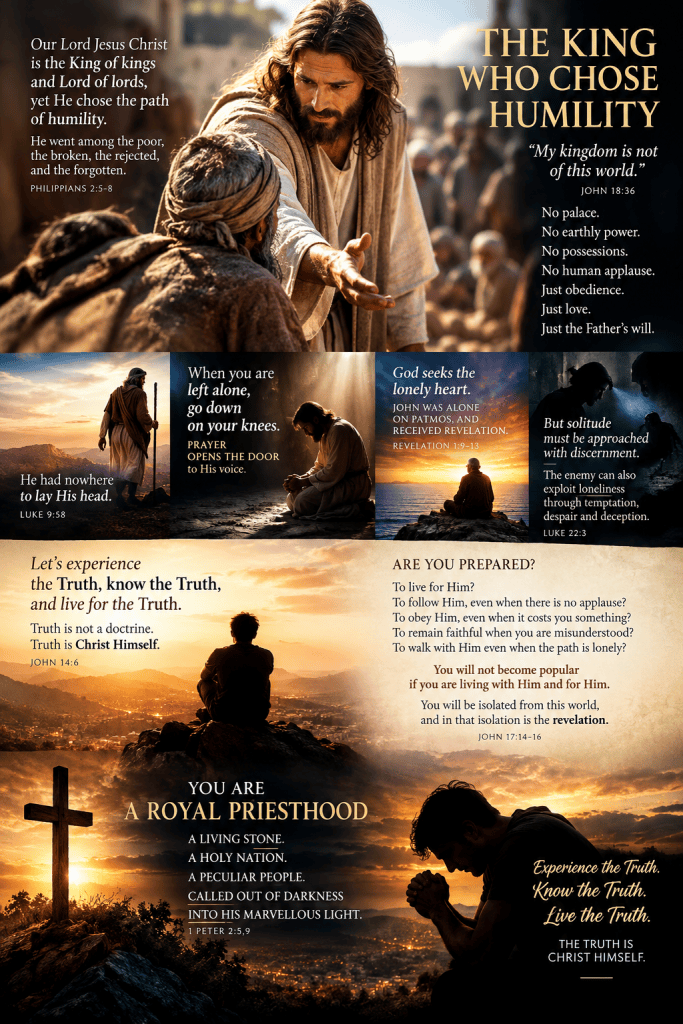
“Ye also, as lively stones, are built up a spiritual house, an holy priesthood, to offer up spiritual sacrifices, acceptable to God by Jesus Christ.” (1 Peter 2:5)
“But ye are a chosen generation, a royal priesthood, an holy nation, a peculiar people; that ye should shew forth the praises of him who hath called you out of darkness into his marvellous light.” (1 Peter 2:9)
We belong to a King who did not come to live as earthly kings live.
Our Lord Jesus Christ is the King of kings and Lord of lords, yet He chose the path of humility.
He went among the poor, the broken, the rejected, and the forgotten.
He did not build His kingdom through earthly status, political power, possessions, or human applause.
Though the Lord Jesus Christ deserved all the royal titles, He did not claim any. When people tried to force Him to be an earthly king or political liberator, He withdrew from them (John 6:15).
He consistently stated, “My kingdom is not of this world.” He did not live in palaces or accumulate material wealth. In Luke 9:58 the The Lord said, “Foxes have holes and birds of the air have nests, but the Son of Man has no place to lay his head.”
The Lord Jesus Christ lived a humble life among the marginalized and poor, identifying completely with their daily struggles and lack of worldly status.
He completely surrendered to Yahweh His Father to do His perfect will, showing complete submission to Him to accomplish His mission.
Our transformation must not be superficial, but total. Our King expects a silent submission; it is in silence that we hear His whisper. Even when you are troubled amidst a crowd, He may call you in a voice audible to you alone.
God seeks the heart that feels lonely, but Satan also prefers the lonely heart.
The Apostle John was alone on the island of Patmos when God sought his heart. His solitude became the setting in which he received the revelation of Jesus Christ (Revelation 1:9–13). But solitude must be approached with discernment. The enemy can also exploit loneliness through temptation, despair, and deception. Judas became vulnerable to the influence of Satan (Luke 22:3). Therefore, when you find yourself alone, do not surrender your heart to darkness.
When you are left alone, go down on your knees; that humble gesture will make you supernatural.
Let’s experience the Truth, know the Truth, and live for the Truth. Truth is He who has chosen you to reveal the Truth.
Spirituality is incredibly vast. To truly understand Him, we must become one with Him; He reveals His Truth only to those who love Him.
Do you love Him?
Are you prepared to live for Him?
You will not become popular if you are living with Him and for Him.
You will be isolated from this world, and in that isolation is the revelation.