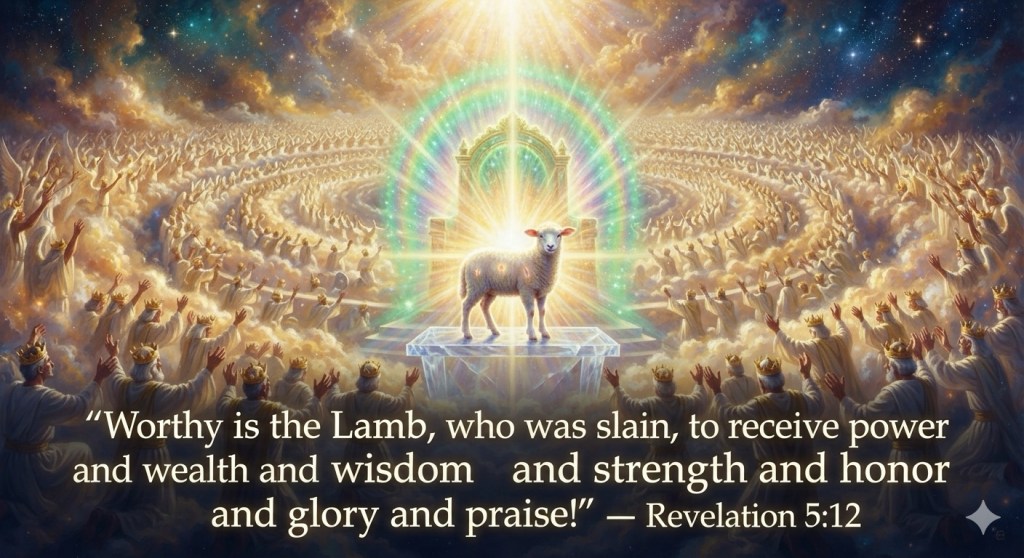
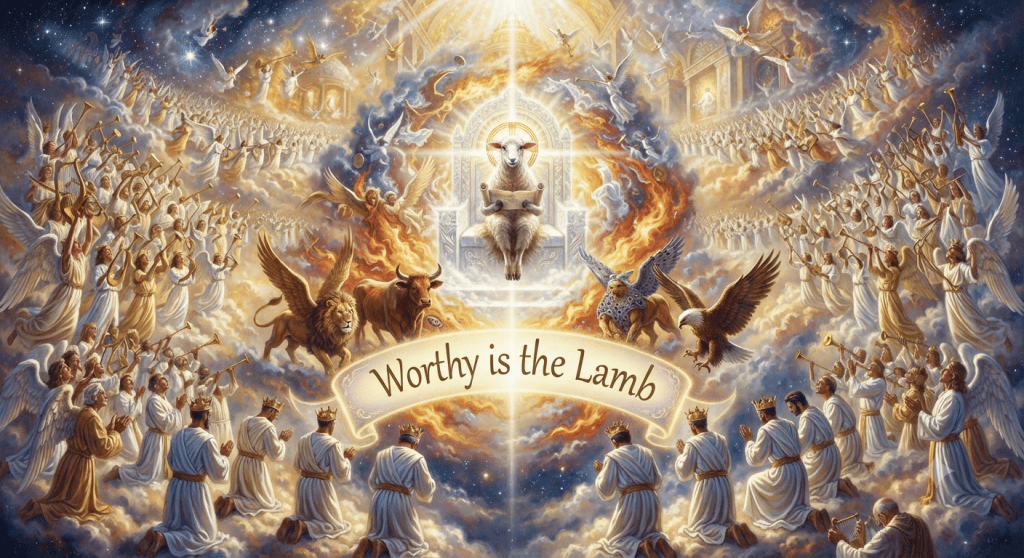
“Worthy is the Lamb that was slain to receive power, and riches, and wisdom, and strength, and honour, and glory, and blessing” (Revelation 5:12).
The Lamb’s worthiness does not stem from the force He exerted, but from the suffering He endured. By willingly laying down His life, He conquered sin and death from the inside out. True spiritual authority is never seized through pride or domination; it is forged in humility, obedience, and sacrificial love.
The number seven represents divine perfection and totality. By attributing seven distinct qualities to the LAMB, the heavenly host declares that nothing is withheld from Him.
Power and Strength: He reigns with supreme sovereignty over every earthly ruler, spiritual force, and personal trial.
Wealth and Wisdom: All creation belongs to Him, and His understanding governs every detail of history, even the chapters we cannot yet make sense of.
Honor, Glory, and Praise: All honor, glory, and praise are His. He alone stands at the rightful center of our worship and devotion.
When life unravels into chaos and uncertainty, Revelation 5:12 wrenches our gaze away from the storm and anchors it to the unshakeable throne of heaven. You were never meant to bear the crushing weight of fixing this broken world or securing your own eternity, the scroll is already held in capable, scarred hands.
True worship is far more than a soundtrack for sunny days; it is a defiant alignment with the eternal reality that the LAMB has conquered, and He is worthy of everything.
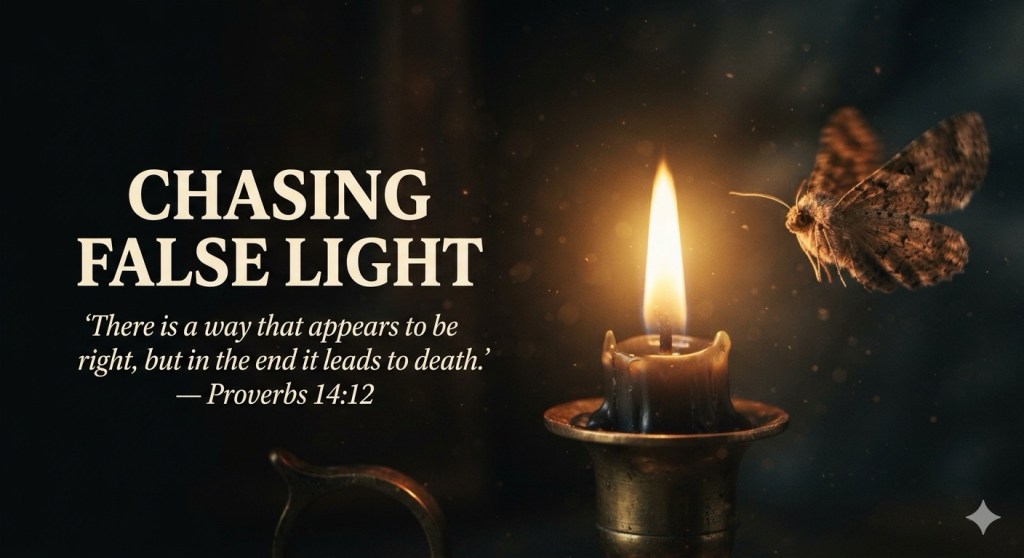
“There is a way which seemeth right unto a man, but the end thereof are the ways of death” (Proverbs 14:12).
Like a moth mistaking a deadly flame for a guiding star, the human heart is easily lured by temptation. Moths navigate by the natural light of the moon and stars, so artificial fire tricks their instincts into flying toward danger. In the same way, sin and worldly distractions disguise themselves as bright, life-giving warmth, pulling us in with false light before leading to spiritual ruin.
Temptation rarely looks like a trap. It disguises itself as beauty, pleasure, or wisdom, mimicking truth to lower your guard.
“And no marvel; for Satan himself is transformed into an angel of light”
(2 Corinthians 11:14).
A moth circling a candle loses all awareness of its true path and becomes trapped in a tightening spiral. Distractions in life work the same way by pulling our focus away from God and onto temporary desires.
The flame only has power because the moth is drawn to it. Our own cravings pull us toward harmful things. What begins as a curious glance or a harmless distraction slowly consumes our time, peace, and devotion.
“But each person is tempted when they are dragged away by their own evil desire and enticed” (James 1:14).
“Turn my eyes away from worthless things; preserve my life according to your word” (Psalm 119:37).
The closer the moth gets to the heat, the harder it is to escape, until the very thing it chased destroys it. Unchecked sin and worldly obsession follow a predictable path from attraction to destruction.
Desire gives birth to action, and persistent sin leads to spiritual death.
The world offers excitement that burns up the soul rather than fulfilling it.
“Then, after desire has conceived, it gives birth to sin; and sin, when it is full-grown, gives birth to death” (James 1:15).
“For the wages of sin is death, but the gift of God is eternal life in Christ Jesus our Lord” (Romans 6:23).
The solution for the moth is not to live in total darkness, but to navigate by the true light in the sky. Avoid destructive distractions by fixing your eyes on Lord Jesus, who gives warmth and guidance without consuming them.
The Lord Jesus Christ offers genuine direction that leads to safety and life rather than ruin. Staying close to God’s Word exposes false flames for what they really are.
In John 8:12 the Lord Jesus said, “I am the light of the world. Whoever follows me will never walk in darkness, but will have the light of life.”
“Your word is a lamp for my feet, a light on my path” (Psalm 119:105).
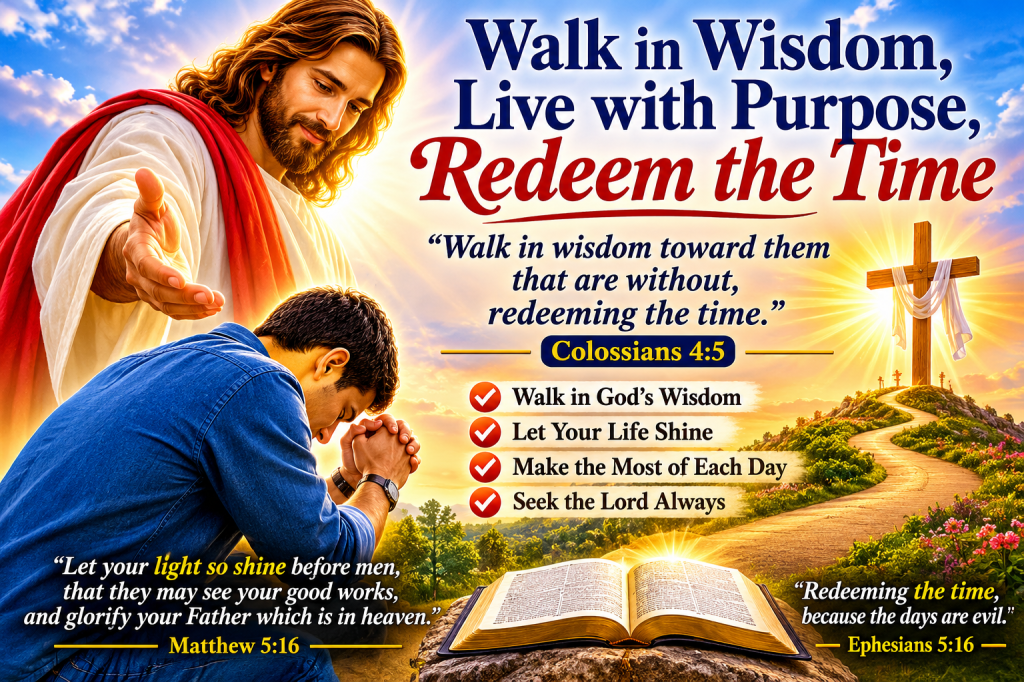
“Walk in wisdom toward them that are without, redeeming the time” (Colossians 4:5).
Time is God’s most precious gift, once a moment passes, it is gone forever.
Live as a living testimony. The world is watching. Your actions, reactions, and integrity may be the only Bible an unbeliever ever reads.
Stop wasting your days. Guard your time from gossip, pride, bitterness, and distractions that carry no eternal value.
Reclaim every moment. Choose purpose over convenience, forgiveness over resentment, and eternity over temporary pleasures.
One day, we will all give an account to God. Do not wait for tomorrow. Walk in wisdom, speak with grace, and surrender your remaining time to Christ today.
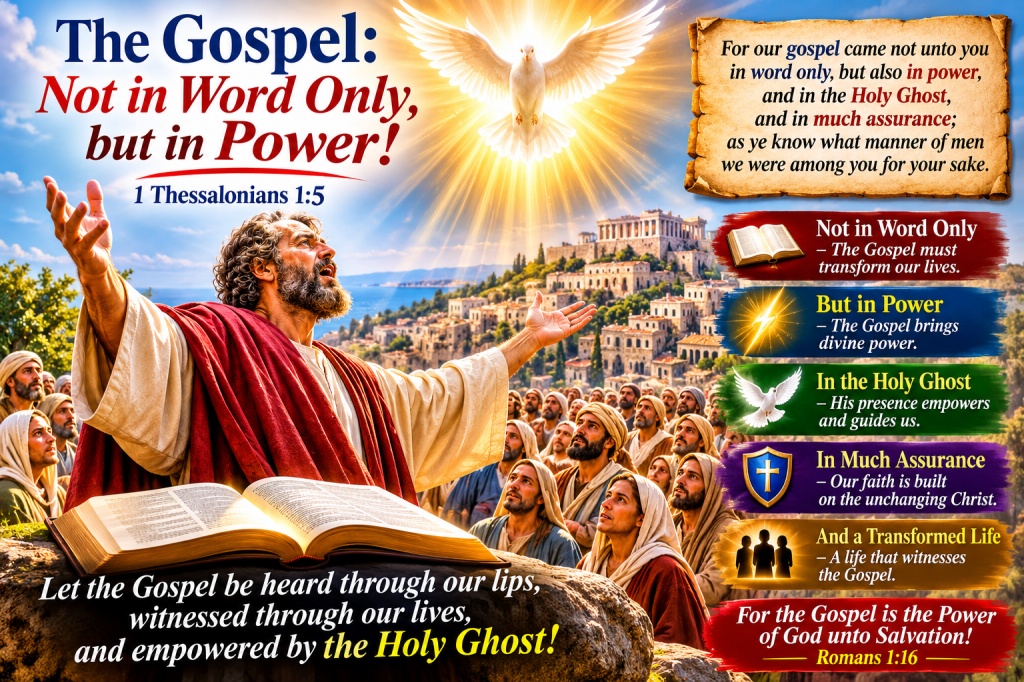
“For our gospel came not unto you in word only, but also in power, and in the Holy Ghost, and in much assurance; as ye know what manner of men we were among you for your sake” (1 Thessalonians 1:5).
The Gospel is the living message of God’s salvation through the Lord Jesus Christ, accompanied by the power of the Holy Spirit.
The Apostle Paul highlights word, power, the Holy Spirit, and much assurance as the four dimensions of genuine Gospel ministry, while placing equal importance on the character and conduct of its preachers.
While words can inform the mind, only God’s truth can transform the heart when it is received through faith and made alive by the Holy Spirit.
The Lord Jesus Himself said in Matthew 15:8: “This people draweth nigh unto me with their mouth, and honoureth me with their lips; but their heart is far from me.”
Christianity is not about how beautifully we speak about Christ; it is about how faithfully we surrender our lives to Him. Be living proof of the truth, not just its voice.
“For I am not ashamed of the gospel of Christ: for it is the power of God unto salvation to every one that believeth” (Romans 1:16).
The power of the Gospel radically transforms lives by bringing light, hope, forgiveness, freedom, and spiritual life to the broken and lost.
When someone truly accepts the Gospel, they must confront the power of sin, let go of their old self, and start a completely new life in Christ.
The Holy Spirit is the divine Person who empowers, convicts, guides, and works through those who proclaim Christ. The disciples were not commissioned to depend upon their own strength. They were to receive divine power to become witnesses of Lord Jesus Christ.
The Lord Jesus Christ promised His disciples: Acts 1:8 “But ye shall receive power, after that the Holy Ghost is come upon you: and ye shall be witnesses unto me.”
The work of God must be accomplished through the power of God.
In 2 Timothy 1:12, the Apostle Paul says, “I know whom I have believed.”
Let our lives point people towards Lord Jesus rather than towards ourselves.
The Apostle Paul did not merely proclaim Christ; he sought to demonstrate the character of Christ through his conduct.
Empowered by the Holy Ghost, the Gospel is a transformative truth to be believed, experienced, lived, and proclaimed so that our changed lives become a bold testimony to others.
“Moreover the law entered, that the offence might abound. But where sin abounded, grace did much more abound: That as sin hath reigned unto death, even so might grace reign through righteousness unto eternal life by Jesus Christ our Lord” (Romans 5: 20, 21).
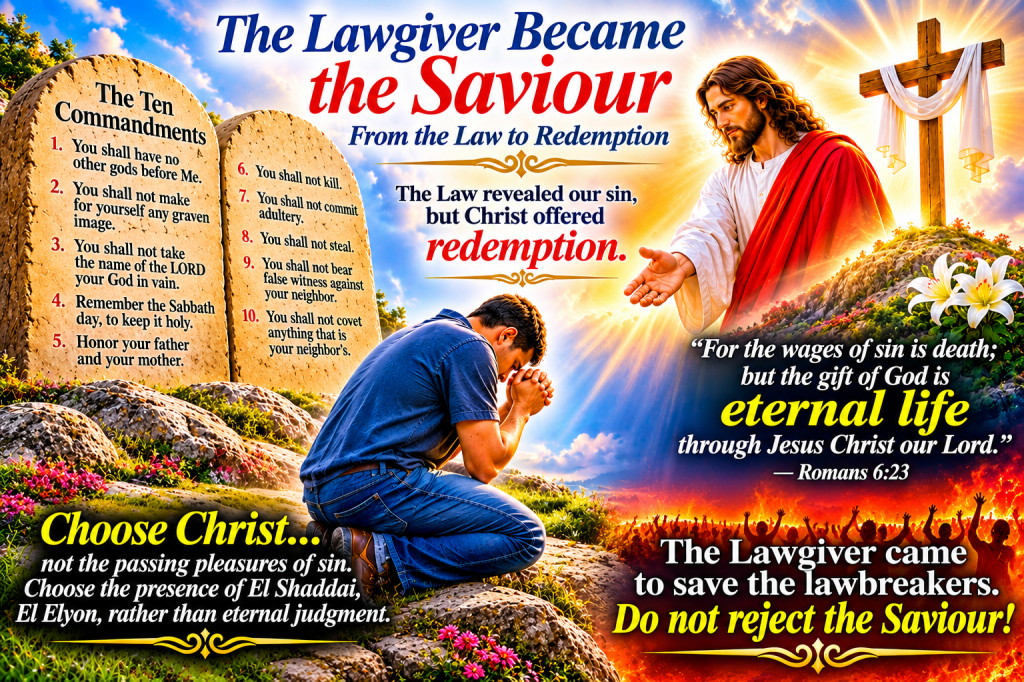
The law was given by the Lawgiver, wanting us to follow it, but men were lawless and heading toward hell. Therefore, the Lawgiver Himself came once for the lawless to save them from their lawlessness. Yet, men love to live lawlessly and prefer to spend their eternity in the lake of sulfur with Lucifer, the lawless one, rather than with El Shaddai, El Elyon.
The Law was given by the Lawgiver, the Almighty God, not to burden humanity, but to reveal His holiness, righteousness, and divine expectations. The Ten Commandments were given so that mankind might understand the difference between holiness and sin, righteousness and wickedness, obedience and rebellion.
The Lawgiver commanded humanity to walk in His ways, honour His commandments, love Him above all things, and live in righteousness. Yet, what did mankind do? Instead of submitting to the authority of the Lawgiver, men chose their own ways. Instead of obeying His commandments, they embraced disobedience. Instead of pursuing holiness, they became servants of sin.
The Law exposed man’s lawlessness, but it could not redeem him from his sin.
As Romans 3:20 declares, “By the law is the knowledge of sin.”
The Lawgiver descended into a rebellious world, not to abandon His creation, but to redeem it. The Lord Jesus Christ came to fulfill the Law that fallen humanity could never keep. The Sinless One bore the punishment for the unrighteous, turning the Law’s declaration of guilt into an offering of redemption. Through this extraordinary love, the Holy One became the ultimate sacrifice, opening the way for sinners to be forgiven and reconciled to God.
After such an immeasurable demonstration of love, many still prefer darkness to light, rebellion to obedience, and sin to holiness. They desire the pleasures of this passing world rather than the eternal presence of their Creator.
The Lawgiver has spoken. The commandments have been given. The Saviour has come. The sacrifice has been made. The invitation to salvation stands before humanity.
What more must God do to demonstrate His love?
Choose the presence of El Shaddai, El Elyon, rather than the eternal judgment prepared for the devil and his angels.
The Lawgiver came to save the lawbreakers. Do not reject the Saviour while holding on to the very lawlessness from which He came to deliver you.
“For the wages of sin is death; but the gift of God is eternal life through Jesus Christ our Lord” (Romans 6:23).
When we look at the cross of Calvary, we see the greatest expression of love the universe has ever known. The Lord Jesus Christ laid down His life, paying a debt He did not owe so that we could have a life we could never earn.
Yet, as we walk through daily life facing bills, uncertainty, weariness, and quiet fears, a question often creeps into our hearts: “If the Lord gave His life for me, will He really take care of all my needs?”
If He held nothing back at the cross, why do things sometimes feel so scarce or difficult? The answer is found not in the shifting circumstances around us, but in the unchanging character of God and the depth of His promise.
He who did not spare his own Son, but gave him up for us all; how will he not also, along with him, graciously give us all things? If God already gave us His most precious, priceless treasure, His own Son, will He withhold the daily bread, the guidance, or the strength you need for today?
In Philippians 4:19, the Apostle Paul writes to believers who were facing pressure and sacrifice: “And my God will supply every need of yours according to his riches in glory in Christ Jesus.”
The Lord Jesus promises to supply every need. Like a Good Shepherd who leads sheep to still waters and restores them, He knows what nourishes us and what distracts us.
King David wrote in Psalm 23:1: “The Lord is my shepherd; I shall not want.”
When the Lord is our Shepherd, the absence of panic does not mean the absence of provision; it means we trust His hand to provide what is right, at the right time.
The Lord Jesus addressed our tendency to worry directly in the Sermon on the Mount (Matthew 6:26, 33): “Look at the birds of the air: they neither sow nor reap nor gather into barns, and yet your heavenly Father feeds them. Are you not of more value than they? But seek first the kingdom of God and his righteousness, and all these things will be added to you.”
“Cast your cares on the Lord and he will sustain you; he will never let the righteous be shaken”(Psalm 55:22).
The Lord who poured out His blood for your soul has not suddenly lost track of your rent, your health, your family, or your future. If He loved you enough to die for you, you can trust Him to live with you and provide for you through every single season.
Let us trade our anxiety for dependence, remembering His inexhaustible storehouse in Philippians 4:19. He gave His life, you belong to Him, and He will not let you go.
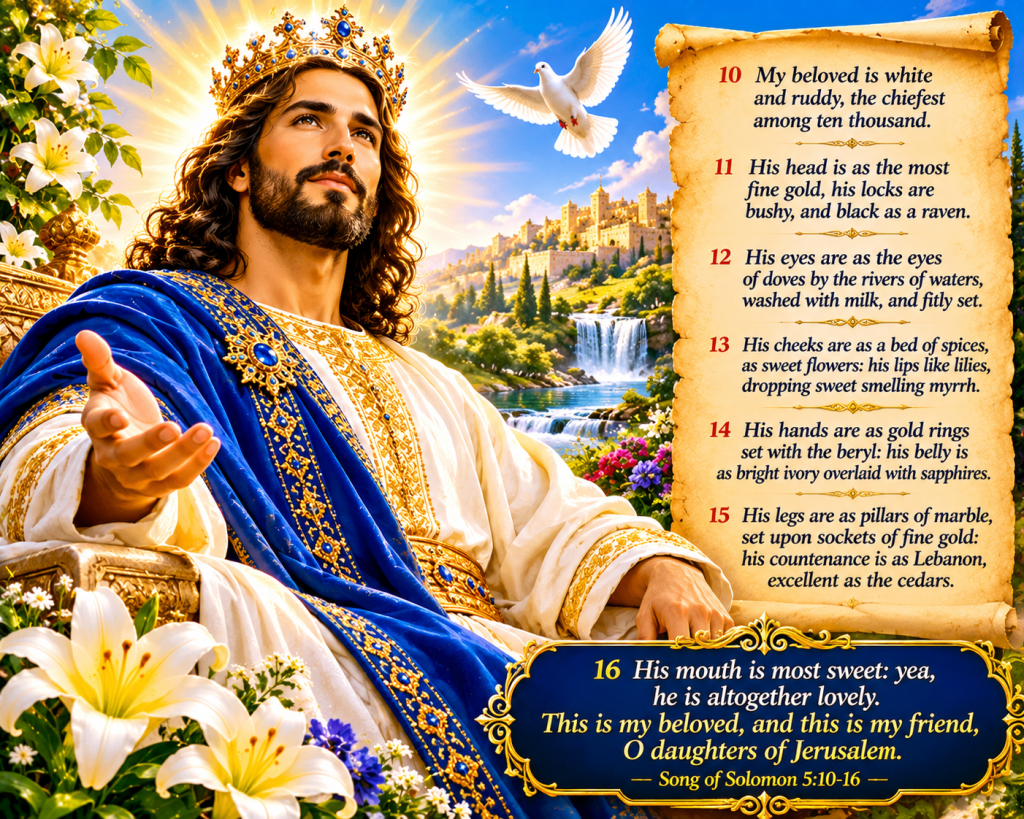
Christ is the King of kings, Incomparable and beyond measure, He surpasses every earthly king, philosopher, ruler, friend, and possession in greatness, wisdom, power, faithfulness, and value. His wisdom is beyond human understanding, His authority is everlasting, and His kingdom shall never pass away.
The world changes its opinions, governments change their rulers, and human wisdom becomes outdated. But the wisdom and authority of Christ remain unshaken.
He is the Head of the Church (Colossians 1:18).
While people judge only by outward appearances and miss your hidden struggles, tears, and silent prayers, the Lord sees straight into your heart. His words bring life to the dying, hope to the hopeless, forgiveness to the repentant, and comfort to the brokenhearted.
When the Lord Jesus spoke, sinners found forgiveness, the sick found healing, and the discouraged found hope. “Come unto me, all ye that labour and are heavy laden, and I will give you rest” (Matthew 11:28).
The powerful, compassionate, and miraculous hands of Jesus, which upheld creation and healed the suffering, were ultimately pierced and nailed to the cross for human salvation.
Hebrews 13:8 declares: “Jesus Christ the same yesterday, and to day, and for ever.” Build your life upon Christ, because everything built upon Him has an eternal foundation. There is no imperfection in Christ. His character is holy, His judgments are righteous, His love is unfailing, and His kingdom is everlasting.
Isaiah 9:6 calls Him: “The mighty God, The everlasting Father, The Prince of Peace.”
He is not a temporary refuge. He is an everlasting dwelling place for those who trust Him. Altogether lovely in His love, mercy, holiness, righteousness, compassion, forgiveness, and faithfulness, He guides us through life’s trials with righteous correction and life-giving, sweet words.
John 6:68 records Peter saying: “Lord, to whom shall we go? thou hast the words of eternal life.”
There is no substitute for Jesus Christ.
The Lord Jesus is not only the King of kings; He is also the Friend of those who belong to Him. The One who created the heavens and the earth invites us into a personal relationship with Him. The One before whom angels bow calls His disciples friends.
John 15:15 says: “Henceforth I call you not servants; for the servant knoweth not what his lord doeth: but I have called you friends.”
He is not a friend who abandons you when difficulties arise. He is the Friend who loved you even when you were still a sinner.
Romans 5:8 reminds us: “But God commendeth his love toward us, in that, while we were yet sinners, Christ died for us.” That is the depth of His love!
The world may have thousands of attractions, but heaven has given us ONE incomparable Beloved!
“As dead flies give perfume a bad smell, so a little folly outweighs wisdom and honour” (Ecclesiastes 10:1).
A good reputation does not happen by accident. It is built drop by drop over a lifetime of discipline, integrity, faithful labor, kindness, and walking in the fear of God. As Scripture reminds us, “A good name is more desirable than great riches; to be esteemed is better than silver or gold” (Proverbs 22:1). Like a perfumer patiently compounding rare spices and oils, wisdom and honor create a soothing, attractive witness that commands respect.
Yet, Solomon warns us never to mistake the smallness of a threat for the magnitude of its damage. He explicitly points to this danger in Ecclesiastes 10:1.
We mistakenly measure foolishness by size. We justify the quick temper because we are stressed, forgetting that “a quick-tempered person does foolish things.” (Proverbs 14:17). We excuse the white lie, the lazy compromise, the greedy shortcut, or the unguarded word because it seems microscopic. We assume a long track record of wisdom acts as an infinite sponge, ready to soak up every minor lapse.
But the jar of ointment does not care that 99% of the oil is pure. A single dead fly rots the entire batch. Your history of integrity cannot insulate you from the consequences of a current compromise. A single hour of carelessness through a hasty tweet, a private concession, or a flash of pride can instantly destroy decades of trusted testimony. Therefore, “above all else, guard your heart, for everything you do flows from it” (Proverbs 4:23).
Guard your life with vigilance; the smallest leak can sink the greatest ship.
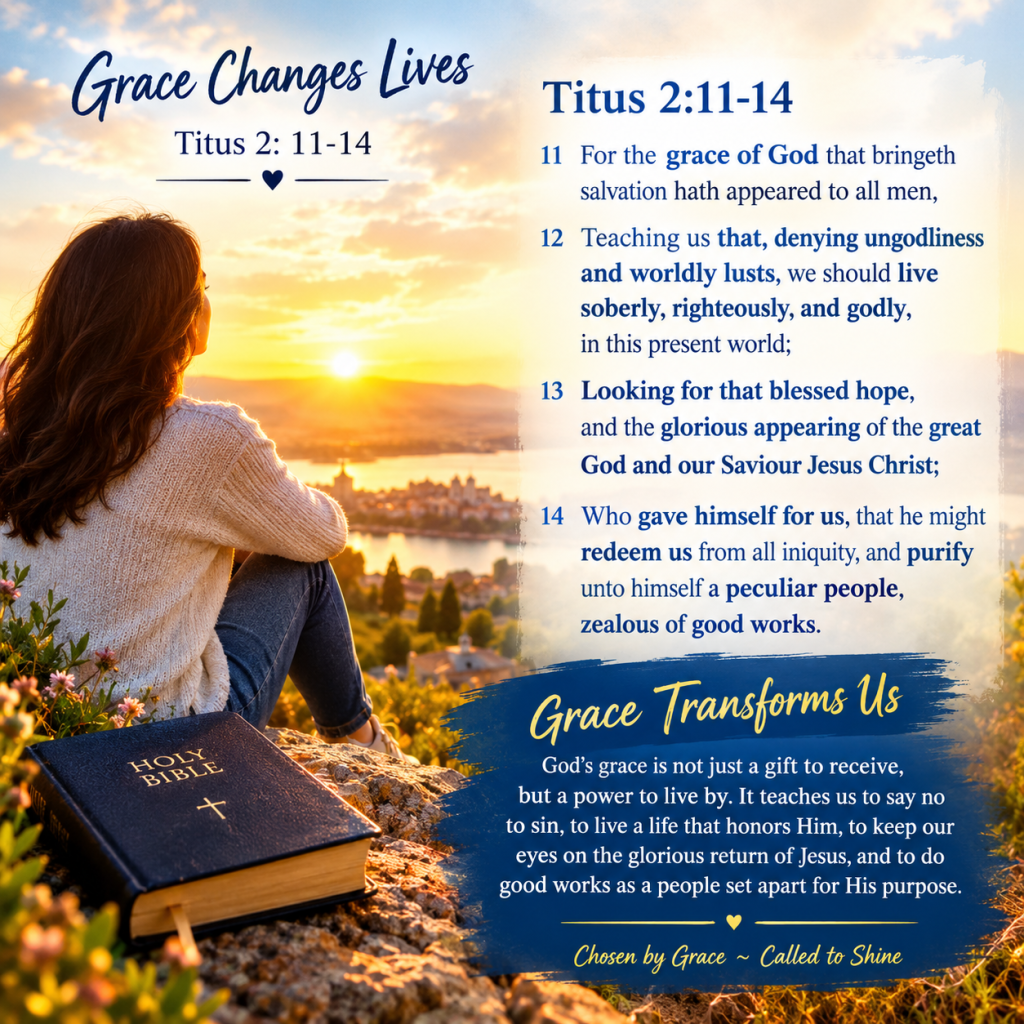
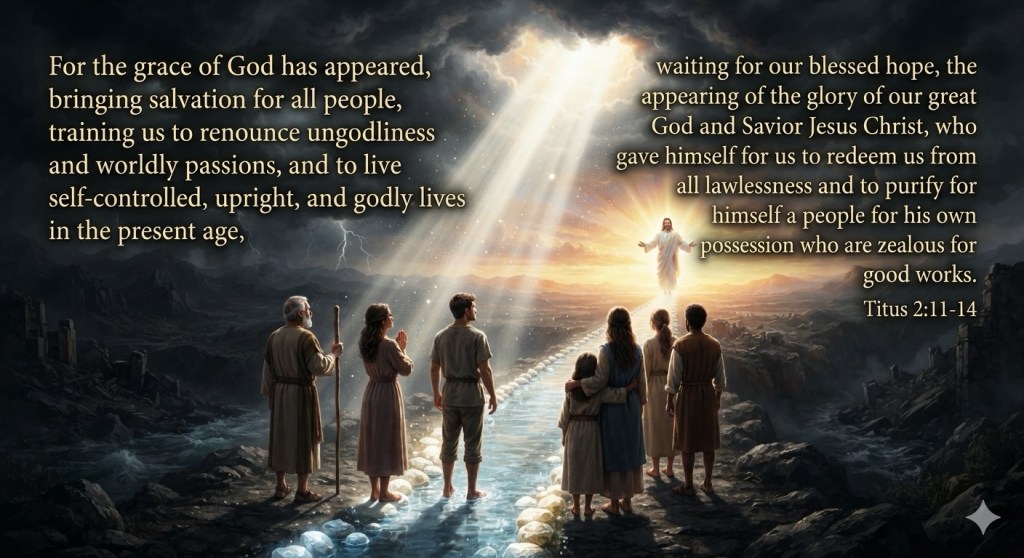
“For the grace of God that bringeth salvation hath appeared to all men, Teaching us that, denying ungodliness and worldly lusts, we should live soberly, righteously, and godly, in this present world; Looking for that blessed hope, and the glorious appearing of the great God and our Saviour Jesus Christ; for us, that he might redeem us from all , and purify unto himself a peculiar people” ( Titus 2: 11-14). God’s grace is the ultimate proof of His immeasurable love for a broken world. Lost in sin and powerless to save ourselves, we were not abandoned. Instead, God gave His only Son, Jesus Christ, as the ultimate sacrifice, a priceless gift we could never earn or buy.
The Cross is the greatest declaration that God desires to save us rather than leave us in our sins. It is a direct invitation to leave the past behind and step into new life.
True surrender changes how we live when no one is watching. Faith cannot be hidden; it must burn brightly through honesty, integrity, justice, mercy, and love. We cannot claim to walk with a righteous God while breaking the hearts of His people.
The true test of our faith is not only how we behave in God’s presence during worship, but how we live when we believe nobody is watching.
We work, we serve, we endure suffering, we forgive, we pray, and we remain faithful because we know that this world is not our final home. Our blessed hope is the return of our Lord Jesus Christ.
Do not become so occupied with the affairs of this world that you forget the King who is coming.
We do not know the day or the hour of His return. Therefore, we must live every day in readiness, keeping our hearts awake to God and our lives faithful to His calling.
The Lord Jesus did not offer a portion of His love. He gave Himself.
He was mocked, rejected, wounded, and crucified. The sinless One bore the burden of our sins so that we might be reconciled to God.
The Cross reveals both the terrible seriousness of sin and the immeasurable greatness of God’s love.
If sin were a small matter, the Son of God would not have needed to suffer and die to redeem us. And if God’s love were small, He would not have given His beloved Son for our salvation.
The Lord Jesus Christ gave Himself not only to rescue us from the penalty of sin but also to redeem us from its bondage.
Redemption means that we no longer need to remain slaves to the sins that once controlled us. Through Christ, we are called to turn away from our former ways and walk in newness of life.
Our lives, time, and talents belong entirely to Him. Every word, decision, relationship, and purpose must align with His leadership.
Today, let us return to the Lord with sincere hearts. Let us surrender our pride, bitterness, jealousy, dishonesty, lust, hatred, and every hidden thing that stands between us and wholehearted obedience to God.
We cannot cleanse ourselves through human strength alone. We need the cleansing mercy of Lord Jesus and the transforming work of the Holy Spirit.
The Lord Jesus gave Himself for us. Let us therefore give our lives to Him not merely with our lips, but with our hearts, our obedience, our love, and our service.
Let us live for the One who died for us, serve the One who redeemed us, and eagerly await the One who is coming again.
For the grace that brings salvation also teaches us how to live and the Saviour who redeemed us is the King whose appearing we await.
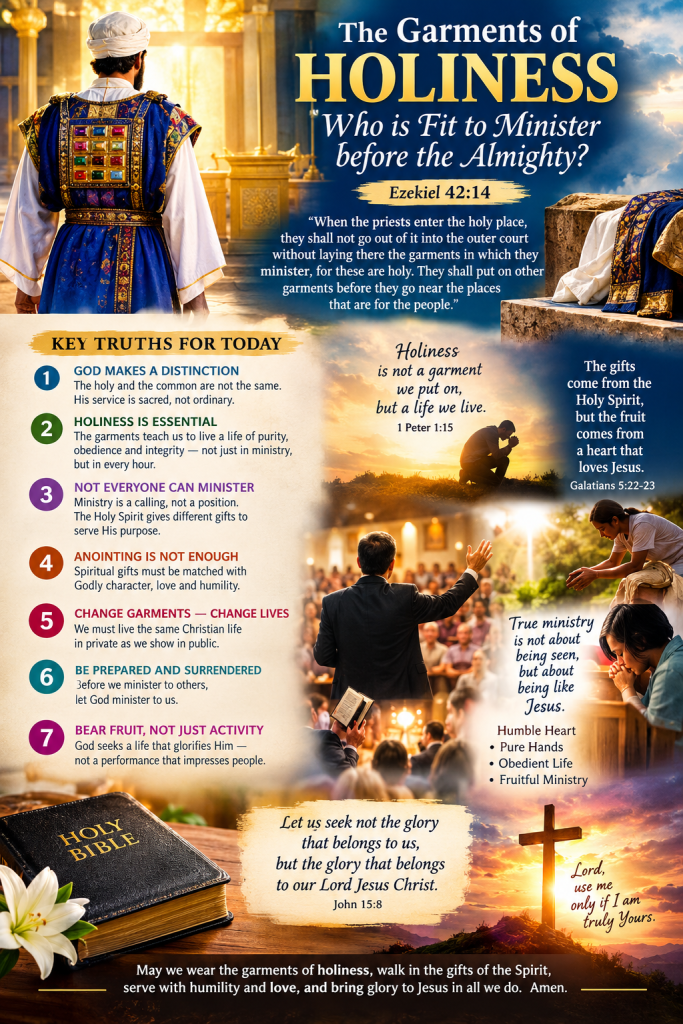
“When the priests enter therein, then shall they not go out of the holy place into the utter court, but there they shall lay their garments wherein they minister; for they are holy; and shall put on other garments, and shall approach to those things which are for the people” (Ezekiel 42:14).
God makes a distinction between the holy and the common.
The Almighty God commanded the priests to wear their sacred garments while ministering in the holy place and to change their garments before approaching the people.
Was God merely concerned about their clothing? Absolutely not! The garments belonged to a ministry that God had set apart for Himself. Their use reminded the priests that they were entering a sacred place to perform sacred duties according to God’s commandments.
The Lord is holy, and His service must never be treated as an ordinary responsibility.
In the Old Testament, the priest did not decide for himself how to approach God. God established the priesthood, prescribed its duties, and gave instructions concerning the garments, sacrifices, and manner of service.
The Lord commanded the prophet Moses: “And thou shalt make holy garments for Aaron thy brother for glory and for beauty” (Exodus 28:2).
Holy garments not merely clothes that distinguished a priest from an ordinary person. They were associated with a sacred calling and a responsibility entrusted by God.
Holiness is a continuous, whole-life commitment to obeying God and reflecting His character in every moment, rather than a temporary performance reserved for Sundays or public ministry.
In 1 Peter 1:15, the Apostle Peter writes: “But as he which hath called you is holy, so be ye holy in all manner of conversation” (1 Peter 1:15).
The true servant of God must seek holiness not merely in the hour of ministry, but in every hour of life. God’s kingdom is not a stage on which everyone competes to be seen. It is a body in which each member serves according to the grace and responsibility entrusted to them.
The Apostle James writes: “Pure religion and undefiled before God and the Father is this, To visit the fatherless and widows in their affliction, and to keep himself unspotted from the world” (James 1:27).
We must not wear one character before the church and another before the world.
Though clothes, responsibilities, and surroundings change, remain committed to Christ and live as His servant at home just as you do in ministry.
True godliness requires matching our everyday conduct with our public ministry, as God desires genuine holiness over performance-based piety.
The same person who worships in the sanctuary must practise patience at home, honesty at work, mercy toward the weak, and humility in ordinary relationships.
The garments of ministry teach us about holiness. Consider the significance of the priests’ garments. Priests wore them only for designated sacred duties and carefully laid them aside afterward; they were not to mix the holy with the common.
The minister of God must understand the difference between being on a platform and being in God’s presence, between possessing a gift and possessing godly character, and between receiving public recognition and being approved by God.
God looks beyond outward appearances. He examines the heart.
“For the LORD seeth not as man seeth; for man looketh on the outward appearance, but the LORD looketh on the heart” (1 Samuel 16:7).
The Apostle Peter describes believers collectively as: “A chosen generation, a royal priesthood, an holy nation, a peculiar people” (1 Peter 2:9).
Under the new covenant, leadership roles vary, but every believer is called to belong to Christ, proclaim His goodness, and follow Him faithfully. Rather than restricting ministry to an elite few, Ezekiel 42:14 shows that true ministry is not self-appointed; it is a divine calling equipped by the Holy Spirit for all believers.
The Lord is able to use imperfect people who humbly submit to Him.
Let the sacred garments of Ezekiel’s priests remind us to walk in our holy calling.
As we leave, let us honor our divine calling by valuing each other’s diverse gifts and living with uncompromising private integrity that matches our public devotion.