
Tag: BE OBEDIENT TO GOD

  • THE VOICE OF YAHWEH AND THE WEIGHT OF OBEDIENCE

    “And the LORD spake unto Moses face to face, as a man speaketh unto his friend” (Exodus 33:11).

    In Numbers 20:7–8, the Lord spoke to Moses: “Take the staff, and gather the assembly together, you and Aaron your brother. Speak to the rock before their eyes, and it will yield its water.”

    God did not ask Moses to raise his hand. He did not ask him to strike the rock as he had years before at Horeb. He gave a precise, specific command: Speak to the rock.

    When the trial is looming before you, when the situation is parched, dry, and impossible, God does not ask for your human effort, your past methods, or your frustration. He asks for your obedience. Speak to the rock. Speak to the mountain. Though it stands high, firm, and unyielding, if you speak the word God commands, the mountain itself will crack, displace, and yield.

    Yet, Moses did not speak. In a moment of haste, pressure, and lingering frustration with a rebellious crowd, Moses raised his hand and struck the rock twice with his rod.

    To human eyes, striking a rock instead of speaking to it seems like a minor oversight, a small mistake born of impatience. After all, water still gushed forth! The people drank. Their thirst was quenched. The ministry seemed successful on the outside. God, in His mercy, still satisfied the needs of His people; He did not forsake them in that moment.

    But in the sacred alignment between God and His prophet, something fundamental was broken.

    Moses had walked with God. He had spoken to Him face to face as a man speaks to his friend. He had demonstrated God’s power in front of hundreds of thousands of people. Because of that close intimacy, Moses was held to a higher standard. His gesture was not a harmless misstep; it was an act of public disobedience and overconfidence that dishonored the sanctity of Yahweh.

    God told Moses immediately after: “Because you did not trust in me enough to honor me as holy in the sight of the Israelites, you will not bring this community into the land I give them”(Numbers 20:12).

    One act of disobedience kept the great deliverer from stepping into the Promised Land.

    From the Garden of Eden to the wilderness of Zin, the primary sin that fractures the relationship between God and humanity has always been disobedience. One disobedience brought a curse upon Adam’s lineage. One disobedience kept Moses from Canaan.

    Where, then, do we stand? We who have disobeyed not once, not twice, but countless times?

    We often treat God with casual familiarity, forgetting who He truly is. But our Lord is a serious God. When He speaks, He expects complete, unquestioning commitment and exact obedience.

    Consider the reality of His Presence. In the throne room of the Almighty, where His majesty extends into infinite height, there is a profound, terrifying silence. It is a quiet so absolute that it strips away all human pretense, pride, and excuses. And out of that holy stillness rings the thunderous voice of Yahweh, reminding us: He is a God to be feared, revered, and obeyed.

    If Moses who led millions out of bondage, through the parted waters, and into breakthrough was called to account for a single impulsive act, are we prepared to stand before Him today?

    We live in a time where grace is often mistaken for permission to compromise. God speaks once, and His words carry eternal weight. We cannot rely on human wisdom or counsel over the direct word of the Almighty.

    Despite hearing God’s voice face to face, Moses frequently sought and took organizational guidance from his father-in-law, Jethro, the priest of Midian.

    Even leaders, prophets, and faithful believers falter when they begin leaning on human advice over divine instruction. Human counsel may seem practical, logical, and efficient, but it can subtly shift our reliance away from the Spirit of God.

    We must return to a posture of total reliance on Yahweh: Men give advice based on logic; God gives commands based on His holiness and sovereign power. 

    Do not move, act, or strike until you have sought Him directly in prayer.

    God is not silent. He speaks through His Word, His Spirit, and His truth. When He gives a directive, our only response must be immediate, full compliance.

    If your time were up today and you were called to face the Great Yahweh, could your foundation stand?

    Do not let frustration drive your actions. Do not let past successes make you overconfident in current trials. When you face an impossible situation today, do not strike in anger or rely on human methods, do what the Lord asks you to do. If He says speak, then speak.

    Let us lay down our self-reliance, repent of our quiet disobedience, and restore a deep, holy reverence for the voice of Almighty God.
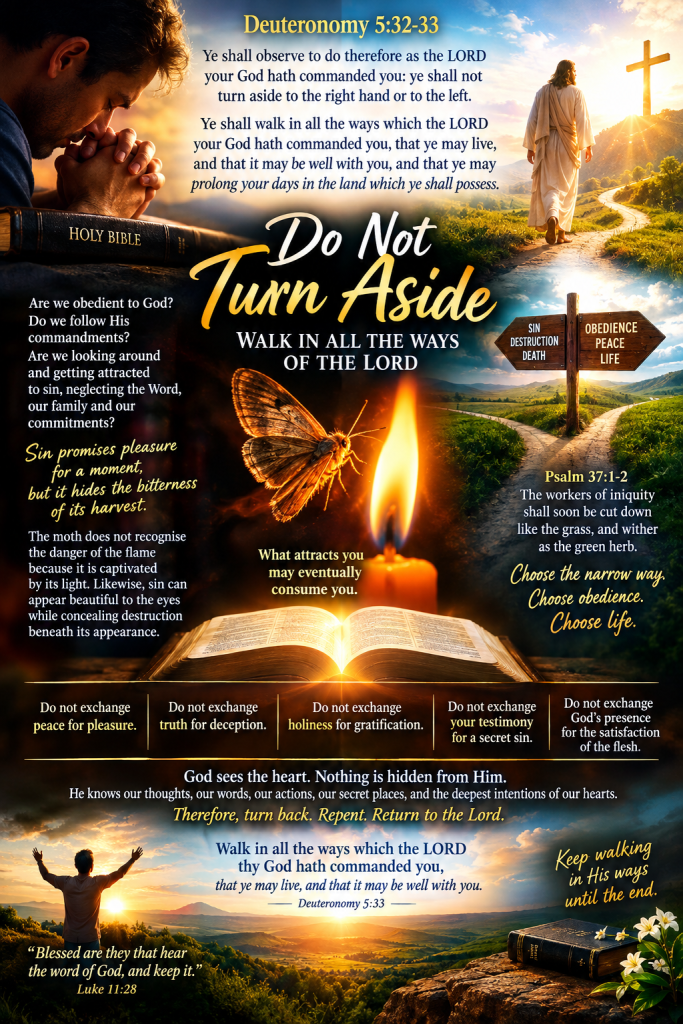

  • DO NOT TURN ASIDE

    “Ye shall observe to do therefore as the LORD your God hath commanded you: ye shall not turn aside to the right hand or to the left. Ye shall walk in all the ways which the LORD your God hath commanded you, that ye may live, and that it may be well with you” (Deuteronomy 5:32, 33).

    The Word of God places a searching question before every soul: Are we truly obedient to God? Are we walking in His ways? Are we keeping His commandments, or have we quietly turned aside?

    God says, “Ye shall walk in all the ways.”

    There is a great danger in turning aside even slightly. A person rarely wakes up one morning and decides to destroy everything that God has entrusted to him. Often, destruction begins with a small compromise, a secret desire, an unchecked thought, a wandering eye, or a craving that is allowed to remain in the heart.

    The eyes begin to look where they should not look. The mind begins to dwell upon what it should reject. The heart begins to desire what God has forbidden. The Word of God is neglected. Prayer becomes less important. Conviction becomes quieter. And eventually, what was once resisted begins to be embraced.

    Sin promises pleasure for a moment, but it hides the bitterness of its harvest.

    Are you looking around and allowing your eyes to become glued to something that is drawing your heart away from God? Are you neglecting the Word, your family, your responsibilities, and the commitments entrusted to you because you are pursuing a temporary craving?

    Be careful. By feeding a temporary desire, you may be starving your own future. You may be damaging the trust of those who love you. You may be allowing promises you once made to quietly dissolve while giving your time, attention, and strength to something that was never sent to bless you.

    The moth does not recognize the danger of the flame because it is captivated by its light. Likewise, sin can appear beautiful to the eyes while concealing destruction beneath its appearance.

    What attracts you may eventually consume you.

    That is why the Lord says: “Ye shall not turn aside to the right hand or to the left.”

    God is calling us back to the straight path.

    Psalm 37:1, 2 reminds us that the workers of iniquity shall soon be cut down like the grass and wither as the green herb. 

    The pleasure of sin is temporary, but its consequences can reach deeply into a person’s life. Therefore, do not exchange what is eternal for what is temporary. Do not exchange peace for pleasure, truth for deception, holiness for gratification, your testimony for a secret sin, and God’s presence for the satisfaction of the flesh.

    Lord Jesus said: “If ye love me, keep my commandments” (John 14:15).

    Obedience is not a way of purchasing God’s love. Rather, obedience is one of the fruits of loving Him. When we truly love the Lord, His Word cannot remain a stranger to us.

    We may face temptation, struggle, stumble, and fall along our journey. But when the Holy Spirit convicts us, we must not harden our hearts. We must repent, rise again, and return to the Lord.

    The greatest danger is not that you have fallen; the greatest danger is becoming comfortable lying on the ground.

    Do not make peace with what God has commanded you to leave, nor mistake your bondage for freedom, darkness for light, compromise for wisdom, or temptation for destiny.

    The enemy would love to make sin appear harmless until the chains become difficult to break. That is why we must “walk in all the ways” of the Lord.

    God’s commandments are not given to destroy our lives. They are given because He knows the path that leads to life. The Lord sees what we cannot by knowing the end from the beginning while we still stand at the start.

    He alone knows where temptation leads, what secret sin costs, which relationships will break, which trust will shatter, which blessings will be lost, and which wounds will linger for years.

    Therefore, when God says “Do not turn aside,” He is not withholding something good from us. He is protecting us from something that will wound us.

    And remember, God sees the heart. Nothing is hidden from Him, the Lord searches us and knows us. Our thoughts, our words, our actions, our secret places, and the deepest intentions of our hearts are known before Him.

    We can never deceive God. Our entire life is open before the One who created us. Therefore, let us examine ourselves honestly.

    What has captured my eyes?

    What occupies my thoughts?

    What am I secretly desiring?

    What am I giving more attention to than God?

    What has become more important to me than His Word?

    Where have I turned aside?

    These are not questions merely for someone else. These are questions for me, for you, and for every soul that claims to follow Christ.

    The answer is not despair. The answer is return.

    “Draw nigh to God, and he will draw nigh to you” (James 4:8).

    Return if your footsteps have wandered afar.
    Rise up if you tripped in the dark.
    Reclaim what was lost where you yielded your heart;
    Rekindle the prayer’s dying spark.

    Unfold the sacred pages once more,
    Where wisdom and promise abide.
    Turn away from the shadows that beckon and pull,
    And rest in the Light as your guide.

    “Looking unto Jesus the author and finisher of our faith” (Hebrews 12:2).

    Do not allow the enemy to convince you that you have wandered too far to return.

    The Shepherd still calls.

    The Father still receives the repentant.

    The mercy of God is still available to the humble heart.

    Today is the day to turn back.

    Step upon the ancient track,

    Where quiet footprints lead us back.

    Turn from the broad and easy street,

    To guide our small and steady feet.

    Let compromise fall fast away,

    And simple truth outshine the day.

    Trade fading joys that burn an hour,

    For quiet grace and holy power.

    Leave empty noise and worldly song,

    To hear where truest echoes long.

    Let passing hungers drift and part,

    As Christ becomes the living heart.

    Let our eyes rest upon the face of Christ, our ears attentive to His Word, our hearts surrendered to His Spirit, our feet established upon His path, and our lives pleasing in His sight. 

    Turn not to the left, nor cast a backward glance. Do not make a covenant with sin. Let no quiet vows bind the soul to shadow.

    Walk where the light is, Walk with God. 

    Hear the voice that calls you home,

    Remain faithful.

    And keep walking in His ways until the end.

    “Blessed are they that hear the word of God, and keep it” (Luke 11:28).

  • THE SERVANT OF CHRIST

    “For do I now persuade men, or God? or do I seek to please men? for if I yet pleased men, I should not be the servant of Christ” (Galatians 1:10).

    The Apostle Paul is essentially asking: “Who is the Master of my life—God or people?” He had been criticized because the Gospel he preached was not designed to make people comfortable. He therefore makes his position unmistakably clear: his responsibility was not to alter God’s message in order to gain people’s approval. If the Apostle Paul had made his preaching softer, changed the truth, or compromised the Gospel simply because people might reject him, then he would no longer be acting as a faithful servant of Christ.

    The Bible teaches us to speak the truth in love, show kindness, live peaceably with others, and treat people with humility and respect. We should never sacrifice God’s truth merely to obtain human approval. There will be moments when doing what is right before God makes someone unhappy with us. The servant has one ultimate Master. A servant cannot have two masters when their instructions conflict. Stand for truth, obey God. If following Christ means losing someone’s approval, we must remember: human approval is temporary, but God’s approval is eternal.

    The Lord Jesus Himself said: “For they loved the praise of men more than the praise of God” (John 12:43). That is a serious warning. We can become so concerned about what people think of us that we gradually become afraid to do what God has called us to do.

    There is freedom in not living for people’s approval. When you constantly try to please people, you can become a prisoner of their opinions:
    You bloom like a flower in the warmth of their praise,
    Then wither away under a critical gaze.
    Anchored and safe in acceptance’s harbor,
    But tossed by rejection into doubt and disorder.

    When your heart becomes settled in Christ, the restless whispers of the world fade away, and you can rise to declare:

    My identity does not come from people’s applause.

    My calling does not come from people’s approval.

    My worth does not come from people’s opinions.

    The Apostle Paul was willing to stand alone. He had something more valuable than popularity: he had a divine commission. He knew that the Gospel was not his invention. Therefore, he could not change it simply to make people happy. This is especially important for anyone who teaches, preaches, writes about the Bible, or shares their faith. We must ask ourselves: “Am I saying this because God has given me truth to speak, or because I want people to praise me?” That question can search the heart deeply.

    A servant of Christ should have courage without arrogance, truth without cruelty, conviction without pride, and boldness with love. The Apostle Paul himself said: “Speaking the truth in love” (Ephesians 4:15). So the Christian’s goal is not to please people at the expense of truth, nor to hurt people in the name of truth. The goal is to please God, speak the truth, walk in love, and remain humble.

    Do not allow the desire to be accepted by people to make you disobedient to God. Doing what is right does not always make you popular. Telling the truth can cause others to misunderstand you. Following Jesus means you walk a narrow path that not everyone likes. You do not live to get praise from others; you live to serve Christ. Listen to God’s quiet whisper. Ask Him to guide your steps and keep your heart faithful. “Lord, what do You want me to do?” Then, whatever the cost, obey Him.

    The ultimate response of a true servant of Christ is: “Lord Jesus, above every human voice, I choose to please You.”

  • BE OBEDIENT TO GOD

    “And being found in fashion as a man, He humbled Himself, and became obedient unto death, even the death of the cross. Wherefore God also hath highly exalted Him, and given Him a name which is above every name: That at the name of Jesus every knee should bow, of things in heaven, and things in earth, and things under the earth; And that every tongue should confess that Jesus Christ is Lord, to the glory of God the Father” (Philippians 2:8,9,10,11).

    Let us be obedient to our calling and ministry, just as the Lord Jesus Christ was obedient to the Father, doing His perfect will.