Tag: BE OBEDIENT TO GOD

  • THE SAVIOUR WHO SUSTAINS

    “Oh, taste and see that the Lord is good! Blessed is the man who takes refuge in him! Oh, fear the Lord, you his saints, for those who fear him have no lack! The young lions suffer want and hunger; but those who seek the Lord lack no good thing” (Psalm 34:8-10).

    In the animal kingdom, the young lion is the apex predator—strong, agile, fierce, and confident in its own power to hunt and conquer. Humans do the same thing. We look at our bank accounts, our resumes, our networks, and our own physical or mental grit, and we think: “I can handle this. I’ve got what it takes.

    King David wrote Psalm 34 not from a palace of comfort, but from a dark cave fleeing for his life, pretending to be insane just to survive. And from that place of total weakness, God gave him a stunning revelation: Even the strongest self-reliant creatures eventually run out of strength, but those who lean on God never run out of grace.

    Lions rely on muscle, strategy, and timing. And there are seasons of droughts, failed hunts, and aging where even the king of beasts comes up empty-handed. Yet, it is during these very seasons that the true resilience of the king is tested, proving that survival is not just about the kill, but the strength to endure and rise again.

    When we depend on our own strength, status, or cleverness, we hit a ceiling. Human resources dry out. Emotional resilience snaps. Financial stability shifts.

    “Cursed is the man who trusts in man and makes flesh his strength, whose heart turns away from the Lord” (Jeremiah 17:5).

    God acts as a loving Father who withholds what is destructive and supplies what is truly best.

    “Seek first the kingdom of God and his righteousness, and all these things will be added to you” (Matthew 6:33).

    “And my God will supply every need of yours according to his riches in glory in Christ Jesus” (Philippians 4:19).

    You cannot argue your way into trusting God; you have to test and surrender to Him. Drop the pretense of your own power. Bring your hunger, your fear, and your empty hands to the table of the Almighty.

    When you seek Him first, you will find that He isn’t just a provider—He is the provision.
  • SET LIKE FLINT: WALKING IN UNSHAKABLE RESOLVE

    “For the Lord GOD will help me; therefore shall I not be confounded: therefore have I set my face like a flint, and I know that I shall not be ashamed” (Isaiah 50:7).

    The word Adonai (Sovereign Lord) reminds us that God sits above every earthly trial, every critic, and every obstacle. When human support falls away, the Creator of the universe steps in as our helper.

    Fear thrives in isolation. But when we recognize who is standing with us, the shifting opinions of the world lose their power to paralyze us.

    Flint is a hard, dense, quartz-like stone. In the ancient world, it was durable enough to create sparks and withstand heavy impact. To set one’s face like flint means to become utterly resolute, unyielding, and focused.

    A face set like flint does not gaze longingly at comfort, nor does it look left and right in panic. It looks straight ahead toward the calling and purpose God has set before it.

    Pressure tries to bend us. Trials try to break us. But a heart anchored in God’s truth develops an inner fortitude that no external circumstance can shatter.

    The world might try to humiliate, mock, or marginalize those who stand for righteousness. But earthly disgrace is temporary; divine vindication is eternal.

    Ultimately, these words find their fullest fulfillment in Lord Jesus Christ. As He resolutely set His face to go to Jerusalem, enduring the cross and scorning its shame, He trusted completely in the Father’s ultimate vindication. Because He stood firm, we too share in His victory.

    Do not rely on your own fleeting strength. Look upward to the Sovereign Lord who helps you. Anchor your soul in His promises, set your face forward with unwavering courage, and walk-in the quiet, unshakable confidence that you will never be put to shame.  

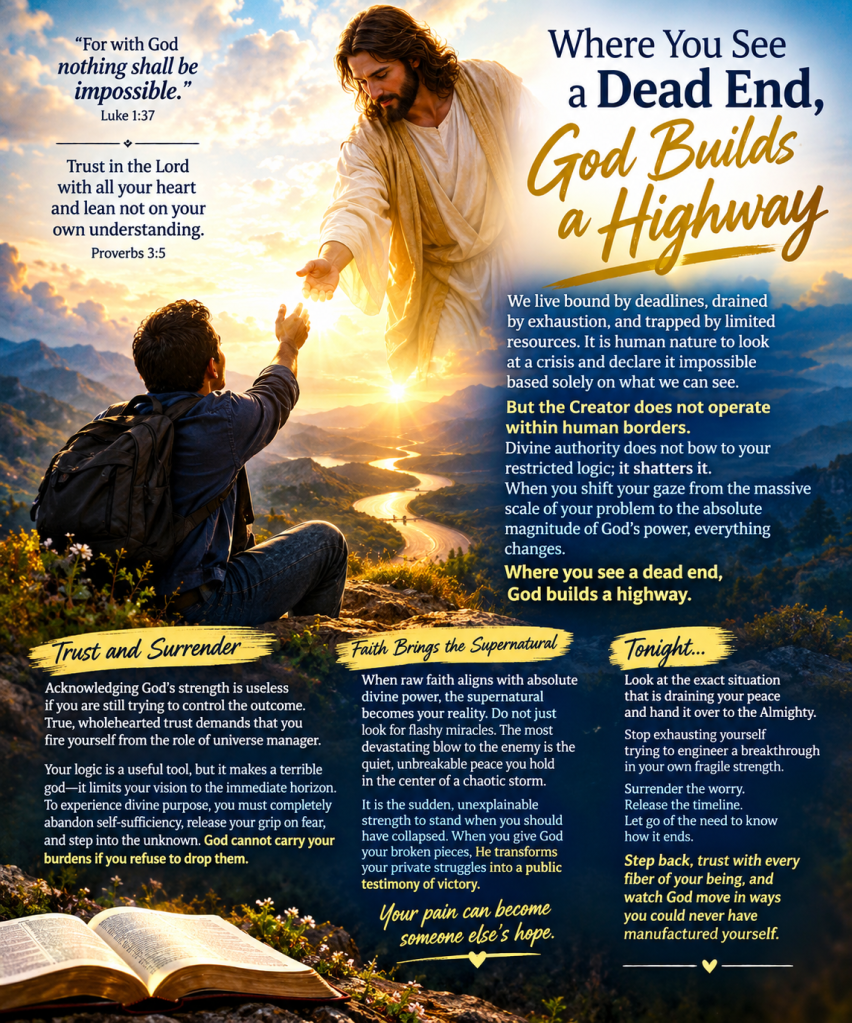
  • WHERE YOU SEE A DEAD END, GOD BUILDS A HIGHWAY

    “For with God nothing shall be impossible” (Luke 1:37).
     “Trust in the Lord with all your heart and lean not on your own understanding” (Proverbs 3:5).

    We live bound by deadlines, drained by exhaustion, and trapped by limited resources. It is human nature to look at a crisis and declare it impossible based solely on what we can see. But the Creator does not operate within human borders. Divine authority does not bow to your restricted logic; it shatters it.

    When you shift your gaze from the massive scale of your problem to the absolute magnitude of God’s power, everything changes. Where you see a dead end, God builds a highway.

    Acknowledging God’s strength is useless if you are still trying to control the outcome.

    True, wholehearted trust demands that you fire yourself from the role of universe manager. Your logic is a useful tool, but it makes a terrible god, it limits your vision to the immediate horizon.

    To experience divine purpose, you must completely abandon self-sufficiency, release your grip on fear, and step into the unknown. God cannot carry your burdens if you refuse to drop them.

    When raw faith aligns with absolute divine power, the supernatural becomes your reality.

    The most devastating blow to the enemy is the quiet, unbreakable peace you hold in the center of a chaotic storm. It is the sudden, unexplainable strength to stand when you should have collapsed. When you give God your broken pieces, He transforms your private struggles into a public testimony of victory.

    Look at the exact situation that is draining your peace and hand it over to the Almighty.

    Stop exhausting yourself trying to engineer a breakthrough in your own fragile strength. Surrender the worry. Release the timeline.

    Let go of the need to know how it ends.

    Step back, trust with every fiber of your being, and watch God move in ways you could never have manufactured yourself.

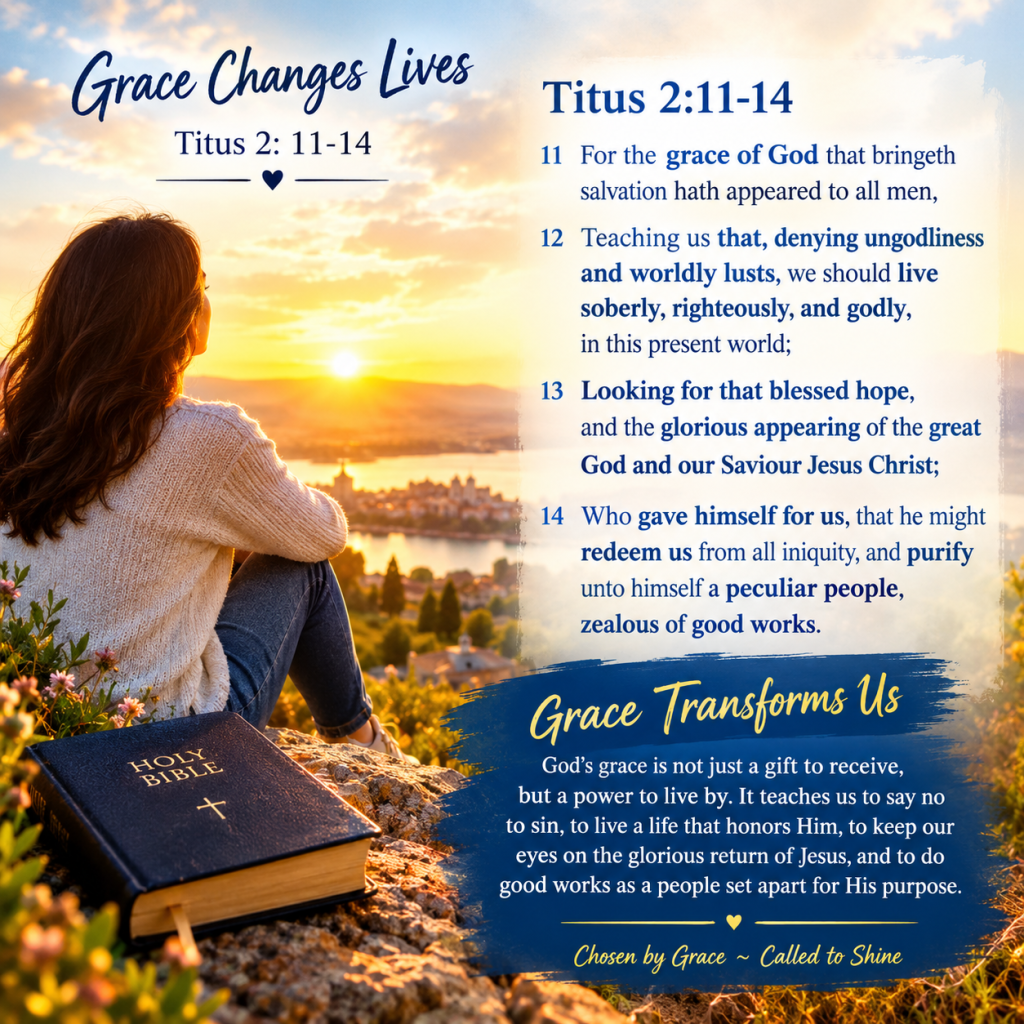
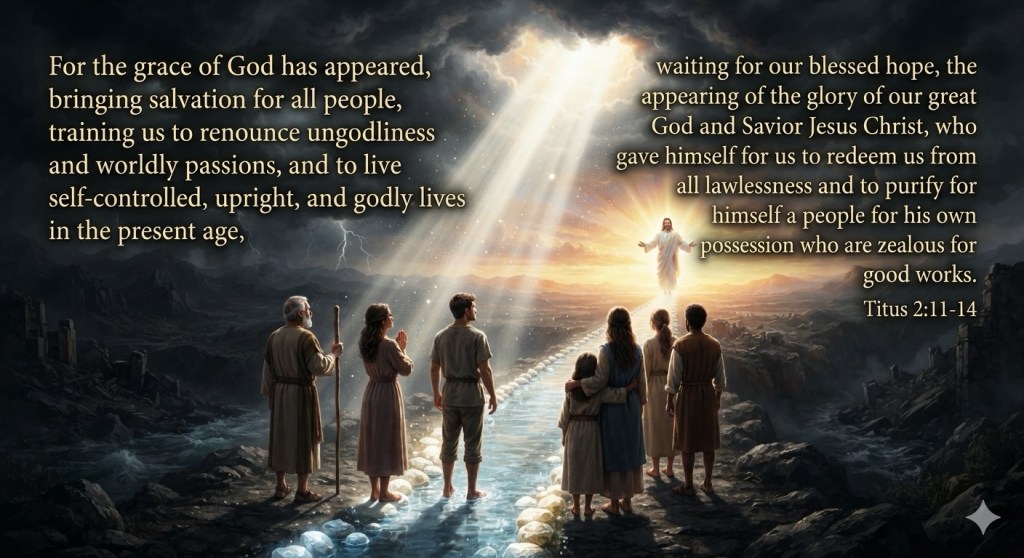
  • THE GRACE THAT SAVES, TRANSFORMS, AND PREPARES US FOR GLORY

    “For the grace of God that bringeth salvation hath appeared to all men, Teaching us that, denying ungodliness and worldly lusts, we should live soberly, righteously, and godly, in this present world; Looking for that blessed hope, and the glorious appearing of the great God and our Saviour Jesus Christ; for us, that he might redeem us from all , and purify unto himself a peculiar people” ( Titus 2: 11-14).
    God’s grace is the ultimate proof of His immeasurable love for a broken world. Lost in sin and powerless to save ourselves, we were not abandoned. Instead, God gave His only Son, Jesus Christ, as the ultimate sacrifice, a priceless gift we could never earn or buy.

    The Cross is the greatest declaration that God desires to save us rather than leave us in our sins. It is a direct invitation to leave the past behind and step into new life.

    True surrender changes how we live when no one is watching. Faith cannot be hidden; it must burn brightly through honesty, integrity, justice, mercy, and love. We cannot claim to walk with a righteous God while breaking the hearts of His people.

    The true test of our faith is not only how we behave in God’s presence during worship, but how we live when we believe nobody is watching.

    We work, we serve, we endure suffering, we forgive, we pray, and we remain faithful because we know that this world is not our final home. Our blessed hope is the return of our Lord Jesus Christ.

    Do not become so occupied with the affairs of this world that you forget the King who is coming.

    We do not know the day or the hour of His return. Therefore, we must live every day in readiness, keeping our hearts awake to God and our lives faithful to His calling.

    The Lord Jesus did not offer a portion of His love. He gave Himself.

    He was mocked, rejected, wounded, and crucified. The sinless One bore the burden of our sins so that we might be reconciled to God.

    The Cross reveals both the terrible seriousness of sin and the immeasurable greatness of God’s love.

    If sin were a small matter, the Son of God would not have needed to suffer and die to redeem us. And if God’s love were small, He would not have given His beloved Son for our salvation.

    The Lord Jesus Christ gave Himself not only to rescue us from the penalty of sin but also to redeem us from its bondage.

    Redemption means that we no longer need to remain slaves to the sins that once controlled us. Through Christ, we are called to turn away from our former ways and walk in newness of life.

    Our lives, time, and talents belong entirely to Him. Every word, decision, relationship, and purpose must align with His leadership.

    Today, let us return to the Lord with sincere hearts. Let us surrender our pride, bitterness, jealousy, dishonesty, lust, hatred, and every hidden thing that stands between us and wholehearted obedience to God.

    We cannot cleanse ourselves through human strength alone. We need the cleansing mercy of Lord Jesus and the transforming work of the Holy Spirit.

    The Lord Jesus gave Himself for us. Let us therefore give our lives to Him not merely with our lips, but with our hearts, our obedience, our love, and our service.

    Let us live for the One who died for us, serve the One who redeemed us, and eagerly await the One who is coming again.

    For the grace that brings salvation also teaches us how to live and the Saviour who redeemed us is the King whose appearing we await.

    .

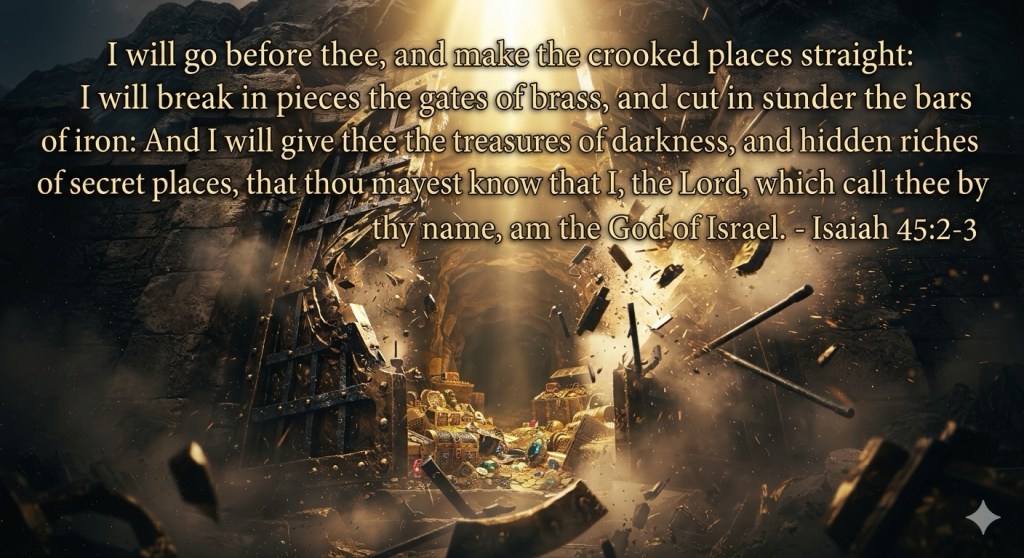
  • THE GOD WHO GOES BEFORE YOU

    No matter what walls stand in front of you today, remember that you do not walk alone.

    The God who creates galaxies is already stepping into your tomorrow. He is moving ahead of you to level the rough ground, shatter the heavy gates of copper, and cut through the iron bars that have kept you feeling trapped or stuck.

    When you find yourself in a season of waiting or walking through deep shadows, don’t despair. God does not waste the dark places—He hides his greatest treasures there. He is preparing to reveal riches of wisdom, strength, and resilience that you could never have discovered in the light.

    He knows your trials, He knows your struggles, and most importantly, He knows your name. You are deeply seen, powerfully protected, and intimately loved by the God who breaks through for you.

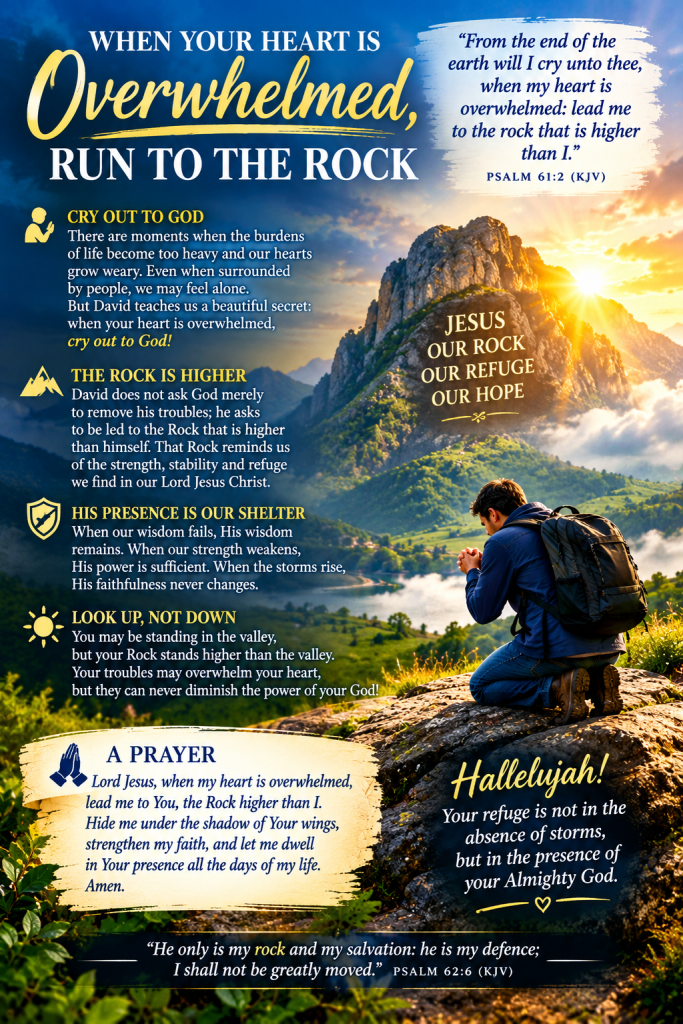
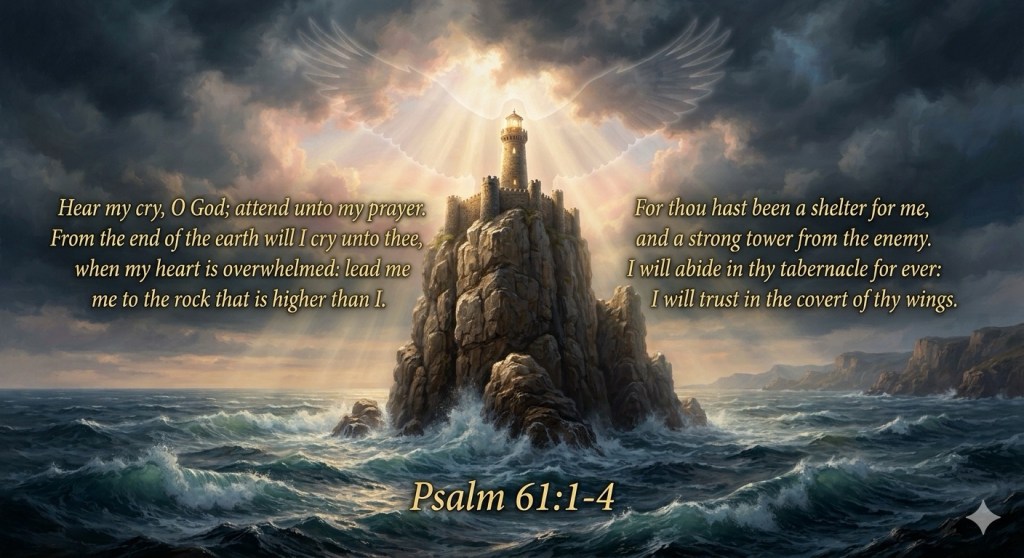
  • WHEN YOUR HEART IS OVERWHELMED, RUN TO THE ROCK THAT IS HIGHER THAN YOU

    “Lead me to the rock that is higher than I” (Psalm 61:2).

    King David wasn’t sitting comfortably on his throne. He was a fugitive, fleeing from his own son Absalom, feeling isolated as if he were at the “end of the earth.” Yet, in the middle of his deepest crisis, David models a brilliant, multi-stage strategy for spiritual survival. He shows us exactly what to do when our hearts are overwhelmed.

    He gave God a raw honest cry. God is never offended by your tears or distant from your isolation.

    When the burdens of life become too heavy, our hearts grow weary, and our strength seems to disappear. Even when surrounded by people, we may feel alone in our struggles. But David teaches us a beautiful secret: when your heart is overwhelmed, cry out to God!

    David does not ask God merely to remove his troubles; he asks to be led to the Rock that is higher than himself. That Rock reminds us of the strength, stability, and refuge we find in our Lord Jesus Christ. When our wisdom fails, His wisdom remains. When our strength weakens, His power is sufficient. When the storms rise, His faithfulness never changes.

    God is not only your refuge in times of trouble; He is your shelter from the storm and your safe dwelling place. Do not allow your circumstances to silence your prayers. The very moment you feel you cannot go any further is the moment to lift your eyes towards the One who can carry you.

    You may be standing in the valley, but your Rock stands higher than the valley. Your troubles may overwhelm your heart, but they can never diminish the power of your God!

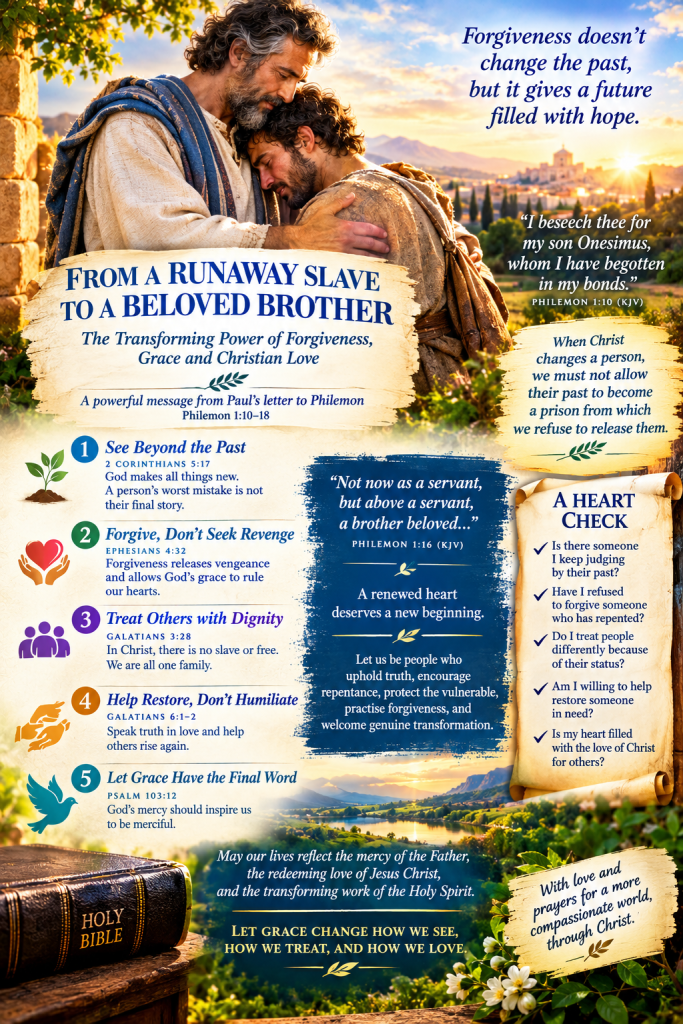
  • ONESIMUS: A RUNAWAY SLAVE TO A BELOVED BROTHER

    The Apostle Paul wrote to Philemon, it is a message about forgiveness, restoration, dignity, brotherhood, and the transforming power of the Gospel.

    The Gospel challenges worldly pride by establishing that all people are equal and deeply valued in Christ,

    Onesimus, a man who had been separated from Philemon and was now connected with Paul during his imprisonment. Onesimus had become a Christian through Paul’s ministry. Paul sends him back to Philemon with a heartfelt appeal: receive him differently not merely according to his past, but in the light of what Christ has done in his life.

    “I beseech thee for my son Onesimus, whom I have begotten in my bonds” (Philemon 1:10).

    The Apostle Paul introduces Onesimus has his own son. In his letter to Philemon, Paul urges him to welcome his runaway servant, Onesimus, not as property, but as an equal, beloved brother in faith.

    By offering to personally pay any debts Onesimus owes, the Apostle Paul mirrors the redeeming, sacrificial love of Jesus Christ. Ultimately, true Christian love goes beyond judging the faults of others, it actively seeks to restore, protect dignity, and guide others toward healing.

    True Christian fellowship requires gentle restoration rather than permanent condemnation. 

    “Be kindly affectioned one to another with brotherly love; in honour preferring one another” (Romans 12: 10).

    We must never allow worldly status to become more important than the love, dignity, and spiritual unity that we are called to share in Christ.

    The greatest test of Christian love is how we treat those who have wronged us.

    A person’s past may explain where they have been, but it does not have to determine where they can go with God. Let us never forget: the grace that rescued us is the same grace that can transform another person.

    The letter does not tell us explicitly how Philemon ultimately responded, but Paul’s appeal leaves us with a lasting challenge: will we allow the love of Christ to change the way we receive people who have a troubled past?

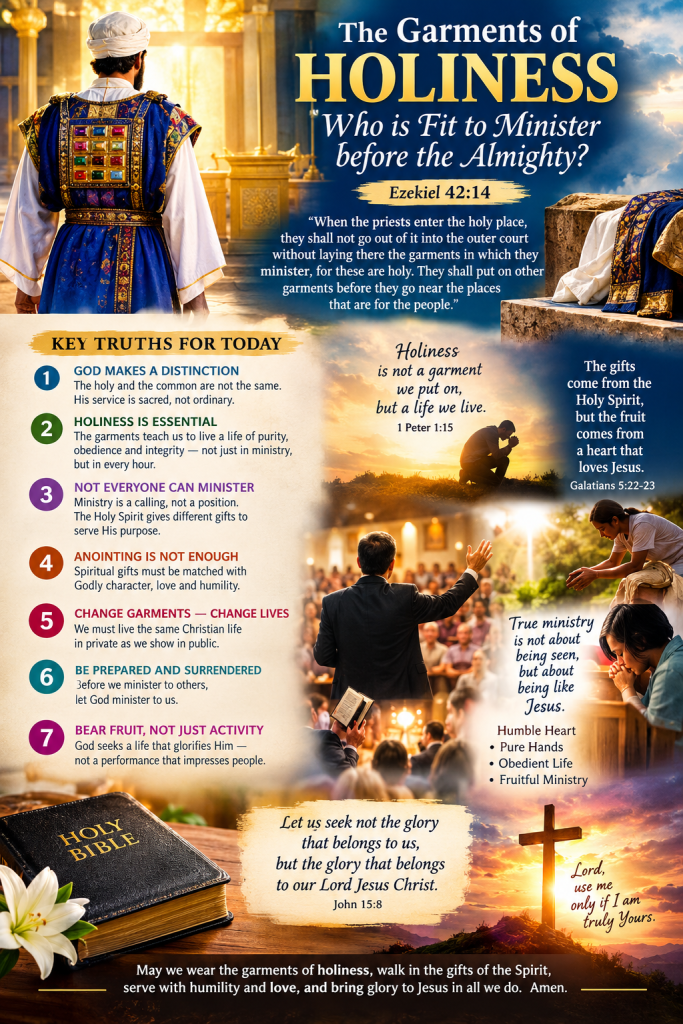
  • THE GARMENTS OF HOLINESS

    “When the priests enter therein, then shall they not go out of the holy place into the utter court, but there they shall lay their garments wherein they minister; for they are holy; and shall put on other garments, and shall approach to those things which are for the people” (Ezekiel 42:14).

    God makes a distinction between the holy and the common.

    The Almighty God commanded the priests to wear their sacred garments while ministering in the holy place and to change their garments before approaching the people.

    Was God merely concerned about their clothing? Absolutely not! The garments belonged to a ministry that God had set apart for Himself. Their use reminded the priests that they were entering a sacred place to perform sacred duties according to God’s commandments.

    The Lord is holy, and His service must never be treated as an ordinary responsibility.

    In the Old Testament, the priest did not decide for himself how to approach God. God established the priesthood, prescribed its duties, and gave instructions concerning the garments, sacrifices, and manner of service.

    The Lord commanded the prophet Moses: “And thou shalt make holy garments for Aaron thy brother for glory and for beauty” (Exodus 28:2).

    Holy garments not merely clothes that distinguished a priest from an ordinary person. They were associated with a sacred calling and a responsibility entrusted by God.

    Holiness is a continuous, whole-life commitment to obeying God and reflecting His character in every moment, rather than a temporary performance reserved for Sundays or public ministry.

    In 1 Peter 1:15, the Apostle Peter writes: “But as he which hath called you is holy, so be ye holy in all manner of conversation” (1 Peter 1:15).

    The true servant of God must seek holiness not merely in the hour of ministry, but in every hour of life. God’s kingdom is not a stage on which everyone competes to be seen. It is a body in which each member serves according to the grace and responsibility entrusted to them.

    The Apostle James writes: “Pure religion and undefiled before God and the Father is this, To visit the fatherless and widows in their affliction, and to keep himself unspotted from the world” (James 1:27).

    We must not wear one character before the church and another before the world.

    Though clothes, responsibilities, and surroundings change, remain committed to Christ and live as His servant at home just as you do in ministry.

    True godliness requires matching our everyday conduct with our public ministry, as God desires genuine holiness over performance-based piety.

    The same person who worships in the sanctuary must practise patience at home, honesty at work, mercy toward the weak, and humility in ordinary relationships.

    The garments of ministry teach us about holiness. Consider the significance of the priests’ garments. Priests wore them only for designated sacred duties and carefully laid them aside afterward; they were not to mix the holy with the common.

    The minister of God must understand the difference between being on a platform and being in God’s presence, between possessing a gift and possessing godly character, and between receiving public recognition and being approved by God.

    God looks beyond outward appearances. He examines the heart.

    “For the LORD seeth not as man seeth; for man looketh on the outward appearance, but the LORD looketh on the heart” (1 Samuel 16:7).

    The Apostle Peter describes believers collectively as: “A chosen generation, a royal priesthood, an holy nation, a peculiar people” (1 Peter 2:9).

    Under the new covenant, leadership roles vary, but every believer is called to belong to Christ, proclaim His goodness, and follow Him faithfully. Rather than restricting ministry to an elite few, Ezekiel 42:14 shows that true ministry is not self-appointed; it is a divine calling equipped by the Holy Spirit for all believers.

    The Lord is able to use imperfect people who humbly submit to Him. 

    Let the sacred garments of Ezekiel’s priests remind us to walk in our holy calling.

    As we leave, let us honor our divine calling by valuing each other’s diverse gifts and living with uncompromising private integrity that matches our public devotion.

  • IS ANYTHING TOO HARD FOR GOD?

    “Behold, I am the LORD, the God of all flesh: is there any thing too hard for me?” (Jeremiah 32:27)

    When the prophet Jeremiah received this word, he wasn’t sitting in a quiet sanctuary or enjoying a peaceful life; he was confined in a courtyard while his nation was under siege. Jerusalem was surrounded by the enemy, chaos reigned, and the future looked utterly hopeless.

    Yet, right in the middle of a siege, God asked Jeremiah to buy a plot of land, a move that made no logical sense in human terms.

    Why buy land in a nation about to be destroyed? God was showing the prophet that human circumstance does not limit Divine Sovereignty. He saw the grief, the uncertainty, and the impossibility of the moment, and He stepped in with a declaration that echoes down through the centuries to us today.

    God says to the prophet Jeremiah that He is Yahweh, the self-existent, eternal God who holds the universe together by the power of His word. He is the Creator of every human heart, every breath we take, and every circumstance we face. There is no heart too hard for Him to soften, no body too weak for Him to strengthen, and no situation too complex for Him to untangle. While human weakness makes life’s problems look like towering mountains, God’s almighty presence dissolves those same obstacles like wax.

    God poses a rhetorical question: “Is there anything too hard for Me?”

    It is a question meant to arrest your doubts. God is inviting you to bring your absolute hardest problem, your deepest sorrow, and your most stubborn impossibility, and lay it side by side with His Almighty Power.

    Heaven is silent, yet God remains limitless. The prophet Jeremiah had to buy that field in faith before he saw the restoration. Likewise, God invites you today to step out in faith. Stop measuring God’s ability by your human capacity. Never accept the narrative that you have come to a dead end. When you cannot see a way forward, remember that God does not just find a way, He creates a way.

    If you face an impossible mountain today, let the truth of Jeremiah 32:27 settle into your soul: look past your circumstances and fix your eyes upon your Redeemer. He is the God who opens paths through the sea, commands the sunrise, and brings dead things back to life. Nothing in your life is beyond His reach, and no prayer you whisper is beyond His power.

  • THE QUIET SANCTUARY

    Meeting God in the middle of the night.

    “I remember your name in the night, O Lord, and I keep your law.” (Psalm 119:55).

    In the quiet of the night, our deepest emotions surface without the noise of daily distractions. The stillness of midnight was not a burden for the psalmist, but it was a sacred sanctuary for devotion.

    When you focus on who God is, your perspective shifts. The night ceases to feel lonely or overwhelming because you are reminded that the Creator of the universe is watching over you. Remembering His character gives you the strength to stand firm and keep His word, even when the path ahead seems unclear.

    Remembering God’s name in scripture means anchoring your mind in His full character, past faithfulness, mercy, and sovereign power rather than just recalling a title.

    “At midnight I will rise to give thanks unto thee, because of your righteous judgments” (Psalm 119:62).

    Slipping out of a warm bed in the middle of the night while the rest of the world sleeps requires a real effort that you intentionally choose to make, serving as an act of pure love and a sacrifice of physical comfort made simply to spend time in God’s presence. 

    Spending time with God in the quiet hours, when absolutely no one else is watching, builds a deep, private foundation of faith. This hidden intimacy is what will sustain you and give you strength during life’s unexpected storms.