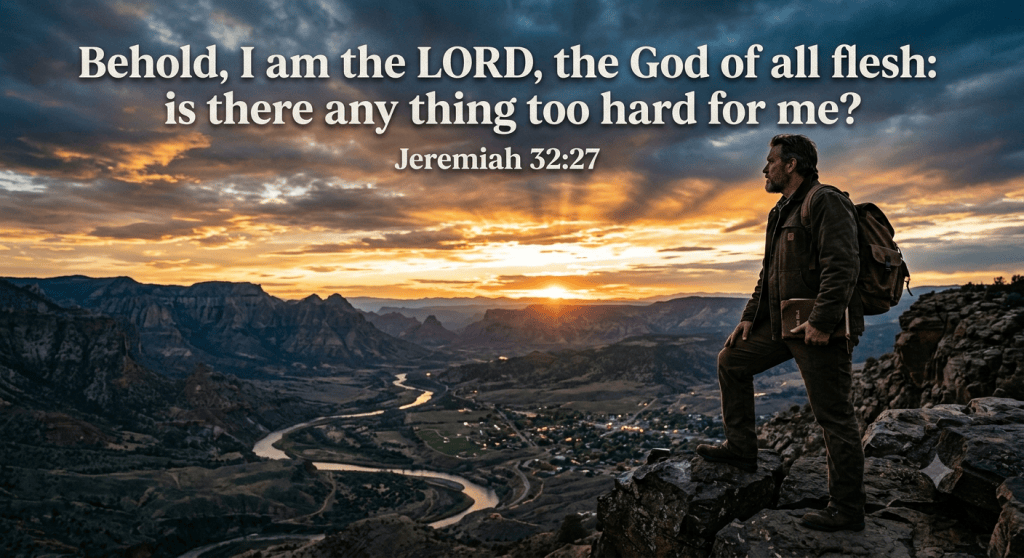
“Behold, I am the LORD, the God of all flesh: is there any thing too hard for me?” (Jeremiah 32:27)
When the prophet Jeremiah received this word, he wasn’t sitting in a quiet sanctuary or enjoying a peaceful life; he was confined in a courtyard while his nation was under siege. Jerusalem was surrounded by the enemy, chaos reigned, and the future looked utterly hopeless.
Yet, right in the middle of a siege, God asked Jeremiah to buy a plot of land, a move that made no logical sense in human terms.
Why buy land in a nation about to be destroyed? God was showing the prophet that human circumstance does not limit Divine Sovereignty. He saw the grief, the uncertainty, and the impossibility of the moment, and He stepped in with a declaration that echoes down through the centuries to us today.
God says to the prophet Jeremiah that He is Yahweh, the self-existent, eternal God who holds the universe together by the power of His word. He is the Creator of every human heart, every breath we take, and every circumstance we face. There is no heart too hard for Him to soften, no body too weak for Him to strengthen, and no situation too complex for Him to untangle. While human weakness makes life’s problems look like towering mountains, God’s almighty presence dissolves those same obstacles like wax.
God poses a rhetorical question: “Is there anything too hard for Me?”
It is a question meant to arrest your doubts. God is inviting you to bring your absolute hardest problem, your deepest sorrow, and your most stubborn impossibility, and lay it side by side with His Almighty Power.
Heaven is silent, yet God remains limitless.The prophet Jeremiah had to buy that field in faith before he saw the restoration. Likewise, God invites you today to step out in faith. Stop measuring God’s ability by your human capacity. Never accept the narrative that you have come to a dead end. When you cannot see a way forward, remember that God does not just find a way, He creates a way.
If you face an impossible mountain today, let the truth of Jeremiah 32:27 settle into your soul: look past your circumstances and fix your eyes upon your Redeemer. He is the God who opens paths through the sea, commands the sunrise, and brings dead things back to life. Nothing in your life is beyond His reach, and no prayer you whisper is beyond His power.
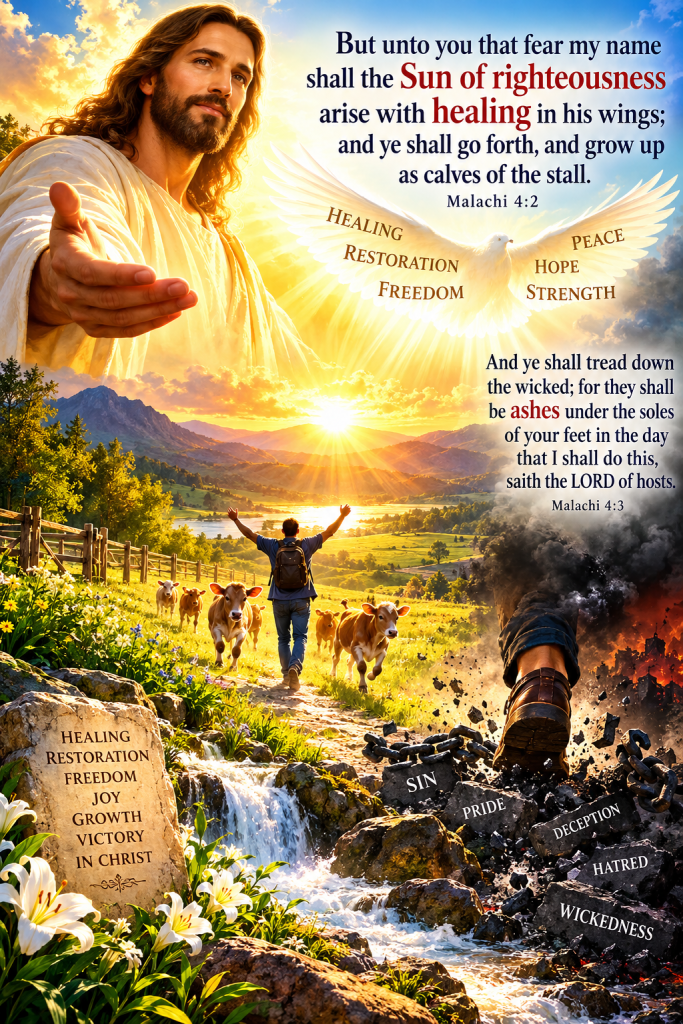
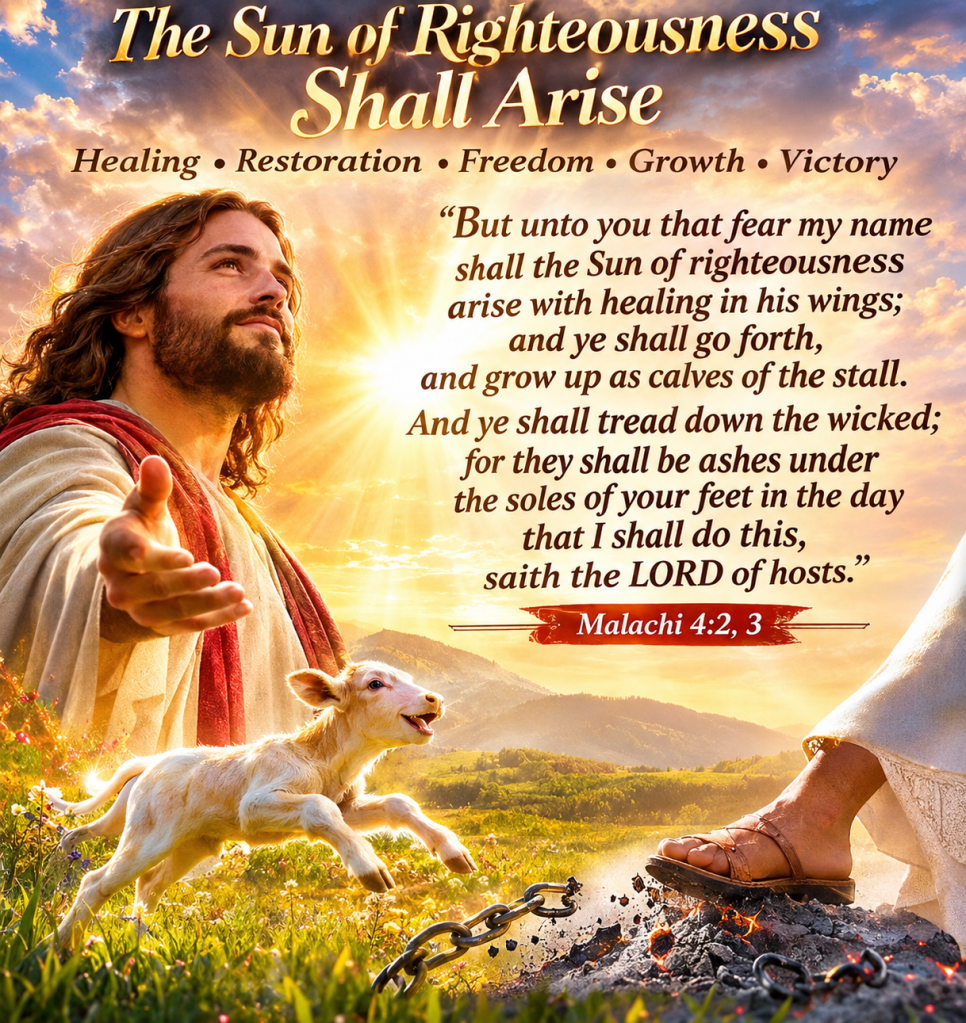
“But unto you that fear my name shall the Sun of righteousness arise with healing in his wings; and ye shall go forth, and grow up as calves of the stall. And ye shall tread down the wicked; for they shall be ashes under the soles of your feet in the day that I shall do this, saith the LORD of hosts” ( Malachi 4:2, 3).
The Lord Jesus declared: “I am the light of the world: he that followeth me shall not walk in darkness, but shall have the light of life” (John 8:12).
When the Sun of Righteousness rises, darkness, despair, sin, and the grave lose their power. Your strength and circumstances may fail you, but God’s faithfulness never will.
Do not mistake a dark season for God’s absence; just as clouds cannot destroy the sun, your current struggles cannot hide His presence or stop His work. Keep your eyes on Lord Jesus, our Light and our Salvation.
The Lord can restore the hidden, unseen wounds of the heart caused by betrayal, rejection, loss, regret, guilt, fear, and disappointment.
Psalm 147:3 declares: “He healeth the broken in heart, and bindeth up their wounds.”
God heals the inner spirit, restores hope and courage, and works alongside medical care to mend every hidden brokenness and burden of the heart.
Your past and the opinions of others do not dictate your future when you turn to God in repentance and faith.
The Lord Jesus said in John 8:36: “If the Son therefore shall make you free, ye shall be free indeed.”
God’s people will experience joyful freedom, renewed strength, and abundant life, much like calves bursting energetically from their stalls after being confined to a narrow space.
A Christian life should not remain spiritually immature forever. We are called to grow in faith, wisdom, holiness, love, and knowledge of our Lord Jesus Christ.
Second Peter 3:18 says: “But grow in grace, and in the knowledge of our Lord and Saviour Jesus Christ.”
Do not be content with merely knowing about Jesus. Seek to know Him more deeply through His Word, prayer, worship, repentance, and obedience.
Let Christ’s light fill your heart, His truth guide your thoughts, and His love shape your actions. May your life prove that His hope cannot be quenched by darkness. The Sun of Righteousness rises, bringing His light as our hope, His grace as our strength, and His victory as our certainty.
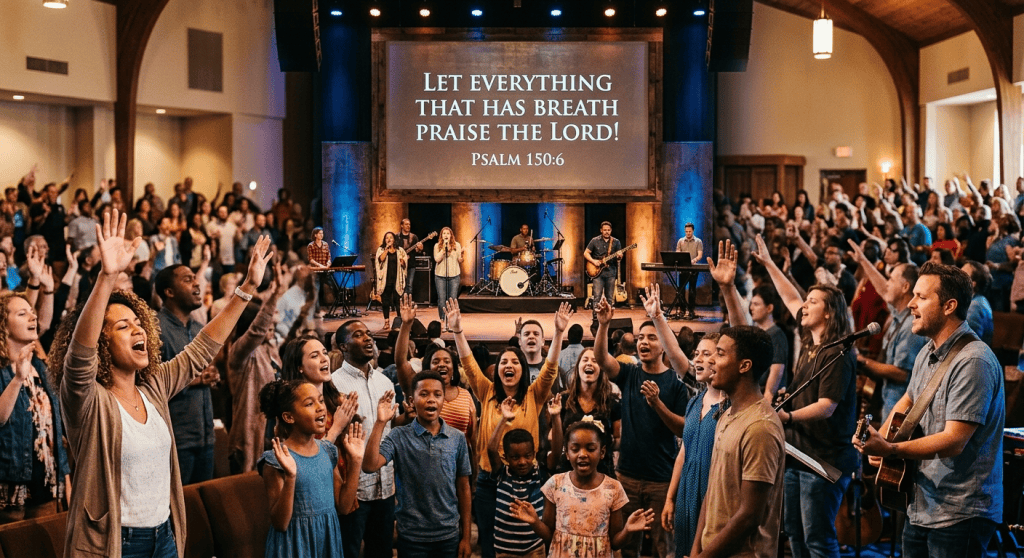
“Let every thing that hath breath praise the LORD. Praise ye the LORD” (Psalm 150:6).
Praise Him as the first light breaks, the birds begin to sing, and you breathe in a brand-new day of grace.
Praise Him in the middle of your work, commutes, classrooms, or chores when responsibilities start demanding your focus.
Praise Him in the heat of the noontime, stepping back to refuel, rest, and reset your heart in the middle of a busy day.
Praise Him when energy dips and the weight of the afternoon grind feels heavy, trusting His strength to carry you through.
Praise Him as the sun goes down, reflecting on how His hand guided you safely through the hours.
Praise Him in the dark when the house is still, casting off anxiety and resting safely under His care.
Praise Him as dead things spring back to life, celebrating fresh starts, restored hope, and planted dreams.
Praise Him in the fullness of bright days, celebrating joy, blessings, and the vibrant fruitfulness around you.
Praise Him as the leaves fall and things change, trusting Him through periods of transition, letting go of the old, and preparing for rest.
Praise Him in the barren or freezing cold, holding fast to faith even when the landscape looks lifeless and spring feels far away.
In every hour of the day and through every changing season of life, praise is our constant anchor.
When we choose to praise Him, whether in the quiet dawn or the midnight hours, in the vibrant warmth of summer or the silent chill of winter, we shift our focus from our temporary circumstances to His eternal faithfulness. Praise transforms our daily routines into sacred moments and anchors our souls through life’s transitions, ensuring that no matter what changes around us, our worship remains steady.
“I will bless the Lord at all times; his praise shall continually be in my mouth” (Psalm 34:1).
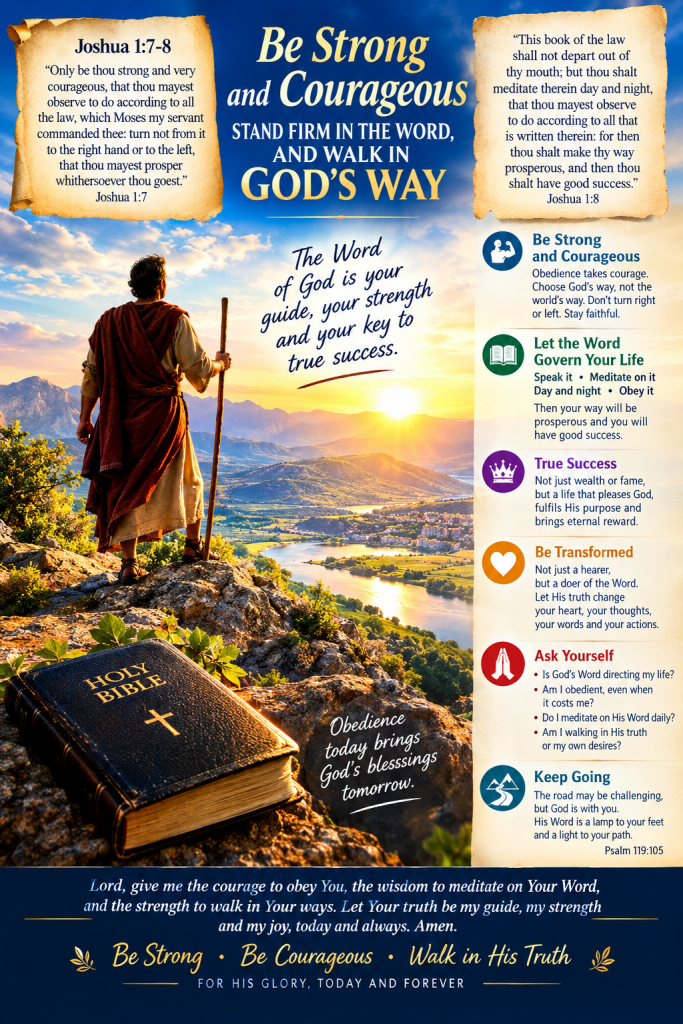
“Only be thou strong and very courageous, that thou mayest observe to do according to all the law, which Moses my servant commanded thee: turn not from it to the right hand or to the left, that thou mayest prosper whithersoever thou goest” (Joshua 1:7).
God commanded Moses’s successor Joshua to be courageous in obedience, not just in battle. True godly courage is the determination to stay faithful to God at any cost. By instructing Joshua not to turn to the right or the left, God teaches us never to alter His truth to fit our personal desires, public opinion, or shifting worldly standards.
The Lord Jesus declared: “Enter ye in at the strait gate: for wide is the gate, and broad is the way, that leadeth to destruction” (Matthew 7:13).
The path of obedience may not always be popular, comfortable, or easy. Be strong enough to obey God, humble enough to accept His correction, and courageous enough to remain faithful when nobody is watching.
“This book of the law shall not depart out of thy mouth; but thou shalt meditate therein day and night, that thou mayest observe to do according to all that is written therein: for then thou shalt make thy way prosperous, and then thou shalt have good success” (Joshua 1:8).
The Word of God must be more than a book we carry in our hands; it must become the truth that governs our hearts, our thoughts, our words, and our decisions. God told Joshua that the Book of the Law must not depart from his mouth. Our words reveal much about what occupies our hearts. If our conversations are constantly filled with bitterness, fear, jealousy, gossip, and complaints, we must examine what is shaping our inner lives.
Joshua 1:8 teaches us to keep God’s Word continually before us. And Psalm 119:11 says: “Thy word have I hid in mine heart, that I might not sin against thee.”
When the Word of God fills your heart, it begins to influence the words you speak, the choices you make, and the way you treat others. Let your mouth become an instrument of truth, encouragement, prayer, and praise, but not an instrument of destruction.
God did not tell Joshua merely to read the Word occasionally. He commanded him to meditate on it day and night. Meditation means giving God’s Word careful attention, reflecting on its meaning, remembering it, praying over it, and considering how to apply it in everyday life.
True spiritual maturity comes from deeply rooting yourself in God’s Word. Like a tree planted by a river, daily meditation provides the nourishment you need to grow fruit and stand firm against life’s storms. You may face disappointment. You may experience rejection. You may walk through seasons when your prayers seem unanswered. But the Word of God can remind you of His character, strengthen your faith, correct your direction, and give you hope to continue.
Knowing God’s Word means actively living out His commands like forgiving, staying humble, and speaking truth, because following Christ promises His presence through hardships, not a life free from them. The Lord Jesus Himself said: “In the world ye shall have tribulation: but be of good cheer; I have overcome the world.” (John 16:33).
True success is walking faithfully with God, growing in holiness, loving others, and staying true to His truth, rather than chasing money, fame, or human approval.
Before making a move, seek God’s wisdom and remember His instruction to guide your actions and speech. When facing temptation, fear, or pride, look to His truth, promises, and humbling Word. Do not hide your sins; instead, confess them and lean on His grace to change. When the future is unclear, do not rush ahead but pray, study Scripture, and trust wise counsel aligned with His truth.
Romans 12:2 teaches believers not to be conformed to this world but to be transformed by the renewing of their minds. Real change happens when you let God’s truth transform your own heart before you try to change others.
Psalm 119:105 declares: “Thy word is a lamp unto my feet, and a light unto my path.”
Trust God for the next step, not just the whole road. The world chases feelings and pride, but God calls you to faith, courage, and obedience in your heart, your home, and your quiet moments. Meditate on it so that you may become more faithful, more humble, more loving, and more obedient.
Rely on God’s strength, stay true to His Word daily, and remember that true success means remaining faithful to Him. Be strong. Be courageous. Hold fast to the Word. Walk in obedience. And never turn away from the path of God’s truth.
Let the Bible be your guide, let obedience be your response, let courage be your testimony, and let Jesus Christ be the Lord of your life.
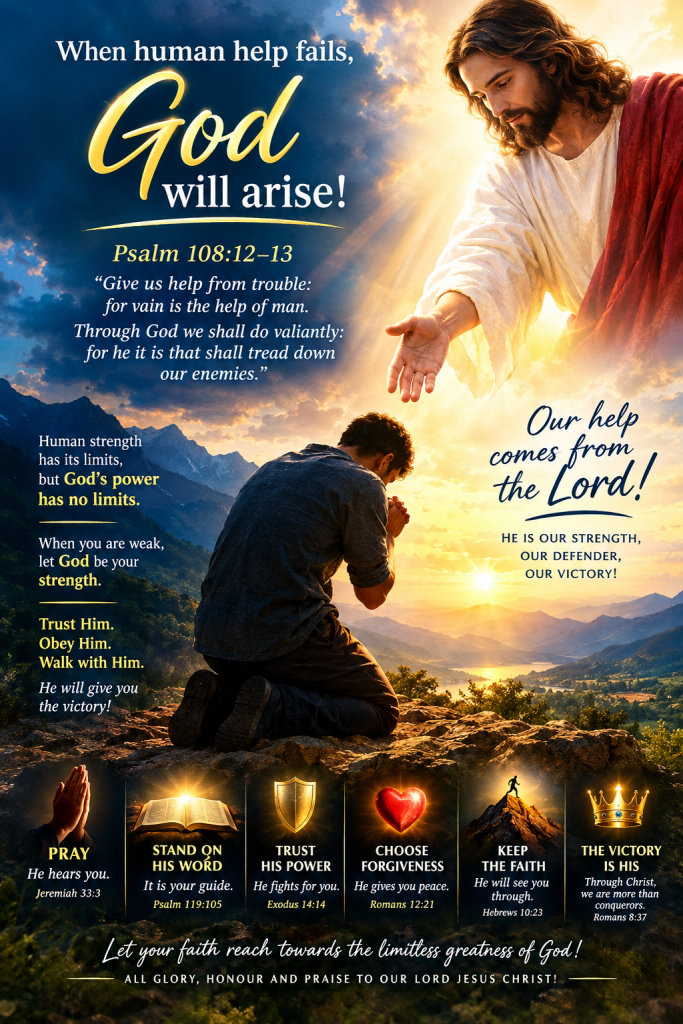
“Give us help from trouble: for vain is the help of man. Through God we shall do valiantly: for he it is that shall tread down our enemies”
(Psalm 108: 12, 13).
Human strength has its limits, but God’s power has none. There are battles in life that cannot be won by human wisdom, influence, wealth, authority, or physical might. There are moments when every door seems closed, every familiar help disappears, and the heart cries out, ‘Lord, where shall I turn?’“
It is precisely in such moments that we must remember who our God is!
Sometimes, we exhaust ourselves trying to solve every problem with our own understanding. We run from one person to another, seek advice from every direction, and struggle to control circumstances that are beyond our power. Yet, in the midst of all our efforts, we forget to kneel before the One who holds our lives in His hands.
When trouble comes, do not allow fear to silence your prayers. When tears fill your eyes, let your heart continue to seek Him. When you cannot see a way forward, remember that your inability to see the way does not mean God has no way.
“Call unto me, and I will answer thee, and shew thee great and mighty things, which thou knowest not” (Jeremiah 33:3).
The Lord who opened the Red Sea before the Israelites is still able to make a way where there appears to be no way.
“It is better to trust in the LORD than to put confidence in man” (Psalm 118:8).
When David stood before Goliath, he did not depend upon the size of his weapon or the strength of his armour. He declared that the battle belonged to the Lord.
“For the battle is the LORD’S” (1 Samuel 17:47)
In every season of weakness, confusion, fear, trouble, or uncertainty, turn to Christ and remain faithful to His wisdom, promises, and sovereign care. And when you do not know what tomorrow holds, remain faithful to the One who holds tomorrow.
“I can do all things through Christ which strengtheneth me” (Philippians 4:13).
When you continue trusting God through suffering, you testify that your hope rests in something greater than your present circumstances.
Through Christ, we can stand firm, endure faithfully, and live courageously for the glory of God. Stand upon His Word. Walk in His ways. Seek His face. Depend upon His grace.
“Touch not mine anointed, and do my prophets no harm”(Psalm 105:15).
When God calls you His “anointed,” it means He has set you apart, placed His mark of ownership upon you, and taken total responsibility for your life, your calling, and your defense.
In a world that can often feel overwhelming, hostile, or uncertain, Psalm 105:15 stands as a bold declaration from the God of the universe: You belong to Him. When you walk in faith and live according to God’s purpose, your life is not at the mercy of human opposition, malice, or circumstance. God Himself draws a line around your life and declares, “Do not touch.”
Being anointed does not mean life will be free from struggles or opposition. The patriarchs faced famines, strange lands, and dangerous rulers. However, opposition never meant defeat; it was proof that God’s presence was actively preserving them. Whenever forces rise against you, remember that the God who called you is the same God who fights for you.
Abraham and his descendants had no military power, yet kings bowed to the God who guarded them. You do not need to fight every battle in your own strength or harbor bitterness toward those who seek to harm you. Stand firm in peace, knowing that God holds your life, your family, and your future securely in His hands.
A Prayer of Confidence:
Heavenly Father, thank You for marking my life with Your purpose and surrounding me with Your divine protection. Help me walk with courage, knowing that no weapon formed against me shall stand, and that You are my ultimate defender. In Jesus’ name, Amen.
None of us can stand before God and claim perfection. We try so hard to patch over our mistakes, clean up our past, and present a flawless face to the world, yet down deep, we know the truth. Our hearts are imperfect, prone to stumbles, and forever in need of grace.
Proverbs 20:9 isn’t meant to bring us shame; it’s meant to bring us freedom.
When we stop pretending we can save ourselves, we open the door for God’s unconditional mercy to step in.
True peace doesn’t come from proving we are spotless, it comes from laying our weary hearts at the altar, bathed in light, and trusting in the One who loves us exactly as we are.
You don’t have to carry the heavy burden of trying to be perfect today. Let His grace be enough.
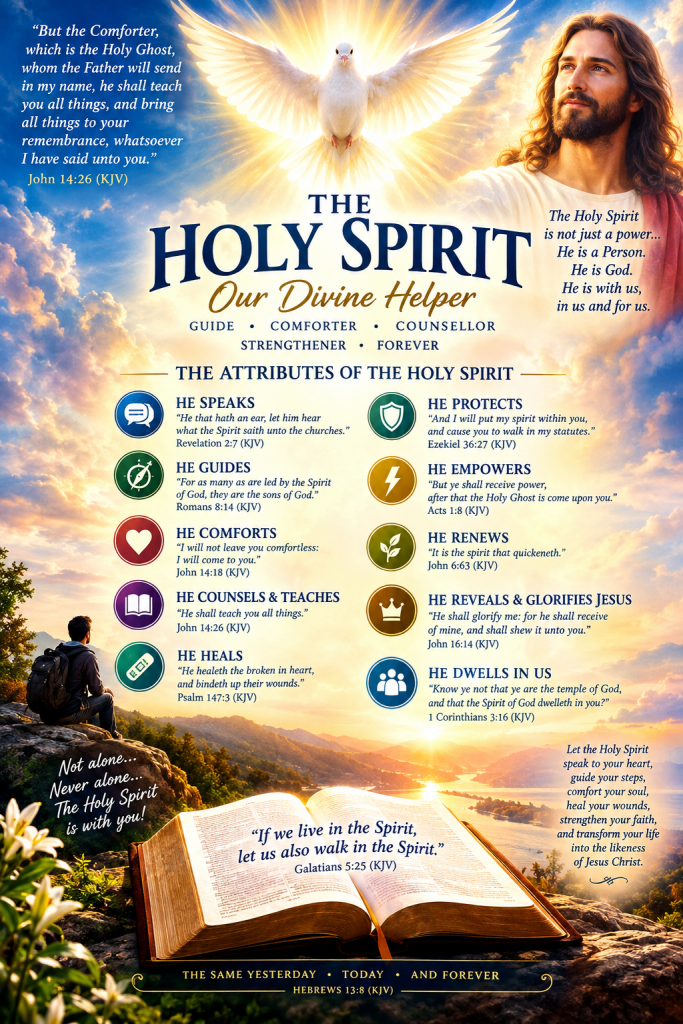
“But the Comforter, which is the Holy Ghost, whom the Father will send in my name, he shall teach you all things, and bring all things to your remembrance, whatsoever I have said unto you”(John 14:26).
Who Is the Holy Spirit?
The Holy Spirit is the Spirit of God, the third Person of the Holy Trinity: Father, Son, and Holy Spirit. He is not an impersonal force, an invisible energy, or merely a feeling that comes upon us. He is divine, personal, holy, and active in the lives of those who belong to God.
From the very beginning of creation to the glorious fulfilment of God’s purposes, the Holy Spirit is at work. He gives life, reveals truth, convicts the heart, teaches the Word, strengthens the weak, comforts the sorrowful, and empowers believers to live according to the will of God.
The Lord Jesus did not promise His disciples that they would never experience sorrow, uncertainty, temptation, or difficulty. He promised them the Holy Spirit, the divine Helper who would remain with them.
“And I will pray the Father, and he shall give you another Comforter, that he may abide with you for ever” (John 14:16).
What a glorious promise! We may sometimes feel alone, but we are never beyond the reach of God’s presence. The Holy Spirit works within us, reminding us of the words of Christ and helping us walk in faith, obedience, and holiness.
The Holy Spirit speaks: “He that hath an ear, let him hear what the Spirit saith unto the churches” (Revelation 2:7).
In Scripture, He speaks through God’s revealed Word, directs God’s servants, brings truth to remembrance, and calls people to obedience.
In Acts 13:2, the Holy Spirit said, “Separate me Barnabas and Saul for the work whereunto I have called them.”
His voice does not lead us away from Christ or contradict the truth of Scripture. Read His Word prayerfully, remain humble, and be willing to obey when Scripture makes His will clear. The heart that listens to God must also be willing to follow Him.
The Holy Spirit guides us: “For as many as are led by the Spirit of God, they are the sons of God” (Romans 8:14).
Life is filled with decisions, crossroads, uncertainties, and moments when we do not know which direction to take. We may understand our circumstances only partially, but God sees the beginning and the end. The Holy Spirit guides us into truth, teaches us to discern right from wrong, and helps us apply God’s Word to our daily lives.
The Lord Jesus said: “Howbeit when he, the Spirit of truth, is come, he will guide you into all truth” (John 16:13).
His guidance calls us to prayer, biblical wisdom, discernment, and obedience. When you do not know what lies ahead, trust God enough to take the next faithful step. You may not see the whole road, but you can seek the One who leads you.
The Holy Spirit comforts us: “I will not leave you comfortless: I will come to you” (John 14:18).
There are wounds that words cannot heal, tears that we hide from others, and sorrows that we struggle to explain. Sometimes even the people who love us cannot fully understand the pain we carry. But God knows. The Holy Spirit is our divine Comforter. He reminds us of God’s promises, strengthens our hearts, and helps us endure seasons of grief, loneliness, disappointment, and suffering. Romans 8:26 tells us that the Spirit helps our infirmities and intercedes for us when we do not know what we should pray for as we ought. You may not always receive an immediate answer to your pain, and your circumstances may not change overnight. Yet you can bring your sorrow before God and ask the Holy Spirit to sustain you through it. When human words fail, we can still turn to the God who knows our hearts.
The Holy Spirit counsels and teaches us: “But the Comforter, which is the Holy Ghost, whom the Father will send in my name, he shall teach you all things, and bring all things to your remembrance, whatsoever I have said unto you”(John 14:26).
The Holy Spirit is our divine Teacher. He helps us understand the truth of God’s Word and reminds us of the teachings of the Lord Jesus. He corrects our wrong thinking, exposes the deception of sin, and teaches us to see our lives through the light of God’s truth. A wise counsellor does not simply tell us what we want to hear; godly counsel leads us towards what is right. The Holy Spirit directs us towards Christlike character, humility, repentance, forgiveness, and obedience. When pride rises within us, He reminds us to be humble. When bitterness takes root, God’s truth calls us to forgive. When temptation presents itself, the Word of God reminds us to choose holiness. Let us never seek the Spirit’s counsel merely to confirm our own desires. Let us seek Him with surrendered hearts, willing to be corrected and transformed.
The Holy Spirit heals and restores: “He healeth the broken in heart, and bindeth up their wounds” (Psalm 147:3).
God is the healer of the brokenhearted. Through the Holy Spirit, God works in human lives to bring conviction, renewal, comfort, strength, and restoration. The Spirit helps us confront the wounds of our past, repent of our sins, release bitterness, and grow in the grace of Christ. The Holy Spirit empowers believers in the ministry of healing, whether by restoring the body, strengthening the soul to endure suffering, or granting the courage to seek help. Whatever our circumstances, we can entrust ourselves to the mercy and wisdom of God.
The Holy Spirit protects and strengthens us: “And I will put my spirit within you, and cause you to walk in my statutes” (Ezekiel 36:27).
The Holy Spirit strengthens believers to resist temptation, stand firm in faith, and persevere through spiritual struggles. He reminds us of God’s truth when deception surrounds us. He empowers us to reject sin and helps us recognise the difference between the works of the flesh and the fruit of the Spirit. Ephesians 6:10–18 teaches us to put on the whole armour of God and to stand against spiritual evil. However, the Spirit’s protection does not mean that Christians will never face danger, persecution, illness, or hardship. Rather, we can trust God’s presence and strength even in the midst of trials.
Do not depend only upon your own strength. Pray, remain grounded in Scripture, resist evil, and seek the wisdom of God. The One who strengthens your faith can help you stand even when the world around you seems uncertain.
The Holy Spirit convicts us of sin: “And when he is come, he will reprove the world of sin, and of righteousness, and of judgment” (John 16:8).
The Holy Spirit reveals our need for repentance and directs us towards the righteousness of Christ. When we have acted wrongly, He brings God’s truth to bear upon our conscience. He calls us to acknowledge our sin, turn away from it, and seek God’s forgiveness. Conviction is an invitation to return to God; it is not a reason to hide from Him. First John 1:9 promises that when we confess our sins, God is faithful and just to forgive us and cleanse us from all unrighteousness. Do not harden your heart when God’s Word exposes something that must change. Humble yourself, seek forgiveness, and allow the Lord to transform you.
The Holy Spirit intercedes for us: “The Spirit itself maketh intercession for us with groanings which cannot be uttered” (Romans 8:26).
There are moments when our hearts are so burdened that we cannot find the words to pray. We may sit before God in silence, carrying grief, confusion, or a longing that we cannot express. Romans 8 reminds us that our weakness does not place us beyond God’s help. The Holy Spirit helps us in our infirmities and intercedes according to the will of God. Prayer is not dependent upon our ability to speak eloquently. Come before God honestly. You do not need to impress Him with beautiful words. Bring Him your tears, your questions, your repentance, your gratitude, and your deepest concerns.
The Holy Spirit empowers us: “But ye shall receive power, after that the Holy Ghost is come upon you: and ye shall be witnesses unto me” (Acts 1:8).
The Holy Spirit empowers believers to bear witness to the Lord Jesus Christ. He gives courage to speak the truth, strength to endure opposition, and grace to serve others. He distributes spiritual gifts according to God’s purposes, equipping the Church for ministry and the building up of the body of Christ (1 Corinthians 12:4–11). The Spirit empowers us to glorify Lord Jesus, serve humbly, love sacrificially, and proclaim the Gospel faithfully. The evidence of His work is not merely an outward display of spiritual enthusiasm. It also includes a transformed life that increasingly reflects the character of Christ.
The Holy Spirit produces His fruit in us: “But the fruit of the Spirit is love, joy, peace, longsuffering, gentleness, goodness, faith, meekness, temperance” (Galatians 5:22–23).
The Holy Spirit does more than give us strength for a particular task. He works within us to transform who we are. He teaches us to love when hatred seems easier, to remain patient when circumstances test us, to speak gently when anger rises, and to pursue peace when conflict surrounds us. The fruit of the Spirit reveals the character God desires to cultivate in His people. Spiritual maturity is not measured simply by how much we know, how eloquently we speak, or how many spiritual experiences we describe. It is also revealed through the love we demonstrate, the forgiveness we offer, the humility we practise, and the holiness we pursue. Let us ask not only for the gifts of the Spirit but also for the grace to bear His fruit.
The Holy Spirit gives life and renews us: “It is the spirit that quickeneth; the flesh profiteth nothing” (John 6:63).
The Holy Spirit is active in the work of spiritual renewal. The Lord Jesus taught Nicodemus that a person must be born of the Spirit to enter the kingdom of God (John 3:5–8). Through the Spirit’s work, we are brought into new life in Christ, renewed in our minds, and enabled to grow in holiness. When we have become spiritually weary, we can pray for renewal. When our love has grown cold, we can return to Christ. When sin has entangled us, we can seek God’s forgiveness and the Spirit’s help to walk in newness of life. The Christian life is not merely an attempt to improve ourselves through human effort. It is a life of dependence upon God’s grace and the transforming work of His Spirit.
The Holy Spirit reveals and glorifies the Lord Jesus Christ: “He shall glorify me: for he shall receive of mine, and shall shew it unto you” (John 16:14).
One of the most important works of the Holy Spirit is to glorify the Lord Jesus Christ. The Spirit does not lead us away from the Lord Jesus. He reveals the truth of Christ, deepens our understanding of His Word, and transforms us to become more like Him. The Holy Spirit reminds us of the significance of Christ’s sacrifice, the greatness of His resurrection, and the hope we have through Him. A genuine work of the Holy Spirit leads us towards greater love for Jesus, deeper reverence for God’s Word, and a life that bears witness to the Gospel. Let Christ remain at the centre of your worship, your prayer, your service, and your life.
The Holy Spirit dwells in believers: “Know ye not that ye are the temple of God, and that the Spirit of God dwelleth in you?” (1 Corinthians 3:16).
We should therefore seek to live in a manner worthy of the One whose presence has been given to us. The presence of the Holy Spirit is a precious gift. Our lives are not meant to be ruled by selfish desires, bitterness, dishonesty, or impurity. We are called to honour God in our bodies, thoughts, words, and actions. Make room for prayer. Meditate upon the Scriptures. Practise obedience. Pursue peace with others. Turn away from what dishonours God. The Spirit’s indwelling presence is not permission to live carelessly; it is a call to live as people who belong to Christ.
The Holy Spirit gives wisdom and discernment: “For to one is given by the Spirit the word of wisdom; to another the word of knowledge by the same Spirit” (1 Corinthians 12:8).
The Holy Spirit equips God’s people with wisdom and discernment for the situations they encounter. He helps us distinguish truth from error, recognise the dangers of temptation, and respond to others with godly understanding. James 1:5 encourages those who lack wisdom to ask God, who gives generously. Ask the Lord to make you wise not only in what you believe, but also in what you say, how you act, and how you treat others.
The Holy Spirit unites us in love and fellowship: Endeavouring to keep the unity of the Spirit in the bond of peace” (Ephesians 4:3).
The Holy Spirit brings believers into the fellowship of Christ’s body and calls them to live in unity, love, and peace. He teaches us to bear with one another, forgive one another, and serve one another with humility. Unity does not mean that every Christian must agree on every matter. It means that we seek to honour Christ, hold fast to the truth, and treat one another with grace rather than pride and hostility. A heart being transformed by the Spirit will increasingly seek reconciliation, show compassion, and pursue the good of others. Where the Spirit’s fruit grows, love becomes visible.
The Holy Spirit is our seal and assurance: “And grieve not the holy Spirit of God, whereby ye are sealed unto the day of redemption” (Ephesians 4:30).
The Holy Spirit is associated with the sealing of believers, marking them as belonging to God and pointing towards the promised redemption. This gives Christians a profound reason for hope. Our salvation rests upon the grace of God through Jesus Christ, not upon our ability to earn His favour. The Spirit’s presence reminds us that we belong to the Lord and are called to live faithfully as His people. Therefore, do not treat the grace of God lightly. Walk in repentance, trust in Christ, and seek to honour the One who has called you to Himself.
The Holy Spirit can be grieved: “And grieve not the holy Spirit of God” (Ephesians 4:30).
Because the Holy Spirit is personal, Scripture warns believers not to grieve Him. Ephesians 4 places this warning in the context of falsehood, corrupt speech, bitterness, wrath, anger, and malice. These are not small matters to God. They damage our relationships and contradict the character of Christ.
We must therefore examine our hearts. Are we harbouring resentment? Are our words building people up or tearing them down? Are we making room for dishonesty or refusing to forgive?
When we recognise our failures, let us not hide behind pride. Let us repent, seek God’s forgiveness, and return to a life of obedience. The Spirit who convicts us also helps us grow in holiness.
The Holy Spirit is our ever-present Helper in every season: “Likewise the Spirit also helpeth our infirmities” (Romans 8:26).
In joy, we can thank Him. In sorrow, we can seek His comfort. In uncertainty, we can ask for wisdom. In temptation, we can seek strength to resist. In weakness, we can pray for His help. In service, we can depend upon His power.
The Holy Spirit is not confined to a church building or a particular hour of prayer. The Christian life is a life of walking with God every day.
Yet we must remember that His work is not a promise that every desire will be fulfilled or every difficulty immediately removed. He works according to God’s wisdom and purpose, leading us to trust Christ in all circumstances.
Whatever season you are passing through, turn to God in faith. Let His Word shape your heart, let prayer strengthen your relationship with Him, and let the Spirit lead you towards the character of Jesus.
Walk in the Spirit
The Holy Spirit speaks, guides, comforts, teaches, convicts, strengthens, empowers, renews, and produces His fruit in those who belong to Christ. He helps us in our weakness, directs us towards truth, and glorifies the Lord Jesus. But let us never seek only what the Holy Spirit can do for us. Let us seek to know God more deeply, love Christ more faithfully, and become more obedient to His Word.
The greatest evidence of the Spirit’s transforming work is not merely what we say about Him, but how our lives increasingly reflect the love, holiness, humility, and truth of the Lord Jesus Christ.
Do not grieve the Holy Spirit. Do not resist His call to repentance. Do not ignore the truth of God’s Word. Instead, pray for wisdom, walk in obedience, cultivate the fruit of the Spirit, and remain steadfast in Christ. May our hearts become willing vessels, our lives become living testimonies, and our words bring glory to the name of Jesus.
Holy Spirit, teach us to hear the truth, give us grace to obey, strengthen us in our weakness, comfort us in our sorrow, and transform us into the likeness of Jesus Christ. Lead us in the way of righteousness, fill us with Your love, and help us glorify our Lord in everything we do. Amen.
“If we live in the Spirit, let us also walk in the Spirit” (Galatians 5:25).
“He which testifieth these things saith, Surely I come quickly. Amen. Even so, come, Lord Jesus”
(Revelation 22:20).
The Bible closes with a promise from the lips of the Lord Jesus Himself: “Surely I come quickly.”
These are the words of the risen Christ, the King of kings and Lord of lords, speaking to His Church and reminding us that history is moving toward a glorious conclusion, the return of the King.
The Lord Jesus came once in humility. He will come again in glory. He came first as the Lamb. He will come again as the King. He came first to bear the crown of thorns. He will come again wearing the crown of glory. He came first to save sinners. He will come again to gather His redeemed people to Himself.
As Scripture declares: “Behold, he cometh with clouds; and every eye shall see him” (Revelation 1:7).
When the Lord Jesus says, “Surely,” there is no uncertainty in His promise. Heaven and earth may pass away, but the word of Christ will never fail.
The Lord Jesus said: “Heaven and earth shall pass away, but my words shall not pass away” (Matthew 24:35).
His promise is more certain than tomorrow’s sunrise. More certain than anything we can see.
The King is coming. The word quickly reminds us that when God’s appointed moment arrives, His coming will not be delayed.
The Apostle Peter reminds us that the apparent delay is not because God has forgotten His promise:
“The Lord is not slack concerning his promise, as some men count slackness” (2 Peter 3:9).
God is patient because He desires people to turn to Him. Therefore, while we wait, we must not become spiritually sleepy.
The Lord Jesus warned: “Watch therefore: for ye know not what hour your Lord doth come” (Matthew 24:42).
The question is not simply, “When will Jesus return?” The deeper question is: “Will He find me ready when He comes?”
The Bride must be ready. The Church is described as the bride awaiting her Bridegroom.
A bride does not prepare because she doubts that the bridegroom is coming. She prepares because she knows he is coming. Likewise, we do not pursue holiness because we are trying to earn Christ’s love.
We pursue holiness because we love the One who is coming for us.
Scripture says: “Let us be glad and rejoice, and give honour to him: for the marriage of the Lamb is come, and his wife hath made herself ready” (Revelation 19:7).
Let our lamps be burning. Let our hearts be awake. Let our garments be clean. Let our faith be alive. Let our love remain burning. Let our eyes remain fixed upon Jesus.
Do not let the world put you to sleep.
The world can make us so occupied with temporary things that we forget eternal things.
We can become consumed with possessions, success, recognition, pleasures, worries, disappointments and the cares of tomorrow.
But everything around us is temporary.
The Lord Jesus is eternal.
Your house is temporary. Your possessions are temporary. Your earthly position is temporary.
Your body is temporary.
But Christ is eternal, His Word is eternal, and the life He promises is eternal.
The Apostle Paul therefore reminds us:
“Set your affection on things above, not on things on the earth” (Colossians 3:2).
Live here but remember that you belong there.
Walk on earth but keep your eyes on heaven.
Work faithfully but remember your eternal reward. Love people but lead them toward Christ. And while you wait for His coming, do not waste your waiting.
What a beautiful way for Scripture to end.
The Lord Jesus says: “Surely I come quickly.”
And the response of His people is: “Amen. Even so, come, Lord Jesus.”
This is not the cry of people who are afraid of Christ’s return. It is the cry of people who love Him.The heart that truly knows Lord Jesus longs to see Him. One day, our waiting will end when faith and prayer become the living presence of the unseen One we have loved, and we finally behold Him face-to-face. And when that glorious moment comes, every earthly sorrow will seem small in the presence of His glory.
There will be no more death. No more crying. No more pain. No more separation.
For: “God shall wipe away all tears from their eyes”(Revelation 21:4).
ARE YOU READY?
The Lord Jesus is coming. Do not be found unprepared. Come to Christ while there is still time. Watch. Pray. Remain faithful.
One day, we will see our King.
And the cry of the redeemed should be:
“Even so, come, Lord Jesus.”
When the world grows darker, remember: The King is coming.
When you feel forgotten, remember: The King is coming.
When righteousness seems to be defeated, remember: The King is coming.
When your heart is weary, remember: The King is coming.
When you are tempted to give up, lift your eyes toward heaven and remember the promise: “Surely I come quickly.”
And let your soul answer: “Amen. Even so, come, Lord Jesus.”
We do not know the day. We do not know the hour.
But we know the One who is coming. His name is Jesus. He is our Saviour. He is our Shepherd. He is our Bridegroom. He is our High Priest. He is our King.
Let us live every day as though we are expecting the sound of the trumpet.
As we wait faithfully for the return of Jesus, let us keep our hearts pure, love one another, and stay ready with our spiritual lamps burning.
“But as for me and my house, we will serve the LORD” (Joshua 24:15).
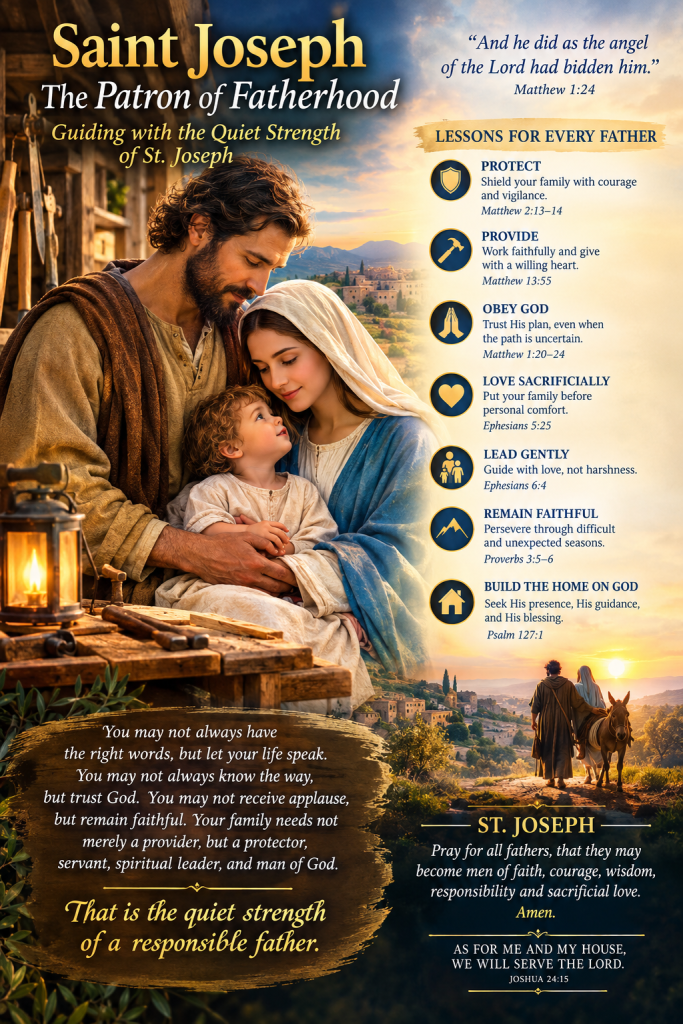
Being a responsible father like St. Joseph means anchoring a family in quiet strength, selfless protection, sacrificial love, and steady, faithful devotion. Scripture introduces Joseph as “a just man” (Matthew 1:19), a man whose righteousness was revealed not through many words, but through his actions, obedience, compassion, and trust in God.
Long before he became the foster-father and guardian of Jesus, Joseph’s profound sense of responsibility was tested when he discovered that Mary was with child. Not understanding the mystery of what God was doing, Joseph nevertheless desired to protect Mary from public disgrace: “Joseph her husband, being a just man, and not willing to make her a public example, was minded to put her away privily” (Matthew 1:19).
But God had a greater purpose. An angel of the Lord appeared to Joseph in a dream and revealed the divine mystery: “Joseph, thou son of David, fear not to take unto thee Mary thy wife: for that which is conceived in her is of the Holy Ghost” (Matthew 1:20).
Joseph did not argue, delay, or demand an explanation. He obeyed. “Then Joseph being raised from sleep did as the angel of the Lord had bidden him, and took unto him his wife” (Matthew 1:24).
Here we see the first great lesson of fatherhood: a godly father listens when God speaks and obeys even when he does not understand everything.
Joseph took Mary into his home, accepting the responsibility God had entrusted to him. He protected her dignity, cared for her needs, and accompanied her on the difficult journey to Bethlehem as she prepared to give birth to the promised Messiah.
And when the child was born, Joseph remained faithful to his God-given responsibility. He became the earthly guardian of the One who is the eternal Son of God.
When an angel warned him of Herod’s murderous intention, Joseph again demonstrated immediate obedience: “Arise, and take the young child and his mother, and flee into Egypt” (Matthew 2:13).
And Scripture tells us: “When he arose, he took the young child and his mother by night, and departed into Egypt” (Matthew 2:14).
There was no complaint recorded. No hesitation. No concern about personal comfort. Joseph simply obeyed.
He uprooted his life in the middle of the night and led Mary and the infant Jesus to safety. In doing so, Joseph teaches fathers that protection sometimes requires sacrifice, inconvenience, courage, and immediate action.
After Herod’s death, Joseph once again received divine direction: “Arise, and take the young child and his mother, and go into the land of Israel” (Matthew 2:20).
Joseph obeyed again and eventually settled with Mary and Jesus in Nazareth.
There, in the quietness of an ordinary home, Joseph fulfilled his vocation. He worked with his hands and provided for the Holy Family. Matthew identifies him as a craftsman or builder (Matthew 13:55). His was not a life of public recognition, but a life of hidden faithfulness.
The Gospel gives us a beautiful glimpse of Jesus growing within the loving care of His earthly family: “And the child grew, and waxed strong in spirit, filled with wisdom: and the grace of God was upon him” (Luke 2:40).
Later, when Jesus was found in the temple, Scripture says: “And he went down with them, and came to Nazareth, and was subject unto them” (Luke 2:51).
Joseph’s life reminds us that great fatherhood is often formed in ordinary places: in the home, at work, and through sacrifice, protection, teaching, and daily faithfulness.
His life proves that true fatherhood does not need applause. It speaks through action more than words.
A father protects, provides, teaches, sacrifices, and prays as he leads his family toward God.
A father’s responsibility is not merely to provide material necessities, but also to care for the physical, emotional, moral, and spiritual well-being of his family.
Scripture gives fathers this solemn responsibility: “And, ye fathers, provoke not your children to wrath: but bring them up in the nurture and admonition of the Lord” (Ephesians 6:4).
A godly father does not lead through fear, domination, or demands, but instead protects, provides for, corrects, and disciplines his family through love, wisdom, patience, example, and prayer ultimately showing them what it means to walk with God through his own life.
Scripture also calls husbands to a sacrificial standard: “Husbands, love your wives, even as Christ also loved the church, and gave himself for it” (Ephesians 5:25).
This is the heart of Christian fatherhood: self-giving love.
Providing for a family is more than fulfilling an obligation. It can become a daily offering of love: the sacrifice of time, energy, comfort, personal ambition, and sometimes even one’s own plans for the good of those entrusted to him.
Every father needs the faith to move forward during uncertainty by trusting God, even when the future remains completely unknown. “Trust in the LORD with all thine heart; and lean not unto thine own understanding”(Proverbs 3:5).
There will be seasons when a father does not know what tomorrow will bring. There may be financial difficulties, family struggles, uncertain decisions, disappointments, or roads he never expected to travel.
In those moments, Joseph’s example speaks silently: Listen to God. Trust God. Obey God. Protect those entrusted to you. Keep moving forward in faith.
A father does not have to be perfect to be faithful. He must be willing to humble himself before God, seek wisdom, repent when he fails, and continue walking faithfully.
Ultimately, the strength of a godly father comes not from himself but from the Lord. “Except the LORD build the house, they labour in vain that build it” (Psalm 127:1).
A father may build walls, provide food, pay bills, teach skills, and protect his family, but only God can truly build a home. Therefore, the greatest inheritance a father can leave his children is not merely wealth or possessions, but a living example of faith.
Let your children see your faith in action: praying, forgiving, serving, and choosing God above all else so they learn to make Him first too.
St. Joseph’s life was largely hidden from the world, yet his faithfulness was precious in the sight of God. He did not preach great sermons recorded in Scripture. He did not perform public miracles. We do not hear a single spoken word from Joseph recorded in the Gospels.
His silence was obedience, his hands were service, his courage was protection, his work was provision, and his faith was leadership.
He became a sanctuary of faithfulness for Mary and the child Jesus.
Build a home where love is strong, faith is alive, prayer is welcomed, forgiveness is practiced, truth is honoured, and Christ is at the centre.
A father’s greatest success is not how loudly the world remembers his name, but how faithfully his family remembers the God he taught them to love.
May every father learn from St. Joseph to become a man of quiet strength, courageous obedience, sacrificial love, humble service, and unwavering faith.
And may every Christian home become what Joseph’s home in Nazareth quietly became: a place where God was honoured, where love was lived, where sacrifice was embraced, where faith was taught, and where the presence of God was cherished above everything else.