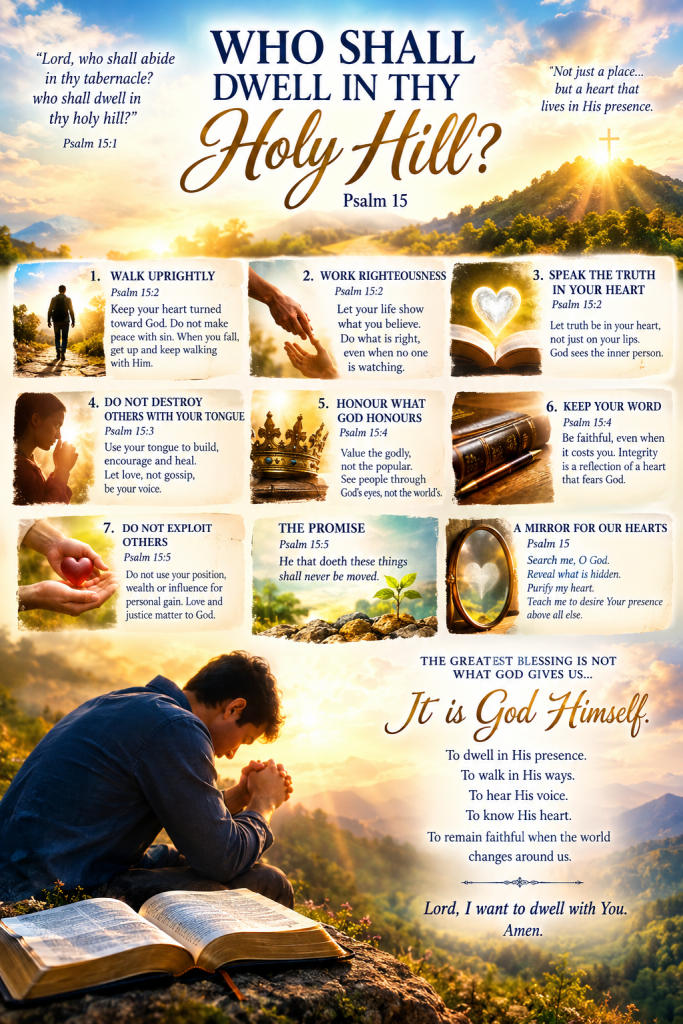
“LORD, who shall abide in thy tabernacle? who shall dwell in thy holy hill?” (Psalm 15:1)
King David is not asking about a physical address. He is asking about fellowship with the living God.
Who can come near Him?
Who can remain in His presence?
What kind of life does God desire from those who call upon His name?
“He that walketh uprightly” (Psalm 15:2).
God is concerned not merely with what we say, but with how we walk.
To walk uprightly does not mean that a person has never fallen. It means that his heart is turned toward God and that he desires to walk in truth.
The upright person does not deliberately make peace with sin. When he discovers sin in his heart, he brings it before God. When he is corrected, he listens. When he falls, he gets up.
King David continues: “and worketh righteousness…” (Psalm 15:2)
Righteousness is not merely something we profess with our lips. It must become visible in our lives.
True faith means doing what is right even when no one is watching, because we live and walk before God, not for human applause.
God desires truth not only on our lips but within our hearts. He desires a heart without deception, a heart that does not need to maintain one appearance before people and another before God.
“He that backbiteth not with his tongue, nor doeth evil to his neighbour, nor taketh up a reproach against his neighbour” (Psalm 15:3).
A person can worship God with his lips and yet wound another person with those same lips.
Words hold the ultimate power to either build lives up or tear them down.
King David says:
“In whose eyes a vile person is contemned; but he honoureth them that fear the LORD” (Psalm 15:4).
We often admire people because of wealth, power, influence, appearance, status, or popularity.
But God looks differently.
The person who fears the Lord may have little recognition in this world and yet be precious in the sight of God.
“He that sweareth to his own hurt, and changeth not” (Psalm 15:4)
God desires people whose word can be trusted.
This is integrity. A person of integrity does not keep his promise only when it is comfortable. He who walks with God learns that faithfulness is more valuable than convenience.
“He that putteth not out his money to usury, nor taketh reward against the innocent” (Psalm 15:5).
God cares about how we treat those who are vulnerable.
Our relationship with God cannot be separated from our relationship with people. A heart that truly desires God’s presence must learn to love righteousness and reject exploitation.
“He that doeth these things shall never be moved”(Psalm 15:5).
The world, people, and circumstances constantly change, and earthly possessions or approval easily disappear. However, someone who builds their life upon God and walks in His ways gains a foundation that external shifts cannot take away.
Ultimately, the greatest blessing we can experience is God Himself. While the world around us remains in constant flux, true peace is found in dwelling in His presence and walking in His ways. By taking the time to hear His voice and deeply know His heart, we gain the spiritual strength needed to remain faithful through every season of change.

