Tag: SPIRITUALITY

  • THE MIND OF CHRIST

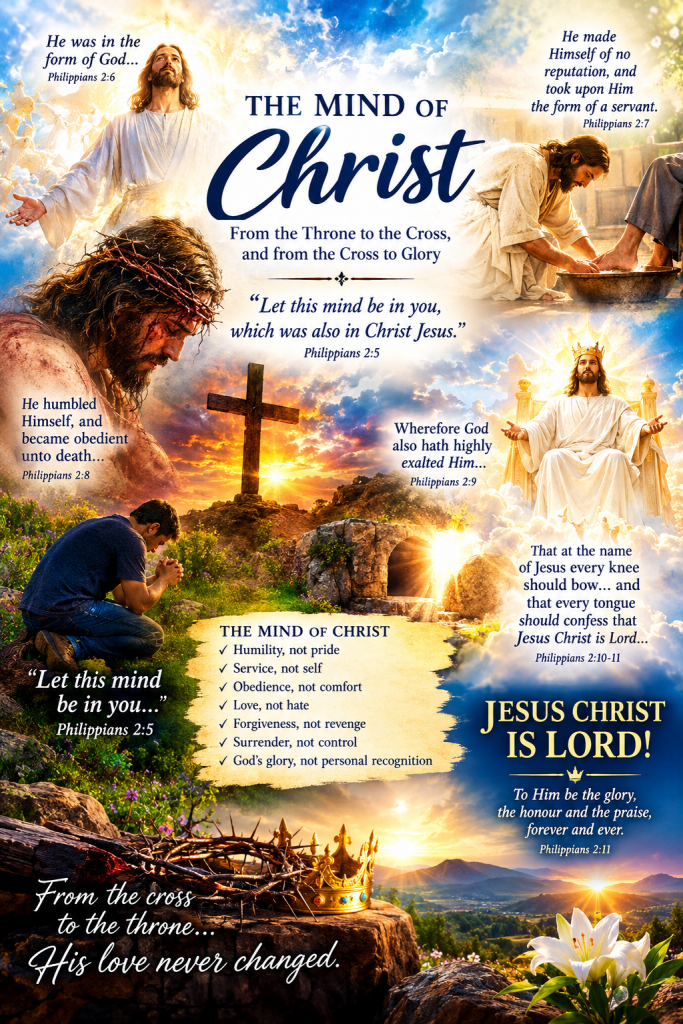
    THE MIND OF CHRIST — FROM THE THRONE TO THE CROSS, AND FROM THE CROSS TO GLORY.

    “Let this mind be in you, which was also in Christ Jesus” (Philippians 2:5).

    There are moments when Scripture does not merely teach us something, it brings us face to face with the heart of God.

    Philippians 2:5–11  reveals the heart of Christ: how the One who was above all chose to humble Himself, how the Lord of glory became a servant, how the sinless One embraced the cross, and how the Father exalted Him above every name.

    And then Scripture gives us a command:

    “Let this mind be in you, which was also in Christ Jesus.”

    The deeper question is: Am I allowing the mind of Christ to shape my life?

    The Apostle Paul tells us that Christ Jesus, “being in the form of God, thought it not robbery to be equal with God” (Philippians 2:6).

    The Lord Jesus did not begin His existence in Bethlehem, Bethlehem was not the beginning of Christ. He came from glory. The One who lay in a manger was the One through whom all things were created.

    The Apostle John declares: “In the beginning was the Word, and the Word was with God, and the Word was God” (John 1:1).

    And: “All things were made by him; and without him was not any thing made that was made” (John 1:3).

    The hands that created the heavens became the hands that were pierced by nails.

    The One who spoke light into existence allowed Himself to enter the darkness of the cross.

    The One before whom angels bow came among humanity as a servant.

    This is the depth of Christ’s love.

    Philippians 2:7 says: “But made himself of no reputation, and took upon him the form of a servant.”

    The world teaches us to seek recognition. Christ teaches us to seek obedience.

    The world says: “Make yourself known.” Christ says: “Humble yourself.”

    The world measures greatness by position, possessions, authority and recognition.

    The Lord Jesus revealed a different kind of greatness. True greatness is found in humble service. He had every right to glory, yet He willingly descended. He had every right to be served, yet He came to serve. The Lord Jesus Himself said: “The Son of man came not to be ministered unto, but to minister, and to give his life a ransom for many” (Mark 10:45).

    That is the mind of Christ.

    Philippians 2:8 says: “And being found in fashion as a man, he humbled himself.” He humbled Himself. Nobody forced Him. Love led Him. He knew what awaited Him. He knew about rejection. He knew about betrayal. He knew about the scourging. He knew about the crown of thorns. He knew about the nails. He knew about Calvary. And yet He continued.

    Why? Because He loved us.

    “Greater love hath no man than this, that a man lay down his life for his friends” (John 15:13).

    At the cross, we see the terrible seriousness of sin, but we also see the immeasurable greatness of God’s love. The cross says to the sinner: “Your sin is serious.” But the cross also says: “You are loved.”

    Philippians 2:8 continues: “He humbled himself, and became obedient unto death, even the death of the cross.”

    The Lord Jesus’ humility was not merely an attitude. It became obedience. He did not simply speak about surrender. He lived it. He did not stop when obedience became painful. He continued all the way to the cross. This is something every follower of Christ must understand. While obedience can be easy, following God sometimes costs us everything by requiring the surrender of our plans, pride, desires, comfort, and reputation.

    But the example of Christ stands before us: Obedience to God must be greater than our desire for comfort. The Lord Jesus Christ prayed in Gethsemane “Not my will, but thine, be done” (Luke 22:42).

    That is the cry of a surrendered heart.

    The Cross was not the end. Human eyes could look at Calvary and see defeat. But heaven saw obedience. The grave appeared to be the end. But resurrection was coming. The cross looked like humiliation. But exaltation was coming.

    Philippians 2:9 declares: “Wherefore God also hath highly exalted him, and given him a name which is above every name.”

    There is a divine principle here: Humility comes before exaltation. The Lord Jesus descended willingly and the Father exalted Him. The world may not recognize humble obedience. People may overlook the servant. Others may never see the sacrifices made in secret. But God sees. And what God sees, God remembers.

    The Lord Jesus taught: “Whosoever shall humble himself shall be exalted” (Matthew 23:12).

    Philippians 2:10–11 gives us one of the most majestic declarations in Scripture: “That at the name of Jesus every knee should bow, of things in heaven, and things in earth, and things under the earth; And that every tongue should confess that Jesus Christ is Lord, to the glory of God the Father.”

    One day, every knee will bow. Every tongue will confess. Kings will bow. Nations will bow. The powerful will bow. The forgotten will bow. The rich will bow. The poor will bow. Every human authority will bow. Every earthly kingdom will bow. Because there is only one eternal King.

    Jesus Christ is Lord.

    The world may reject Him today. Some may mock His name. Some may ignore Him. Some may deny Him. But His rejection by men cannot diminish His glory. Jesus is still Lord. His throne cannot be shaken. His kingdom cannot be destroyed. His name cannot be erased. His glory cannot be diminished.

    The Apostle Paul begins this passage with: “Let this mind be in you, which was also in Christ Jesus.”

    We are not merely being asked to admire the Lord Jesus. We are being called to follow Him. To have His mind. To walk in His humility. To serve as He served. To forgive as He forgave. To love as He loved. To obey as He obeyed. To surrender as He surrendered. To put God before self.

    The Christian life is not simply saying: “Jesus is Lord.” It is allowing the Lord Jesus to become the pattern of our lives.

    When you feel the need to be recognized, look at Christ. When you are tempted to repay an insult, look at Christ. When obedience becomes difficult, look at Christ. When serving others feels beneath you, look at Christ. When you want to exalt yourself, look at Christ. When you are suffering for doing what is right, look at Christ. When you feel forgotten, look at Christ.

    He descended before He was exalted. He served before He was glorified. He suffered before He was crowned. He obeyed before the Father highly exalted Him.

    The Apostle Paul in Philippians 2:5–11 takes us on a breathtaking journey: From deity to humanity. From glory to humility. From being served to serving. From obedience to suffering. From suffering to the cross. From the cross to resurrection. From resurrection to exaltation. From exaltation to everlasting Lordship.

    And at the centre of it all stands one glorious name: JESUS.

    He is not merely a teacher. He is not merely a prophet. He is not merely an example. He is Lord. The One who humbled Himself will reign forever. The One who wore the crown of thorns will wear the crown of glory. The One who was rejected by men will be confessed by every tongue. The One whose hands were pierced will rule with all authority.

    Do others see the humble, loving, forgiving, compassionate, and obedient heart of Christ reflected in our lives, pointing to God’s glory rather than our own recognition? Because Christianity is not merely about carrying the name Christian. It is about carrying the character of Christ. We can possess outward religious practice and knowledge while remaining inwardly unchanged and disobedient to God.

    But the  Apostle Paul says: “Let this mind be in you.” Let Christ’s mind, heart, humility, obedience, and love shape your thoughts, desires, relationships, decisions, and actions.

    Philippians chapter 2, begins with humility, but it ends with glory. And this gives hope to every faithful servant of God. Your obedience is not wasted. Your tears are not wasted. Your prayers are not wasted. Your sacrifices are not wasted. Your quiet service is not wasted. Your faithfulness when nobody notices is not wasted. God sees. Keep walking. Keep serving. Keep obeying. Keep your eyes upon Jesus. Because the Christ who humbled Himself is the Christ who has been highly exalted.

    And the day is coming when every knee shall bow and every tongue shall confess:

    JESUS CHRIST IS LORD!

    A PRAYER

    The Lord Jesus,

    Give us the mind that was in You. Remove pride from our hearts and teach us humility. Take away our desire for recognition and give us a servant’s heart. When obedience becomes difficult, strengthen us. When suffering comes, keep our eyes upon You. When we are tempted to exalt ourselves, remind us of Calvary. Teach us to love, forgive, serve and obey. Let our lives bring glory to Your holy name. And may everything within us ultimately declare what heaven itself declares: Jesus Christ is Lord.

    To Him be the glory, the honour and the praise, forever and ever. Amen.
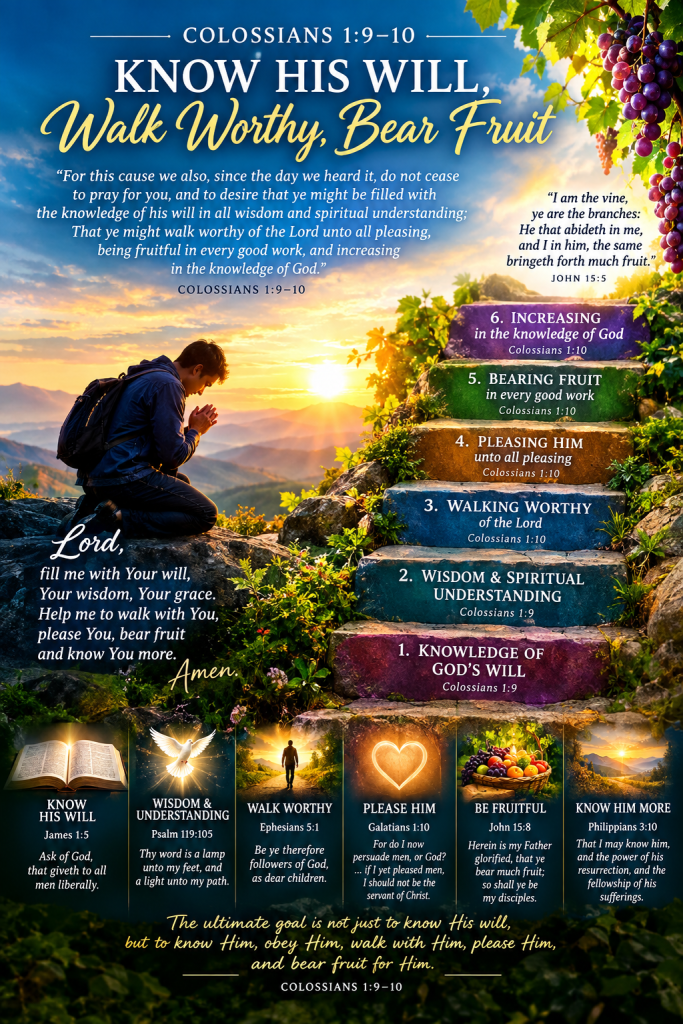
  • KNOW HIS WILL

    “For this cause we also, since the day we heard it, do not cease to pray for you, and to desire that ye might be filled with the knowledge of his will in all wisdom and spiritual understanding; That ye might walk worthy of the Lord unto all pleasing, being fruitful in every good work, and increasing in the knowledge of God” (Colossians 1:9, 10).

    The Christian life cannot be safely directed by human wisdom alone. We need the wisdom that comes from above. “If any of you lack wisdom, let him ask of God, that giveth to all men liberally” (James 1:5).

    God wants His children to seek His will, not merely ask Him to bless our will. The Lord Jesus Himself demonstrated this in Gethsemane: “Not my will, but thine, be done” (Luke 22:42). That is the heart of surrender.

    The Apostle Paul connects the knowledge of God’s will with wisdom and spiritual understanding. There is a difference between knowing Scripture intellectually and understanding how God’s Word should govern our lives.

    A person can know many verses and still make foolish decisions. But when the Holy Spirit illuminates God’s Word, Scripture begins to become living guidance. “Thy word is a lamp unto my feet, and a light unto my path” (Psalm 119:105). The Word gives us the light; spiritual understanding helps us walk in that light. This is where knowledge becomes life.

    Our faith must become visible in the way we live. To walk worthy of Christ means that our conduct should increasingly reflect the One whom we claim to follow. “Be ye therefore followers of God, as dear children” (Ephesians 5:1). We cannot truly say, “I belong to Christ,” while deliberately choosing a life that continually contradicts Christ. Walking worthy does not mean that we become perfect overnight. It means that our direction has changed.

    Although we stumble, fall, are corrected, and are tested, we continually rise, repent, obey, and press forward in our walk with Christ. The Apostle Paul’s desire is that the believer’s life should be pleasing to the Lord. He writes in Galatians 1:10: “For do I now persuade men, or God? or do I seek to please men? if I yet pleased men, I should not be the servant of Christ.” True obedience to God means choosing His approval over the applause of the world, even when it requires standing alone.

    A healthy tree produces fruit. A life genuinely connected to Christ should eventually produce spiritual fruit. The Lord Jesus said: “Herein is my Father glorified, that ye bear much fruit; so shall ye be my disciples” (John 15:8). A tree produces fruit because it is rooted and connected to its source of life. We bear spiritual fruit when we abide in Christ: “He that abideth in me, and I in him, the same bringeth forth much fruit” (John 15:5).

    The Christian life is not meant to remain spiritually stagnant. You should know Christ more deeply today than you did yesterday. Not merely know more information about Him, but know Him more intimately. The Apostle Paul himself, despite everything he had experienced, still cried: “That I may know him, and the power of his resurrection, and the fellowship of his sufferings” (Philippians 3:10). He had preached Christ, suffered for Christ, served Christ, and witnessed God’s power, yet he still said: “That I may know Him.”

    There is always more of Christ to discover.

    Ultimately, a life of surrender, obedience, and fruitfulness is only possible when we continuously seek His guidance.

    A prayer for transformation: “Lord, fill me with the knowledge of Your will. Give me spiritual wisdom and understanding. Teach me to walk worthy of You. Let my life please You. Make me fruitful in every good work. And above everything else, let me continue increasing in the knowledge of You. Amen.”

  • THE GOD OF THE IMMEASURABLE

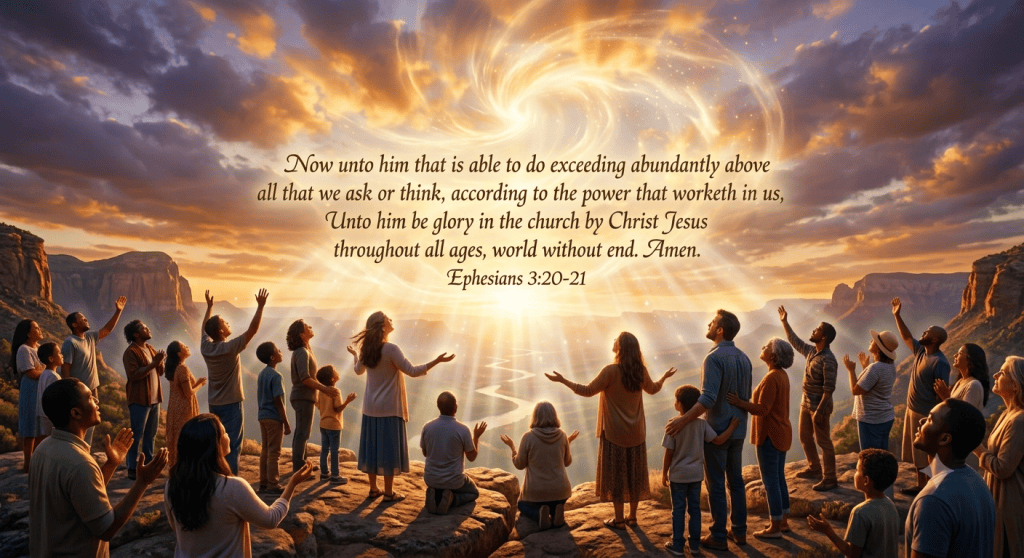
    “Now unto him that is able to do exceeding abundantly above all that we ask or think, according to the power that worketh in us,
    Unto him be glory in the church by Christ Jesus throughout all ages, world without end. Amen” (Ephesians 3:20, 21).

    The Apostle Paul emphasizes that God’s capacity to act far exceeds human comprehension. Whatever you pray for or even dream up, God’s ability to respond surpasses it. Human expectations are limited by a finite perspective, but divine resources and willingness are infinite.

    This infinite power is not distant or remote; it operates actively within the life of the believer. The same power that raised Christ from the dead is at work within believers, changing hearts, renewing minds, and granting spiritual endurance.

    God chooses to manifest His immense strength through human vessels.

    God’s glory is made visible in Christ Jesus. The Lord Jesus is the ultimate manifestation of God’s character, love, and redemption. And in the Church, the collective body of believers reflects God’s wisdom and power to the world, when living out unity, love, and faith.

    God’s glory extends through every generation of believers. The ultimate purpose of creation and salvation is an unending cycle of praise and glory to God throughout eternity.

    Trust God beyond personal limitations. Prayer is not about convincing God to act within human expectations, but aligning with an all-powerful God who is already at work internally to accomplish far more than human imagination can fathom.

  • THE BEATITUDES — WALKING IN THE HEART OF CHRIST

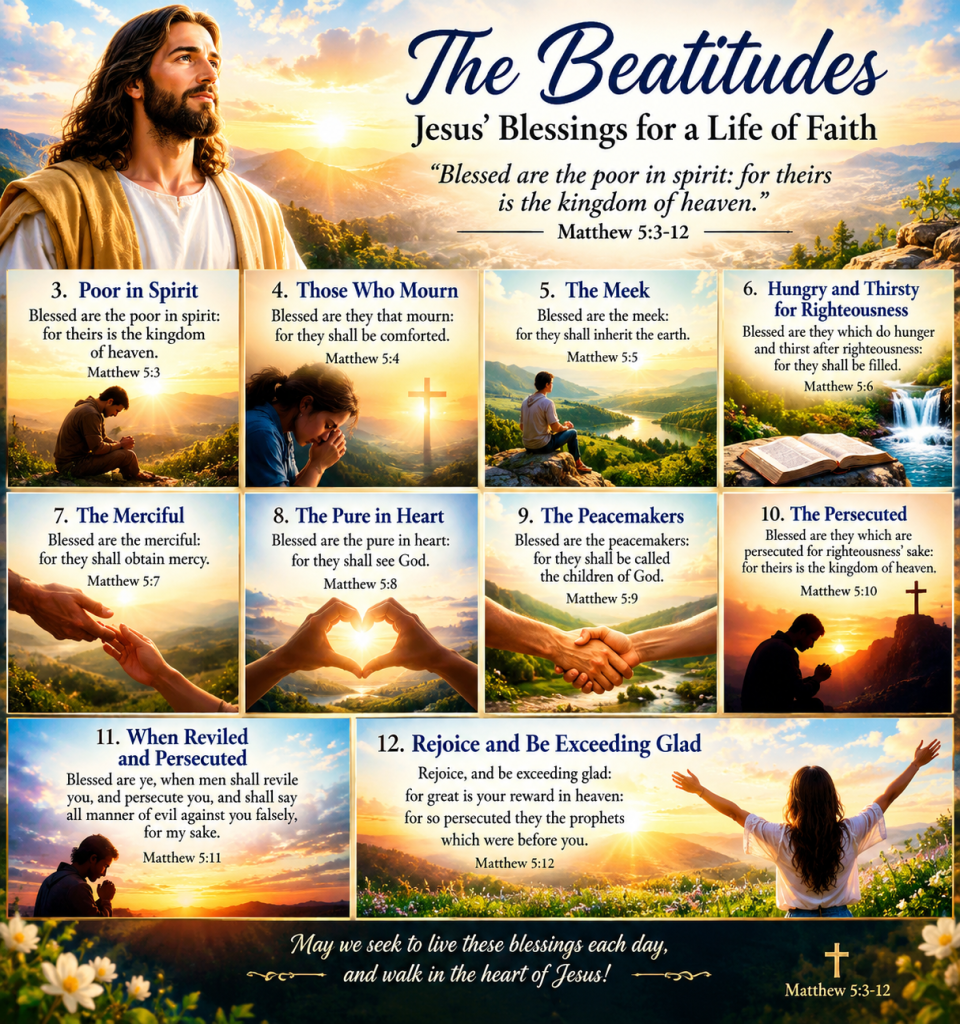
    1. “Blessed are the poor in spirit: for theirs is the kingdom of heaven” (Matthew 5:3).

    To be poor in spirit means to recognize our complete dependence upon God. It is humility before Him, knowing that we need His grace and cannot rely on ourselves.

    2. “Blessed are they that mourn: for they shall be comforted” (Matthew 5:4).

    This speaks of those who grieve deeply, including sorrow over sin and the brokenness of the world. God promises His comfort to the hurting and repentant heart.

    3. “Blessed are the meek: for they shall inherit the earth” (Matthew 5:5).

    Meekness is not weakness. It is strength brought under God’s control responding with gentleness, humility, and self-control rather than pride or revenge.

    4. “Blessed are they which do hunger and thirst after righteousness: for they shall be filled” (Matthew 5:6).

    Just as the body longs for food and water, the believer should deeply desire to live rightly before God. Jesus promises that those who genuinely seek righteousness will be spiritually satisfied.

    5. “Blessed are the merciful: for they shall obtain mercy” (Matthew 5:7).

    Mercy means showing compassion, forgiveness, and kindness to others, especially when they have fallen short. Those who extend mercy reflect God’s own merciful character.

    6. “Blessed are the pure in heart: for they shall see God” (Matthew 5:8).

    A pure heart seeks God sincerely, without hypocrisy or divided devotion. Lord Jesus points us toward an inner life that is clean, sincere, and devoted to Him.

    7. “Blessed are the peacemakers: for they shall be called the children of God” (Matthew 5:9).

    Peacemakers do more than avoid conflict. They actively seek reconciliation, forgiveness, and harmony. They reflect the character of God, who calls people into peace with Himself and one another.

    8. “Blessed are they which are persecuted for righteousness’ sake: for theirs is the kingdom of heaven” (Matthew 5:10).

    Following righteousness can sometimes bring rejection or suffering. Lord Jesus reminds His followers that faithfulness to God has eternal significance, even when it is costly.

    9. “Blessed are ye, when men shall revile you, and persecute you” (Matthew 5:11).

    When people insult, falsely accuse, or mistreat believers because of their faith in Christ, Lord Jesus tells them not to abandon Him. Their identity and reward are found in Him, not in human approval.

    10. “Rejoice, and be exceeding glad: for great is your reward in heaven” (Matthew 5:12).

    Lord Jesus calls His followers to rejoice even in suffering for His sake. The focus shifts from present hardship to the eternal reward with God. The prophets before them also endured persecution for their faithfulness.

    The Beatitudes describe a Christ-centered way of living that reflects His heart. Starting with humility, recognizing our need for God, they guide us to be gentle, merciful, pure, and peaceful, finding joy and comfort in Him even through trials.

  • STANDING FIRM IN THE PROMISES OF GOD

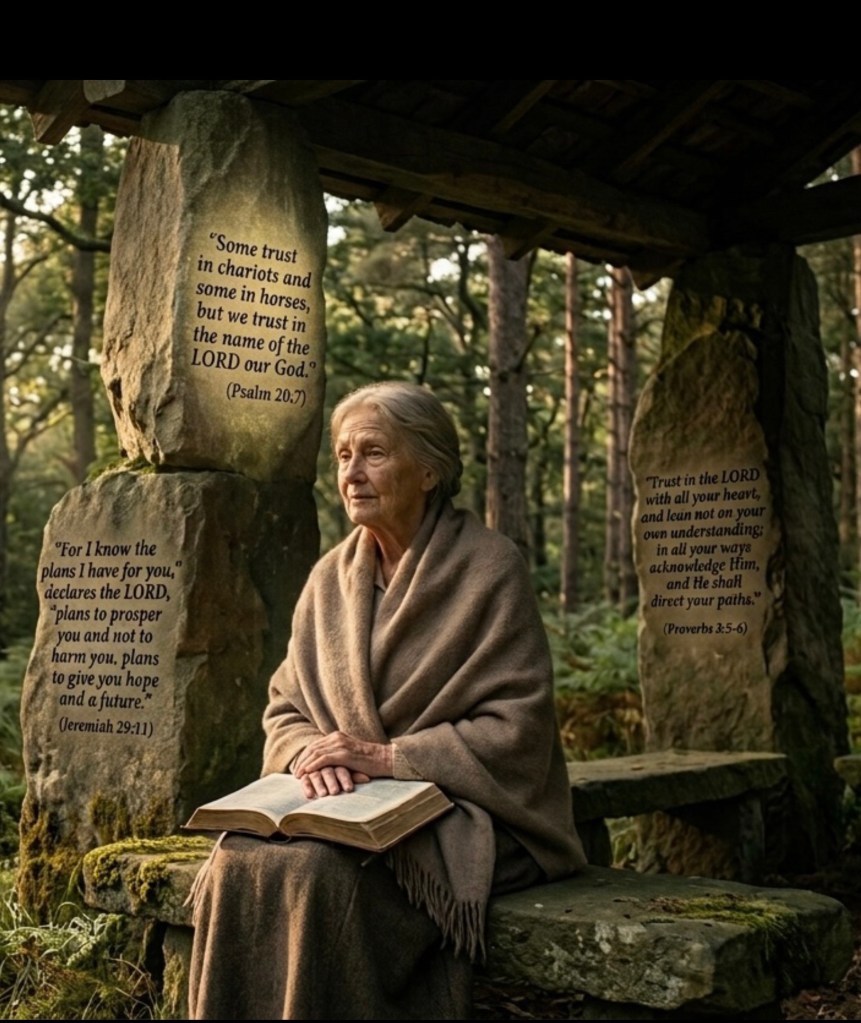
    “Some trust in chariots and some in horses, but we trust in the name of the LORD our God” (Psalm 20:7).

    Psalm 20 is an important prayer for a king before battle. It was written for a time when chariots and horses were not just concepts, they were real, and they were charging.

    The Chariots and Horses represent human power. In the ancient world, they were the most terrifying and sophisticated weapons of war. They were symbolic of military might, wealth, and national security. They are everything that the world counts as powerful and dependable.

    In our own lives, the chariots and horses are different, but their function is the same. They are the things we love to cling to for security: our health, our wealth, our influence, our knowledge, our technology. These are not inherently bad things; they are gifts and tools.

    The danger is that we begin to love the gift more than the Giver, and we build our foundation on something that, in the end, cannot sustain us.

    The Prophet Isaiah warns, “Woe to those who go down to Egypt for help and rely on horses, who trust in the abundance of their chariots and in the great strength of their horsemen, but do not look to the Holy One of Israel” (Isaiah 31:1).

    For all their strength, chariots and horses cannot give peace to a restless soul. They cannot mend a broken heart. And they can disappear in an instant.

    Turn to the name of the LORD our God.

    To trust in the “name of the LORD” is to trust in: His Power, as the Creator of the universe. His Character, as the faithful, unchanging, and merciful God who keeps His promises (Exodus 34:6). The unique covenant name, Yahweh (the LORD), which reminds us that He is the “I AM WHO I AM” (Exodus 3:14) – the ever-present, self-sustaining God who is always there, and always for us.

    This trust is not a superficial positive thinking. It is an intentional, deep-seated reliance. It is the wisdom to say, “Even if everything I own and every plan I have fails, my foundation is secure.”It is the humble act of acknowledging that our human strength has limits, but God’s strength has none.

    It’s the heart behind the powerful declaration of Isaiah 40:29: “He gives strength to the weary and increases the power of the weak.”

    It is not just for the good times. It is a battle cry for the moments of overwhelming fear. When your own strength is gone, and the “chariots” of your life seem broken, you can still whisper, “I trust in the name of the LORD my God.”

    And in that trust, you find a hidden power. You discover that you can stand when everything around you is falling. You find a security that is not of this world. As promised in Proverbs 18:10: “The name of the LORD is a strong tower; the righteous run into it and are safe.”

    Where is your trust built? What is the thing you are most afraid of losing? Is it your “chariot” or is it your “strong tower”?

    You do not need to choose between being prepared and having faith. You are allowed to have “horses.” But the Psalmist calls you to a higher love, to a love that places its primary hope in the One who will never fail you, even when all the world’s power falls. It is a wisdom that brings a peace that passes understanding.

    God does not care about fast horses or strong fighters; instead, God loves people who respect him and trust his steady love. 

    “His pleasure is not in the strength of the horse, nor His delight in the legs of the warrior; the LORD delights in those who fear Him, who put their hope in His unfailing love” ( Psalm 147:10, 11).

    “They cried unto thee, and were delivered: they trusted in thee, and were not confounded” (Psalm 22:5).

  • BENEATH THE WINGS OF GRACE

    “Keep me as the apple of Your eye; hide me under the shadow of Your wings” (Psalm 17:8).

    During a period of intense trial and opposition,  King David penned this verse, which is one of the most tender, powerful, and reassuring declarations of divine love and protection in the entire Bible.

    “Keep me as the apple of Your eye.” The  pupil is one of the most vital, delicate, and sensitive parts of the human body.

     Just as your eyelid reflexively blinks to shield your eye from the slightest particle or harm, God actively guards you with the same instinctual, instant protection.

     You are central to His vision. You are not an afterthought or lost in the crowd; God’s gaze is focused on you with immense value, tenderness, and love (Zechariah 2:8).

    “Hide me under the shadow of Your wings.”

     A mother bird gathers her young under her broad, strong wings to shield them from predators, harsh weather, or scorching heat.

     A place of physical proximity, you have to be right next to God to stay within His shadow. It implies total intimacy and refuge. While the danger outside may still rage, beneath His wings there is stillness, comfort, and ultimate security.

    God does not protect us out of mere duty; He protects us out of deep affection. You are cherished like the most delicate part of His eye and sheltered with the fierce, protective love of a parent bird over its young. Step out of the storm and rest in the safety of His presence.

  • WHO SHALL DWELL IN THY HOLY HILL?

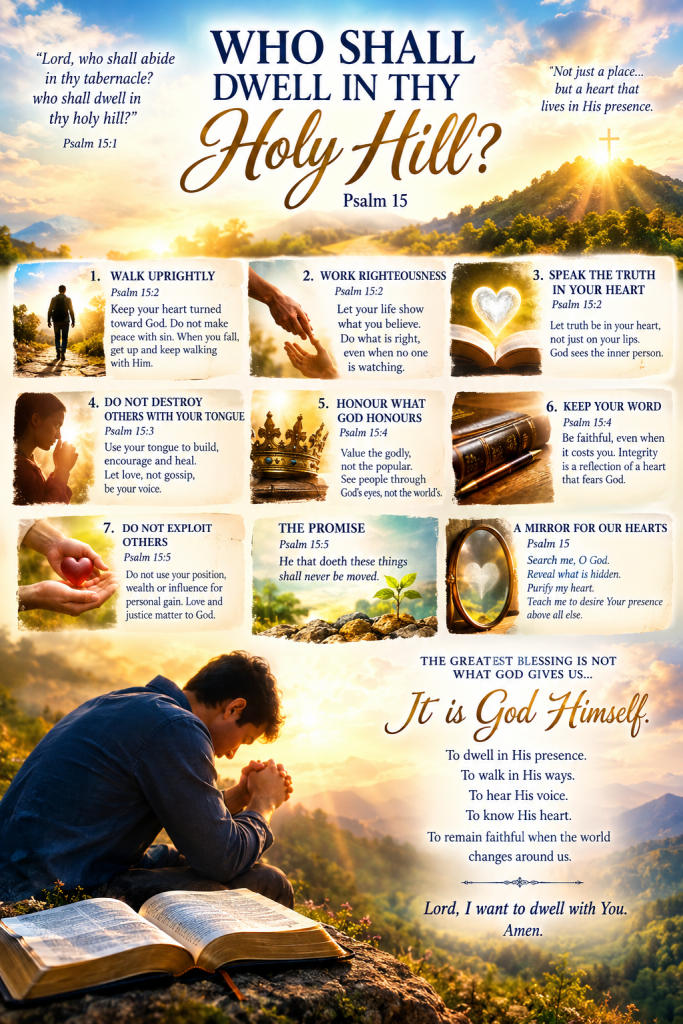
    “LORD, who shall abide in thy tabernacle? who shall dwell in thy holy hill?” (Psalm 15:1)

    King David is not asking about a physical address. He is asking about fellowship with the living God.

    Who can come near Him?

    Who can remain in His presence?

    What kind of life does God desire from those who call upon His name?

    “He that walketh uprightly” (Psalm 15:2).

    God is concerned not merely with what we say, but with how we walk.

    To walk uprightly does not mean that a person has never fallen. It means that his heart is turned toward God and that he desires to walk in truth.

    The upright person does not deliberately make peace with sin. When he discovers sin in his heart, he brings it before God. When he is corrected, he listens. When he falls, he gets up.

    King David continues: “and worketh righteousness…” (Psalm 15:2)

    Righteousness is not merely something we profess with our lips. It must become visible in our lives.

    True faith means doing what is right even when no one is watching, because we live and walk before God, not for human applause. 

    God desires truth not only on our lips but within our hearts. He desires a heart without deception, a heart that does not need to maintain one appearance before people and another before God.

    “He that backbiteth not with his tongue, nor doeth evil to his neighbour, nor taketh up a reproach against his neighbour” (Psalm 15:3).

    A person can worship God with his lips and yet wound another person with those same lips.

    Words hold the ultimate power to either build lives up or tear them down.

    King David says:

    “In whose eyes a vile person is contemned; but he honoureth them that fear the LORD” (Psalm 15:4).

    We  often admire people because of wealth, power, influence, appearance, status, or popularity.

    But God looks differently.

    The person who fears the Lord may have little recognition in this world and yet be precious in the sight of God.

    “He that sweareth to his own hurt, and changeth not” (Psalm 15:4)

    God desires people whose word can be trusted.

    This is integrity. A person of integrity does not keep his promise only when it is comfortable. He who walks with God learns that faithfulness is more valuable than convenience.

    “He that putteth not out his money to usury, nor taketh reward against the innocent” (Psalm 15:5).

    God cares about how we treat those who are vulnerable.

    Our relationship with God cannot be separated from our relationship with people. A heart that truly desires God’s presence must learn to love righteousness and reject exploitation.

    “He that doeth these things shall never be moved”(Psalm 15:5).

    The world, people, and circumstances constantly change, and earthly possessions or approval easily disappear. However, someone who builds their life upon God and walks in His ways gains a foundation that external shifts cannot take away.

    Ultimately, the greatest blessing we can experience is God Himself. While the world around us remains in constant flux, true peace is found in dwelling in His presence and walking in His ways. By taking the time to hear His voice and deeply know His heart, we gain the spiritual strength needed to remain faithful through every season of change.

  • FACE LIKE FLINT

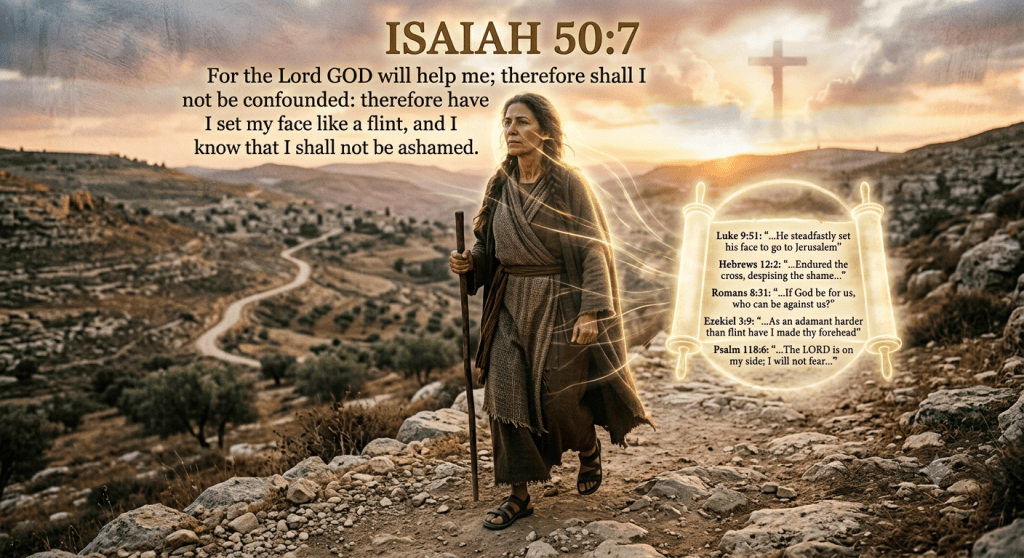
    Life frequently brings moments where your purpose is tested, your motives are questioned, or the road ahead looks steep and lonely. In those seasons, human willpower eventually fatigues but holy conviction does not.

    Setting your face like flint is not about being cold, rigid, or stubborn toward people; it is about being entirely uncompromising regarding your direction in God. 

    Stop measuring your journey against the noise, criticism, or doubts of the crowd.

    Realise that if God has called you to step forward, His strength will sustain every step you take.

     Circumstances may test you today, but God’s promises guarantee that your story does not end in defeat.

    Whatever trial, goal, or calling lies before you today, fix your gaze forward. Let your trust in God make your resolve harder than any obstacle in your path.

    “Therefore, my beloved brethren, be ye stedfast, unmovable, always abounding in the work of the Lord, forasmuch as ye know that your labour is not in vain in the Lord” ( 1 Corinthians 15:58).

     “Cast not away therefore your confidence, which hath great recompence of reward. For ye have need of patience, that, after ye have done the will of God, ye might receive the promise” (Hebrews 10:35, 36).

  • THE UNSHAKABLE REIGN

    “From the rising of the sun unto the going down of the same the LORD’s name is to be praised”(Psalm 113:3).

    Earthly power has an expiration date. Presidents, prime ministers, kings, and emperors wield a borrowed authority that is bound by borders, broken by time, and cut short by the grave. When human leaders receive honor, it is merely for an office they temporarily occupy.

    The Creator’s claim to glory knows no such limits. His praise spans “from the rising of the sun unto the going down of the same”, stretching across every timezone and filling every corner of space without pause.

    While human rulers beg for the support of citizens, lean on advisors, and fight over resources to keep their thrones, God’s authority is absolute and underived. Everything in this universe needs a cause, a fuel, or a maker to exist. But God exists from everlasting to everlasting (Psalm 90:2). He is uncaused. He relies on nothing.

    He is not measured by a standard of goodness or truth, He is the source and definition of them. He guards strict justice while holding out deep mercy, patience, and grace to His creation. From the smallest subatomic particle to the largest spinning galaxy, all things hang in continuous, breathless dependence upon Him.

    Earthly empires rise and fall like the tide, but the Kingdom of God remains unshaken. In a world of shifting allegiances and fragile leadership, human power is ultimately eclipsed by the One who needs no throne, fears no successor, and answers to no court. To Him alone belongs the honor that never fades.

    “Now unto the King eternal, immortal, invisible, the only wise God, be honour and glory for ever and ever. Amen” (1 Timothy 1:17).

    “The LORD shall reign for ever, even thy God, O Zion, unto all generations. Praise ye the LORD”(Psalm 146:10).

  • RIGHTEOUSLY UNRIGHTEOUS

    In the dust where my footfall faltered,

    In the shadow of a fractured grace,

    I brought a heart I could not alter,

    To stand before the Holy Face.

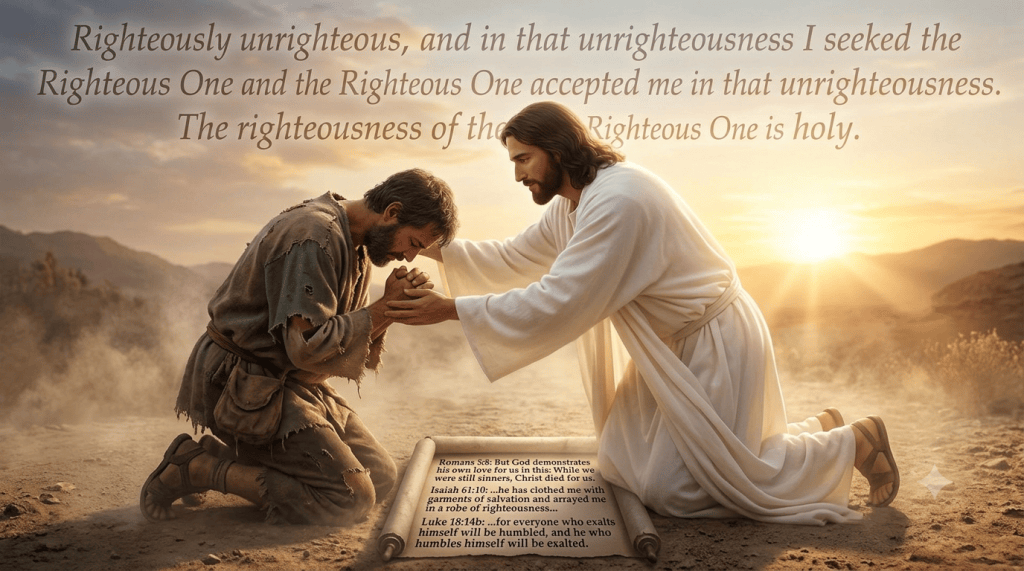
    Righteously unrighteous, bent and broken,

    Cloaked in the truth of my own decay,

    With no grand plea or polished token,

    I walked the dark toward the light of day.

    I sought the One who holds the suns,

    Whose purity no fault can stain,

    And found the arms of the Righteous One

    Open to gather my guilt and pain.

    Not after the wash, not after the mend,

    But deep in the mire where I used to lie,

    The Holy bowed down to call me friend,

    And answered my frail, unworthy cry.

    Now wrapped in a light I did not earn,

    Where mercy and holiness tightly twine,

    I rest in the grace for which I yearned—

    His holy righteousness, forever mine.