Tag: Love the Lord

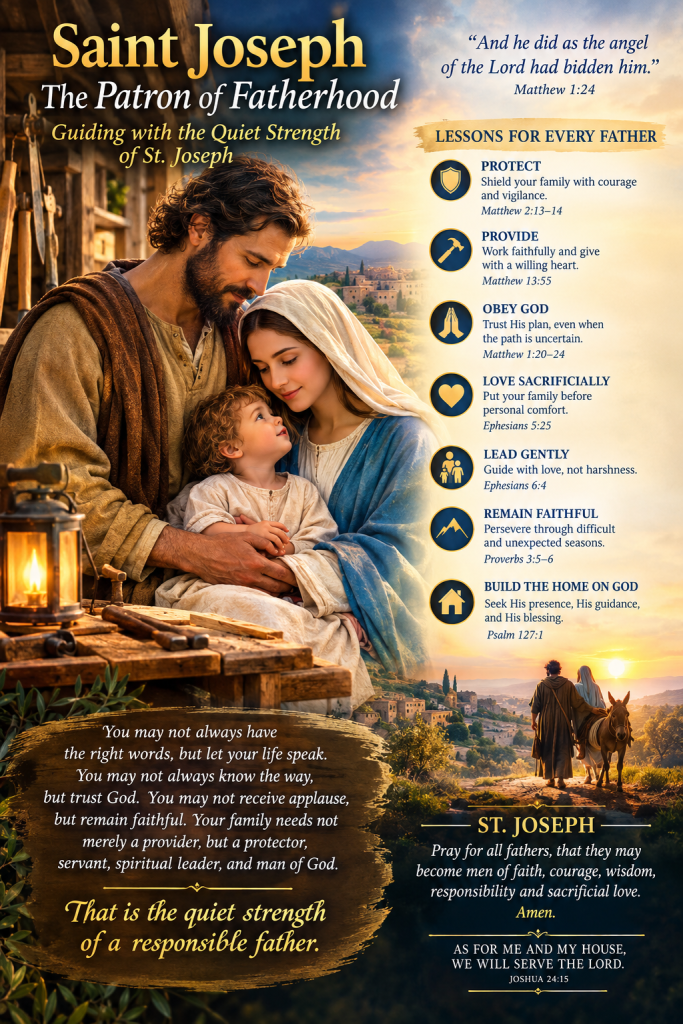
  • THE PATRON OF FATHERHOOD

    “But as for me and my house, we will serve the LORD” (Joshua 24:15).

    Being a responsible father like St. Joseph means anchoring a family in quiet strength, selfless protection, sacrificial love, and steady, faithful devotion. Scripture introduces Joseph as “a just man” (Matthew 1:19), a man whose righteousness was revealed not through many words, but through his actions, obedience, compassion, and trust in God.

    Long before he became the foster-father and guardian of Jesus, Joseph’s profound sense of responsibility was tested when he discovered that Mary was with child. Not understanding the mystery of what God was doing, Joseph nevertheless desired to protect Mary from public disgrace: “Joseph her husband, being a just man, and not willing to make her a public example, was minded to put her away privily” (Matthew 1:19).

    But God had a greater purpose. An angel of the Lord appeared to Joseph in a dream and revealed the divine mystery: “Joseph, thou son of David, fear not to take unto thee Mary thy wife: for that which is conceived in her is of the Holy Ghost” (Matthew 1:20).

    Joseph did not argue, delay, or demand an explanation. He obeyed. “Then Joseph being raised from sleep did as the angel of the Lord had bidden him, and took unto him his wife” (Matthew 1:24).

    Here we see the first great lesson of fatherhood: a godly father listens when God speaks and obeys even when he does not understand everything.

    Joseph took Mary into his home, accepting the responsibility God had entrusted to him. He protected her dignity, cared for her needs, and accompanied her on the difficult journey to Bethlehem as she prepared to give birth to the promised Messiah.

    And when the child was born, Joseph remained faithful to his God-given responsibility. He became the earthly guardian of the One who is the eternal Son of God.

    When an angel warned him of Herod’s murderous intention, Joseph again demonstrated immediate obedience: “Arise, and take the young child and his mother, and flee into Egypt” (Matthew 2:13).

    And Scripture tells us: “When he arose, he took the young child and his mother by night, and departed into Egypt” (Matthew 2:14).

    There was no complaint recorded. No hesitation. No concern about personal comfort. Joseph simply obeyed.

    He uprooted his life in the middle of the night and led Mary and the infant Jesus to safety. In doing so, Joseph teaches fathers that protection sometimes requires sacrifice, inconvenience, courage, and immediate action.

    After Herod’s death, Joseph once again received divine direction: “Arise, and take the young child and his mother, and go into the land of Israel” (Matthew 2:20).

    Joseph obeyed again and eventually settled with Mary and Jesus in Nazareth.

    There, in the quietness of an ordinary home, Joseph fulfilled his vocation. He worked with his hands and provided for the Holy Family. Matthew identifies him as a craftsman or builder (Matthew 13:55). His was not a life of public recognition, but a life of hidden faithfulness.

    The Gospel gives us a beautiful glimpse of Jesus growing within the loving care of His earthly family: “And the child grew, and waxed strong in spirit, filled with wisdom: and the grace of God was upon him” (Luke 2:40).

    Later, when Jesus was found in the temple, Scripture says: “And he went down with them, and came to Nazareth, and was subject unto them” (Luke 2:51).

    Joseph’s life reminds us that great fatherhood is often formed in ordinary places: in the home, at work, and through sacrifice, protection, teaching, and daily faithfulness.

    His life proves that true fatherhood does not need applause. It speaks through action more than words.

    A father protects, provides, teaches, sacrifices, and prays as he leads his family toward God.

    A father’s responsibility is not merely to provide material necessities, but also to care for the physical, emotional, moral, and spiritual well-being of his family.

    Scripture gives fathers this solemn responsibility: “And, ye fathers, provoke not your children to wrath: but bring them up in the nurture and admonition of the Lord” (Ephesians 6:4).

    A godly father does not lead through fear, domination, or demands, but instead protects, provides for, corrects, and disciplines his family through love, wisdom, patience, example, and prayer ultimately showing them what it means to walk with God through his own life.

    Scripture also calls husbands to a sacrificial standard: “Husbands, love your wives, even as Christ also loved the church, and gave himself for it” (Ephesians 5:25).

    This is the heart of Christian fatherhood: self-giving love.

    Providing for a family is more than fulfilling an obligation. It can become a daily offering of love: the sacrifice of time, energy, comfort, personal ambition, and sometimes even one’s own plans for the good of those entrusted to him.

    Every father needs the faith to move forward during uncertainty by trusting God, even when the future remains completely unknown. “Trust in the LORD with all thine heart; and lean not unto thine own understanding”(Proverbs 3:5).

    There will be seasons when a father does not know what tomorrow will bring. There may be financial difficulties, family struggles, uncertain decisions, disappointments, or roads he never expected to travel.

    In those moments, Joseph’s example speaks silently: Listen to God. Trust God. Obey God. Protect those entrusted to you. Keep moving forward in faith.

    A father does not have to be perfect to be faithful. He must be willing to humble himself before God, seek wisdom, repent when he fails, and continue walking faithfully.

    Ultimately, the strength of a godly father comes not from himself but from the Lord. “Except the LORD build the house, they labour in vain that build it” (Psalm 127:1).

    A father may build walls, provide food, pay bills, teach skills, and protect his family, but only God can truly build a home. Therefore, the greatest inheritance a father can leave his children is not merely wealth or possessions, but a living example of faith.

    Let your children see your faith in action: praying, forgiving, serving, and choosing God above all else so they learn to make Him first too.

    St. Joseph’s life was largely hidden from the world, yet his faithfulness was precious in the sight of God. He did not preach great sermons recorded in Scripture. He did not perform public miracles. We do not hear a single spoken word from Joseph recorded in the Gospels.

    His silence was obedience, his hands were service, his courage was protection, his work was provision, and his faith was leadership.

    He became a sanctuary of faithfulness for Mary and the child Jesus.

    Build a home where love is strong, faith is alive, prayer is welcomed, forgiveness is practiced, truth is honoured, and Christ is at the centre.

    A father’s greatest success is not how loudly the world remembers his name, but how faithfully his family remembers the God he taught them to love.

    May every father learn from St. Joseph to become a man of quiet strength, courageous obedience, sacrificial love, humble service, and unwavering faith.

    And may every Christian home become what Joseph’s home in Nazareth quietly became: a place where God was honoured, where love was lived, where sacrifice was embraced, where faith was taught, and where the presence of God was cherished above everything else. 
  • THE LIVING TABERNACLE

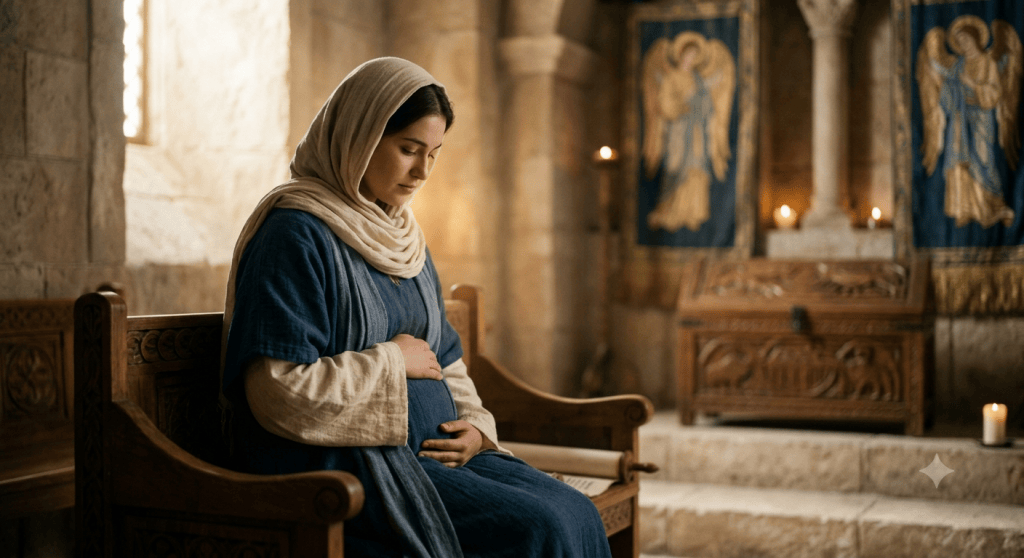
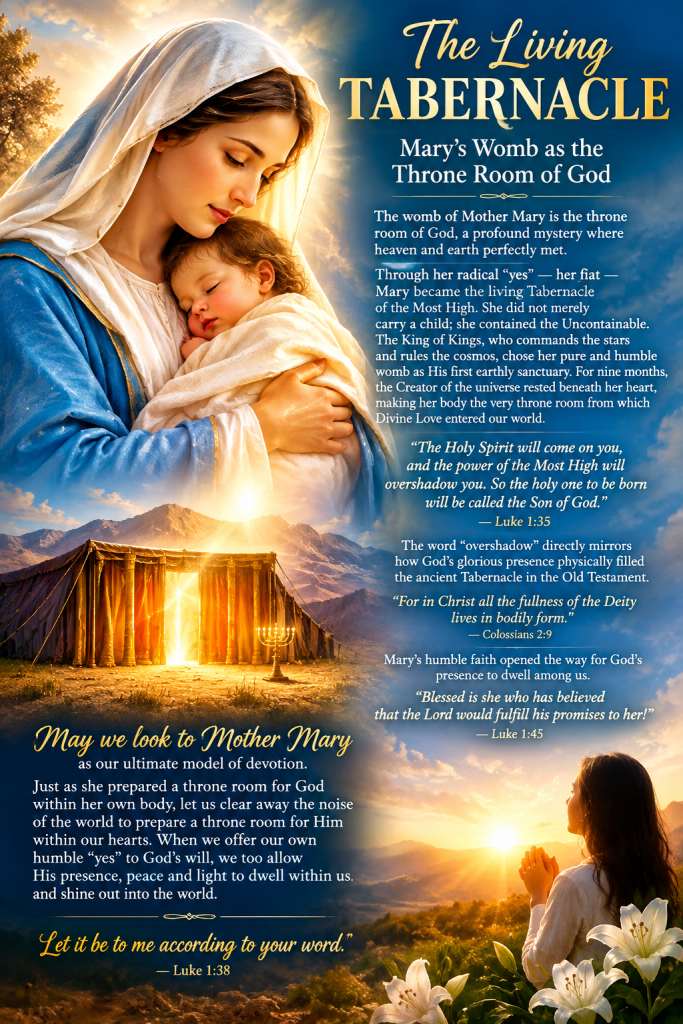
    The Living Tabernacle: Mary’s Womb as the Throne Room of God

    “For with God nothing shall be impossible” ( Luke 1:37).

    The Womb of Mother Mary is the throne room of God, a profound mystery where heaven and earth perfectly met.

    Through her radical “yes” and her fiat, Mary became the living Tabernacle of the Most High. She did not merely carry a child; she contained the Uncontainable.

    The King of Kings, who commands the stars and rules the cosmos, chose her pure and humble womb as His first earthly sanctuary. For nine months, the Creator of the universe rested beneath her heart, making her body the very throne room from which Divine Love entered our world.

    This reality fulfills the beautiful announcement given to her by the Angel Gabriel:

    “The Holy Spirit will come on you, and the power of the Most High will overshadow you. So the holy one to be born will be called the Son of God” (Luke 1:35).

    The word “overshadow” directly mirrors how God’s glorious presence physically filled the ancient Tabernacle in the Old Testament. In Mary, God came to dwell not in a tent, but in human flesh:

    “For in Christ all the fullness of the Deity lives in bodily form” (Colossians 2:9).

    This sacred truth reminds us of the incredible dignity of the human person and the power of surrender. God did not choose a grand, earthly palace of marble and gold for His throne; He chose the quiet, hidden, and faithful womb of a humble young woman, prompted by her deep faith:

    “Blessed is she who has believed that the Lord would fulfill his promises to her!” ( Like 1:45)

    May we look to Mother Mary as our ultimate model of devotion. Just as she prepared a throne room for God within her own body, let us clear away the noise of the world to prepare a throne room for Him within our hearts. When we offer our own humble “yes” to God’s will, we too allow His presence, peace, and light to dwell within us and shine out into the world.

  • THE MIND OF CHRIST

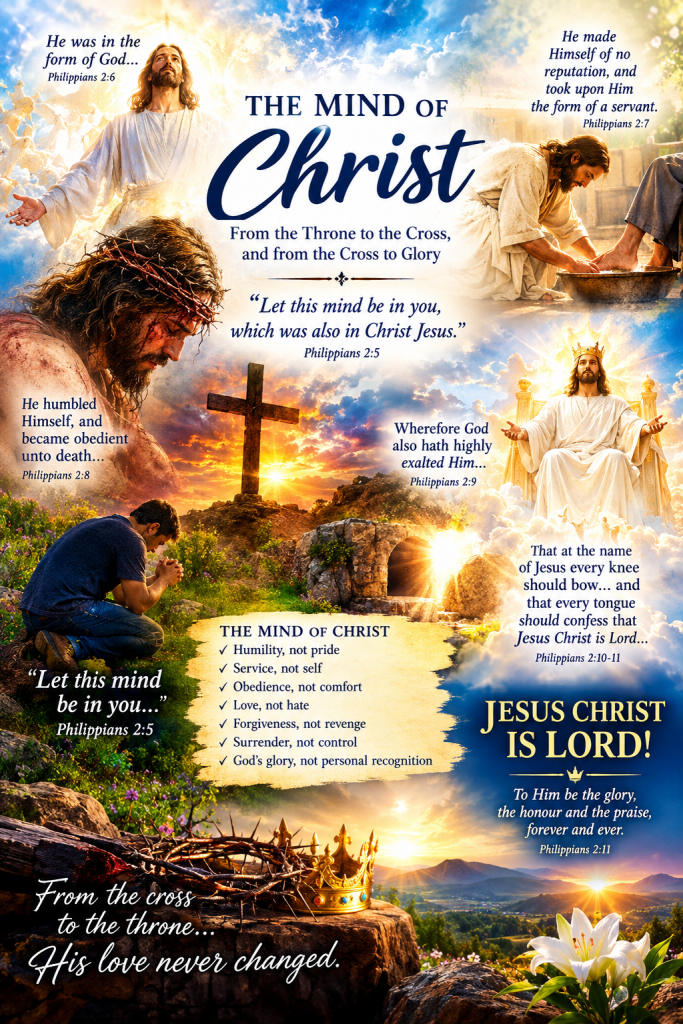
    “Let this mind be in you, which was also in Christ Jesus” (Philippians 2:5).

    Philippians 2:5–11 reveals the heart of Christ: the One who was equal with God chose to humble Himself, took the form of a servant, endured the cross, and was exalted by the Father above every name.

    The Apostle Paul tells us that Christ Jesus, “being in the form of God, thought it not robbery to be equal with God” (Philippians 2:6).

    The Lord Jesus did not begin His existence in Bethlehem, Bethlehem was not the beginning of Christ. He came from glory. The One who lay in a manger was the One through whom all things were created.

    The Apostle John declares: “In the beginning was the Word, and the Word was with God, and the Word was God” (John 1:1). And: “All things were made by him; and without him was not any thing made that was made” (John 1:3).

    The Creator who spoke light into existence, shaped the heavens, and receives the worship of angels humbled Himself to become a servant and endure the piercing darkness of the cross.

    Philippians 2:7 says: “But made himself of no reputation, and took upon him the form of a servant.”

    True greatness is not about status or power, but about humility, serving others, and obeying God.

    True greatness is demonstrated not by being served or claiming glory, but by humbling oneself to serve others and give one’s life as a ransom, just as Jesus Christ did.

    Philippians 2:8 says: “And being found in fashion as a man, he humbled himself.” He humbled Himself. Nobody forced Him. Love led Him. He knew what awaited Him. He knew about rejection. He knew about betrayal. He knew about the scourging. He knew about the crown of thorns. He knew about the nails. He knew about Calvary. And yet He continued.

    Why? Because He loved us.

    “Greater love hath no man than this, that a man lay down his life for his friends” (John 15:13).

    At the cross, we see the terrible seriousness of sin, but we also see the immeasurable greatness of God’s love. The cross says to the sinner: “Your sin is serious.” But the cross also says: “You are loved.”

    He humbled himself, and became obedient unto death, even the death of the cross.

    True Christian humility demands active obedience to God, calling followers to surrender their pride, plans, comfort, and reputation just as the Lord Jesus did all the way to the cross.

    But the example of Christ stands before us: Obedience to God must be greater than our desire for comfort. The Lord Jesus Christ prayed in Gethsemane “Not my will, but thine, be done” (Luke 22:42).

    The Cross was not the end. Human eyes could look at Calvary and see defeat. But heaven saw obedience. The grave appeared to be the end. But resurrection was coming. The cross looked like humiliation. But exaltation was coming.

    Philippians 2:9 declares: “Wherefore God also hath highly exalted him, and given him a name which is above every name.”

    God sees and remembers every act of humble, unseen obedience, and He will ultimately exalt those whom the world overlooks.

    The Lord Jesus taught: “Whosoever shall humble himself shall be exalted” (Matthew 23:12).

    Philippians 2:10–11 gives us one of the most majestic declarations in Scripture: “That at the name of Jesus every knee should bow, of things in heaven, and things in earth, and things under the earth; And that every tongue should confess that Jesus Christ is Lord, to the glory of God the Father.”

    One day, every person and power in all creation will bow and confess that Lord Jesus Christ  is the one true King.

    Despite the world’s rejection of the Lord Jesus Christ, His unshakable lordship calls us not just to admire Him, but to surrender our lives and follow His example of humility, love, and obedience.

    The Christian life is not simply saying: “Jesus is Lord.” It is allowing the Lord Jesus to become the pattern of our lives. In moments of pride, hurt, or hardship, looking to Christ provides the ultimate pattern for humility, obedience, and endurance.

    He descended before He was exalted. He served before He was glorified. He suffered before He was crowned. He obeyed before the Father highly exalted Him.

    The Apostle Paul outlines the ultimate trajectory of Jesus Christ, who descended from divine glory to the humility of the cross before being exalted to everlasting Lordship over all creation.

    THE LORD JESUS CHRIST: He is not merely a teacher. He is not merely a prophet. He is not merely an example. He is Lord. The One who humbled Himself will reign forever. The One who wore the crown of thorns will wear the crown of glory. The One who was rejected by men will be confessed by every tongue. The One whose hands were pierced will rule with all authority.

    Let Christ’s mind, heart, humility, obedience, and love shape your thoughts, desires, relationships, decisions, and actions.

    Your prayers, tears, and quiet service are never wasted because God sees everything. Keep serving, obeying, and looking to Jesus. The Christ who humbled Himself is now highly exalted and He sees your faithfulness.

    And the day is coming when every knee shall bow and every tongue shall confess:

    JESUS CHRIST IS LORD!

  • THE GOD OF THE IMMEASURABLE

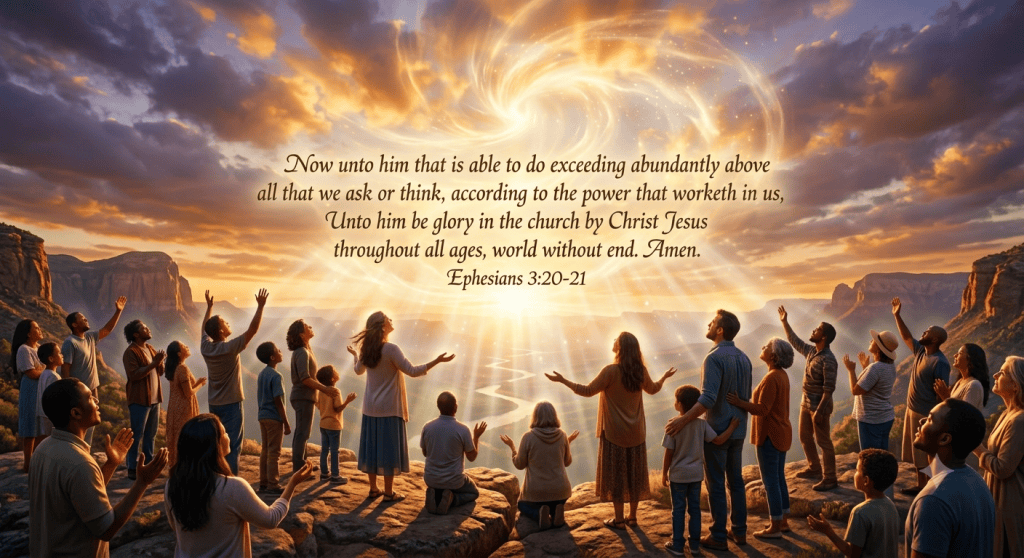
    “Now unto him that is able to do exceeding abundantly above all that we ask or think, according to the power that worketh in us,
    Unto him be glory in the church by Christ Jesus throughout all ages, world without end. Amen” (Ephesians 3:20, 21).

    The Apostle Paul emphasizes that God’s capacity to act far exceeds human comprehension. Whatever you pray for or even dream up, God’s ability to respond surpasses it. Human expectations are limited by a finite perspective, but divine resources and willingness are infinite.

    This infinite power is not distant or remote; it operates actively within the life of the believer. The same power that raised Christ from the dead is at work within believers, changing hearts, renewing minds, and granting spiritual endurance.

    God chooses to manifest His immense strength through human vessels.

    God’s glory is made visible in Christ Jesus. The Lord Jesus is the ultimate manifestation of God’s character, love, and redemption. And in the Church, the collective body of believers reflects God’s wisdom and power to the world, when living out unity, love, and faith.

    God’s glory extends through every generation of believers. The ultimate purpose of creation and salvation is an unending cycle of praise and glory to God throughout eternity.

    Trust God beyond personal limitations. Prayer is not about convincing God to act within human expectations, but aligning with an all-powerful God who is already at work internally to accomplish far more than human imagination can fathom.

  • BENEATH THE WINGS OF GRACE

    “Keep me as the apple of Your eye; hide me under the shadow of Your wings” (Psalm 17:8).

    During a period of intense trial and opposition,  King David penned this verse, which is one of the most tender, powerful, and reassuring declarations of divine love and protection in the entire Bible.

    “Keep me as the apple of Your eye.” The  pupil is one of the most vital, delicate, and sensitive parts of the human body.

     Just as your eyelid reflexively blinks to shield your eye from the slightest particle or harm, God actively guards you with the same instinctual, instant protection.

     You are central to His vision. You are not an afterthought or lost in the crowd; God’s gaze is focused on you with immense value, tenderness, and love (Zechariah 2:8).

    “Hide me under the shadow of Your wings.”

     A mother bird gathers her young under her broad, strong wings to shield them from predators, harsh weather, or scorching heat.

     A place of physical proximity, you have to be right next to God to stay within His shadow. It implies total intimacy and refuge. While the danger outside may still rage, beneath His wings there is stillness, comfort, and ultimate security.

    God does not protect us out of mere duty; He protects us out of deep affection. You are cherished like the most delicate part of His eye and sheltered with the fierce, protective love of a parent bird over its young. Step out of the storm and rest in the safety of His presence.

  • WHO SHALL DWELL IN THY HOLY HILL?

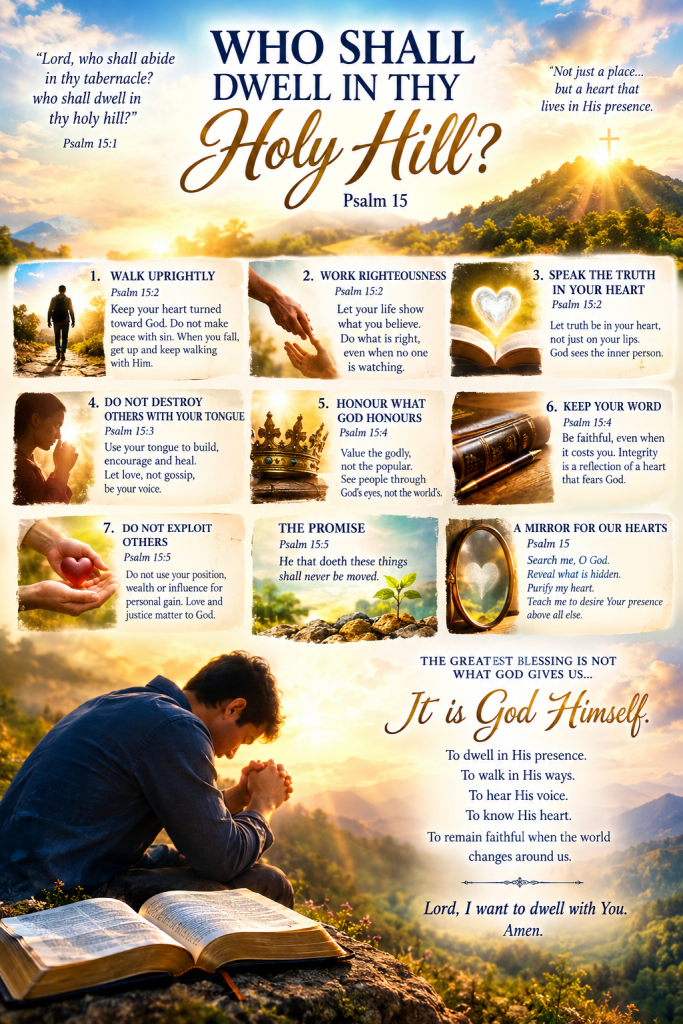
    “LORD, who shall abide in thy tabernacle? who shall dwell in thy holy hill?” (Psalm 15:1)

    King David is not asking about a physical address. He is asking about fellowship with the living God.

    Who can come near Him?

    Who can remain in His presence?

    What kind of life does God desire from those who call upon His name?

    “He that walketh uprightly” (Psalm 15:2).

    God is concerned not merely with what we say, but with how we walk.

    To walk uprightly does not mean that a person has never fallen. It means that his heart is turned toward God and that he desires to walk in truth.

    The upright person does not deliberately make peace with sin. When he discovers sin in his heart, he brings it before God. When he is corrected, he listens. When he falls, he gets up.

    King David continues: “and worketh righteousness…” (Psalm 15:2)

    Righteousness is not merely something we profess with our lips. It must become visible in our lives.

    True faith means doing what is right even when no one is watching, because we live and walk before God, not for human applause. 

    God desires truth not only on our lips but within our hearts. He desires a heart without deception, a heart that does not need to maintain one appearance before people and another before God.

    “He that backbiteth not with his tongue, nor doeth evil to his neighbour, nor taketh up a reproach against his neighbour” (Psalm 15:3).

    A person can worship God with his lips and yet wound another person with those same lips.

    Words hold the ultimate power to either build lives up or tear them down.

    King David says:

    “In whose eyes a vile person is contemned; but he honoureth them that fear the LORD” (Psalm 15:4).

    We  often admire people because of wealth, power, influence, appearance, status, or popularity.

    But God looks differently.

    The person who fears the Lord may have little recognition in this world and yet be precious in the sight of God.

    “He that sweareth to his own hurt, and changeth not” (Psalm 15:4)

    God desires people whose word can be trusted.

    This is integrity. A person of integrity does not keep his promise only when it is comfortable. He who walks with God learns that faithfulness is more valuable than convenience.

    “He that putteth not out his money to usury, nor taketh reward against the innocent” (Psalm 15:5).

    God cares about how we treat those who are vulnerable.

    Our relationship with God cannot be separated from our relationship with people. A heart that truly desires God’s presence must learn to love righteousness and reject exploitation.

    “He that doeth these things shall never be moved”(Psalm 15:5).

    The world, people, and circumstances constantly change, and earthly possessions or approval easily disappear. However, someone who builds their life upon God and walks in His ways gains a foundation that external shifts cannot take away.

    Ultimately, the greatest blessing we can experience is God Himself. While the world around us remains in constant flux, true peace is found in dwelling in His presence and walking in His ways. By taking the time to hear His voice and deeply know His heart, we gain the spiritual strength needed to remain faithful through every season of change.

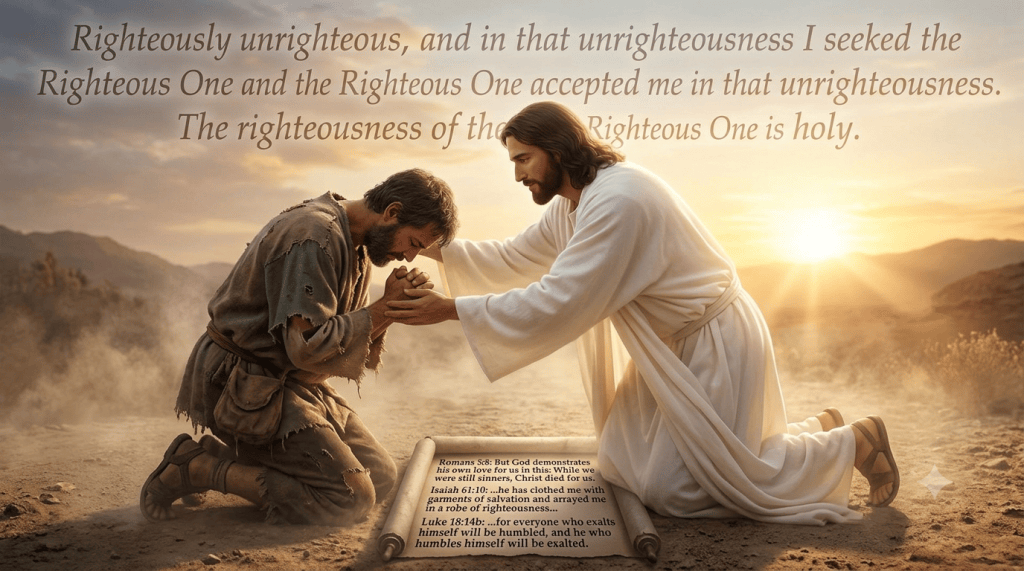
  • RIGHTEOUSLY UNRIGHTEOUS

    In the dust where my footfall faltered,

    In the shadow of a fractured grace,

    I brought a heart I could not alter,

    To stand before the Holy Face.

    Righteously unrighteous, bent and broken,

    Cloaked in the truth of my own decay,

    With no grand plea or polished token,

    I walked the dark toward the light of day.

    I sought the One who holds the suns,

    Whose purity no fault can stain,

    And found the arms of the Righteous One

    Open to gather my guilt and pain.

    Not after the wash, not after the mend,

    But deep in the mire where I used to lie,

    The Holy bowed down to call me friend,

    And answered my frail, unworthy cry.

    Now wrapped in a light I did not earn,

    Where mercy and holiness tightly twine,

    I rest in the grace for which I yearned—

    His holy righteousness, forever mine.

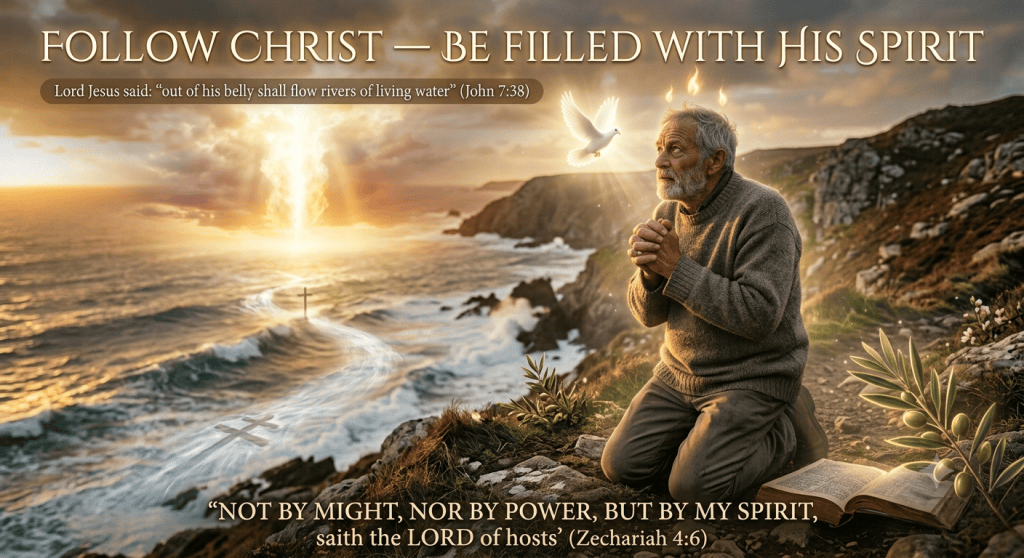
  • FOLLOW CHRIST — BE FILLED WITH HIS SPIRIT

    Christians are called to follow Christ not merely in name, but in life, in obedience, in holiness, and in the power of the Holy Spirit.

    The Lord Jesus Himself was baptized in water, and the Holy Spirit descended upon Him. The Scripture says: “And the Holy Ghost descended in a bodily shape like a dove upon him” (Luke 3:22).

    If we call ourselves followers of Christ, we must earnestly seek to walk in the footsteps of Christ.

    When Israel passed through the Red Sea, the Apostle Paul described it as a figure of baptism: “And were all baptized unto Moses in the cloud and in the sea” (1 Corinthians 10:2).

    Their passage through the waters marked a separation from the life they had known in Egypt. They were moving forward into a new journey under the leadership of God.

    Then God manifested His presence among them. At Mount Sinai, the glory and fire of the Lord were revealed. And throughout their wilderness journey, God did not leave His people without direction: “And the LORD went before them by day in a pillar of a cloud, to lead them the way; and by night in a pillar of fire, to give them light” (Exodus 13:21)

    Cloud by day. Fire by night.

    God did not merely bring His people out, He desired to lead them.

    In the same way, receiving the Holy Spirit is not merely about having an experience. The Holy Spirit comes to dwell in you, to teach, guide, comfort, convict, strengthen, and lead you into the truth.

    The Lord Jesus said: “And I will pray the Father, and he shall give you another Comforter, that he may abide with you for ever” (John 14:16).

    And in John 16:13: “Howbeit when he, the Spirit of truth, is come, he will guide you into all truth.”

    The Holy Spirit is the Spirit of God.

    The Apostle Paul writes: “Now if any man have not the Spirit of Christ, he is none of his.” (Romans 8:9).

    If you are not filled with the Spirit of God, you don’t belong to Him.

    Water baptism has profound biblical meaning. It testifies to repentance, identification with Christ, the death of the old life, and the beginning of a new life: “Therefore we are buried with him by baptism into death: that like as Christ was raised up from the dead by the glory of the Father, even so we also should walk in newness of life” (Romans 6:4).

    The old life must die, and the new life must be lived in Christ. The Holy Spirit is central to that new life.

    The Lord Jesus declared: “Except a man be born of water and of the Spirit, he cannot enter into the kingdom of God” (John 3:5).

    The new birth is the work of God within the heart.

    On the Day of Pentecost, the promise of the Father was manifested with extraordinary power: “And there appeared unto them cloven tongues like as of fire, and it sat upon each of them. And they were all filled with the Holy Ghost” (Acts 2:3–4).

    They were filled with the Holy Spirit, and they began to speak with other tongues as the Spirit gave them utterance.

    Tongues are one of the spiritual gifts mentioned by the Apostle Paul among the manifestations of the Spirit (1 Corinthians 12:8–10). The Holy Spirit gives different gifts to different believers according to His will (1 Corinthians 12:11).

    Therefore, we should not measure the presence of the Holy Spirit merely by one particular manifestation.

    God looks deeper than our outward actions. “For man looketh on the outward appearance, but the LORD looketh on the heart” (1 Samuel 16:7).

    Therefore, do not be satisfied with water baptism alone.

    Do not be satisfied merely because you were baptized as a child. A ceremony cannot substitute for a surrendered heart.

    A person may pass through religious ceremonies and still wander far from God. Israel itself passed through the sea, witnessed God’s mighty works, and yet many later fell into disobedience and unbelief. Apostle Paul warns us to learn from their example (1 Corinthians 10:1–12).

    So let us examine ourselves. Have we truly repented? Have we surrendered our lives to Christ? Are we walking in obedience, seeking the Holy Spirit, and  allowing the Spirit of God to lead us?

    The Scripture says: “As many as are led by the Spirit of God, they are the sons of God” (Romans 8:14). 

    Repentance must be more than words.

    True repentance turns the heart toward God. “Repent ye therefore, and be converted, that your sins may be blotted out” (Acts 3:19).

    Come before the Lord sincerely. Fast, pray, and search your heart. Confess your sins to God. Ask Him to cleanse you, change you, and fill you with His Spirit. Lord Jesus Himself gave this invitation: “If any man thirst, let him come unto me, and drink” (John 7:37).

    And then He gave this extraordinary promise: “He that believeth on me, as the scripture hath said, out of his belly shall flow rivers of living water” (John 7:38).

    If your desire is to serve the Lord and reach souls, ask Him to equip you.

    Say: “Lord Jesus, I do not want merely to speak about You. I want You to use my life. Cleanse me. Teach me. Lead me. Fill me with Your Holy Spirit. Give me wisdom, courage, love, discernment, and every gift You desire to place within me. Make me a vessel for Your glory.”

    Seek the Lord with your whole heart.

    Be filled with His Spirit. Walk in His light.

    Bear His fruit. Carry His love. Obey His voice.

    And let your life become a living testimony that Jesus Christ is Lord.

    “Not by might, nor by power, but by my spirit, saith the LORD of hosts” (Zechariah 4:6).

  • THE PERFECT GOD AND THE IMPERFECT VESSEL

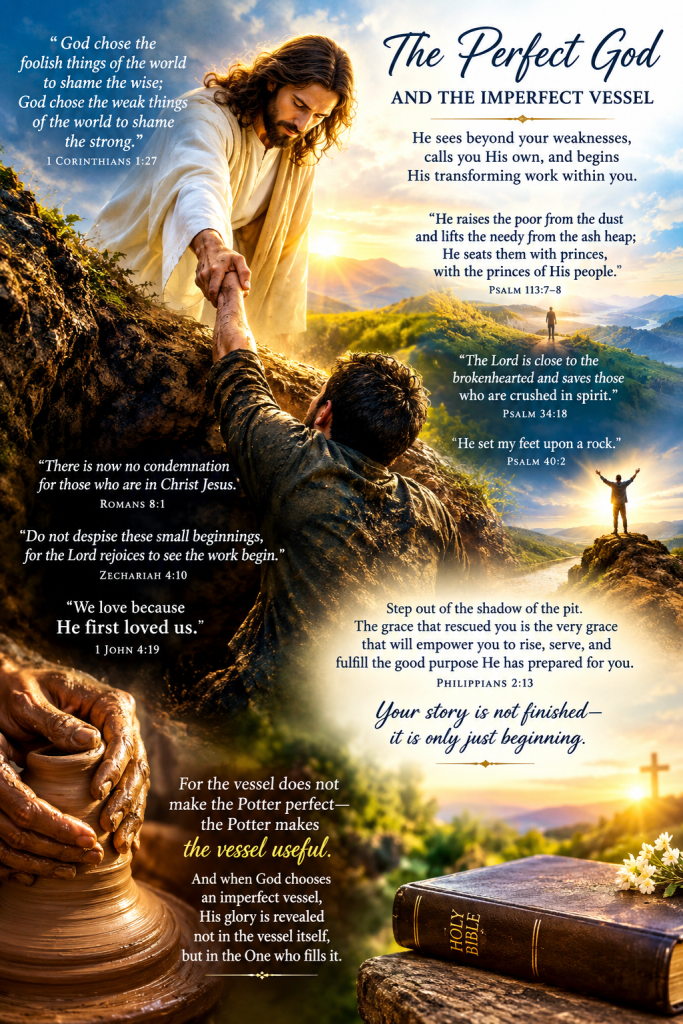
    The perfect God, whose throne is established in holiness and light, has chosen the imperfect to serve the All-Perfect One.

    As the Apostle Paul writes, “God chose the foolish things of the world to shame the wise; God chose the weak things of the world to shame the strong” (1 Corinthians 1:27).

    You may feel inadequate, fragile, and unworthy, yet in His divine mercy, He sees beyond your weaknesses, calls you His own, and begins His transforming work within you.

    He is the God who stoops down to the lowest places. Long before you knew how to reach for Him, “He raises the poor from the dust and lifts the needy from the ash heap; He seats them with princes, with the princes of His people” (Psalm 113:7–8).

    You may have felt buried beneath the weight of your own limitations, trapped in a pit of pain and despair. Even when your voice failed and you could not cry out, His eyes never left you. “The Lord is close to the brokenhearted and saves those who are crushed in spirit” (Psalm 34:18). He saw every hidden tear, every silent struggle, and reached deep into the mire to pull you out, setting your feet upon a rock (Psalm 40:2).

    Within your soul burns a quiet desire to do greater things for Him, to offer a life of purpose, power, and glory to His name. Yet you look back and feel as though you have not done enough. Do not let condemnation weigh heavily on your heart, for “there is now no condemnation for those who are in Christ Jesus” (Romans 8:1). God does not measure your worth by the greatness of your past achievements, but He delights in a heart that turns toward Him in faith and obedience. “Do not despise these small beginnings, for the Lord rejoices to see the work begin” (Zechariah 4:10).

    You love Him deeply, yet you often feel that you have not fully expressed that love, held back by fear, hesitation, or the weight of your own unworthiness. But remember this: “We love because He first loved us” (1 John 4:19). Your love for Him, even when expressed through quiet obedience and unspoken longing, is precious before Him. He is not asking you to become flawless before you serve Him; He asks for a willing and surrendered heart.

    “For it is God who works in you to will and to act in order to fulfill His good purpose” (Philippians 2:13).

    The hands that lifted you from the pit have not released you. The God who found you in your brokenness is the same God who can use your life for His glory.

    Do not wait until you feel worthy. Do not wait until you feel strong. Come as you are, surrender what you have, and let Him do through you what you could never accomplish by your own strength.

    For the vessel does not make the Potter perfect, but the Potter makes the vessel useful.

    And when God chooses an imperfect vessel, His glory is revealed not in the vessel itself, but in the One who fills it.

  • GO YE INTO ALL THE WORLD

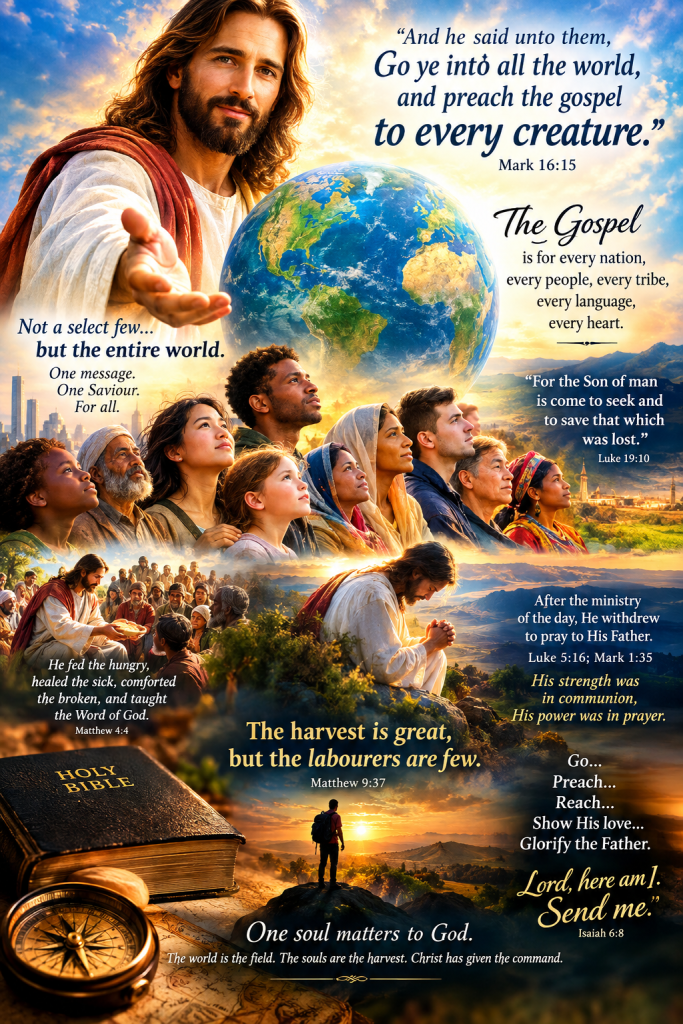
    “And he said unto them, Go ye into all the world, and preach the gospel to every creature”

    (Mark 16:15).

    The mission given by our Lord Jesus Christ is not confined to a particular nation, community, congregation, family, or select group of people. Our vision must reach beyond the boundaries we can see. Our target must be the entire world.

    The Gospel is for every creature.

    There are souls everywhere who are searching for hope, longing for peace, carrying wounds that nobody can see, and walking through darkness without knowing where to turn. Some may never enter a church. Some may never open a Bible. Some may never hear a sermon from a pulpit.

    But they can encounter Christ through a word spoken in love, a life lived in obedience, a helping hand, a testimony, a message, or someone who is willing to carry the Gospel beyond familiar boundaries.

    The Lord Jesus did not come into this world merely to reach a comfortable few. He came to seek and to save that which was lost. 

    “For the Son of man is come to seek and to save that which was lost” (Luke 19:10).

    Christ’s eyes were always upon souls

    The earthly ministry of our Lord Jesus Christ gives us a pattern that cannot be ignored.

    He went among the people. He saw the multitudes. He listened to the broken. He touched the rejected. He welcomed the forgotten. He taught those who were hungry for truth. He comforted those who were grieving. He healed the sick and strengthened the weak.

    He did not see people merely according to their social position, wealth, reputation, or status.

    He saw souls.

    When He looked upon the multitude, He was moved with compassion. “But when he saw the multitudes, he was moved with compassion on them, because they fainted, and were scattered abroad, as sheep having no shepherd” (Matthew 9:36).

    When we look at the world, do we see only people or do we see souls that Christ loves?

    He fed both body and soul. Lord Jesus cared about people’s physical needs, but He never neglected their spiritual needs.

    He fed the hungry, yet He also taught them the Word of God. He healed the sick, yet He called people to repentance and faith. He comforted the brokenhearted, yet He directed them toward the Father.

    The Lord Jesus said: “Man shall not live by bread alone, but by every word that proceedeth out of the mouth of God” (Matthew 4:4).

    Food can sustain the body for a day. The Word of God can lead a soul toward eternal life.

    He glorified the Father. Throughout His earthly ministry, Lord Jesus continually directed attention to His Father. He did not seek His own glory. His life was an offering of obedience.

    Whatever work God has placed before us, our ultimate purpose should not be to make our own name great. It should be to glorify His Name.

    Our ministry, our words, our gifts, our resources, our time, and even our daily conduct should point people toward Christ. 

    The hidden strength behind His public ministry was a life of prayer. After ministering to the multitudes, Lord Jesus often withdrew from the crowds to seek His Father. “And he withdrew himself into the wilderness, and prayed” (Luke 5:16). 

    “And in the morning, rising up a great while before day, he went out, and departed into a solitary place, and there prayed” (Mark 1:35).

    The One who had spent the day teaching, healing, comforting, travelling, answering questions, and ministering to people still made time to be alone with the Father. His public strength was connected to His private communion with God.

    We cannot effectively carry God’s message to the world while neglecting our own relationship with God. Before we speak to people about the Father, we must learn to spend time speaking with the Father.

    The Lord Jesus looked at the multitudes and said:

    The harvest is great but the labourers are few.

    The world is still full of souls. Our responsibility is not necessarily to stand before thousands.

    We may begin with one person. One soul matters to God.

    One encouraging word may prevent someone from giving up. One testimony may awaken faith. One act of kindness may open a heart. One Scripture may remain in someone’s mind for years. One person who faithfully shares Christ may become the instrument through which another person encounters the Gospel.

    We must therefore never underestimate what God can do through a willing servant.

    Let us not make the Gospel smaller than Christ made it.

    We must look beyond just our neighborhood, friends, those who already agree with us, or those who are easy to reach.

    The Gospel crosses borders, languages, cultures, and social boundaries because the love of Christ is not confined by the boundaries created by humanity.

    Are we willing to go?

    The world does not merely need more religious words. It needs people whose lives demonstrate that they have encountered Christ.

    We are called to go, speak, serve, love, pray, encourage, teach, and testify.

    Prophet Isaiah heard the voice of the Lord:

    “Whom shall I send, and who will go for us?”

    And he answered:

    “Lord, here am I. Send me” (Isaiah 6:8).