Tag: Lord Jesus loves you

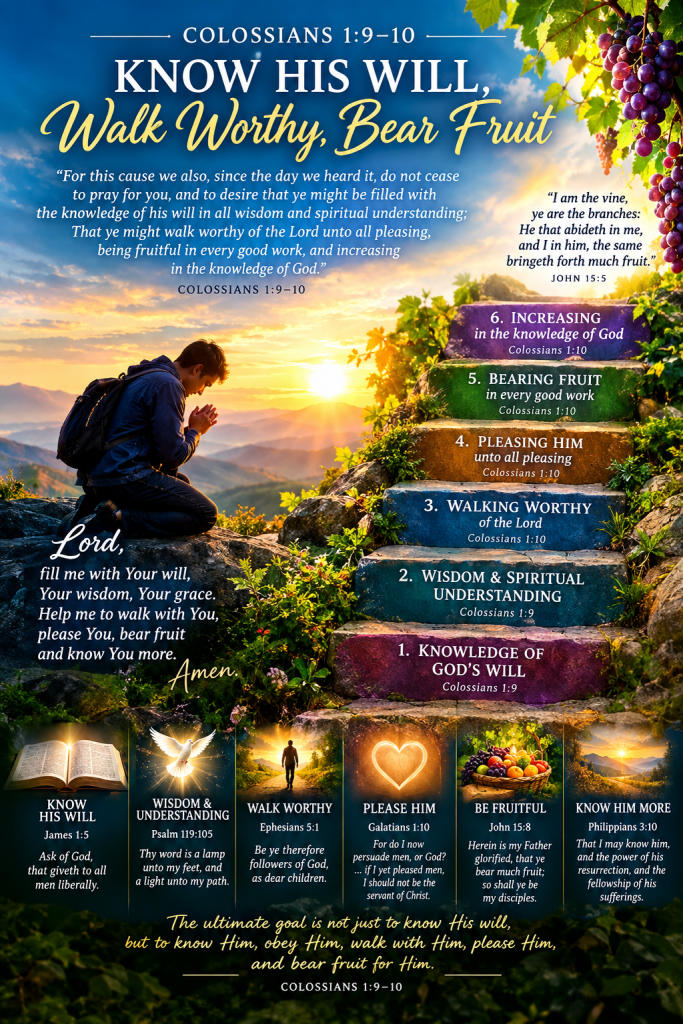
  • KNOW HIS WILL

    “For this cause we also, since the day we heard it, do not cease to pray for you, and to desire that ye might be filled with the knowledge of his will in all wisdom and spiritual understanding; That ye might walk worthy of the Lord unto all pleasing, being fruitful in every good work, and increasing in the knowledge of God” (Colossians 1:9, 10).

    The Christian life cannot be safely directed by human wisdom alone. We need the wisdom that comes from above. “If any of you lack wisdom, let him ask of God, that giveth to all men liberally” (James 1:5).

    God wants His children to seek His will, not merely ask Him to bless our will. The Lord Jesus Himself demonstrated this in Gethsemane: “Not my will, but thine, be done” (Luke 22:42). That is the heart of surrender.

    The Apostle Paul connects the knowledge of God’s will with wisdom and spiritual understanding. There is a difference between knowing Scripture intellectually and understanding how God’s Word should govern our lives.

    A person can know many verses and still make foolish decisions. But when the Holy Spirit illuminates God’s Word, Scripture begins to become living guidance. “Thy word is a lamp unto my feet, and a light unto my path” (Psalm 119:105). The Word gives us the light; spiritual understanding helps us walk in that light. This is where knowledge becomes life.

    Our faith must become visible in the way we live. To walk worthy of Christ means that our conduct should increasingly reflect the One whom we claim to follow. “Be ye therefore followers of God, as dear children” (Ephesians 5:1). We cannot truly say, “I belong to Christ,” while deliberately choosing a life that continually contradicts Christ. Walking worthy does not mean that we become perfect overnight. It means that our direction has changed.

    Although we stumble, fall, are corrected, and are tested, we continually rise, repent, obey, and press forward in our walk with Christ. The Apostle Paul’s desire is that the believer’s life should be pleasing to the Lord. He writes in Galatians 1:10: “For do I now persuade men, or God? or do I seek to please men? if I yet pleased men, I should not be the servant of Christ.” True obedience to God means choosing His approval over the applause of the world, even when it requires standing alone.

    A healthy tree produces fruit. A life genuinely connected to Christ should eventually produce spiritual fruit. The Lord Jesus said: “Herein is my Father glorified, that ye bear much fruit; so shall ye be my disciples” (John 15:8). A tree produces fruit because it is rooted and connected to its source of life. We bear spiritual fruit when we abide in Christ: “He that abideth in me, and I in him, the same bringeth forth much fruit” (John 15:5).

    The Christian life is not meant to remain spiritually stagnant. You should know Christ more deeply today than you did yesterday. Not merely know more information about Him, but know Him more intimately. The Apostle Paul himself, despite everything he had experienced, still cried: “That I may know him, and the power of his resurrection, and the fellowship of his sufferings” (Philippians 3:10). He had preached Christ, suffered for Christ, served Christ, and witnessed God’s power, yet he still said: “That I may know Him.”

    There is always more of Christ to discover.

    Ultimately, a life of surrender, obedience, and fruitfulness is only possible when we continuously seek His guidance.

    A prayer for transformation: “Lord, fill me with the knowledge of Your will. Give me spiritual wisdom and understanding. Teach me to walk worthy of You. Let my life please You. Make me fruitful in every good work. And above everything else, let me continue increasing in the knowledge of You. Amen.”
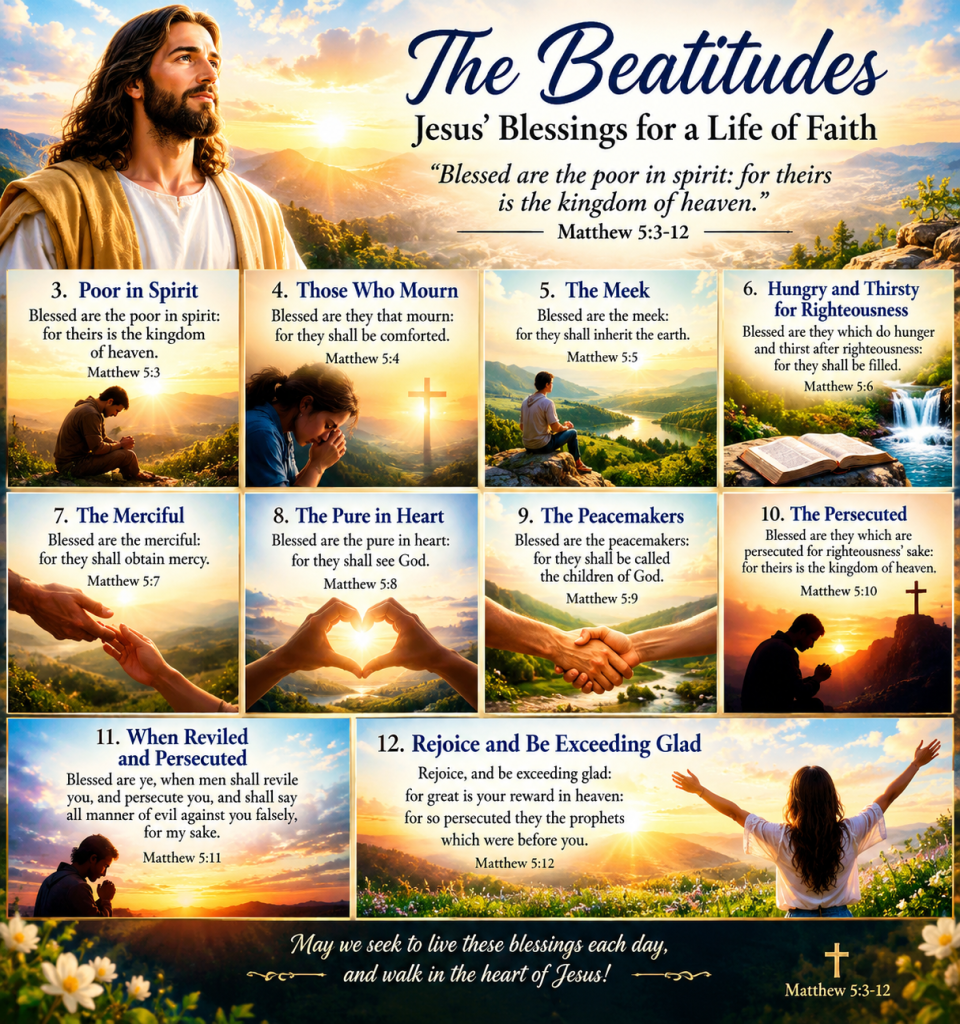
  • THE BEATITUDES — WALKING IN THE HEART OF CHRIST

    1. “Blessed are the poor in spirit: for theirs is the kingdom of heaven” (Matthew 5:3).

    To be poor in spirit means to recognize our complete dependence upon God. It is humility before Him, knowing that we need His grace and cannot rely on ourselves.

    2. “Blessed are they that mourn: for they shall be comforted” (Matthew 5:4).

    This speaks of those who grieve deeply, including sorrow over sin and the brokenness of the world. God promises His comfort to the hurting and repentant heart.

    3. “Blessed are the meek: for they shall inherit the earth” (Matthew 5:5).

    Meekness is not weakness. It is strength brought under God’s control responding with gentleness, humility, and self-control rather than pride or revenge.

    4. “Blessed are they which do hunger and thirst after righteousness: for they shall be filled” (Matthew 5:6).

    Just as the body longs for food and water, the believer should deeply desire to live rightly before God. Jesus promises that those who genuinely seek righteousness will be spiritually satisfied.

    5. “Blessed are the merciful: for they shall obtain mercy” (Matthew 5:7).

    Mercy means showing compassion, forgiveness, and kindness to others, especially when they have fallen short. Those who extend mercy reflect God’s own merciful character.

    6. “Blessed are the pure in heart: for they shall see God” (Matthew 5:8).

    A pure heart seeks God sincerely, without hypocrisy or divided devotion. Lord Jesus points us toward an inner life that is clean, sincere, and devoted to Him.

    7. “Blessed are the peacemakers: for they shall be called the children of God” (Matthew 5:9).

    Peacemakers do more than avoid conflict. They actively seek reconciliation, forgiveness, and harmony. They reflect the character of God, who calls people into peace with Himself and one another.

    8. “Blessed are they which are persecuted for righteousness’ sake: for theirs is the kingdom of heaven” (Matthew 5:10).

    Following righteousness can sometimes bring rejection or suffering. Lord Jesus reminds His followers that faithfulness to God has eternal significance, even when it is costly.

    9. “Blessed are ye, when men shall revile you, and persecute you” (Matthew 5:11).

    When people insult, falsely accuse, or mistreat believers because of their faith in Christ, Lord Jesus tells them not to abandon Him. Their identity and reward are found in Him, not in human approval.

    10. “Rejoice, and be exceeding glad: for great is your reward in heaven” (Matthew 5:12).

    Lord Jesus calls His followers to rejoice even in suffering for His sake. The focus shifts from present hardship to the eternal reward with God. The prophets before them also endured persecution for their faithfulness.

    The Beatitudes describe a Christ-centered way of living that reflects His heart. Starting with humility, recognizing our need for God, they guide us to be gentle, merciful, pure, and peaceful, finding joy and comfort in Him even through trials.

  • STANDING FIRM IN THE PROMISES OF GOD

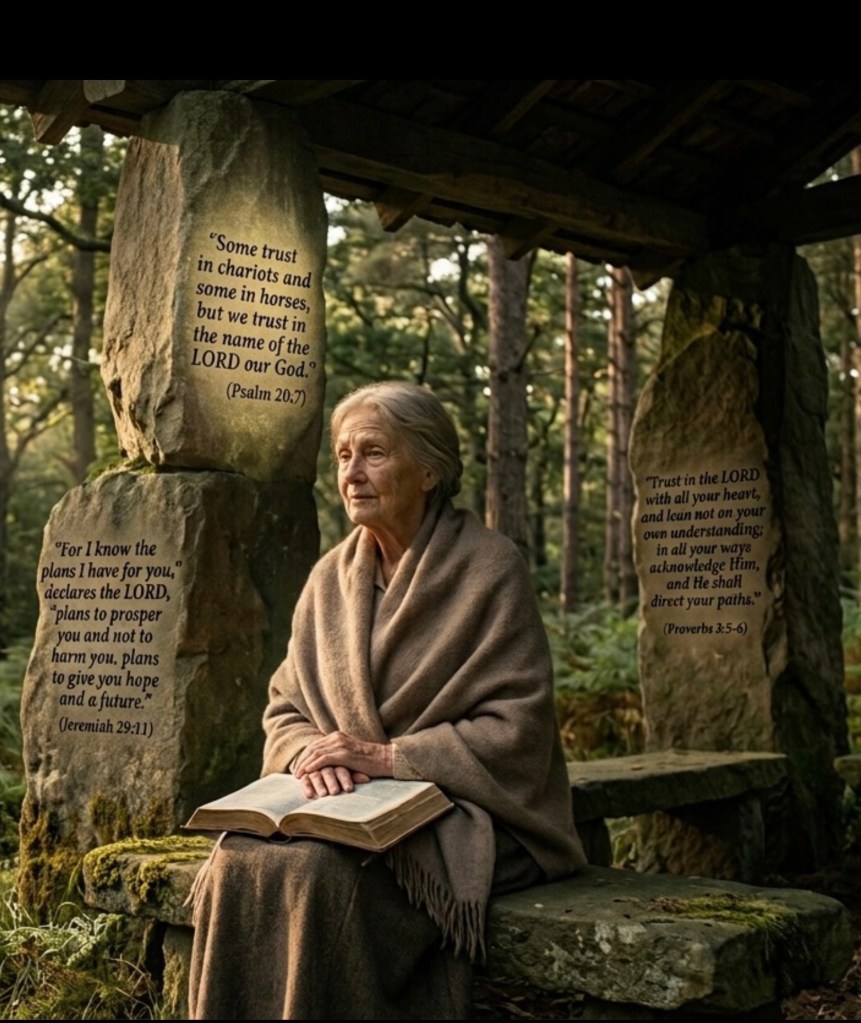
    “Some trust in chariots and some in horses, but we trust in the name of the LORD our God” (Psalm 20:7).

    Psalm 20 is an important prayer for a king before battle. It was written for a time when chariots and horses were not just concepts, they were real, and they were charging.

    The Chariots and Horses represent human power. In the ancient world, they were the most terrifying and sophisticated weapons of war. They were symbolic of military might, wealth, and national security. They are everything that the world counts as powerful and dependable.

    In our own lives, the chariots and horses are different, but their function is the same. They are the things we love to cling to for security: our health, our wealth, our influence, our knowledge, our technology. These are not inherently bad things; they are gifts and tools.

    The danger is that we begin to love the gift more than the Giver, and we build our foundation on something that, in the end, cannot sustain us.

    The Prophet Isaiah warns, “Woe to those who go down to Egypt for help and rely on horses, who trust in the abundance of their chariots and in the great strength of their horsemen, but do not look to the Holy One of Israel” (Isaiah 31:1).

    For all their strength, chariots and horses cannot give peace to a restless soul. They cannot mend a broken heart. And they can disappear in an instant.

    Turn to the name of the LORD our God.

    To trust in the “name of the LORD” is to trust in: His Power, as the Creator of the universe. His Character, as the faithful, unchanging, and merciful God who keeps His promises (Exodus 34:6). The unique covenant name, Yahweh (the LORD), which reminds us that He is the “I AM WHO I AM” (Exodus 3:14) – the ever-present, self-sustaining God who is always there, and always for us.

    This trust is not a superficial positive thinking. It is an intentional, deep-seated reliance. It is the wisdom to say, “Even if everything I own and every plan I have fails, my foundation is secure.”It is the humble act of acknowledging that our human strength has limits, but God’s strength has none.

    It’s the heart behind the powerful declaration of Isaiah 40:29: “He gives strength to the weary and increases the power of the weak.”

    It is not just for the good times. It is a battle cry for the moments of overwhelming fear. When your own strength is gone, and the “chariots” of your life seem broken, you can still whisper, “I trust in the name of the LORD my God.”

    And in that trust, you find a hidden power. You discover that you can stand when everything around you is falling. You find a security that is not of this world. As promised in Proverbs 18:10: “The name of the LORD is a strong tower; the righteous run into it and are safe.”

    Where is your trust built? What is the thing you are most afraid of losing? Is it your “chariot” or is it your “strong tower”?

    You do not need to choose between being prepared and having faith. You are allowed to have “horses.” But the Psalmist calls you to a higher love, to a love that places its primary hope in the One who will never fail you, even when all the world’s power falls. It is a wisdom that brings a peace that passes understanding.

    God does not care about fast horses or strong fighters; instead, God loves people who respect him and trust his steady love. 

    “His pleasure is not in the strength of the horse, nor His delight in the legs of the warrior; the LORD delights in those who fear Him, who put their hope in His unfailing love” ( Psalm 147:10, 11).

    “They cried unto thee, and were delivered: they trusted in thee, and were not confounded” (Psalm 22:5).

  • BENEATH THE WINGS OF GRACE

    “Keep me as the apple of Your eye; hide me under the shadow of Your wings” (Psalm 17:8).

    During a period of intense trial and opposition,  King David penned this verse, which is one of the most tender, powerful, and reassuring declarations of divine love and protection in the entire Bible.

    “Keep me as the apple of Your eye.” The  pupil is one of the most vital, delicate, and sensitive parts of the human body.

     Just as your eyelid reflexively blinks to shield your eye from the slightest particle or harm, God actively guards you with the same instinctual, instant protection.

     You are central to His vision. You are not an afterthought or lost in the crowd; God’s gaze is focused on you with immense value, tenderness, and love (Zechariah 2:8).

    “Hide me under the shadow of Your wings.”

     A mother bird gathers her young under her broad, strong wings to shield them from predators, harsh weather, or scorching heat.

     A place of physical proximity, you have to be right next to God to stay within His shadow. It implies total intimacy and refuge. While the danger outside may still rage, beneath His wings there is stillness, comfort, and ultimate security.

    God does not protect us out of mere duty; He protects us out of deep affection. You are cherished like the most delicate part of His eye and sheltered with the fierce, protective love of a parent bird over its young. Step out of the storm and rest in the safety of His presence.

  • WHO SHALL DWELL IN THY HOLY HILL?

    “LORD, who shall abide in thy tabernacle? who shall dwell in thy holy hill?” (Psalm 15:1)

    King David is not asking about a physical address. He is asking about fellowship with the living God.

    Who can come near Him?

    Who can remain in His presence?

    What kind of life does God desire from those who call upon His name?

    “He that walketh uprightly” (Psalm 15:2).

    God is concerned not merely with what we say, but with how we walk.

    To walk uprightly does not mean that a person has never fallen. It means that his heart is turned toward God and that he desires to walk in truth.

    The upright person does not deliberately make peace with sin. When he discovers sin in his heart, he brings it before God. When he is corrected, he listens. When he falls, he gets up.

    King David continues: “and worketh righteousness…” (Psalm 15:2)

    Righteousness is not merely something we profess with our lips. It must become visible in our lives.

    True faith means doing what is right even when no one is watching, because we live and walk before God, not for human applause. 

    God desires truth not only on our lips but within our hearts. He desires a heart without deception, a heart that does not need to maintain one appearance before people and another before God.

    “He that backbiteth not with his tongue, nor doeth evil to his neighbour, nor taketh up a reproach against his neighbour” (Psalm 15:3).

    A person can worship God with his lips and yet wound another person with those same lips.

    Words hold the ultimate power to either build lives up or tear them down.

    King David says:

    “In whose eyes a vile person is contemned; but he honoureth them that fear the LORD” (Psalm 15:4).

    We  often admire people because of wealth, power, influence, appearance, status, or popularity.

    But God looks differently.

    The person who fears the Lord may have little recognition in this world and yet be precious in the sight of God.

    “He that sweareth to his own hurt, and changeth not” (Psalm 15:4)

    God desires people whose word can be trusted.

    This is integrity. A person of integrity does not keep his promise only when it is comfortable. He who walks with God learns that faithfulness is more valuable than convenience.

    “He that putteth not out his money to usury, nor taketh reward against the innocent” (Psalm 15:5).

    God cares about how we treat those who are vulnerable.

    Our relationship with God cannot be separated from our relationship with people. A heart that truly desires God’s presence must learn to love righteousness and reject exploitation.

    “He that doeth these things shall never be moved”(Psalm 15:5).

    The world, people, and circumstances constantly change, and earthly possessions or approval easily disappear. However, someone who builds their life upon God and walks in His ways gains a foundation that external shifts cannot take away.

    Ultimately, the greatest blessing we can experience is God Himself. While the world around us remains in constant flux, true peace is found in dwelling in His presence and walking in His ways. By taking the time to hear His voice and deeply know His heart, we gain the spiritual strength needed to remain faithful through every season of change.

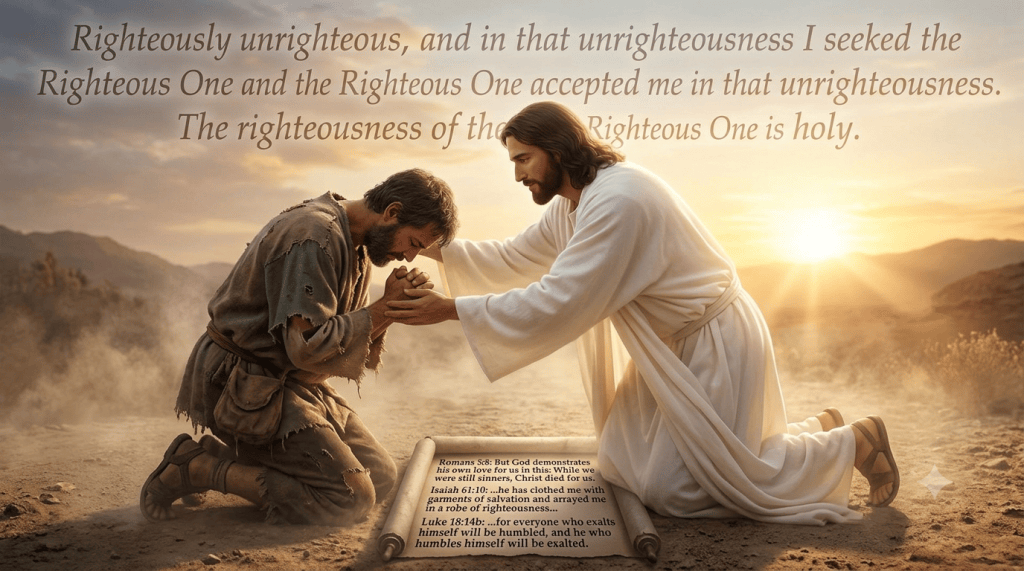
  • RIGHTEOUSLY UNRIGHTEOUS

    In the dust where my footfall faltered,

    In the shadow of a fractured grace,

    I brought a heart I could not alter,

    To stand before the Holy Face.

    Righteously unrighteous, bent and broken,

    Cloaked in the truth of my own decay,

    With no grand plea or polished token,

    I walked the dark toward the light of day.

    I sought the One who holds the suns,

    Whose purity no fault can stain,

    And found the arms of the Righteous One

    Open to gather my guilt and pain.

    Not after the wash, not after the mend,

    But deep in the mire where I used to lie,

    The Holy bowed down to call me friend,

    And answered my frail, unworthy cry.

    Now wrapped in a light I did not earn,

    Where mercy and holiness tightly twine,

    I rest in the grace for which I yearned—

    His holy righteousness, forever mine.

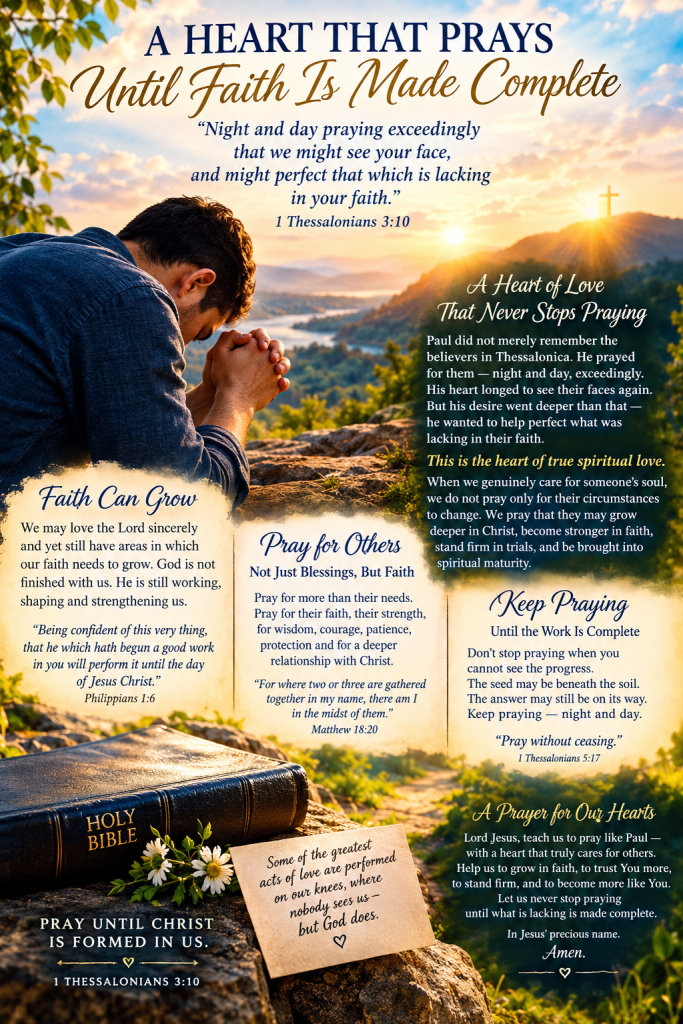
  • A HEART THAT PRAYS

    “Night and day praying exceedingly that we might see your face, and might perfect that which is lacking in your faith” (1 Thessalonians 3:10).

    The Apostle Paul prayed for the believers night and day, exceedingly. His heart longed to see their faces again. But his desire went deeper than simply meeting them. He wanted to help perfect what was lacking in their faith.

    When we genuinely care for someone’s soul, we do not pray only for their comfort, prosperity, success, or happiness. We pray that they may grow deeper in Christ, become stronger in faith, stand firm in trials, and be brought into spiritual maturity.

    Even with sincere love for God, our faith grows gradually through our doubts, fears, and delayed answers, and He remains patient with us instead of abandoning us.

    The Apostle Paul’s prayers were not casual, as he prayed exceedingly night and day. They were not quickly spoken and forgotten; instead, the spiritual condition of these souls had become a true burden upon his heart.

    We bring our loved ones before God’s throne of grace. We pray when the world is awake, and we pray when the world is asleep. We pray when we have answers, and we pray when we have none.

    When our hands cannot reach someone, our prayers still can. Distance cannot stop prayer. Silence cannot stop prayer. Closed doors cannot stop prayer. Even when we cannot see the work God is doing, we can still kneel before Him and ask Him to keep going.

    Christianity is a relationship, a life being transformed by Christ.

    Are you growing closer to Jesus, is your faith becoming stronger, are you standing when the storm comes, and is Christ being formed in you?

    Perhaps you notice shortcomings in your life, wish your faith were stronger, face ongoing battles, or still struggle to trust God in certain areas.

    Do not despair. God is still working.

    “Being confident of this very thing, that he which hath begun a good work in you will perform it until the day of Jesus Christ” (Philippians 1:6).

    The same God who began the work is able to continue it because your weaknesses and unfinished places do not surprise or frighten Him, and your journey is not over as He still wants to teach you, strengthen you, and lead you into deeper faith.

    The greatest blessing is becoming more like Christ.

    God often works through one believer to strengthen another.

    Never underestimate the power of your words, presence, and silent prayers to become God’s instrument in bringing someone safely through a storm.

    Keep praying through every struggle, wandering, weak faith, unchanged circumstance, or silent heaven because prayer is trusting God rather than our own ability to change someone.

    Prayer is trusting God to do what we cannot do.

    And sometimes the answer to our prayer begins long before we can see

    As followers of the Lord Jesus Christ, we are called to trust Him, obey Him, endure with Him, walk with Him, and become more like Him.

    Pray as the Apostle Paul prayed with a heart that truly cares for the souls of others.

    When we cannot do anything else for someone, let us remember that we can always pray.

    Some of the greatest acts of love are performed on our knees, where nobody sees us but God does.

    “Night and day praying exceedingly” (Thessalonians 3:10).

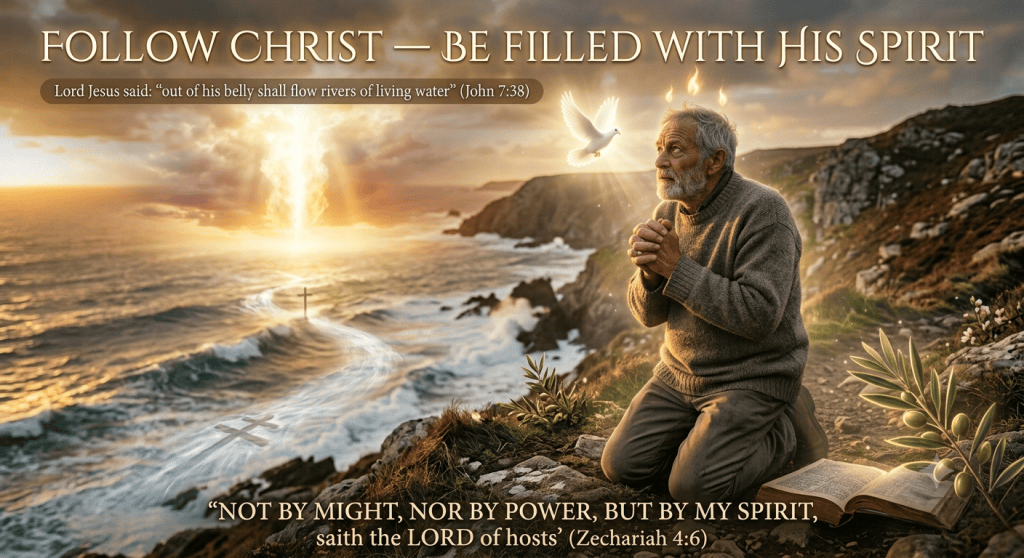
  • FOLLOW CHRIST — BE FILLED WITH HIS SPIRIT

    Christians are called to follow Christ not merely in name, but in life, in obedience, in holiness, and in the power of the Holy Spirit.

    The Lord Jesus Himself was baptized in water, and the Holy Spirit descended upon Him. The Scripture says: “And the Holy Ghost descended in a bodily shape like a dove upon him” (Luke 3:22).

    If we call ourselves followers of Christ, we must earnestly seek to walk in the footsteps of Christ.

    When Israel passed through the Red Sea, the Apostle Paul described it as a figure of baptism: “And were all baptized unto Moses in the cloud and in the sea” (1 Corinthians 10:2).

    Their passage through the waters marked a separation from the life they had known in Egypt. They were moving forward into a new journey under the leadership of God.

    Then God manifested His presence among them. At Mount Sinai, the glory and fire of the Lord were revealed. And throughout their wilderness journey, God did not leave His people without direction: “And the LORD went before them by day in a pillar of a cloud, to lead them the way; and by night in a pillar of fire, to give them light” (Exodus 13:21)

    Cloud by day. Fire by night.

    God did not merely bring His people out, He desired to lead them.

    In the same way, receiving the Holy Spirit is not merely about having an experience. The Holy Spirit comes to dwell in you, to teach, guide, comfort, convict, strengthen, and lead you into the truth.

    The Lord Jesus said: “And I will pray the Father, and he shall give you another Comforter, that he may abide with you for ever” (John 14:16).

    And in John 16:13: “Howbeit when he, the Spirit of truth, is come, he will guide you into all truth.”

    The Holy Spirit is the Spirit of God.

    The Apostle Paul writes: “Now if any man have not the Spirit of Christ, he is none of his.” (Romans 8:9).

    If you are not filled with the Spirit of God, you don’t belong to Him.

    Water baptism has profound biblical meaning. It testifies to repentance, identification with Christ, the death of the old life, and the beginning of a new life: “Therefore we are buried with him by baptism into death: that like as Christ was raised up from the dead by the glory of the Father, even so we also should walk in newness of life” (Romans 6:4).

    The old life must die, and the new life must be lived in Christ. The Holy Spirit is central to that new life.

    The Lord Jesus declared: “Except a man be born of water and of the Spirit, he cannot enter into the kingdom of God” (John 3:5).

    The new birth is the work of God within the heart.

    On the Day of Pentecost, the promise of the Father was manifested with extraordinary power: “And there appeared unto them cloven tongues like as of fire, and it sat upon each of them. And they were all filled with the Holy Ghost” (Acts 2:3–4).

    They were filled with the Holy Spirit, and they began to speak with other tongues as the Spirit gave them utterance.

    Tongues are one of the spiritual gifts mentioned by the Apostle Paul among the manifestations of the Spirit (1 Corinthians 12:8–10). The Holy Spirit gives different gifts to different believers according to His will (1 Corinthians 12:11).

    Therefore, we should not measure the presence of the Holy Spirit merely by one particular manifestation.

    God looks deeper than our outward actions. “For man looketh on the outward appearance, but the LORD looketh on the heart” (1 Samuel 16:7).

    Therefore, do not be satisfied with water baptism alone.

    Do not be satisfied merely because you were baptized as a child. A ceremony cannot substitute for a surrendered heart.

    A person may pass through religious ceremonies and still wander far from God. Israel itself passed through the sea, witnessed God’s mighty works, and yet many later fell into disobedience and unbelief. Apostle Paul warns us to learn from their example (1 Corinthians 10:1–12).

    So let us examine ourselves. Have we truly repented? Have we surrendered our lives to Christ? Are we walking in obedience, seeking the Holy Spirit, and  allowing the Spirit of God to lead us?

    The Scripture says: “As many as are led by the Spirit of God, they are the sons of God” (Romans 8:14). 

    Repentance must be more than words.

    True repentance turns the heart toward God. “Repent ye therefore, and be converted, that your sins may be blotted out” (Acts 3:19).

    Come before the Lord sincerely. Fast, pray, and search your heart. Confess your sins to God. Ask Him to cleanse you, change you, and fill you with His Spirit. Lord Jesus Himself gave this invitation: “If any man thirst, let him come unto me, and drink” (John 7:37).

    And then He gave this extraordinary promise: “He that believeth on me, as the scripture hath said, out of his belly shall flow rivers of living water” (John 7:38).

    If your desire is to serve the Lord and reach souls, ask Him to equip you.

    Say: “Lord Jesus, I do not want merely to speak about You. I want You to use my life. Cleanse me. Teach me. Lead me. Fill me with Your Holy Spirit. Give me wisdom, courage, love, discernment, and every gift You desire to place within me. Make me a vessel for Your glory.”

    Seek the Lord with your whole heart.

    Be filled with His Spirit. Walk in His light.

    Bear His fruit. Carry His love. Obey His voice.

    And let your life become a living testimony that Jesus Christ is Lord.

    “Not by might, nor by power, but by my spirit, saith the LORD of hosts” (Zechariah 4:6).

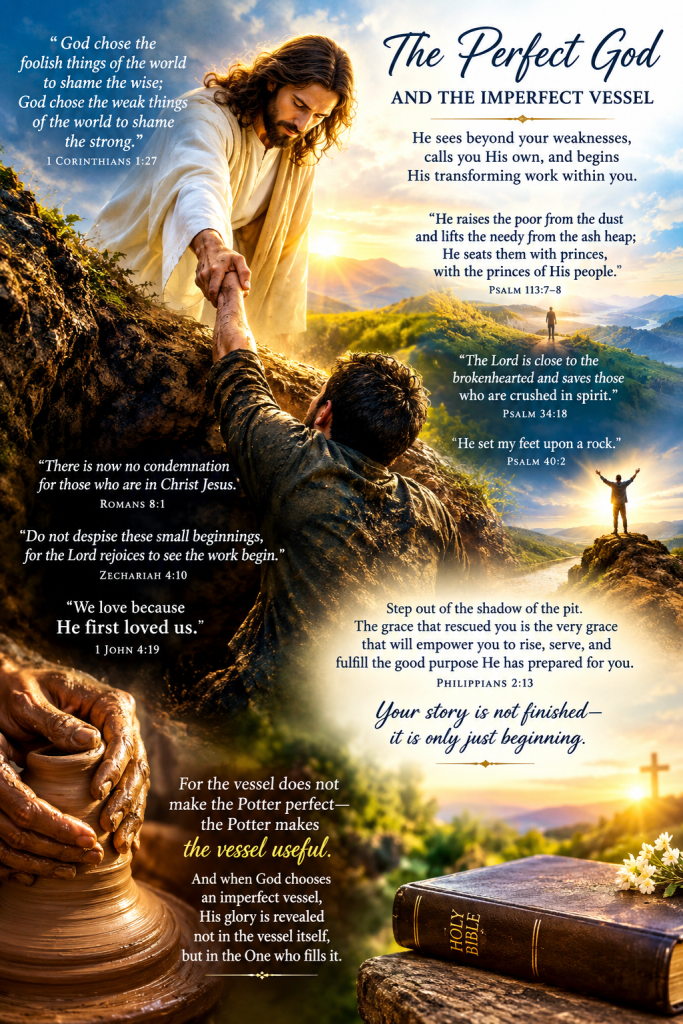
  • THE PERFECT GOD AND THE IMPERFECT VESSEL

    The perfect God, whose throne is established in holiness and light, has chosen the imperfect to serve the All-Perfect One.

    As the Apostle Paul writes, “God chose the foolish things of the world to shame the wise; God chose the weak things of the world to shame the strong” (1 Corinthians 1:27).

    You may feel inadequate, fragile, and unworthy, yet in His divine mercy, He sees beyond your weaknesses, calls you His own, and begins His transforming work within you.

    He is the God who stoops down to the lowest places. Long before you knew how to reach for Him, “He raises the poor from the dust and lifts the needy from the ash heap; He seats them with princes, with the princes of His people” (Psalm 113:7–8).

    You may have felt buried beneath the weight of your own limitations, trapped in a pit of pain and despair. Even when your voice failed and you could not cry out, His eyes never left you. “The Lord is close to the brokenhearted and saves those who are crushed in spirit” (Psalm 34:18). He saw every hidden tear, every silent struggle, and reached deep into the mire to pull you out, setting your feet upon a rock (Psalm 40:2).

    Within your soul burns a quiet desire to do greater things for Him, to offer a life of purpose, power, and glory to His name. Yet you look back and feel as though you have not done enough. Do not let condemnation weigh heavily on your heart, for “there is now no condemnation for those who are in Christ Jesus” (Romans 8:1). God does not measure your worth by the greatness of your past achievements, but He delights in a heart that turns toward Him in faith and obedience. “Do not despise these small beginnings, for the Lord rejoices to see the work begin” (Zechariah 4:10).

    You love Him deeply, yet you often feel that you have not fully expressed that love, held back by fear, hesitation, or the weight of your own unworthiness. But remember this: “We love because He first loved us” (1 John 4:19). Your love for Him, even when expressed through quiet obedience and unspoken longing, is precious before Him. He is not asking you to become flawless before you serve Him; He asks for a willing and surrendered heart.

    “For it is God who works in you to will and to act in order to fulfill His good purpose” (Philippians 2:13).

    The hands that lifted you from the pit have not released you. The God who found you in your brokenness is the same God who can use your life for His glory.

    Do not wait until you feel worthy. Do not wait until you feel strong. Come as you are, surrender what you have, and let Him do through you what you could never accomplish by your own strength.

    For the vessel does not make the Potter perfect, but the Potter makes the vessel useful.

    And when God chooses an imperfect vessel, His glory is revealed not in the vessel itself, but in the One who fills it.

  • GO YE INTO ALL THE WORLD

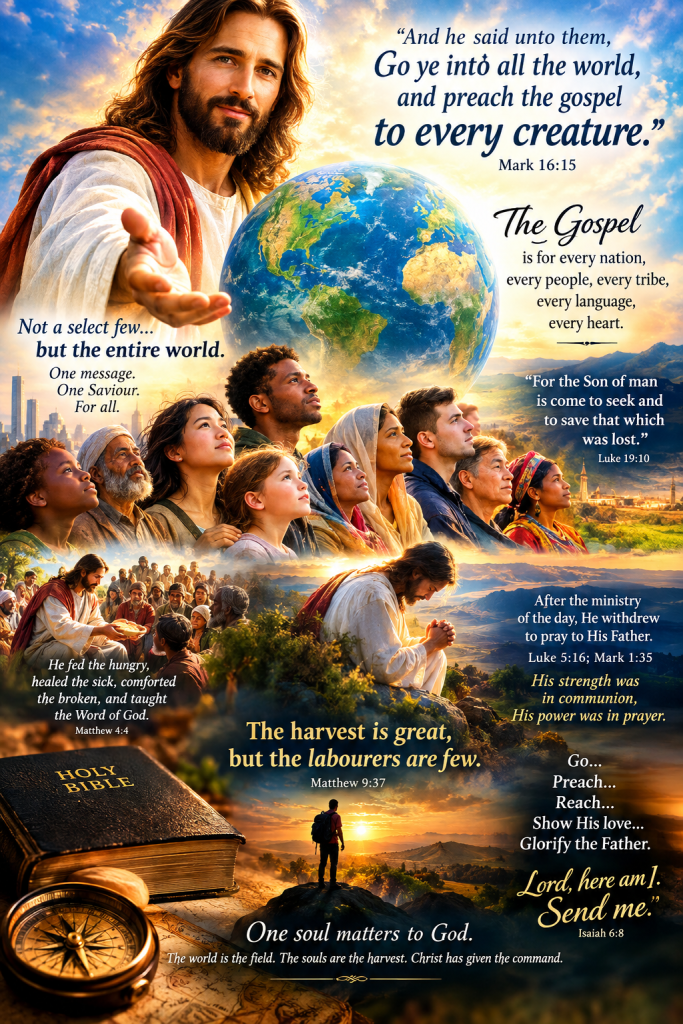
    “And he said unto them, Go ye into all the world, and preach the gospel to every creature”

    (Mark 16:15).

    The mission given by our Lord Jesus Christ is not confined to a particular nation, community, congregation, family, or select group of people. Our vision must reach beyond the boundaries we can see. Our target must be the entire world.

    The Gospel is for every creature.

    There are souls everywhere who are searching for hope, longing for peace, carrying wounds that nobody can see, and walking through darkness without knowing where to turn. Some may never enter a church. Some may never open a Bible. Some may never hear a sermon from a pulpit.

    But they can encounter Christ through a word spoken in love, a life lived in obedience, a helping hand, a testimony, a message, or someone who is willing to carry the Gospel beyond familiar boundaries.

    The Lord Jesus did not come into this world merely to reach a comfortable few. He came to seek and to save that which was lost. 

    “For the Son of man is come to seek and to save that which was lost” (Luke 19:10).

    Christ’s eyes were always upon souls

    The earthly ministry of our Lord Jesus Christ gives us a pattern that cannot be ignored.

    He went among the people. He saw the multitudes. He listened to the broken. He touched the rejected. He welcomed the forgotten. He taught those who were hungry for truth. He comforted those who were grieving. He healed the sick and strengthened the weak.

    He did not see people merely according to their social position, wealth, reputation, or status.

    He saw souls.

    When He looked upon the multitude, He was moved with compassion. “But when he saw the multitudes, he was moved with compassion on them, because they fainted, and were scattered abroad, as sheep having no shepherd” (Matthew 9:36).

    When we look at the world, do we see only people or do we see souls that Christ loves?

    He fed both body and soul. Lord Jesus cared about people’s physical needs, but He never neglected their spiritual needs.

    He fed the hungry, yet He also taught them the Word of God. He healed the sick, yet He called people to repentance and faith. He comforted the brokenhearted, yet He directed them toward the Father.

    The Lord Jesus said: “Man shall not live by bread alone, but by every word that proceedeth out of the mouth of God” (Matthew 4:4).

    Food can sustain the body for a day. The Word of God can lead a soul toward eternal life.

    He glorified the Father. Throughout His earthly ministry, Lord Jesus continually directed attention to His Father. He did not seek His own glory. His life was an offering of obedience.

    Whatever work God has placed before us, our ultimate purpose should not be to make our own name great. It should be to glorify His Name.

    Our ministry, our words, our gifts, our resources, our time, and even our daily conduct should point people toward Christ. 

    The hidden strength behind His public ministry was a life of prayer. After ministering to the multitudes, Lord Jesus often withdrew from the crowds to seek His Father. “And he withdrew himself into the wilderness, and prayed” (Luke 5:16). 

    “And in the morning, rising up a great while before day, he went out, and departed into a solitary place, and there prayed” (Mark 1:35).

    The One who had spent the day teaching, healing, comforting, travelling, answering questions, and ministering to people still made time to be alone with the Father. His public strength was connected to His private communion with God.

    We cannot effectively carry God’s message to the world while neglecting our own relationship with God. Before we speak to people about the Father, we must learn to spend time speaking with the Father.

    The Lord Jesus looked at the multitudes and said:

    The harvest is great but the labourers are few.

    The world is still full of souls. Our responsibility is not necessarily to stand before thousands.

    We may begin with one person. One soul matters to God.

    One encouraging word may prevent someone from giving up. One testimony may awaken faith. One act of kindness may open a heart. One Scripture may remain in someone’s mind for years. One person who faithfully shares Christ may become the instrument through which another person encounters the Gospel.

    We must therefore never underestimate what God can do through a willing servant.

    Let us not make the Gospel smaller than Christ made it.

    We must look beyond just our neighborhood, friends, those who already agree with us, or those who are easy to reach.

    The Gospel crosses borders, languages, cultures, and social boundaries because the love of Christ is not confined by the boundaries created by humanity.

    Are we willing to go?

    The world does not merely need more religious words. It needs people whose lives demonstrate that they have encountered Christ.

    We are called to go, speak, serve, love, pray, encourage, teach, and testify.

    Prophet Isaiah heard the voice of the Lord:

    “Whom shall I send, and who will go for us?”

    And he answered:

    “Lord, here am I. Send me” (Isaiah 6:8).