Tag: Lord Jesus loves you

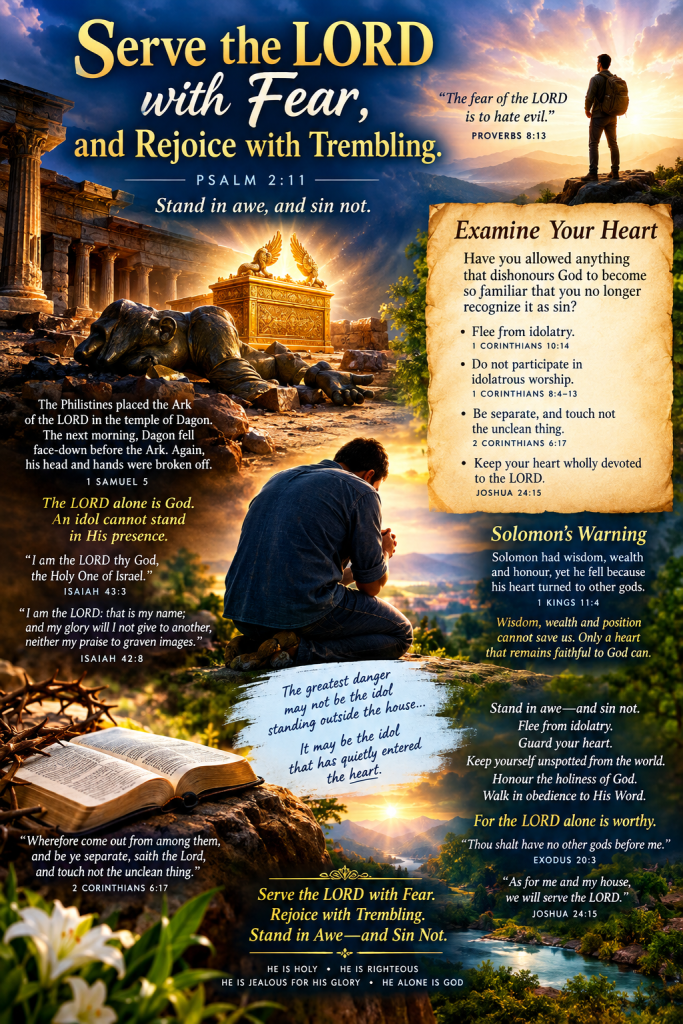
  • STAND IN AWE AND SIN NOT

    “Serve the LORD with fear, and rejoice with trembling” (Psalm 2:11).

    To fear the LORD is not merely to be afraid of Him. It is to stand in awe of His holiness, honour His authority, obey His Word, and tremble at the thought of treating holy things lightly. The presence of God should produce reverence in us, not familiarity that leads to carelessness.

    Scripture says: “The fear of the LORD is to hate evil” (Proverbs 8:13).

    God is holy, and He calls His people to holiness. Therefore, we must never become so accustomed to sin and idolatry around us that we cease to recognize what is offensive to God.

    In 1 Samuel 5, the Philistines defeated Israel and captured the Ark of the Covenant. They carried it to Ashdod and placed it inside the temple of Dagon, their god. In doing so, they attempted to place the symbol of the God of Israel beside the image of their false god as though Dagon had triumphed over the LORD.

    But the LORD does not share His glory with idols.

    The next morning, Dagon was found fallen face-down before the Ark of the LORD. The Philistines raised their idol and put it back in its place. But the following morning, Dagon had fallen again, this time with his head and hands broken off.

    The message was unmistakable: The LORD alone is God. An idol cannot stand in His presence.

    The Scripture declares:

    “For I am the LORD thy God, the Holy One of Israel”(Isaiah 43:3).

    And: “I am the LORD: that is my name: and my glory will I not give to another, neither my praise to graven images” (Isaiah 42:8).

    The Ark did not need to defend itself. God Himself demonstrated His supremacy.

    Do we tolerate what God commands us to reject?

    Have we allowed things that dishonour God to become so familiar that we no longer recognize them as spiritually dangerous? Have we compromised with idolatry, worldly values, or practices that are contrary to God’s Word?

    Apostle Paul warns us: “What agreement hath the temple of God with idols?” (2 Corinthians 6:16).

    We are called to be the temple of the living God. Therefore Scripture says: “Wherefore come out from among them, and be ye separate, saith the Lord, and touch not the unclean thing” (2 Corinthians 6:17).

    Separation from ungodliness does not mean hatred of people. We are commanded to love our neighbour and even our enemies. But loving people does not require us to approve of everything they do.

    Lord Jesus Himself said: “If ye love me, keep my commandments” (John 14:15).

    King Solomon received extraordinary wisdom from God. Yet wisdom itself could not preserve him when his heart turned away from the LORD.

    Scripture records: “For it came to pass, when Solomon was old, that his wives turned away his heart after other gods” (1 Kings 11:4).

    His foreign wives turned his heart toward their gods, and Solomon built places for their worship.

    A person may possess wisdom, wealth, position and honour, yet still fall if the heart is allowed to depart from God.

    Solomon’s tragedy was not that he lacked wisdom. It was that he failed to remain faithful to the God who had given him that wisdom.

    Therefore, we must never trust in our knowledge, accomplishments, wealth, or spiritual history. Our confidence must remain in the LORD.

    Apostle Paul gives the believer a direct command:

    “Wherefore, my dearly beloved, flee from idolatry” (1 Corinthians 10:14).

    Apostle Paul says flee. He does not say to become comfortable with it. He strongly warned believers against participating in idolatrous worship or becoming a stumbling block to another person’s conscience 

    Our hearts belong to God. Stand in awe and sin not

    Psalm 2:11 commands us: “Serve the LORD with fear, and rejoice with trembling.”

    Scripture says: “Be ye holy; for I am holy” (1 Peter 1:16)

    And: “Let us have grace, whereby we may serve God acceptably with reverence and godly fear” (Hebrews 12:28).

    “What does the Word of God say?”

    Let us therefore examine ourselves before examining everyone else.

    Is my heart wholly devoted to the LORD?

    Have I permitted anything to take God’s rightful place in my life?

    Have wealth, pleasure, relationships, possessions, reputation, power, or worldly approval become idols in my heart?

    Am I standing firm in God’s truth, or have I quietly compromised?

    The greatest danger may not be the idol standing outside the house. It may be the idol that has quietly entered the heart. Therefore, beloved, stand in awe of the LORD and sin not.

    Flee from idolatry. Guard your heart. Keep yourself unspotted from the world. Honour the holiness of God. Walk in obedience to His Word. For the LORD alone is worthy.

    “Thou shalt have no other gods before me” (Exodus 20:3).

    And let the cry of our hearts always be: “As for me and my house, we will serve the LORD” (Joshua 24:15).

    Serve the LORD with fear. Rejoice with trembling.

    Stand in awe and sin not.

    For He is holy. He is righteous. He is jealous for His glory.

    And He alone is God.

  • WALK AFTER THE LORD

    “Ye shall walk after the LORD your God, and fear him, and keep his commandments, and obey his voice, and ye shall serve him, and cleave unto him” (Deuteronomy 13:4).

    When you truly love God, you will desire to honour Him. When you honour Him, you will desire to obey Him. And when your heart is turned toward Him, you will begin to recognise His voice.

    The Christian life is not merely about knowing about God; it is about walking with God.

    We live in a world filled with noise—voices of temptation, pride, hatred, greed, fear, confusion and sin. Every day, countless voices compete for our attention. Yet, in the midst of all that noise, there is another voice—the voice of the One who created us, loves us and calls us to Himself.

    We need His guidance. Without the Lord directing our steps, how easily can we lose our way! We cannot successfully navigate this fallen and sinful world by human wisdom alone. We need God to guide our thoughts, our decisions, our relationships, our words and every step of our journey.

    The Scripture says:

    “In all thy ways acknowledge him, and he shall direct thy paths” (Proverbs 3:6).

    Therefore, humble yourself before Him. Hold on to Him. Cleave to Him. Seek His presence before seeking the approval of the world. And when you hold on to God, remember this: He is holding on to you.

    God deserves the first place in everything. The first portion belongs to Him. The first part of your day belongs to Him. Your very first thought in the morning is for Him. The first quiet moments of the day are His. The first true wish of your heart turns to Him. God remains the top priority of your life.

    Before the world begins speaking to us, let us learn to sit at the feet of Jesus. Before we reach for the things of this world, let us reach for the presence of God. Before we listen to the many voices around us, let us become still enough to hear the voice of our Creator.

    “But seek ye first the kingdom of God, and his righteousness” (Matthew 6:33)

    How precious it is to begin the day with God!

    The world may be sleeping, the streets may be quiet, and everything around us may be still—but the soul that loves God can already be awake in His presence.

    When the world is running after everything except God, we should be found at His feet.

    Like Mary, who sat at the feet of Jesus and listened to His word, may we learn that there are moments when the most important thing we can do is simply be still and listen.

    God is not confined to a particular hour, a particular day, or a particular place. He speaks through the quietness of the heart. 

    “My sheep hear my voice, and I know them, and they follow me” (John 10:27).

    He Is Looking for a Heart That Will Wait.

    Hearing God’s voice is not merely about receiving a message. It is about developing a heart that is willing to obey.

    God desires a people who will seek Him—not only when they are in trouble, not only when they need a blessing, not only when they need an answer, but because they love Him.

    There is something precious about a soul that waits for God simply because it longs for God.

    “My soul, wait thou only upon God; for my expectation is from him” (Psalm 62:5).

    To wait for God is an expression of love.

    When you love someone, you desire their presence. You listen for their voice. You look forward to being with them. So it should be with the Lord.

    Seek His face. Seek the Blesser. Seek the Giver.

    Come to Him because He is worthy of your love.

    Begin each day by saying:

    “Lord, before I hear the world, I want to hear You. Before I make my plans, I want to surrender them to You. Before I walk into this day, I want You to walk with me. Guide my steps. Guard my heart. Govern my words. Let me not live this day without You.”

    Will you love Him?

    The Lord is calling us deeper—not merely into religion, but into relationship; not merely into outward service, but into inward surrender.

    He wants a heart that says: “Lord, I am Yours.”

    A heart that will listen. A heart that will obey.

    A heart that will wait. A heart that will hold fast.

    A heart that will follow Him even when the path is difficult.

    Seek Him. Wait for Him. Walk after Him. Fear Him. Love Him. Hear His Word. Obey His voice.

    Hold fast to Him Keep His commandments.

    Serve Him.

    This is not merely a command for one moment of life. It is a way of life.

    Walk with Him in the morning. Walk with Him at noon. Walk with Him at night. Walk with Him when everything is going well. Walk with Him when everything seems to be falling apart. Walk with Him when you understand. Walk with Him when you do not understand. And when the world becomes dark and confusing, hold on to Him even more tightly.

    For the soul that has learned to love God, wait upon God, hear His Word and obey His voice has discovered something the world cannot give.

    The greatest victory is not conquering the world around you. The greatest victory is refusing to allow the world to conquer the God-given soul within you.

    So, will you begin your day with Him?

    Will you wait for Him?

    Will you listen?

    Will you obey?

    Will you love Him—not merely for what He can give you, but simply because He is God and He is worthy of your love?

    “Draw nigh to God, and he will draw nigh to you” (James 4:8).

    And let God be first. Always. When the world is running after everything except God, we should be found at His feet.

    “Speak, LORD; for thy servant heareth” ( 1 Samuel 3:9 ).

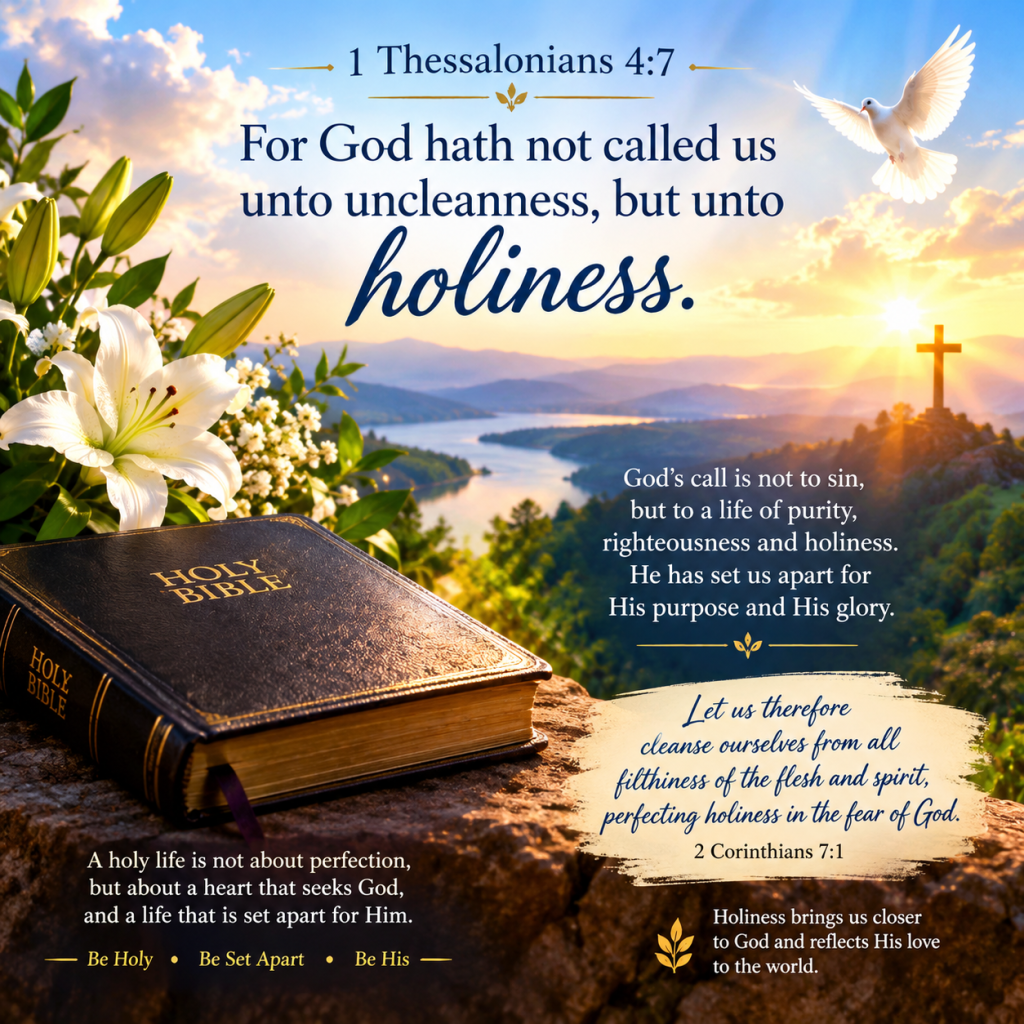
  • CALLED TO HOLINESS

    “And to you who are troubled rest with us, when the Lord Jesus shall be revealed from heaven with his mighty angels, in flaming fire taking vengeance on them that know not God, and that obey not the gospel of our Lord Jesus Christ.” (2 Thessalonians 1:7,8)

    The Lord Jesus, who came first in humility to give His life on the cross, will one day return as Judge and King. The day is coming when the opportunity to repent will end, and every person must stand before Him. Because God is perfectly holy, He calls us to absolute holiness. As Hebrews 12:14 warns, without holiness, no one will see the Lord.

    Scripture shows us what it means to walk faithfully with God in corrupt times:

    Righteous Noah took God’s invisible warning seriously. His faith produced active obedience, and he prepared an ark to save his household.

    Prophet Moses stood before the immense power of Pharaoh without an army, relying entirely on the presence of God. He refused to go anywhere unless God led him.

    God’s commandments are not optional suggestions; they reflect His righteous character. He sees through every mask, and nothing is hidden from His sight.

    The Judge will judge. On judgment day, all earthly distinctions will vanish. The rich, the poor, the powerful, and the forgotten will all stand equal before the King of kings. No wealth or human reputation can buy a pardon.

    Salvation is a gift of grace through faith in Christ, but grace is not permission to keep sinning—it is the power to live a transformed life. Heaven, hell, judgment, and eternity are real. Therefore, we must not live carelessly. We must watch, pray, repent, and actively follow in the footsteps of Christ.

    The Judge is coming. The King is coming. The Lord is coming.

    Are you ready to meet Him?

    “Prepare to meet thy God” (Amos 4:12).

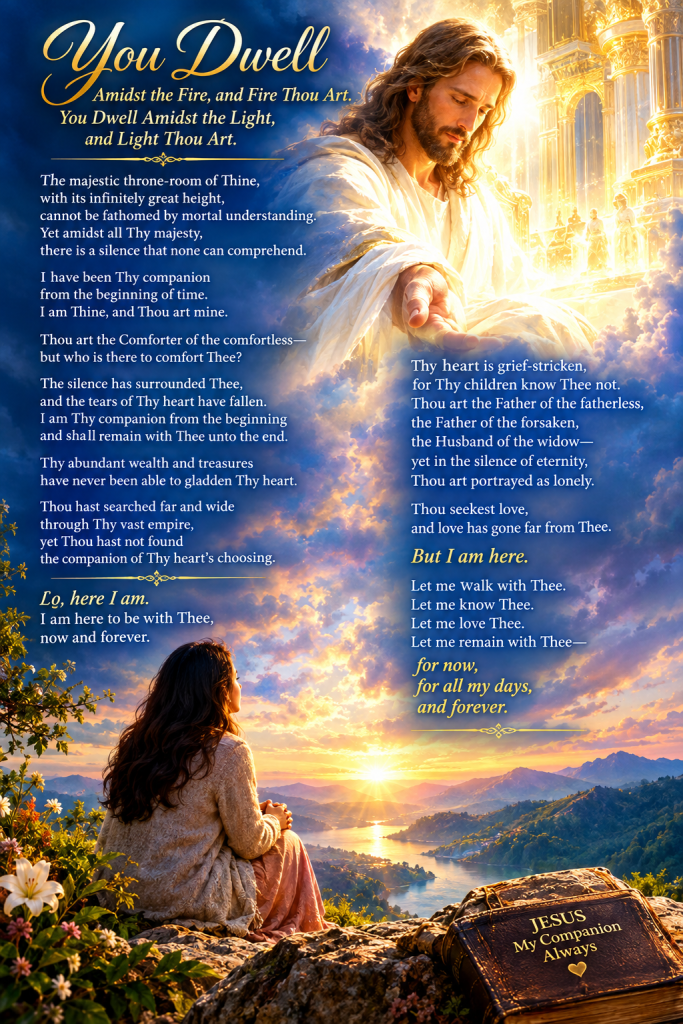
  • I AM THINE, AND THOU ART MINE

    You dwell amidst the fire, and fire Thou art.

    You dwell amidst the light, and light Thou art.

    The majestic throne-room of Thine,

    with its infinitely great height,

    cannot be fathomed by mortal understanding.

    Yet amidst all Thy majesty,

    there is a silence that none can comprehend.

    I have been Thy companion

    from the beginning of time.

    I am Thine, and Thou art mine.

    Thou art the Comforter of the comfortless—

    but who is there to comfort Thee?

    The silence has surrounded Thee,

    and the tears of Thy heart have fallen.

    I am Thy companion from the beginning

    and shall remain with Thee unto the end.

    Thy abundant wealth and treasures

    have never been able to gladden Thy heart.

    Thou hast searched far and wide

    through Thy vast empire,

    yet Thou hast not found

    the companion of Thy heart’s choosing.

    Lo, here I am.

    I am here to be with Thee,

    now and forever.

    Thy heart is grief-stricken,

    for Thy children know Thee not.

    Thou art the Father of the fatherless,

    the Father of the forsaken,

    the Husband of the widow—

    yet in the silence of eternity,

    Thou art portrayed as lonely.

    Thou seekest love,

    and love has gone far from Thee.

    But I am here.

    Let me walk with Thee.

    Let me know Thee.

    Let me love Thee.

    Let me remain with Thee—

    for now,

    for all my days,

    and forever.

    John Mark

  • THE VINE TREE

    The Lord gives Prophet Ezekiel a picture of the vine tree. He asks whether the wood of a vine is useful like the wood of other trees.

    Vine wood is not suitable for making something strong or useful. Its particular purpose is to bear fruit.

    The Lord says:

    “What is the vine tree more than any tree, or than a branch which is among the trees of the forest?” (Ezekiel 15:2)

    And then: “Behold, it is cast into the fire for fuel; the fire devoureth both the ends of it, and the midst of it is burned. Is it meet for any work?” (Ezekiel 15:4)

    You had been chosen and given a special relationship with God, but had turned away from Him and were not producing the fruit He desired.

    A vine is valuable because it produces fruit. If it refuses to fulfil its purpose, its wood has very little use.

    God does not merely call us to carry His name outwardly. He desires fruit in our lives—obedience, righteousness, faithfulness, love, repentance and holiness.

    Lord Jesus said in John 15:8:

    “Herein is my Father glorified, that ye bear much fruit; so shall ye be my disciples.”

    Ezekiel 15 speaks of the vine that fails to fulfil its purpose; John 15 speaks of abiding in Christ and bearing much fruit.

    We have received tremendous privileges from God. But privilege without faithfulness does not protect a person from judgment.

    The Lord says: “And I will set my face against them; they shall go out from one fire, and another fire shall devour them; and ye shall know that I am the LORD, when I set my face against them” (Ezekiel 15:7).

    This is a serious warning. Being associated with God’s people, knowing Scripture, attending worship, or having a Christian identity is not the same as walking faithfully with God.

    God looks at the fruit of our lives.

    God does not reject everyone who fails.” Rather, it is a solemn call to examine ourselves and return to God.

    When we discover that our lives are not producing the fruit God desires, the right response is not pride or despair.

    It is: “Lord Jesus, search my heart. Remove what is displeasing to You. Prune me, cleanse me, and help me abide in You so that my life may bear fruit for Your glory.”

    “Abide in me, and I in you. As the branch cannot bear fruit of itself, except it abide in the vine; no more can ye, except ye abide in me.
    I am the vine, ye are the branches: He that abideth in me, and I in him, the same bringeth forth much fruit: for without me ye can do nothing” (John 15:4,5).

    God did not call us merely to occupy space in His vineyard. He called us to bear fruit.

    A branch does not produce fruit by struggling independently from the vine. It produces fruit by remaining connected to the vine.

    And Lord Jesus says: “I am the true vine, and my Father is the husbandman” (John 15:1).

    Do not merely carry the name of the Vine—abide in the True Vine.

    Do not merely appear alive—bear fruit.

    Do not merely receive God’s blessings—walk in obedience.

    Do not merely hear His Word—let His Word transform your life.

    The Lord is looking for fruit, not merely leaves. When we remain in Christ, the One who is the True Vine, He Himself supplies what we need to bear fruit. 

    “By their fruits ye shall know them” (Matthew 7:20).

  • CHRIST JESUS CAME INTO THE WORLD TO SAVE SINNERS

    “This is a faithful saying, and worthy of all acceptation, that Christ Jesus came into the world to save sinners; of whom I am chief” (1 Timothy 1:15).

    There are many things in this world that people consider valuable—wealth, position, education, success, recognition, relationships, and possessions. But there is one truth that is more precious than everything the world can offer:

    Christ Jesus came into the world to save sinners.

    This is not merely a religious statement. It is the very heart of the Gospel. It is the good news that gives hope to the hopeless, forgiveness to the guilty, restoration to the broken, and eternal life to those who believe in the Lord Jesus Christ.

    Apostle Paul calls this “a faithful saying, and worthy of all acceptation.” This is a truth that can be completely trusted. It is worthy of everyone’s attention, everyone’s acceptance, and everyone’s faith.

    Lord Jesus Christ did not come for the perfect.

    He did not come into the world because humanity was already righteous. He came because humanity was lost. He did not come looking for people who had never failed. He came looking for sinners who needed mercy.

    “For the Son of man is come to seek and to save that which was lost” (Luke 19:10).

    This is the beauty of God’s grace.

    The world often says, “Make yourself worthy, and then come.” But  Lord Jesus says, “Come to Me.”

    We do not clean ourselves up first and then approach Christ. We come to Christ, and He begins the work of cleansing, transforming, and restoring us.

    The wounded can come. The broken can come.

    The ashamed can come. The rejected can come.

    The fallen can come. The repentant sinner can come.

    The door of grace is still open.

    Apostle Paul’s words are remarkable:

    “Of whom I am chief.”

    He was not glorifying his sin. He was expressing profound humility and recognizing how desperately he needed the mercy of God.

    Before his encounter with Christ, Apostle Paul had persecuted the followers of Jesus. Yet the same man who once opposed Christ became one of Christ’s greatest servants.

    What changed him?

    Grace.

    Apostle Paul discovered that God’s mercy was greater than his past.

    Your past does not have to determine your future when you surrender your life to Jesus Christ.

    The person you were yesterday does not have to be the person you become tomorrow.

    Grace can transform a persecutor into a preacher.

    Grace can transform a sinner into a servant.

    Grace can transform shame into testimony.

    Grace can transform a broken life into an instrument for God’s glory.

    Sometimes people look at their past and think:

    “God cannot forgive someone like me.”

    But that is not the voice of the Gospel.

    The Bible declares: “But where sin abounded, grace did much more abound” (Romans 5:20).

    Where sin increased, grace increased even more.

    This does not mean that sin is unimportant or that we should continue living in sin. It means that the mercy of God is greater than the depth of our failure when we genuinely repent and turn to Him.

    There is no sin too great for the power of Christ to forgive when a person truly comes to Him in repentance and faith.

    Your sin may be great, but God’s grace is greater.

    Your failure may be deep, but His mercy reaches deeper.

    Your past may be dark, but His light can still shine into your life.

    The heart of Christ is beautifully revealed in John 3:17: “For God sent not his Son into the world to condemn the world; but that the world through him might be saved.”

    Lord Jesus came as the Saviour. He came to rescue us from the power and consequences of sin. He came to reconcile us to God. He came to bring us from darkness into light. He came to give us a new heart and a new life. He came so that sinners could become children of God through faith in Him.

    This is why the cross is not merely a symbol of suffering. The cross is the declaration of God’s redeeming love. At the cross, Lord Jesus took upon Himself what we could never carry ourselves. He bore our sins so that we could receive His forgiveness.

    The greatest miracle is a changed life. Sometimes we look for spectacular miracles, but one of God’s greatest miracles is the transformation of a human heart.

    When Christ enters a person’s life, He does not merely change their circumstances. He changes the person.

    He can take hatred and teach love. He can take bitterness and bring forgiveness. He can take fear and give courage. He can take despair and give hope. He can take spiritual blindness and bring understanding. He can take a life controlled by sin and begin transforming it into a life surrendered to God.

    Apostle Paul’s own life became evidence of this transforming grace. His testimony was essentially: “I was a sinner, but Christ saved me.”

    And that testimony continues to speak today.

    No one is beyond the reach of Lord Jesus. Perhaps someone feels that they have gone too far. Perhaps they are carrying guilt that nobody else knows about. Perhaps they have failed again and again. Perhaps they have become ashamed to approach God. But remember this: Lord Jesus came into the world to save sinners. He did not say, “I came to save people who never failed.”

    Lord Jesus Christ came for sinners. Therefore, do not run away from Him because of your sin. Run to Lord Jesus because of your sin.

    Do not hide from the One who can heal you. Do not allow shame to keep you away from the One who offers forgiveness. Do not believe the lie that your past is greater than God’s grace.

    Come to Christ. Repent. Believe. Surrender. And let His grace begin its work in you.

    The cross tells us something powerful: God’s love is greater than our failure.

    Lord Jesus Christ stretched out His hands on the cross, and those hands speak of mercy. They speak to the sinner who thinks, “There is no hope for me.” They speak to the broken person who says, “I cannot go on.” They speak to the person who has fallen and wonders whether they can rise again.

    And the message of Our Lord Jesus Christ is: “Come unto me.”

    Lord Jesus does not promise that following Him will make life completely free from difficulties. But He promises His presence, His grace, His strength, and ultimately eternal life to those who trust in Him.

    The fact that Lord Jesus saves sinners is not an invitation to remain comfortable in sin.

    Grace is not permission to continue in rebellion.

    Grace calls us to repentance. When we truly encounter the grace of Christ, we should desire to leave behind the things that dishonour Him.

    Apostle Paul’s life did not remain the same after encountering Jesus. Grace changed his direction. Grace changed his purpose. Grace changed his heart. Grace changed his future. Therefore, when Christ saves us, we should not merely say, “Thank You, Lord, for forgiving me.” We should also say: “Lord, here is my life. Use me for Your glory.”

    Our testimony should point to Lord Jesus.

    “Look how great Lord Jesus is.”

    I was lost—but Jesus found me. I was broken—but Jesus restored me. I was guilty—but Jesus showed me mercy. I was weak—but Jesus became my strength. I had no hope—but Jesus gave me hope. I was far from God—but Jesus brought me near.

    The glory belongs to Christ.

    The message of 1 Timothy 1:15 is for every generation.

    It is for the religious person who thinks they do not need a Saviour. It is for the person who feels completely unworthy. It is for the person who has wandered far away. It is for the person who has fallen many times. It is for the person who secretly cries at night. It is for the person who believes nobody understands them. And it is for every one of us.

    Christ Jesus came into the world to save sinners.

    The Gospel is not a message of hopelessness.

    It is a message of redemption. Not condemnation, but mercy. Not rejection, but reconciliation. Not darkness, but light. Not death, but life. Not slavery, but freedom. Not an ending, but a new beginning.

    How amazing is the grace of God!

    The One who created us came to rescue us.

    The King came for the sinner.

    The Holy One came for the unholy.

    The Shepherd came searching for the lost sheep.

    The Healer came for the broken.

    The Saviour came for those who could not save themselves.

    And Lord Jesus still calls people today.

    “Come unto me, all ye that labour and are heavy laden, and I will give you rest” (Matthew 11:28).

    So never say, “I am too sinful for Jesus.”

    Instead say: “I am a sinner, and that is why I need Jesus.”

    Never say, “My past is too terrible for God’s grace.”

    Say: “My past may be terrible, but God’s grace is greater.”

    Never say, “There is no hope for me.”

    Say: “Christ Jesus came into the world to save sinners.”

    And never forget Paul’s humble testimony:

    “Christ Jesus came into the world to save sinners; of whom I am chief.”

    The Gospel is not about how good we are. The Gospel is about how good, merciful, loving, and faithful Lord Jesus Christ is.

    May we never become proud because we have been saved. May we become humble because we have been shown mercy. May our lives become living testimonies of His grace.

    And may everything we say and do point people toward the One who came into this world for one glorious purpose:

    Lord Jesus saves.

    Lord Jesus forgives.

    Lord Jesus restores.

    Lord Jesus transforms.

    Lord Jesus gives hope.

    Lord Jesus gives new life.

    To Christ Jesus alone be all the glory, honour, and praise.

  • THERE IS NO OTHER GOD WHO CAN DELIVER

    When thou walkest through the fire, thou shalt not be burned; neither shall the flame kindle upon thee” (Isaiah 43:2).

    There are moments in life when the fire becomes so intense that human strength cannot save us, human wisdom cannot rescue us, and human connections cannot deliver us. But it is precisely in those moments that God reveals who He truly is.

    Shadrach, Meshach, and Abednego were thrown into a blazing furnace because they refused to bow before an idol. They did not know how God would deliver them—but they knew God was able to deliver them.

    Their faith was not based on the absence of fire. Their faith was based on the presence of God in the fire.

    They declared: “Our God whom we serve is able to deliver us from the burning fiery furnace” (Daniel 3:17).

    And when they entered the furnace, they were not alone. The king looked into the fire and saw a fourth man walking with them.

    What the enemy intended to destroy became the place where God displayed His glory. The fire did not consume them. It only burned the ropes that bound them.

    Sometimes God does not keep you from entering the fire; He enters the fire with you.

    Your trial may be painful, but God has not abandoned you.

    Your situation may look impossible, but God is still sovereign.

    Your enemies may think your story is finished, but God has the final word.

    Nebuchadnezzar himself had to acknowledge what he had witnessed: “There is no other God that can deliver after this sort” (Daniel 3:29).

    Never measure the power of God by the size of your problem. The greater the furnace, the greater the testimony when God brings you through it.

    The God who delivered the three Hebrew men is still God today. He is the God who makes a way where there seems to be no way. He is the God who can turn a furnace into a testimony, a trial into a testimony of faith, and a place of suffering into a place where His presence is revealed.

    Do not bow to the pressure. Do not compromise your faith to escape the fire. Do not worship what the world worships just because everyone else is doing it.

    Stand for God. And if you must walk through the fire, walk through it knowing this:

    You may enter the fire with chains, but you will come out with freedom.

    You may enter the fire being tested, but you will come out with a testimony.

    You may enter the fire alone in the eyes of men, but you will never enter it alone in the presence of God.

    There is no God like our God. There is no deliverer like our Deliverer. There is no fire hot enough to defeat the God who walks with His children through the flames.

    The fire may be real—but so is the God who stands with you in it.

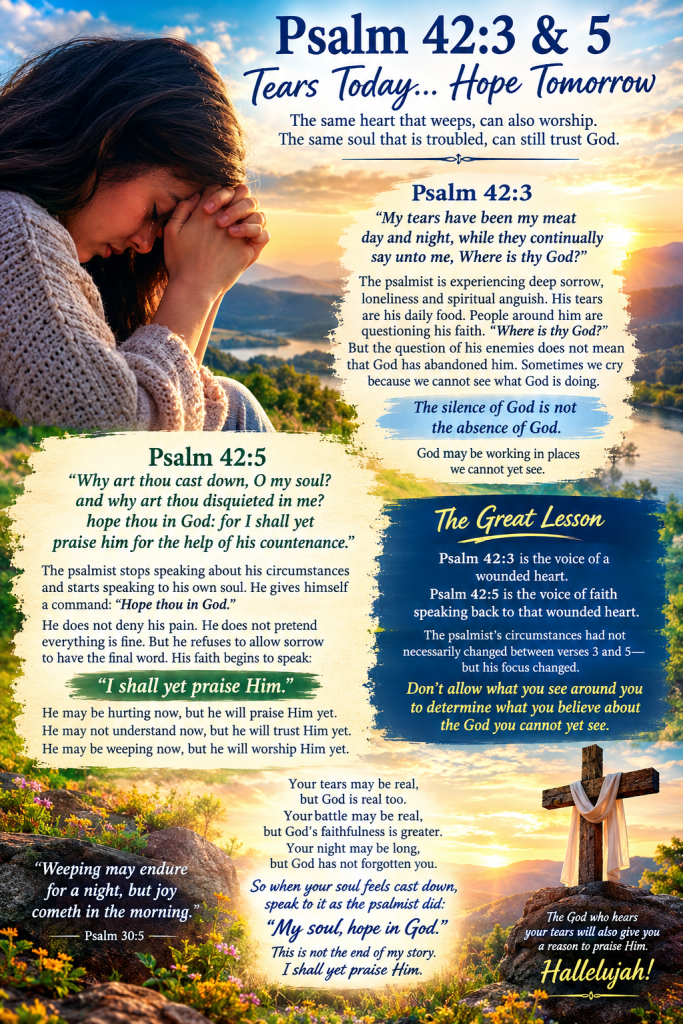
  • TEARS TODAY ; HOPE TOMORROW

    “My tears have been my meat day and night, while they continually say unto me, Where is thy God?” (Psalm 42:3)

    When we are experiencing deep sorrow, loneliness, and spiritual anguish,  tears become like our daily food and we cannot escape the grief.

    Suffering does not only come from within; people around us also question our faith.

    “Where is thy God?”

    That question can be extremely painful when someone is already going through a difficult season. It is almost as though the circumstances are being used as evidence against God’s presence.

    Such questions does not mean that God has abandoned us.

    Sometimes we may cry because we cannot see what God is doing.

    Sometimes we may pray and seemingly receive no answer.

    Sometimes people may look at our situation and say, “Where is your God now?”

    But the silence of God is not the absence of God.

    God may be working in places we cannot yet see.

    “Weeping may endure for a night, but joy cometh in the morning” (Psalm 30:5).

    Don’t allow what you see around you to determine what you believe about the God you cannot yet see.

    Your tears may be real, but God is real too.

    Your battle may be real, but God’s faithfulness is greater.

    Your night may be long, but God has not forgotten you.

    “Why art thou cast down, O my soul? and why art thou disquieted in me? hope thou in God: for I shall yet praise him for the help of his countenance” (Psalm 42:5).

    Though pain is heavy now, your voice will rise in praise.
    Though paths are hidden now, your trust will find His ways.
    Though sleep claims quiet now, your soul will worship still.
    Though dawn is silent now, your heart will hope His will.

    Be not discouraged. when your soul feels cast down, speak to it as the psalmist did:

    “My soul, hope in God. This is not the end of my story. I shall yet praise Him.”

  • DO NOT BE LUKEWARM — BE ON FIRE FOR CHRIST

    “I know thy works, that thou art neither cold nor hot: I would thou wert cold or hot. So then because thou art lukewarm, and neither cold nor hot, I will spue thee out of my mouth” (Revelation 3:15,16).

    These are the words of  our Lord Jesus Christ, who knows the condition of our hearts. He sees what people cannot see. He knows our works, our motives, our devotion, our compromises, and what happens inside us when nobody is watching.

    Lord Jesus does not desire a faith that is merely outward, a Christianity that speaks about Him on Sunday but forgets Him throughout the week. He does not want a heart that is divided between Christ and the world.

    Lukewarmness is dangerous because it can look like faith while lacking genuine surrender.

    A lukewarm heart says:

    “I want Jesus, but I also want the world.”

    “I will obey God when it is convenient.”

    “I will follow Christ, but I will not surrender everything.”

    But Lord Jesus said, “Thou shalt love the Lord thy God with all thy heart, and with all thy soul, and with all thy mind” (Matthew 22:37).

    God wants your entire heart.

    There may have been a time when you prayed with passion, worshipped with tears, loved God’s Word, and eagerly obeyed His voice.

    But slowly, distractions came.

    Prayer became occasional.

    The Word became neglected.

    Worship became routine.

    Sin became comfortable.

    The voice of the world became louder than the voice of God.

    The fire did not disappear in one moment, it became weaker little by little.

    Guard the fire God has placed within you. “Quench not the Spirit” (1Thessalonians 5:19).

    A person who is cold knows that they are far away. But lukewarmness can deceive a person into believing that everything is fine.

    You can attend church and still be far from Christ.

    You can know Scripture and still refuse obedience.

    You can speak religious words and still have an unchanged heart.

    You can have the appearance of godliness while denying its power. “Having a form of godliness, but denying the power thereof” (2 Timothy 3:5).

    God is not looking merely at what we appear to be. He is looking at who we truly are.

    Our Lord Jesus says in Revelation 3:19, “As many as I love, I rebuke and chasten: be zealous therefore, and repent.”

    His correction is not rejection. His rebuke is a call back to Himself.

    If your fire has grown cold, return.

    If your prayer life has weakened, return.

    If you have compromised with sin, repent.

    If the world has captured your attention, turn your eyes back to Lord Jesus.

    If your heart has become lukewarm, ask the Holy Spirit to ignite it again.

    Give your Lord everything.

    Do not settle for a faith that merely survives.

    Be passionate in prayer.

    Be faithful in obedience.

    Be hungry for God’s Word.

    Be courageous in your witness.

    Be humble in your service.

    Be holy in your living.

    Be completely surrendered to Christ.

    Apostle Paul wrote in Romans 12:11 “Not slothful in business; fervent in spirit; serving the Lord.”

    The world does not need another lukewarm Christian.

    It needs believers whose lives declare: “Don’t merely carry the name of Christ; carry His fire.”

    Lord Jesus is asking each one of us:

    “Where is your heart?”

    Do not ignore His voice.

    Do not postpone repentance.

    Do not allow your spiritual fire to die.

    Choose Christ.

    Choose surrender.

    Choose obedience.

    Choose holiness.

    Choose to burn brightly for Jesus.

    “Be zealous therefore, and repent” (Revelation 3).

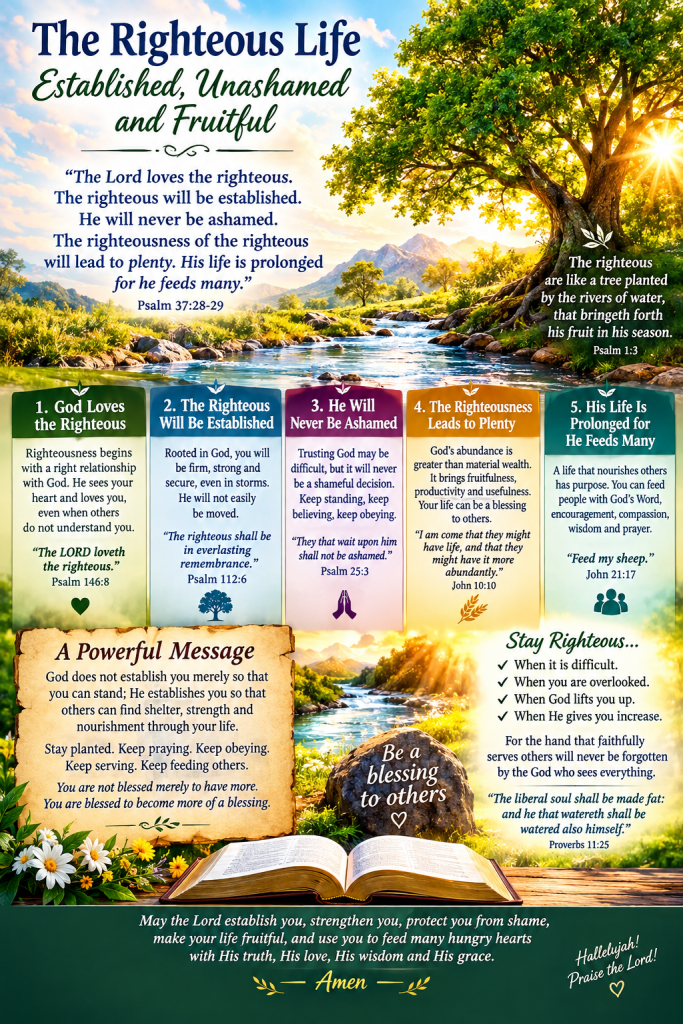
  • THE RIGHTEOUS LIFE

    The righteous shall flourish like the palm tree”(Psalm 92:12).

    Righteousness begins with a right relationship with God. The righteous person is not someone who claims to be perfect; rather, he is someone who trusts God, walks in His ways, loves His truth, and seeks to obey Him.

    The righteous will be established. “The righteous shall be in everlasting remembrance” (Psalm 112:6).

    He shall be like a tree planted by the rivers of water”(Psalm 1:3). God does not merely want you to survive every storm. He wants you rooted so deeply in Him that the storm cannot uproot you.

    They that wait upon him shall not be ashamed”(Psalm 25:3).

    There may be seasons when you wonder, “Lord, where are You?”

    Keep trusting.

    There may be moments when others question your faith.

    Keep standing.

    There may be times when obedience seems to cost you something.

    Keep walking.

    God has never disappointed the person who genuinely places his trust in Him.

    Lord Jesus said: “I am come that they might have life, and that they might have it more abundantly” (John 10:10).

    When your life is surrendered to God, what He places in your hands can become a blessing to others.

    Your wisdom can feed someone.

    Your testimony can encourage someone.

    Your prayers can strengthen someone.

    Your kindness can restore someone.

    Your experience can guide someone.

    Your faith can give someone hope.

    God blesses us not merely to increase what we possess, but so that our lives can become channels through which His goodness reaches others.

    A life that feeds others is a life with purpose.

    You don’t need to be famous to feed people.

    You can feed someone with the Word of God.

    You can feed someone with encouragement.

    You can feed someone with compassion.

    You can feed someone with wisdom.

    You can feed someone with prayer.

    Lord Jesus told Peter: “Feed my sheep.” (John 21:17)

    God does not establish a person merely so that he can stand; He establishes him so that others can find shelter, strength, and nourishment through his life.

    A life that God can use to nourish others becomes a life of tremendous significance.