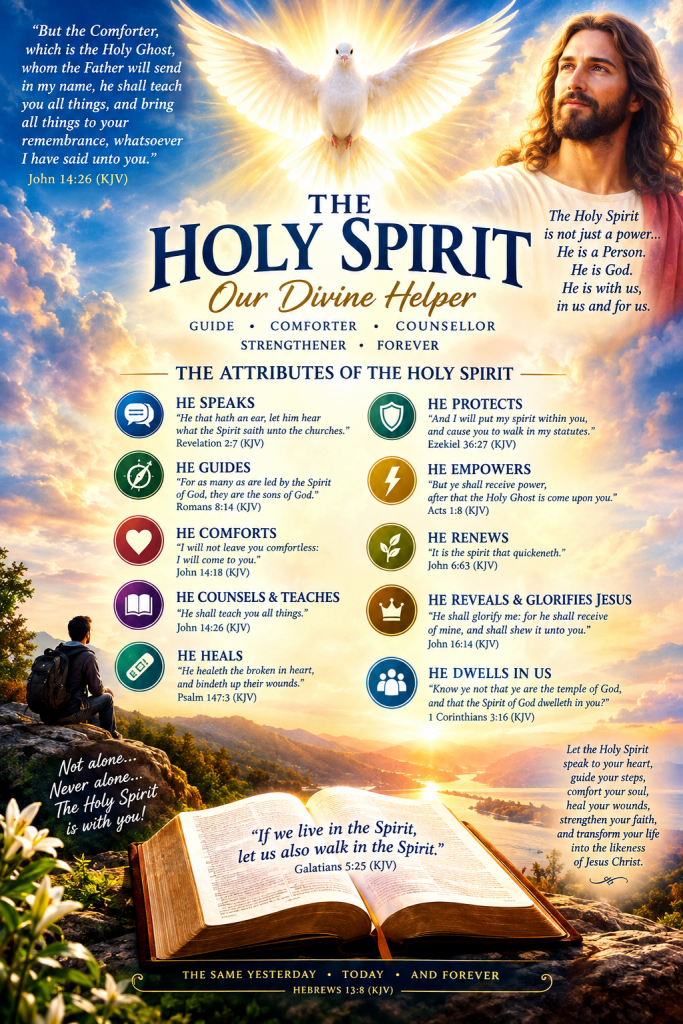
“But the Comforter, which is the Holy Ghost, whom the Father will send in my name, he shall teach you all things, and bring all things to your remembrance, whatsoever I have said unto you”(John 14:26).
Who Is the Holy Spirit?
The Holy Spirit is the Spirit of God, the third Person of the Holy Trinity: Father, Son, and Holy Spirit. He is not an impersonal force, an invisible energy, or merely a feeling that comes upon us. He is divine, personal, holy, and active in the lives of those who belong to God.
From the very beginning of creation to the glorious fulfilment of God’s purposes, the Holy Spirit is at work. He gives life, reveals truth, convicts the heart, teaches the Word, strengthens the weak, comforts the sorrowful, and empowers believers to live according to the will of God.
The Lord Jesus did not promise His disciples that they would never experience sorrow, uncertainty, temptation, or difficulty. He promised them the Holy Spirit, the divine Helper who would remain with them.
“And I will pray the Father, and he shall give you another Comforter, that he may abide with you for ever” (John 14:16).
What a glorious promise! We may sometimes feel alone, but we are never beyond the reach of God’s presence. The Holy Spirit works within us, reminding us of the words of Christ and helping us walk in faith, obedience, and holiness.
The Holy Spirit speaks: “He that hath an ear, let him hear what the Spirit saith unto the churches” (Revelation 2:7).
In Scripture, He speaks through God’s revealed Word, directs God’s servants, brings truth to remembrance, and calls people to obedience.
In Acts 13:2, the Holy Spirit said, “Separate me Barnabas and Saul for the work whereunto I have called them.”
His voice does not lead us away from Christ or contradict the truth of Scripture. Read His Word prayerfully, remain humble, and be willing to obey when Scripture makes His will clear. The heart that listens to God must also be willing to follow Him.
The Holy Spirit guides us: “For as many as are led by the Spirit of God, they are the sons of God” (Romans 8:14).
Life is filled with decisions, crossroads, uncertainties, and moments when we do not know which direction to take. We may understand our circumstances only partially, but God sees the beginning and the end. The Holy Spirit guides us into truth, teaches us to discern right from wrong, and helps us apply God’s Word to our daily lives.
The Lord Jesus said: “Howbeit when he, the Spirit of truth, is come, he will guide you into all truth” (John 16:13).
His guidance calls us to prayer, biblical wisdom, discernment, and obedience. When you do not know what lies ahead, trust God enough to take the next faithful step. You may not see the whole road, but you can seek the One who leads you.
The Holy Spirit comforts us: “I will not leave you comfortless: I will come to you” (John 14:18).
There are wounds that words cannot heal, tears that we hide from others, and sorrows that we struggle to explain. Sometimes even the people who love us cannot fully understand the pain we carry. But God knows. The Holy Spirit is our divine Comforter. He reminds us of God’s promises, strengthens our hearts, and helps us endure seasons of grief, loneliness, disappointment, and suffering. Romans 8:26 tells us that the Spirit helps our infirmities and intercedes for us when we do not know what we should pray for as we ought. You may not always receive an immediate answer to your pain, and your circumstances may not change overnight. Yet you can bring your sorrow before God and ask the Holy Spirit to sustain you through it. When human words fail, we can still turn to the God who knows our hearts.
The Holy Spirit counsels and teaches us: “But the Comforter, which is the Holy Ghost, whom the Father will send in my name, he shall teach you all things, and bring all things to your remembrance, whatsoever I have said unto you”(John 14:26).
The Holy Spirit is our divine Teacher. He helps us understand the truth of God’s Word and reminds us of the teachings of the Lord Jesus. He corrects our wrong thinking, exposes the deception of sin, and teaches us to see our lives through the light of God’s truth. A wise counsellor does not simply tell us what we want to hear; godly counsel leads us towards what is right. The Holy Spirit directs us towards Christlike character, humility, repentance, forgiveness, and obedience. When pride rises within us, He reminds us to be humble. When bitterness takes root, God’s truth calls us to forgive. When temptation presents itself, the Word of God reminds us to choose holiness. Let us never seek the Spirit’s counsel merely to confirm our own desires. Let us seek Him with surrendered hearts, willing to be corrected and transformed.
The Holy Spirit heals and restores: “He healeth the broken in heart, and bindeth up their wounds” (Psalm 147:3).
God is the healer of the brokenhearted. Through the Holy Spirit, God works in human lives to bring conviction, renewal, comfort, strength, and restoration. The Spirit helps us confront the wounds of our past, repent of our sins, release bitterness, and grow in the grace of Christ. The Holy Spirit empowers believers in the ministry of healing, whether by restoring the body, strengthening the soul to endure suffering, or granting the courage to seek help. Whatever our circumstances, we can entrust ourselves to the mercy and wisdom of God.
The Holy Spirit protects and strengthens us: “And I will put my spirit within you, and cause you to walk in my statutes” (Ezekiel 36:27).
The Holy Spirit strengthens believers to resist temptation, stand firm in faith, and persevere through spiritual struggles. He reminds us of God’s truth when deception surrounds us. He empowers us to reject sin and helps us recognise the difference between the works of the flesh and the fruit of the Spirit. Ephesians 6:10–18 teaches us to put on the whole armour of God and to stand against spiritual evil. However, the Spirit’s protection does not mean that Christians will never face danger, persecution, illness, or hardship. Rather, we can trust God’s presence and strength even in the midst of trials.
Do not depend only upon your own strength. Pray, remain grounded in Scripture, resist evil, and seek the wisdom of God. The One who strengthens your faith can help you stand even when the world around you seems uncertain.
The Holy Spirit convicts us of sin: “And when he is come, he will reprove the world of sin, and of righteousness, and of judgment” (John 16:8).
The Holy Spirit reveals our need for repentance and directs us towards the righteousness of Christ. When we have acted wrongly, He brings God’s truth to bear upon our conscience. He calls us to acknowledge our sin, turn away from it, and seek God’s forgiveness. Conviction is an invitation to return to God; it is not a reason to hide from Him. First John 1:9 promises that when we confess our sins, God is faithful and just to forgive us and cleanse us from all unrighteousness. Do not harden your heart when God’s Word exposes something that must change. Humble yourself, seek forgiveness, and allow the Lord to transform you.
The Holy Spirit intercedes for us: “The Spirit itself maketh intercession for us with groanings which cannot be uttered” (Romans 8:26).
There are moments when our hearts are so burdened that we cannot find the words to pray. We may sit before God in silence, carrying grief, confusion, or a longing that we cannot express. Romans 8 reminds us that our weakness does not place us beyond God’s help. The Holy Spirit helps us in our infirmities and intercedes according to the will of God. Prayer is not dependent upon our ability to speak eloquently. Come before God honestly. You do not need to impress Him with beautiful words. Bring Him your tears, your questions, your repentance, your gratitude, and your deepest concerns.
The Holy Spirit empowers us: “But ye shall receive power, after that the Holy Ghost is come upon you: and ye shall be witnesses unto me” (Acts 1:8).
The Holy Spirit empowers believers to bear witness to the Lord Jesus Christ. He gives courage to speak the truth, strength to endure opposition, and grace to serve others. He distributes spiritual gifts according to God’s purposes, equipping the Church for ministry and the building up of the body of Christ (1 Corinthians 12:4–11). The Spirit empowers us to glorify Lord Jesus, serve humbly, love sacrificially, and proclaim the Gospel faithfully. The evidence of His work is not merely an outward display of spiritual enthusiasm. It also includes a transformed life that increasingly reflects the character of Christ.
The Holy Spirit produces His fruit in us: “But the fruit of the Spirit is love, joy, peace, longsuffering, gentleness, goodness, faith, meekness, temperance” (Galatians 5:22–23).
The Holy Spirit does more than give us strength for a particular task. He works within us to transform who we are. He teaches us to love when hatred seems easier, to remain patient when circumstances test us, to speak gently when anger rises, and to pursue peace when conflict surrounds us. The fruit of the Spirit reveals the character God desires to cultivate in His people. Spiritual maturity is not measured simply by how much we know, how eloquently we speak, or how many spiritual experiences we describe. It is also revealed through the love we demonstrate, the forgiveness we offer, the humility we practise, and the holiness we pursue. Let us ask not only for the gifts of the Spirit but also for the grace to bear His fruit.
The Holy Spirit gives life and renews us: “It is the spirit that quickeneth; the flesh profiteth nothing” (John 6:63).
The Holy Spirit is active in the work of spiritual renewal. The Lord Jesus taught Nicodemus that a person must be born of the Spirit to enter the kingdom of God (John 3:5–8). Through the Spirit’s work, we are brought into new life in Christ, renewed in our minds, and enabled to grow in holiness. When we have become spiritually weary, we can pray for renewal. When our love has grown cold, we can return to Christ. When sin has entangled us, we can seek God’s forgiveness and the Spirit’s help to walk in newness of life. The Christian life is not merely an attempt to improve ourselves through human effort. It is a life of dependence upon God’s grace and the transforming work of His Spirit.
The Holy Spirit reveals and glorifies the Lord Jesus Christ: “He shall glorify me: for he shall receive of mine, and shall shew it unto you” (John 16:14).
One of the most important works of the Holy Spirit is to glorify the Lord Jesus Christ. The Spirit does not lead us away from the Lord Jesus. He reveals the truth of Christ, deepens our understanding of His Word, and transforms us to become more like Him. The Holy Spirit reminds us of the significance of Christ’s sacrifice, the greatness of His resurrection, and the hope we have through Him. A genuine work of the Holy Spirit leads us towards greater love for Jesus, deeper reverence for God’s Word, and a life that bears witness to the Gospel. Let Christ remain at the centre of your worship, your prayer, your service, and your life.
The Holy Spirit dwells in believers: “Know ye not that ye are the temple of God, and that the Spirit of God dwelleth in you?” (1 Corinthians 3:16).
We should therefore seek to live in a manner worthy of the One whose presence has been given to us. The presence of the Holy Spirit is a precious gift. Our lives are not meant to be ruled by selfish desires, bitterness, dishonesty, or impurity. We are called to honour God in our bodies, thoughts, words, and actions. Make room for prayer. Meditate upon the Scriptures. Practise obedience. Pursue peace with others. Turn away from what dishonours God. The Spirit’s indwelling presence is not permission to live carelessly; it is a call to live as people who belong to Christ.
The Holy Spirit gives wisdom and discernment: “For to one is given by the Spirit the word of wisdom; to another the word of knowledge by the same Spirit” (1 Corinthians 12:8).
The Holy Spirit equips God’s people with wisdom and discernment for the situations they encounter. He helps us distinguish truth from error, recognise the dangers of temptation, and respond to others with godly understanding. James 1:5 encourages those who lack wisdom to ask God, who gives generously. Ask the Lord to make you wise not only in what you believe, but also in what you say, how you act, and how you treat others.
The Holy Spirit unites us in love and fellowship: Endeavouring to keep the unity of the Spirit in the bond of peace” (Ephesians 4:3).
The Holy Spirit brings believers into the fellowship of Christ’s body and calls them to live in unity, love, and peace. He teaches us to bear with one another, forgive one another, and serve one another with humility. Unity does not mean that every Christian must agree on every matter. It means that we seek to honour Christ, hold fast to the truth, and treat one another with grace rather than pride and hostility. A heart being transformed by the Spirit will increasingly seek reconciliation, show compassion, and pursue the good of others. Where the Spirit’s fruit grows, love becomes visible.
The Holy Spirit is our seal and assurance: “And grieve not the holy Spirit of God, whereby ye are sealed unto the day of redemption” (Ephesians 4:30).
The Holy Spirit is associated with the sealing of believers, marking them as belonging to God and pointing towards the promised redemption. This gives Christians a profound reason for hope. Our salvation rests upon the grace of God through Jesus Christ, not upon our ability to earn His favour. The Spirit’s presence reminds us that we belong to the Lord and are called to live faithfully as His people. Therefore, do not treat the grace of God lightly. Walk in repentance, trust in Christ, and seek to honour the One who has called you to Himself.
The Holy Spirit can be grieved: “And grieve not the holy Spirit of God” (Ephesians 4:30).
Because the Holy Spirit is personal, Scripture warns believers not to grieve Him. Ephesians 4 places this warning in the context of falsehood, corrupt speech, bitterness, wrath, anger, and malice. These are not small matters to God. They damage our relationships and contradict the character of Christ.
We must therefore examine our hearts. Are we harbouring resentment? Are our words building people up or tearing them down? Are we making room for dishonesty or refusing to forgive?
When we recognise our failures, let us not hide behind pride. Let us repent, seek God’s forgiveness, and return to a life of obedience. The Spirit who convicts us also helps us grow in holiness.
The Holy Spirit is our ever-present Helper in every season: “Likewise the Spirit also helpeth our infirmities” (Romans 8:26).
In joy, we can thank Him. In sorrow, we can seek His comfort. In uncertainty, we can ask for wisdom. In temptation, we can seek strength to resist. In weakness, we can pray for His help. In service, we can depend upon His power.
The Holy Spirit is not confined to a church building or a particular hour of prayer. The Christian life is a life of walking with God every day.
Yet we must remember that His work is not a promise that every desire will be fulfilled or every difficulty immediately removed. He works according to God’s wisdom and purpose, leading us to trust Christ in all circumstances.
Whatever season you are passing through, turn to God in faith. Let His Word shape your heart, let prayer strengthen your relationship with Him, and let the Spirit lead you towards the character of Jesus.
Walk in the Spirit
The Holy Spirit speaks, guides, comforts, teaches, convicts, strengthens, empowers, renews, and produces His fruit in those who belong to Christ. He helps us in our weakness, directs us towards truth, and glorifies the Lord Jesus. But let us never seek only what the Holy Spirit can do for us. Let us seek to know God more deeply, love Christ more faithfully, and become more obedient to His Word.
The greatest evidence of the Spirit’s transforming work is not merely what we say about Him, but how our lives increasingly reflect the love, holiness, humility, and truth of the Lord Jesus Christ.
Do not grieve the Holy Spirit. Do not resist His call to repentance. Do not ignore the truth of God’s Word. Instead, pray for wisdom, walk in obedience, cultivate the fruit of the Spirit, and remain steadfast in Christ. May our hearts become willing vessels, our lives become living testimonies, and our words bring glory to the name of Jesus.
Holy Spirit, teach us to hear the truth, give us grace to obey, strengthen us in our weakness, comfort us in our sorrow, and transform us into the likeness of Jesus Christ. Lead us in the way of righteousness, fill us with Your love, and help us glorify our Lord in everything we do. Amen.
“If we live in the Spirit, let us also walk in the Spirit” (Galatians 5:25).