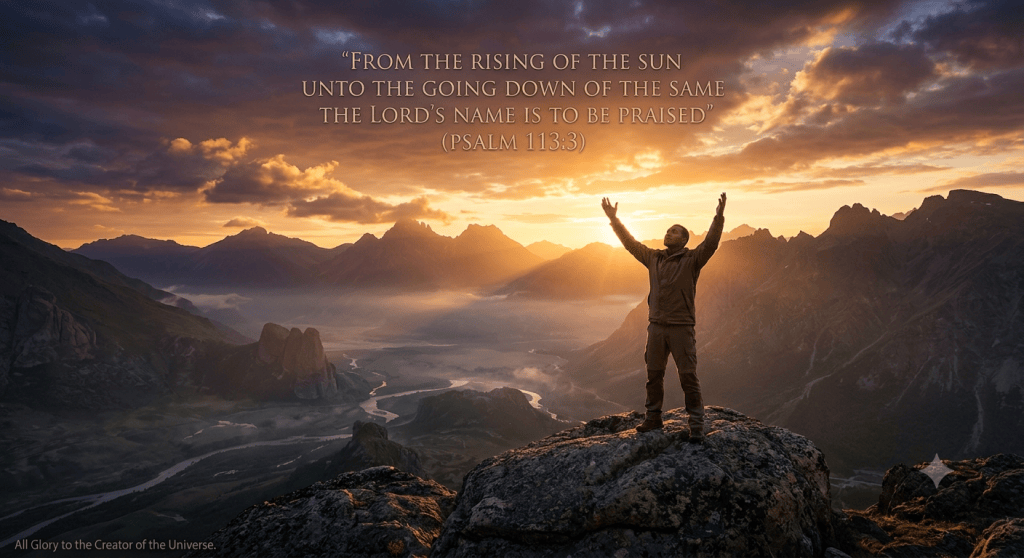
“From the rising of the sun unto the going down of the same the LORD’s name is to be praised”(Psalm 113:3).
Earthly power has an expiration date. Presidents, prime ministers, kings, and emperors wield a borrowed authority that is bound by borders, broken by time, and cut short by the grave. When human leaders receive honor, it is merely for an office they temporarily occupy.
The Creator’s claim to glory knows no such limits. His praise spans “from the rising of the sun unto the going down of the same”, stretching across every timezone and filling every corner of space without pause.
While human rulers beg for the support of citizens, lean on advisors, and fight over resources to keep their thrones, God’s authority is absolute and underived. Everything in this universe needs a cause, a fuel, or a maker to exist. But God exists from everlasting to everlasting (Psalm 90:2). He is uncaused. He relies on nothing.
He is not measured by a standard of goodness or truth, He is the source and definition of them. He guards strict justice while holding out deep mercy, patience, and grace to His creation. From the smallest subatomic particle to the largest spinning galaxy, all things hang in continuous, breathless dependence upon Him.
Earthly empires rise and fall like the tide, but the Kingdom of God remains unshaken. In a world of shifting allegiances and fragile leadership, human power is ultimately eclipsed by the One who needs no throne, fears no successor, and answers to no court. To Him alone belongs the honor that never fades.
“Now unto the King eternal, immortal, invisible, the only wise God, be honour and glory for ever and ever. Amen” (1 Timothy 1:17).
“The LORD shall reign for ever, even thy God, O Zion, unto all generations. Praise ye the LORD”(Psalm 146:10).
Christians are called to follow Christ not merely in name, but in life, in obedience, in holiness, and in the power of the Holy Spirit.
The Lord Jesus Himself was baptized in water, and the Holy Spirit descended upon Him. The Scripture says: “And the Holy Ghost descended in a bodily shape like a dove upon him” (Luke 3:22).
If we call ourselves followers of Christ, we must earnestly seek to walk in the footsteps of Christ.
When Israel passed through the Red Sea, the Apostle Paul described it as a figure of baptism: “And were all baptized unto Moses in the cloud and in the sea” (1 Corinthians 10:2).
Their passage through the waters marked a separation from the life they had known in Egypt. They were moving forward into a new journey under the leadership of God.
Then God manifested His presence among them. At Mount Sinai, the glory and fire of the Lord were revealed. And throughout their wilderness journey, God did not leave His people without direction: “And the LORD went before them by day in a pillar of a cloud, to lead them the way; and by night in a pillar of fire, to give them light” (Exodus 13:21)
Cloud by day. Fire by night.
God did not merely bring His people out, He desired to lead them.
In the same way, receiving the Holy Spirit is not merely about having an experience. The Holy Spirit comes to dwell in you, to teach, guide, comfort, convict, strengthen, and lead you into the truth.
The Lord Jesus said: “And I will pray the Father, and he shall give you another Comforter, that he may abide with you for ever” (John 14:16).
And in John 16:13: “Howbeit when he, the Spirit of truth, is come, he will guide you into all truth.”
The Holy Spirit is the Spirit of God.
The Apostle Paul writes: “Now if any man have not the Spirit of Christ, he is none of his.” (Romans 8:9).
If you are not filled with the Spirit of God, you don’t belong to Him.
Water baptism has profound biblical meaning. It testifies to repentance, identification with Christ, the death of the old life, and the beginning of a new life: “Therefore we are buried with him by baptism into death: that like as Christ was raised up from the dead by the glory of the Father, even so we also should walk in newness of life” (Romans 6:4).
The old life must die, and the new life must be lived in Christ. The Holy Spirit is central to that new life.
The Lord Jesus declared: “Except a man be born of water and of the Spirit, he cannot enter into the kingdom of God” (John 3:5).
The new birth is the work of God within the heart.
On the Day of Pentecost, the promise of the Father was manifested with extraordinary power: “And there appeared unto them cloven tongues like as of fire, and it sat upon each of them. And they were all filled with the Holy Ghost” (Acts 2:3–4).
They were filled with the Holy Spirit, and they began to speak with other tongues as the Spirit gave them utterance.
Tongues are one of the spiritual gifts mentioned by the Apostle Paul among the manifestations of the Spirit (1 Corinthians 12:8–10). The Holy Spirit gives different gifts to different believers according to His will (1 Corinthians 12:11).
Therefore, we should not measure the presence of the Holy Spirit merely by one particular manifestation.
God looks deeper than our outward actions. “For man looketh on the outward appearance, but the LORD looketh on the heart” (1 Samuel 16:7).
Therefore, do not be satisfied with water baptism alone.
Do not be satisfied merely because you were baptized as a child. A ceremony cannot substitute for a surrendered heart.
A person may pass through religious ceremonies and still wander far from God. Israel itself passed through the sea, witnessed God’s mighty works, and yet many later fell into disobedience and unbelief. Apostle Paul warns us to learn from their example (1 Corinthians 10:1–12).
So let us examine ourselves. Have we truly repented? Have we surrendered our lives to Christ? Are we walking in obedience, seeking the Holy Spirit, and allowing the Spirit of God to lead us?
The Scripture says: “As many as are led by the Spirit of God, they are the sons of God” (Romans 8:14).
Repentance must be more than words.
True repentance turns the heart toward God. “Repent ye therefore, and be converted, that your sins may be blotted out” (Acts 3:19).
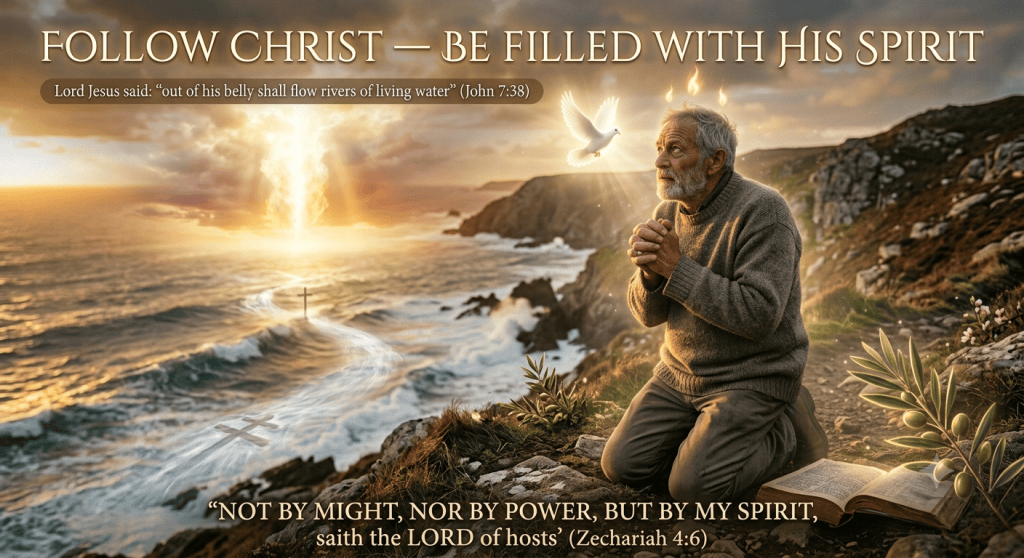
Come before the Lord sincerely. Fast, pray, and search your heart. Confess your sins to God. Ask Him to cleanse you, change you, and fill you with His Spirit. Lord Jesus Himself gave this invitation: “If any man thirst, let him come unto me, and drink” (John 7:37).
And then He gave this extraordinary promise: “He that believeth on me, as the scripture hath said, out of his belly shall flow rivers of living water” (John 7:38).
If your desire is to serve the Lord and reach souls, ask Him to equip you.
Say: “Lord Jesus, I do not want merely to speak about You. I want You to use my life. Cleanse me. Teach me. Lead me. Fill me with Your Holy Spirit. Give me wisdom, courage, love, discernment, and every gift You desire to place within me. Make me a vessel for Your glory.”
Seek the Lord with your whole heart.
Be filled with His Spirit. Walk in His light.
Bear His fruit. Carry His love. Obey His voice.
And let your life become a living testimony that Jesus Christ is Lord.
“Not by might, nor by power, but by my spirit, saith the LORD of hosts” (Zechariah 4:6).
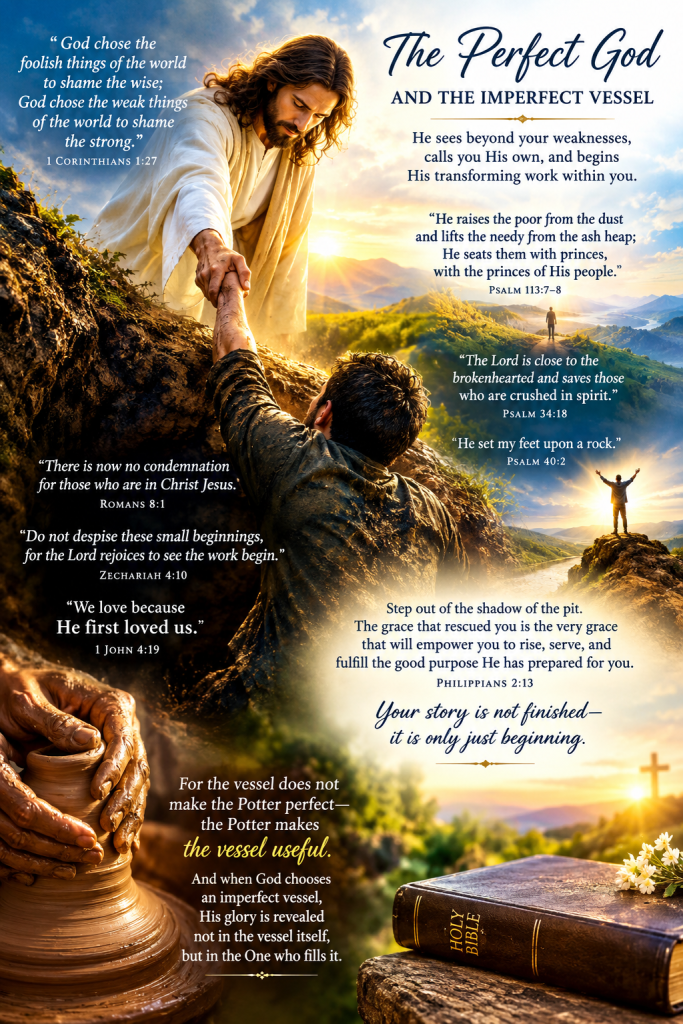
The perfect God, whose throne is established in holiness and light, has chosen the imperfect to serve the All-Perfect One.
As the Apostle Paul writes, “God chose the foolish things of the world to shame the wise; God chose the weak things of the world to shame the strong” (1 Corinthians 1:27).
You may feel inadequate, fragile, and unworthy, yet in His divine mercy, He sees beyond your weaknesses, calls you His own, and begins His transforming work within you.
He is the God who stoops down to the lowest places. Long before you knew how to reach for Him, “He raises the poor from the dust and lifts the needy from the ash heap; He seats them with princes, with the princes of His people” (Psalm 113:7–8).
You may have felt buried beneath the weight of your own limitations, trapped in a pit of pain and despair. Even when your voice failed and you could not cry out, His eyes never left you. “The Lord is close to the brokenhearted and saves those who are crushed in spirit” (Psalm 34:18). He saw every hidden tear, every silent struggle, and reached deep into the mire to pull you out, setting your feet upon a rock (Psalm 40:2).
Within your soul burns a quiet desire to do greater things for Him, to offer a life of purpose, power, and glory to His name. Yet you look back and feel as though you have not done enough. Do not let condemnation weigh heavily on your heart, for “there is now no condemnation for those who are in Christ Jesus” (Romans 8:1). God does not measure your worth by the greatness of your past achievements, but He delights in a heart that turns toward Him in faith and obedience. “Do not despise these small beginnings, for the Lord rejoices to see the work begin” (Zechariah 4:10).
You love Him deeply, yet you often feel that you have not fully expressed that love, held back by fear, hesitation, or the weight of your own unworthiness. But remember this: “We love because He first loved us” (1 John 4:19). Your love for Him, even when expressed through quiet obedience and unspoken longing, is precious before Him. He is not asking you to become flawless before you serve Him; He asks for a willing and surrendered heart.
“For it is God who works in you to will and to act in order to fulfill His good purpose” (Philippians 2:13).
The hands that lifted you from the pit have not released you. The God who found you in your brokenness is the same God who can use your life for His glory.
Do not wait until you feel worthy. Do not wait until you feel strong. Come as you are, surrender what you have, and let Him do through you what you could never accomplish by your own strength.
For the vessel does not make the Potter perfect, but the Potter makes the vessel useful.
And when God chooses an imperfect vessel, His glory is revealed not in the vessel itself, but in the One who fills it.
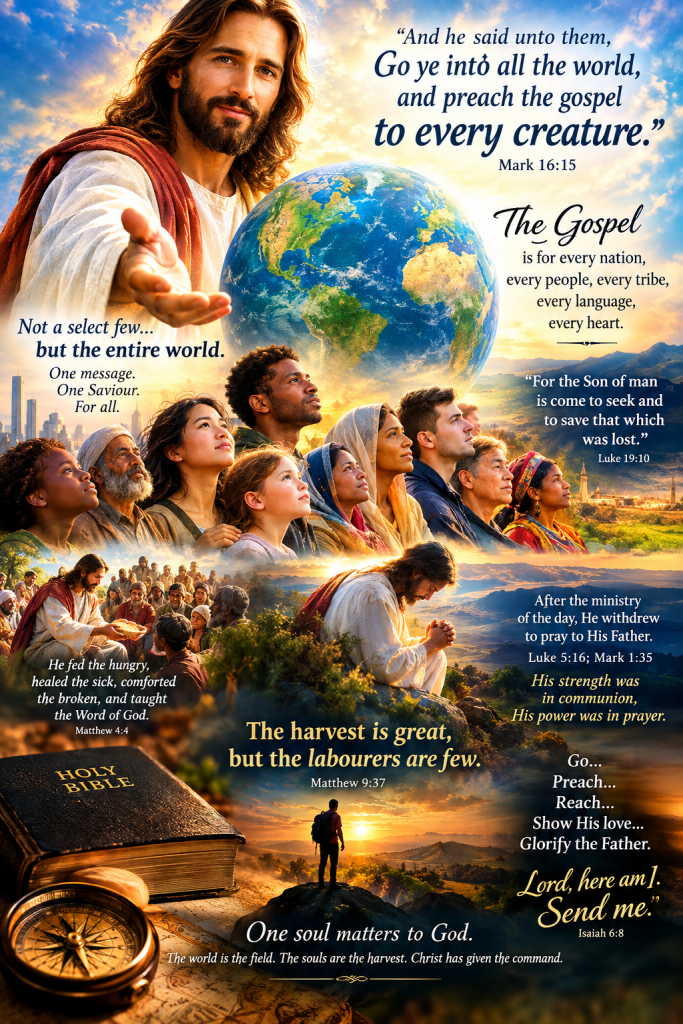
“And he said unto them, Go ye into all the world, and preach the gospel to every creature”
(Mark 16:15).
The mission given by our Lord Jesus Christ is not confined to a particular nation, community, congregation, family, or select group of people. Our vision must reach beyond the boundaries we can see. Our target must be the entire world.
The Gospel is for every creature.
There are souls everywhere who are searching for hope, longing for peace, carrying wounds that nobody can see, and walking through darkness without knowing where to turn. Some may never enter a church. Some may never open a Bible. Some may never hear a sermon from a pulpit.
But they can encounter Christ through a word spoken in love, a life lived in obedience, a helping hand, a testimony, a message, or someone who is willing to carry the Gospel beyond familiar boundaries.
The Lord Jesus did not come into this world merely to reach a comfortable few. He came to seek and to save that which was lost.
“For the Son of man is come to seek and to save that which was lost” (Luke 19:10).
Christ’s eyes were always upon souls
The earthly ministry of our Lord Jesus Christ gives us a pattern that cannot be ignored.
He went among the people. He saw the multitudes. He listened to the broken. He touched the rejected. He welcomed the forgotten. He taught those who were hungry for truth. He comforted those who were grieving. He healed the sick and strengthened the weak.
He did not see people merely according to their social position, wealth, reputation, or status.
He saw souls.
When He looked upon the multitude, He was moved with compassion. “But when he saw the multitudes, he was moved with compassion on them, because they fainted, and were scattered abroad, as sheep having no shepherd” (Matthew 9:36).
When we look at the world, do we see only people or do we see souls that Christ loves?
He fed both body and soul. Lord Jesus cared about people’s physical needs, but He never neglected their spiritual needs.
He fed the hungry, yet He also taught them the Word of God. He healed the sick, yet He called people to repentance and faith. He comforted the brokenhearted, yet He directed them toward the Father.
The Lord Jesus said: “Man shall not live by bread alone, but by every word that proceedeth out of the mouth of God” (Matthew 4:4).
Food can sustain the body for a day. The Word of God can lead a soul toward eternal life.
He glorified the Father. Throughout His earthly ministry, Lord Jesus continually directed attention to His Father. He did not seek His own glory. His life was an offering of obedience.
Whatever work God has placed before us, our ultimate purpose should not be to make our own name great. It should be to glorify His Name.
Our ministry, our words, our gifts, our resources, our time, and even our daily conduct should point people toward Christ.
The hidden strength behind His public ministry was a life of prayer. After ministering to the multitudes, Lord Jesus often withdrew from the crowds to seek His Father. “And he withdrew himself into the wilderness, and prayed” (Luke 5:16).
“And in the morning, rising up a great while before day, he went out, and departed into a solitary place, and there prayed” (Mark 1:35).
The One who had spent the day teaching, healing, comforting, travelling, answering questions, and ministering to people still made time to be alone with the Father. His public strength was connected to His private communion with God.
We cannot effectively carry God’s message to the world while neglecting our own relationship with God. Before we speak to people about the Father, we must learn to spend time speaking with the Father.
The Lord Jesus looked at the multitudes and said:
The harvest is great but the labourers are few.
The world is still full of souls. Our responsibility is not necessarily to stand before thousands.
We may begin with one person. One soul matters to God.
One encouraging word may prevent someone from giving up. One testimony may awaken faith. One act of kindness may open a heart. One Scripture may remain in someone’s mind for years. One person who faithfully shares Christ may become the instrument through which another person encounters the Gospel.
We must therefore never underestimate what God can do through a willing servant.
Let us not make the Gospel smaller than Christ made it.
We must look beyond just our neighborhood, friends, those who already agree with us, or those who are easy to reach.
The Gospel crosses borders, languages, cultures, and social boundaries because the love of Christ is not confined by the boundaries created by humanity.
Are we willing to go?
The world does not merely need more religious words. It needs people whose lives demonstrate that they have encountered Christ.
We are called to go, speak, serve, love, pray, encourage, teach, and testify.
“Great is our Lord, and abundant in power; his understanding is beyond measure.”
(Psalms 147:5)
“It is he who made the earth by his power, who established the world by his wisdom, and by his understanding stretched out the heavens.” (Jeremiah 10:12)
“The Lord is the everlasting God, the Creator of the ends of the earth. He does not faint or grow weary; his understanding is unsearchable.” (Isaiah 40:28)
“Ah, Lord God! It is you who have made the heavens and the earth by your great power and by your outstretched arm! Nothing is too hard for you. (Jeremiah 32:17)
“The Lord is a man of war; the Lord is his name.” (Exodus 15:3)
“Your right hand, O Lord, glorious in power, your right hand, O Lord, shatters the enemy.” ( Exodus 15:6)
“The Lord your God is in your midst, a mighty one who will save; he will rejoice over you with gladness.” (Zephaniah 3:17)
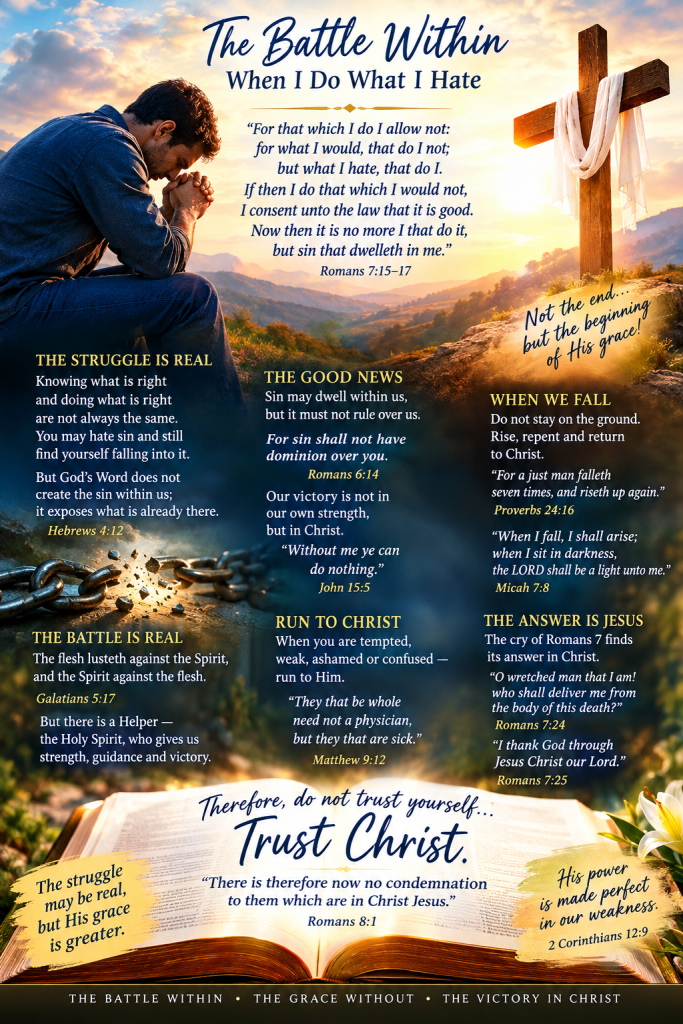
There is a battle that cannot always be seen by human eyes. It is not fought with swords, armies, or earthly weapons. It is fought within the heart of man.
The Apostle Paul speaks with remarkable honesty in Romans 7:15–17: “What I would, that do I not; but what I hate, that do I.”
These words reveal something every believer must understand: knowing the will of God and obeying the will of God are not always the same thing.
A person may know what is right and still struggle to do it. He may hate sin and yet find himself falling into temptation. He may desire holiness and still discover weakness within himself.
The Apostle Paul says: “If then I do that which I would not, I consent unto the law that it is good.”
The problem is not God’s law. God’s commandment is good because God is good. “Wherefore the law is holy, and the commandment holy, and just, and good” (Romans 7:12). God’s Word does not create the sin within us; it exposes what is already there. Hebrews 4:12 declares: “For the word of God is quick, and powerful, and sharper than any twoedged sword.” When God’s Word enters our hearts, it shows us not merely what we want others to see, but who we truly are before God.
The Apostle Paul says: “What I hate, that do I.” He acknowledges his weakness with humility, and that is where spiritual healing begins. He who comes before God and says, “Lord, search me, reveal me, cleanse me, and change me,” has opened his heart to the work of grace. King David prayed: “Search me, O God, and know my heart: try me, and know my thoughts” (Psalm 139:23). True spirituality is bringing our struggles into the presence of God.
The Apostle Paul says: “Sin that dwelleth in me.” In Romans 6:14, he later declares: “For sin shall not have dominion over you.” We are not strong enough to defeat sin. Christ is stronger than the sin that is fighting against us. Lord Jesus said: “Without me ye can do nothing” (John 15:5). Our victory does not come from trusting our own strength. It comes from abiding in Christ.
Are you struggling with sin or making peace with it?
If you have sinned, then you must repent. You must return to Christ. “For a just man falleth seven times, and riseth up again” (Proverbs 24:16). “When I fall, I shall arise; when I sit in darkness, the LORD shall be a light unto me” (Micah 7:8).
You may have been experiencing a painful struggle, making you wonder whether you truly belong to God and why you are still fighting this battle. The Christian life involves warfare. Galatians 5:17 says: “For the flesh lusteth against the Spirit, and the Spirit against the flesh.” But the Holy Spirit works within us, teaching us, correcting us, strengthening us, and leading us toward holiness. Therefore, when you recognize the battle within, do not run away from God, but run toward Him. When you face weakness, temptation, or moments of doubt and shame, turn immediately to Christ for strength.
Do not hide from the Physician. Go to the Physician. Lord Jesus said: “They that be whole need not a physician, but they that are sick” (Matthew 9:12).
The Lord Jesus Christ is more real than our weaknesses. His grace outlasts our failures, His mercy covers our shame, and His power is greater than any temptation. Whenever we stumble, His strong hand is always ready to lift us back up. Therefore, do not trust yourself, but trust the Living Christ.
The Lord told the Apostle Paul: “My grace is sufficient for thee: for my strength is made perfect in weakness” (2 Corinthians 12:9).
Abide in Christ. “There is therefore now no condemnation to them which are in Christ Jesus” (Romans 8:1).
For the battle is not ultimately won by the strength of the man who fights. It is won by the grace of the Christ who lives in him.
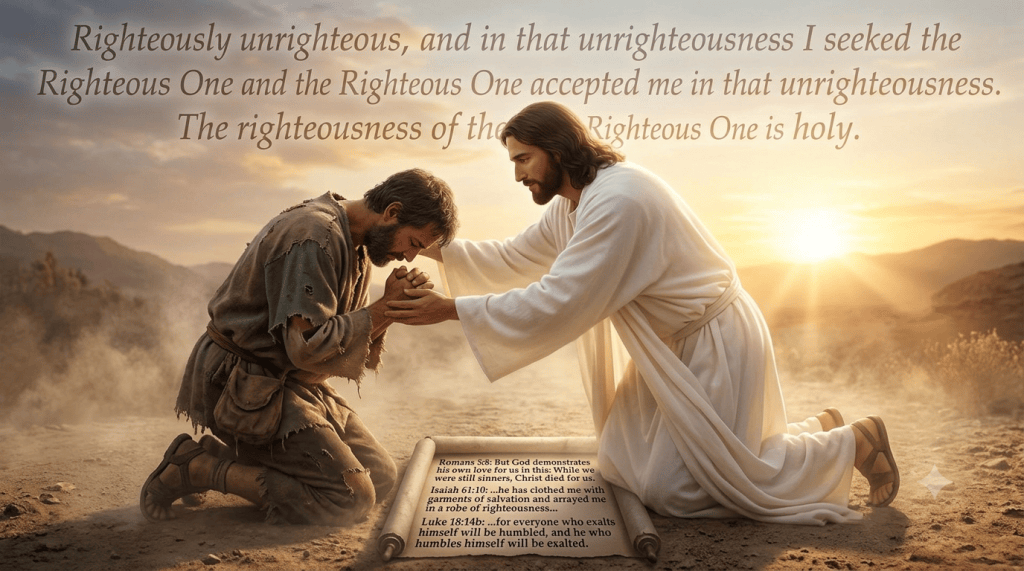
No, not one is good. No one is perfect. All are sinners.
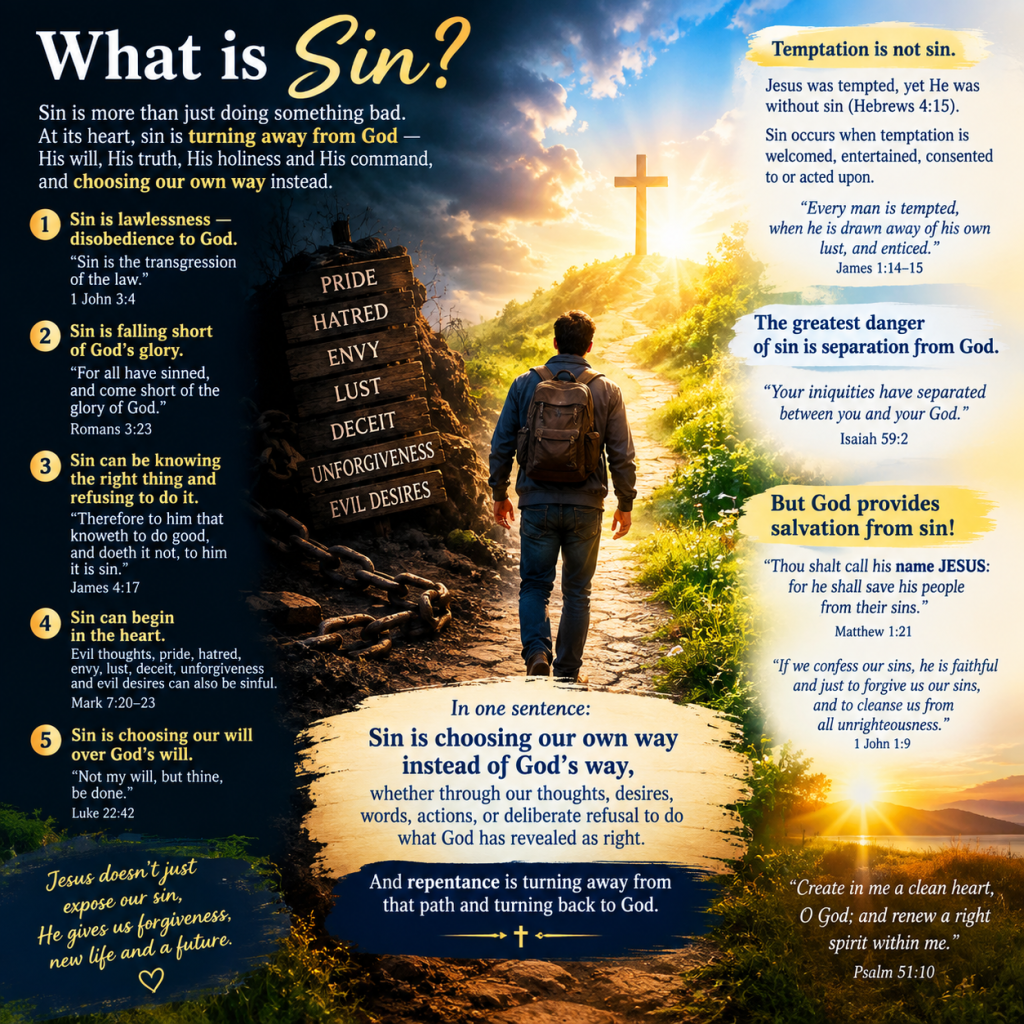
Sin is lawlessness and disobedience to God. “Sin is the transgression of the law” (1 John 3:4). God establishes what is right and holy. When we knowingly reject His command, we sin.
Sin is falling short of God’s glory. “For all have sinned, and come short of the glory of God” (Romans 3:23).
Every time we commit sin, we crucify the Lamb. Sin is not merely breaking a rule; it is failing to live according to the holiness and righteousness God desires. Sin can be knowing the right thing and refusing to do it. “Therefore, to him that knoweth to do good, and doeth it not, to him it is sin” (James 4:17).
Sin can be what we do, but it can also be what we deliberately refuse to do when God has shown us what is right. When we miss the prayer hour and fail to wait at His feet, we sin.
Sin can begin in the heart. The Lord Jesus taught that evil actions proceed from within the human heart (Mark 7:20–23). That means sin is not restricted to outward actions. Pride, hatred, envy, lust, deceit, unforgiveness, and evil desires can also be sinful.
Sin is choosing our will over God’s will. Our Lord Jesus prays: “Not my will, but thine, be done” (Luke 22:42). A person is considered good if he loves God, trusts Him, and submits his will to His.
The Lord Jesus was tempted, yet He was without sin (Hebrews 4:15). Sin occurs when temptation is welcomed, entertained, consented to, or acted upon. “Every man is tempted, when he is drawn away of his own lust, and enticed” (James 1:14).
Sin separates you from God: “Your iniquities have separated between you and your God” (Isaiah 59:2).
God does not merely expose sin; He provides salvation from sin through Jesus Christ. “Thou shalt call his name JESUS: for he shall save his people from their sins” (Matthew 1:21).
And: “If we confess our sins, he is faithful and just to forgive us our sins, and to cleanse us from all unrighteousness” (1 John 1:9).
Sin is choosing our own way instead of God’s way, whether through our thoughts, desires, words, actions, or deliberate refusal to do what God has revealed as right. And repentance is turning away from that path and turning back to God.
If one commits sin repeatedly, God will surely bring punishment. He will try to correct you, speak to you in your mind, and convict you that you are wrong; but if you repeatedly refuse to pay heed, you are inviting disaster into your life.
“He that overcometh shall inherit all things; and I will be his God, and he shall be my son. But the fearful, and unbelieving, and the abominable, and murderers, and whoremongers, and sorcerers, and idolaters, and all liars, shall have their part in the lake which burneth with fire and brimstone: which is the second death” (Revelation 21:7, 8).
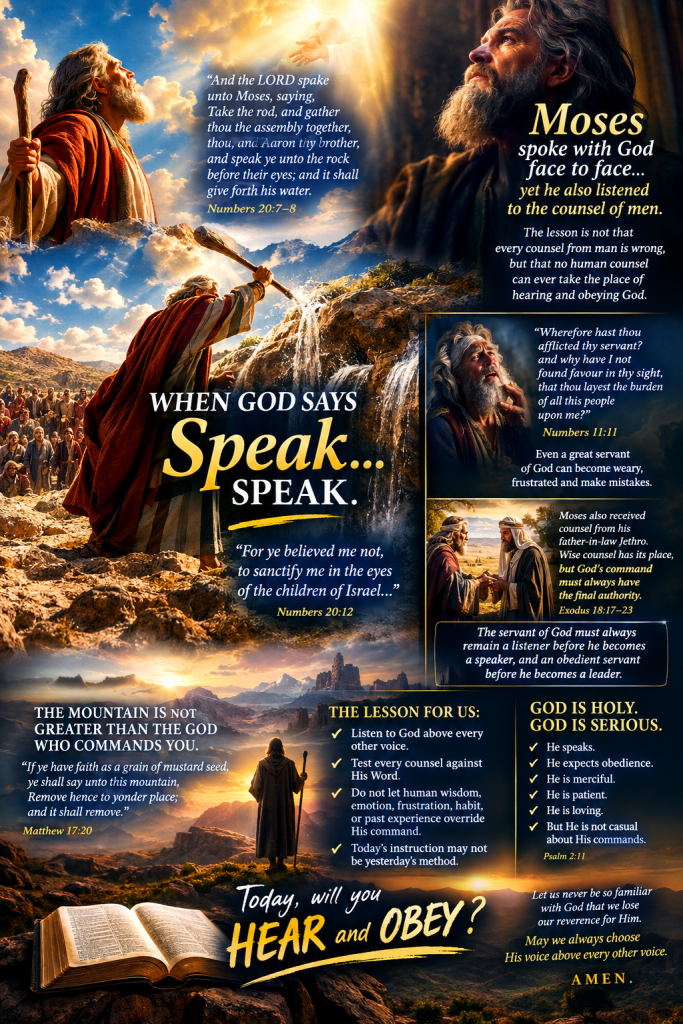
“And the LORD spake unto Moses face to face, as a man speaketh unto his friend” (Exodus 33:11).
In Numbers 20:7–8, the Lord spoke to Moses: “Take the staff, and gather the assembly together, you and Aaron your brother. Speak to the rock before their eyes, and it will yield its water.”
God did not ask Moses to raise his hand. He did not ask him to strike the rock as he had years before at Horeb. He gave a precise, specific command: Speak to the rock.
When the trial is looming before you, when the situation is parched, dry, and impossible, God does not ask for your human effort, your past methods, or your frustration. He asks for your obedience. Speak to the rock. Speak to the mountain. Though it stands high, firm, and unyielding, if you speak the word God commands, the mountain itself will crack, displace, and yield.
Yet, Moses did not speak. In a moment of haste, pressure, and lingering frustration with a rebellious crowd, Moses raised his hand and struck the rock twice with his rod.
To human eyes, striking a rock instead of speaking to it seems like a minor oversight, a small mistake born of impatience. After all, water still gushed forth! The people drank. Their thirst was quenched. The ministry seemed successful on the outside. God, in His mercy, still satisfied the needs of His people; He did not forsake them in that moment.
But in the sacred alignment between God and His prophet, something fundamental was broken.
Moses had walked with God. He had spoken to Him face to face as a man speaks to his friend. He had demonstrated God’s power in front of hundreds of thousands of people. Because of that close intimacy, Moses was held to a higher standard. His gesture was not a harmless misstep; it was an act of public disobedience and overconfidence that dishonored the sanctity of Yahweh.
God told Moses immediately after: “Because you did not trust in me enough to honor me as holy in the sight of the Israelites, you will not bring this community into the land I give them”(Numbers 20:12).
One act of disobedience kept the great deliverer from stepping into the Promised Land.
From the Garden of Eden to the wilderness of Zin, the primary sin that fractures the relationship between God and humanity has always been disobedience. One disobedience brought a curse upon Adam’s lineage. One disobedience kept Moses from Canaan.
Where, then, do we stand? We who have disobeyed not once, not twice, but countless times?
We often treat God with casual familiarity, forgetting who He truly is. But our Lord is a serious God. When He speaks, He expects complete, unquestioning commitment and exact obedience.
Consider the reality of His Presence. In the throne room of the Almighty, where His majesty extends into infinite height, there is a profound, terrifying silence. It is a quiet so absolute that it strips away all human pretense, pride, and excuses. And out of that holy stillness rings the thunderous voice of Yahweh, reminding us: He is a God to be feared, revered, and obeyed.
If Moses who led millions out of bondage, through the parted waters, and into breakthrough was called to account for a single impulsive act, are we prepared to stand before Him today?
We live in a time where grace is often mistaken for permission to compromise. God speaks once, and His words carry eternal weight. We cannot rely on human wisdom or counsel over the direct word of the Almighty.
Despite hearing God’s voice face to face, Moses frequently sought and took organizational guidance from his father-in-law, Jethro, the priest of Midian.
Even leaders, prophets, and faithful believers falter when they begin leaning on human advice over divine instruction. Human counsel may seem practical, logical, and efficient, but it can subtly shift our reliance away from the Spirit of God.
We must return to a posture of total reliance on Yahweh: Men give advice based on logic; God gives commands based on His holiness and sovereign power.
Do not move, act, or strike until you have sought Him directly in prayer.
God is not silent. He speaks through His Word, His Spirit, and His truth. When He gives a directive, our only response must be immediate, full compliance.
If your time were up today and you were called to face the Great Yahweh, could your foundation stand?
Do not let frustration drive your actions. Do not let past successes make you overconfident in current trials. When you face an impossible situation today, do not strike in anger or rely on human methods, do what the Lord asks you to do. If He says speak, then speak.
Let us lay down our self-reliance, repent of our quiet disobedience, and restore a deep, holy reverence for the voice of Almighty God.
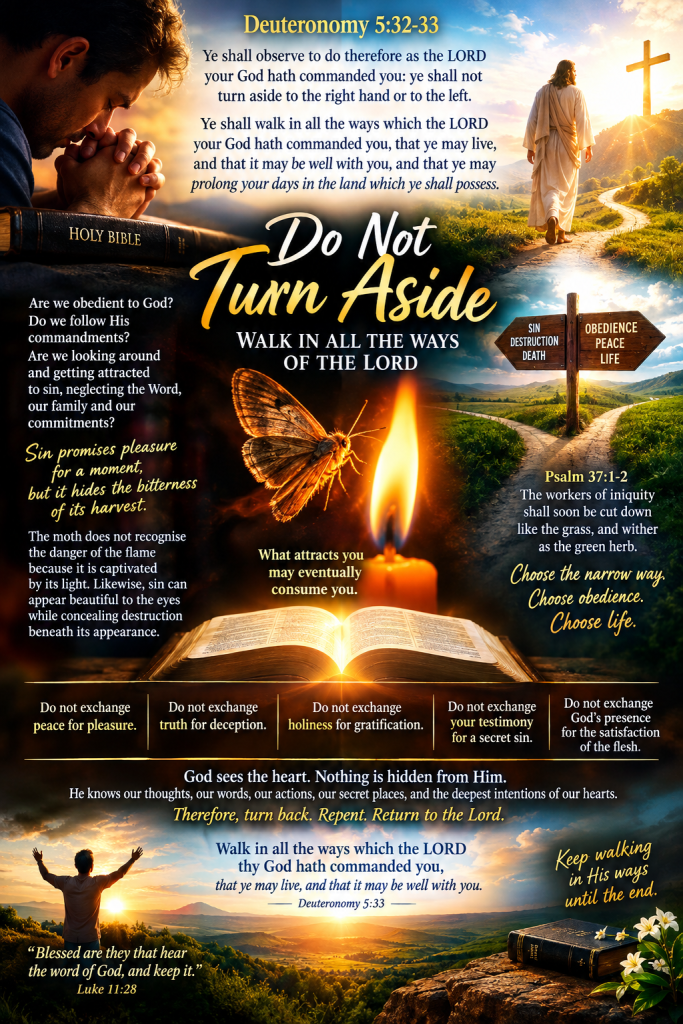
“Ye shall observe to do therefore as the LORD your God hath commanded you: ye shall not turn aside to the right hand or to the left. Ye shall walk in all the ways which the LORD your God hath commanded you, that ye may live, and that it may be well with you” (Deuteronomy 5:32, 33).
The Word of God places a searching question before every soul: Are we truly obedient to God? Are we walking in His ways? Are we keeping His commandments, or have we quietly turned aside?
God says, “Ye shall walk in all the ways.”
There is a great danger in turning aside even slightly. A person rarely wakes up one morning and decides to destroy everything that God has entrusted to him. Often, destruction begins with a small compromise, a secret desire, an unchecked thought, a wandering eye, or a craving that is allowed to remain in the heart.
The eyes begin to look where they should not look. The mind begins to dwell upon what it should reject. The heart begins to desire what God has forbidden. The Word of God is neglected. Prayer becomes less important. Conviction becomes quieter. And eventually, what was once resisted begins to be embraced.
Sin promises pleasure for a moment, but it hides the bitterness of its harvest.
Are you looking around and allowing your eyes to become glued to something that is drawing your heart away from God? Are you neglecting the Word, your family, your responsibilities, and the commitments entrusted to you because you are pursuing a temporary craving?
Be careful. By feeding a temporary desire, you may be starving your own future. You may be damaging the trust of those who love you. You may be allowing promises you once made to quietly dissolve while giving your time, attention, and strength to something that was never sent to bless you.
The moth does not recognize the danger of the flame because it is captivated by its light. Likewise, sin can appear beautiful to the eyes while concealing destruction beneath its appearance.
What attracts you may eventually consume you.
That is why the Lord says: “Ye shall not turn aside to the right hand or to the left.”
God is calling us back to the straight path.
Psalm 37:1, 2 reminds us that the workers of iniquity shall soon be cut down like the grass and wither as the green herb.
The pleasure of sin is temporary, but its consequences can reach deeply into a person’s life. Therefore, do not exchange what is eternal for what is temporary. Do not exchange peace for pleasure, truth for deception, holiness for gratification, your testimony for a secret sin, and God’s presence for the satisfaction of the flesh.
Lord Jesus said: “If ye love me, keep my commandments” (John 14:15).
Obedience is not a way of purchasing God’s love. Rather, obedience is one of the fruits of loving Him. When we truly love the Lord, His Word cannot remain a stranger to us.
We may face temptation, struggle, stumble, and fall along our journey. But when the Holy Spirit convicts us, we must not harden our hearts. We must repent, rise again, and return to the Lord.
The greatest danger is not that you have fallen; the greatest danger is becoming comfortable lying on the ground.
Do not make peace with what God has commanded you to leave, nor mistake your bondage for freedom, darkness for light, compromise for wisdom, or temptation for destiny.
The enemy would love to make sin appear harmless until the chains become difficult to break. That is why we must “walk in all the ways” of the Lord.
God’s commandments are not given to destroy our lives. They are given because He knows the path that leads to life. The Lord sees what we cannot by knowing the end from the beginning while we still stand at the start.
He alone knows where temptation leads, what secret sin costs, which relationships will break, which trust will shatter, which blessings will be lost, and which wounds will linger for years.
Therefore, when God says “Do not turn aside,” He is not withholding something good from us. He is protecting us from something that will wound us.
And remember, God sees the heart. Nothing is hidden from Him, the Lord searches us and knows us. Our thoughts, our words, our actions, our secret places, and the deepest intentions of our hearts are known before Him.
We can never deceive God. Our entire life is open before the One who created us. Therefore, let us examine ourselves honestly.
What has captured my eyes?
What occupies my thoughts?
What am I secretly desiring?
What am I giving more attention to than God?
What has become more important to me than His Word?
Where have I turned aside?
These are not questions merely for someone else. These are questions for me, for you, and for every soul that claims to follow Christ.
The answer is not despair. The answer is return.
“Draw nigh to God, and he will draw nigh to you” (James 4:8).
Return if your footsteps have wandered afar. Rise up if you tripped in the dark. Reclaim what was lost where you yielded your heart; Rekindle the prayer’s dying spark.
Unfold the sacred pages once more, Where wisdom and promise abide. Turn away from the shadows that beckon and pull, And rest in the Light as your guide.
“Looking unto Jesus the author and finisher of our faith” (Hebrews 12:2).
Do not allow the enemy to convince you that you have wandered too far to return.
The Shepherd still calls.
The Father still receives the repentant.
The mercy of God is still available to the humble heart.
Today is the day to turn back.
Step upon the ancient track,
Where quiet footprints lead us back.
Turn from the broad and easy street,
To guide our small and steady feet.
Let compromise fall fast away,
And simple truth outshine the day.
Trade fading joys that burn an hour,
For quiet grace and holy power.
Leave empty noise and worldly song,
To hear where truest echoes long.
Let passing hungers drift and part,
As Christ becomes the living heart.
Let our eyes rest upon the face of Christ, our ears attentive to His Word, our hearts surrendered to His Spirit, our feet established upon His path, and our lives pleasing in His sight.
Turn not to the left, nor cast a backward glance. Do not make a covenant with sin. Let no quiet vows bind the soul to shadow.
Walk where the light is, Walk with God.
Hear the voice that calls you home,
Remain faithful.
And keep walking in His ways until the end.
“Blessed are they that hear the word of God, and keep it” (Luke 11:28).