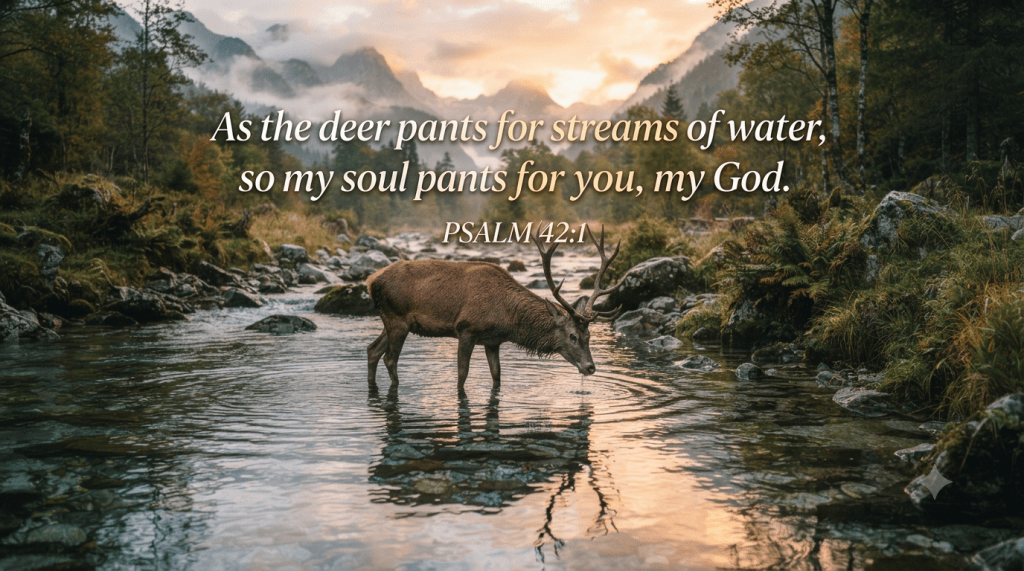
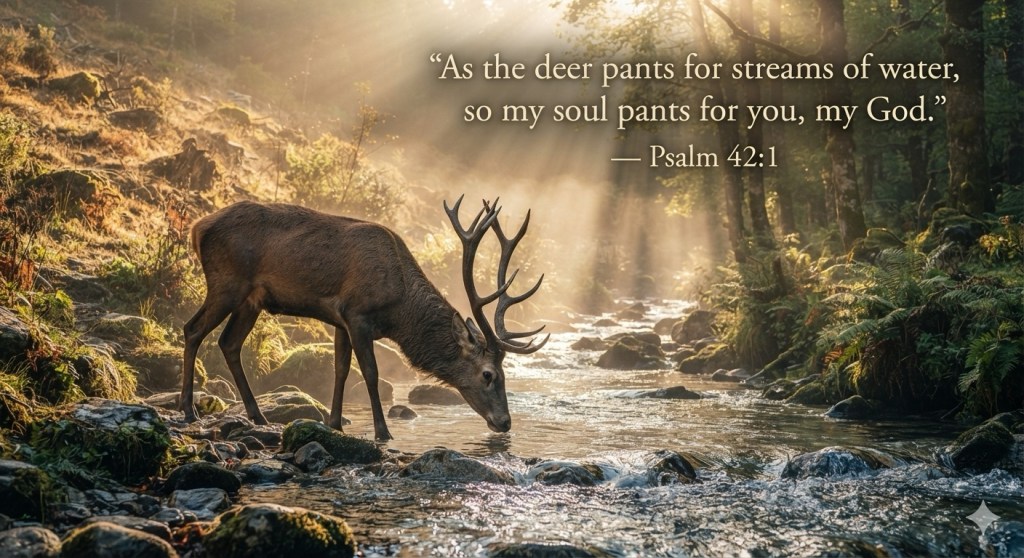
“As the hart panteth after the water brooks, so panteth my soul after thee, O God” (Psalm 42:1).
Today, many of us are walking through spiritual deserts. We are busy, distracted, and exhausted, yet we try to quench our deepest spiritual thirst with everything except the Living Water.
In nature, only the living feel thirst; the dead do not. Similarly, an emptiness that money, success, or relationships cannot satisfy is proof that your soul is alive. God created you with a spiritual void that only He can fill, and your restlessness is your soul crying out for Him. The real danger isn’t feeling empty; it’s ignoring that thirst or trying to quench it with saltwater that only leaves you drier (Jeremiah 2:13).
Why is a deer panting so desperately for water? Usually, for one of two reasons:
The sun has scorched the land, drying up the shallow puddles and forcing the deer to search for deep, flowing streams. A deer running for its life pushes its lungs to the limit. As it flees, its scent trails behind it until it reaches running water to wash away the scent and refresh its strength.
Some of us are panting because of the heat of life’s trials: grief, financial strain, health battles, or broken relationships have dried up our joy. Others are panting because we are running from predators: guilt, shame, anxiety, or past mistakes chasing us down. In both cases, stagnant pond water won’t save you. You need streams of water: fresh, moving, life-giving grace that only flows from the presence of God (Isaiah 55:1).
We live in a culture of wants, craving comfort, answers, and control. Too often, we treat God like a cosmic vending machine, seeking His hand for blessings while ignoring His face.
The psalmist realized that even if God fixed every problem, without God Himself, the soul would still starve. True spiritual breakthrough begins the moment God stops being a useful tool and becomes our ultimate necessity.
God isn’t looking for polished perfection; He is looking for honest thirst. The Lord Jesus stood up in the middle of a crowded festival and cried out, “Let anyone who is thirsty come to me and drink” (John 7:37), promising that whoever believes in Him will have “streams of living water” flow from within them (John 7:38). He went to the cross and cried out, “I thirst” (John 19:28), enduring the ultimate spiritual dryness so that you and I could have an endless supply of living water.
Stop trying to fill your soul with things that cannot satisfy. Bring your dry, weary, panting heart to Lord Jesus today and drink deeply.
“For this cause we also, since the day we heard it, do not cease to pray for you, and to desire that ye might be filled with the knowledge of his will in all wisdom and spiritual understanding; That ye might walk worthy of the Lord unto all pleasing, being fruitful in every good work, and increasing in the knowledge of God” (Colossians 1:9, 10).
The Christian life cannot be safely directed by human wisdom alone. We need the wisdom that comes from above. “If any of you lack wisdom, let him ask of God, that giveth to all men liberally” (James 1:5).
God wants His children to seek His will, not merely ask Him to bless our will. The Lord Jesus Himself demonstrated this in Gethsemane: “Not my will, but thine, be done” (Luke 22:42). That is the heart of surrender.
The Apostle Paul connects the knowledge of God’s will with wisdom and spiritual understanding. There is a difference between knowing Scripture intellectually and understanding how God’s Word should govern our lives.
A person can know many verses and still make foolish decisions. But when the Holy Spirit illuminates God’s Word, Scripture begins to become living guidance. “Thy word is a lamp unto my feet, and a light unto my path” (Psalm 119:105). The Word gives us the light; spiritual understanding helps us walk in that light. This is where knowledge becomes life.
Our faith must become visible in the way we live. To walk worthy of Christ means that our conduct should increasingly reflect the One whom we claim to follow. “Be ye therefore followers of God, as dear children” (Ephesians 5:1). We cannot truly say, “I belong to Christ,” while deliberately choosing a life that continually contradicts Christ. Walking worthy does not mean that we become perfect overnight. It means that our direction has changed.
Although we stumble, fall, are corrected, and are tested, we continually rise, repent, obey, and press forward in our walk with Christ. The Apostle Paul’s desire is that the believer’s life should be pleasing to the Lord. He writes in Galatians 1:10: “For do I now persuade men, or God? or do I seek to please men? if I yet pleased men, I should not be the servant of Christ.” True obedience to God means choosing His approval over the applause of the world, even when it requires standing alone.
A healthy tree produces fruit. A life genuinely connected to Christ should eventually produce spiritual fruit. The Lord Jesus said: “Herein is my Father glorified, that ye bear much fruit; so shall ye be my disciples” (John 15:8). A tree produces fruit because it is rooted and connected to its source of life. We bear spiritual fruit when we abide in Christ: “He that abideth in me, and I in him, the same bringeth forth much fruit” (John 15:5).
The Christian life is not meant to remain spiritually stagnant. You should know Christ more deeply today than you did yesterday. Not merely know more information about Him, but know Him more intimately. The Apostle Paul himself, despite everything he had experienced, still cried: “That I may know him, and the power of his resurrection, and the fellowship of his sufferings” (Philippians 3:10). He had preached Christ, suffered for Christ, served Christ, and witnessed God’s power, yet he still said: “That I may know Him.”
There is always more of Christ to discover.
Ultimately, a life of surrender, obedience, and fruitfulness is only possible when we continuously seek His guidance.
A prayer for transformation: “Lord, fill me with the knowledge of Your will. Give me spiritual wisdom and understanding. Teach me to walk worthy of You. Let my life please You. Make me fruitful in every good work. And above everything else, let me continue increasing in the knowledge of You. Amen.”
Christians are called to follow Christ not merely in name, but in life, in obedience, in holiness, and in the power of the Holy Spirit.
The Lord Jesus Himself was baptized in water, and the Holy Spirit descended upon Him. The Scripture says: “And the Holy Ghost descended in a bodily shape like a dove upon him” (Luke 3:22).
If we call ourselves followers of Christ, we must earnestly seek to walk in the footsteps of Christ.
When Israel passed through the Red Sea, the Apostle Paul described it as a figure of baptism: “And were all baptized unto Moses in the cloud and in the sea” (1 Corinthians 10:2).
Their passage through the waters marked a separation from the life they had known in Egypt. They were moving forward into a new journey under the leadership of God.
Then God manifested His presence among them. At Mount Sinai, the glory and fire of the Lord were revealed. And throughout their wilderness journey, God did not leave His people without direction: “And the LORD went before them by day in a pillar of a cloud, to lead them the way; and by night in a pillar of fire, to give them light” (Exodus 13:21)
Cloud by day. Fire by night.
God did not merely bring His people out, He desired to lead them.
In the same way, receiving the Holy Spirit is not merely about having an experience. The Holy Spirit comes to dwell in you, to teach, guide, comfort, convict, strengthen, and lead you into the truth.
The Lord Jesus said: “And I will pray the Father, and he shall give you another Comforter, that he may abide with you for ever” (John 14:16).
And in John 16:13: “Howbeit when he, the Spirit of truth, is come, he will guide you into all truth.”
The Holy Spirit is the Spirit of God.
The Apostle Paul writes: “Now if any man have not the Spirit of Christ, he is none of his.” (Romans 8:9).
If you are not filled with the Spirit of God, you don’t belong to Him.
Water baptism has profound biblical meaning. It testifies to repentance, identification with Christ, the death of the old life, and the beginning of a new life: “Therefore we are buried with him by baptism into death: that like as Christ was raised up from the dead by the glory of the Father, even so we also should walk in newness of life” (Romans 6:4).
The old life must die, and the new life must be lived in Christ. The Holy Spirit is central to that new life.
The Lord Jesus declared: “Except a man be born of water and of the Spirit, he cannot enter into the kingdom of God” (John 3:5).
The new birth is the work of God within the heart.
On the Day of Pentecost, the promise of the Father was manifested with extraordinary power: “And there appeared unto them cloven tongues like as of fire, and it sat upon each of them. And they were all filled with the Holy Ghost” (Acts 2:3–4).
They were filled with the Holy Spirit, and they began to speak with other tongues as the Spirit gave them utterance.
Tongues are one of the spiritual gifts mentioned by the Apostle Paul among the manifestations of the Spirit (1 Corinthians 12:8–10). The Holy Spirit gives different gifts to different believers according to His will (1 Corinthians 12:11).
Therefore, we should not measure the presence of the Holy Spirit merely by one particular manifestation.
God looks deeper than our outward actions. “For man looketh on the outward appearance, but the LORD looketh on the heart” (1 Samuel 16:7).
Therefore, do not be satisfied with water baptism alone.
Do not be satisfied merely because you were baptized as a child. A ceremony cannot substitute for a surrendered heart.
A person may pass through religious ceremonies and still wander far from God. Israel itself passed through the sea, witnessed God’s mighty works, and yet many later fell into disobedience and unbelief. Apostle Paul warns us to learn from their example (1 Corinthians 10:1–12).
So let us examine ourselves. Have we truly repented? Have we surrendered our lives to Christ? Are we walking in obedience, seeking the Holy Spirit, and allowing the Spirit of God to lead us?
The Scripture says: “As many as are led by the Spirit of God, they are the sons of God” (Romans 8:14).
Repentance must be more than words.
True repentance turns the heart toward God. “Repent ye therefore, and be converted, that your sins may be blotted out” (Acts 3:19).
Come before the Lord sincerely. Fast, pray, and search your heart. Confess your sins to God. Ask Him to cleanse you, change you, and fill you with His Spirit. Lord Jesus Himself gave this invitation: “If any man thirst, let him come unto me, and drink” (John 7:37).
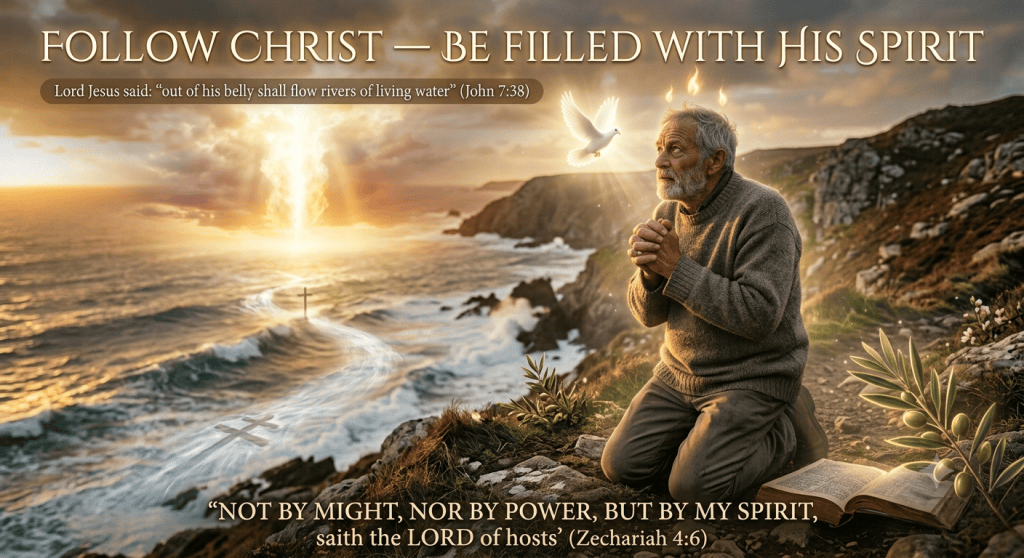
And then He gave this extraordinary promise: “He that believeth on me, as the scripture hath said, out of his belly shall flow rivers of living water” (John 7:38).
If your desire is to serve the Lord and reach souls, ask Him to equip you.
Say: “Lord Jesus, I do not want merely to speak about You. I want You to use my life. Cleanse me. Teach me. Lead me. Fill me with Your Holy Spirit. Give me wisdom, courage, love, discernment, and every gift You desire to place within me. Make me a vessel for Your glory.”
Seek the Lord with your whole heart.
Be filled with His Spirit. Walk in His light.
Bear His fruit. Carry His love. Obey His voice.
And let your life become a living testimony that Jesus Christ is Lord.
“Not by might, nor by power, but by my spirit, saith the LORD of hosts” (Zechariah 4:6).