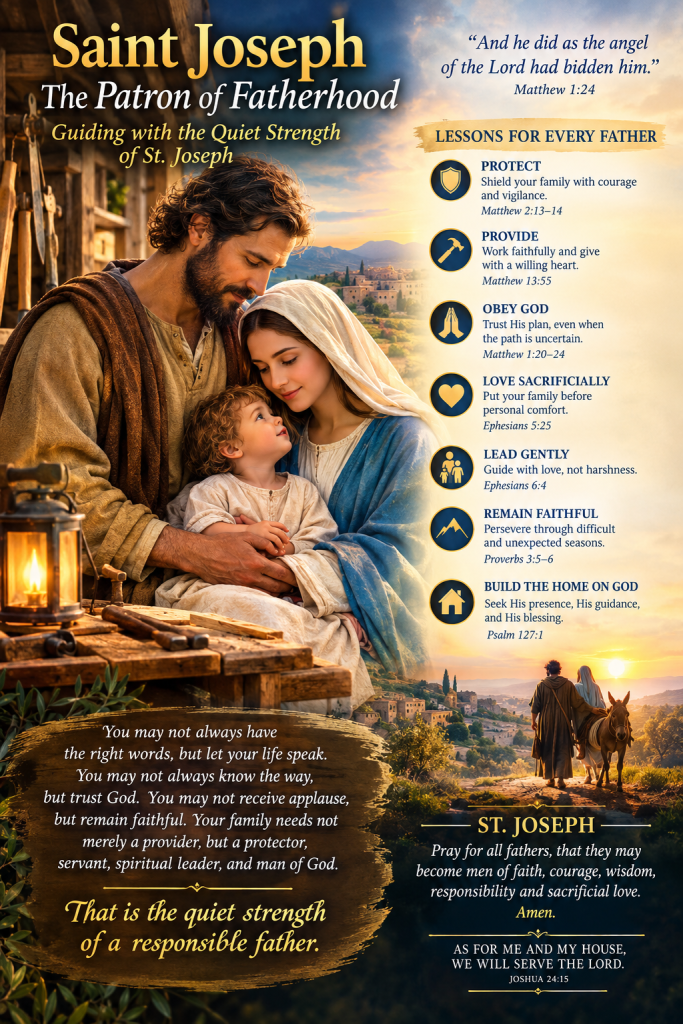
“But as for me and my house, we will serve the LORD” (Joshua 24:15).
Being a responsible father like St. Joseph means anchoring a family in quiet strength, selfless protection, sacrificial love, and steady, faithful devotion. Scripture introduces Joseph as “a just man” (Matthew 1:19), a man whose righteousness was revealed not through many words, but through his actions, obedience, compassion, and trust in God.
Long before he became the foster-father and guardian of Jesus, Joseph’s profound sense of responsibility was tested when he discovered that Mary was with child. Not understanding the mystery of what God was doing, Joseph nevertheless desired to protect Mary from public disgrace: “Joseph her husband, being a just man, and not willing to make her a public example, was minded to put her away privily” (Matthew 1:19).
But God had a greater purpose. An angel of the Lord appeared to Joseph in a dream and revealed the divine mystery: “Joseph, thou son of David, fear not to take unto thee Mary thy wife: for that which is conceived in her is of the Holy Ghost” (Matthew 1:20).
Joseph did not argue, delay, or demand an explanation. He obeyed. “Then Joseph being raised from sleep did as the angel of the Lord had bidden him, and took unto him his wife” (Matthew 1:24).
Here we see the first great lesson of fatherhood: a godly father listens when God speaks and obeys even when he does not understand everything.
Joseph took Mary into his home, accepting the responsibility God had entrusted to him. He protected her dignity, cared for her needs, and accompanied her on the difficult journey to Bethlehem as she prepared to give birth to the promised Messiah.
And when the child was born, Joseph remained faithful to his God-given responsibility. He became the earthly guardian of the One who is the eternal Son of God.
When an angel warned him of Herod’s murderous intention, Joseph again demonstrated immediate obedience: “Arise, and take the young child and his mother, and flee into Egypt” (Matthew 2:13).
And Scripture tells us: “When he arose, he took the young child and his mother by night, and departed into Egypt” (Matthew 2:14).
There was no complaint recorded. No hesitation. No concern about personal comfort. Joseph simply obeyed.
He uprooted his life in the middle of the night and led Mary and the infant Jesus to safety. In doing so, Joseph teaches fathers that protection sometimes requires sacrifice, inconvenience, courage, and immediate action.
After Herod’s death, Joseph once again received divine direction: “Arise, and take the young child and his mother, and go into the land of Israel” (Matthew 2:20).
Joseph obeyed again and eventually settled with Mary and Jesus in Nazareth.
There, in the quietness of an ordinary home, Joseph fulfilled his vocation. He worked with his hands and provided for the Holy Family. Matthew identifies him as a craftsman or builder (Matthew 13:55). His was not a life of public recognition, but a life of hidden faithfulness.
The Gospel gives us a beautiful glimpse of Jesus growing within the loving care of His earthly family: “And the child grew, and waxed strong in spirit, filled with wisdom: and the grace of God was upon him” (Luke 2:40).
Later, when Jesus was found in the temple, Scripture says: “And he went down with them, and came to Nazareth, and was subject unto them” (Luke 2:51).
Joseph’s life reminds us that great fatherhood is often formed in ordinary places: in the home, at work, and through sacrifice, protection, teaching, and daily faithfulness.
His life proves that true fatherhood does not need applause. It speaks through action more than words.
A father protects, provides, teaches, sacrifices, and prays as he leads his family toward God.
A father’s responsibility is not merely to provide material necessities, but also to care for the physical, emotional, moral, and spiritual well-being of his family.
Scripture gives fathers this solemn responsibility: “And, ye fathers, provoke not your children to wrath: but bring them up in the nurture and admonition of the Lord” (Ephesians 6:4).
A godly father does not lead through fear, domination, or demands, but instead protects, provides for, corrects, and disciplines his family through love, wisdom, patience, example, and prayer ultimately showing them what it means to walk with God through his own life.
Scripture also calls husbands to a sacrificial standard: “Husbands, love your wives, even as Christ also loved the church, and gave himself for it” (Ephesians 5:25).
This is the heart of Christian fatherhood: self-giving love.
Providing for a family is more than fulfilling an obligation. It can become a daily offering of love: the sacrifice of time, energy, comfort, personal ambition, and sometimes even one’s own plans for the good of those entrusted to him.
Every father needs the faith to move forward during uncertainty by trusting God, even when the future remains completely unknown. “Trust in the LORD with all thine heart; and lean not unto thine own understanding”(Proverbs 3:5).
There will be seasons when a father does not know what tomorrow will bring. There may be financial difficulties, family struggles, uncertain decisions, disappointments, or roads he never expected to travel.
In those moments, Joseph’s example speaks silently: Listen to God. Trust God. Obey God. Protect those entrusted to you. Keep moving forward in faith.
A father does not have to be perfect to be faithful. He must be willing to humble himself before God, seek wisdom, repent when he fails, and continue walking faithfully.
Ultimately, the strength of a godly father comes not from himself but from the Lord. “Except the LORD build the house, they labour in vain that build it” (Psalm 127:1).
A father may build walls, provide food, pay bills, teach skills, and protect his family, but only God can truly build a home. Therefore, the greatest inheritance a father can leave his children is not merely wealth or possessions, but a living example of faith.
Let your children see your faith in action: praying, forgiving, serving, and choosing God above all else so they learn to make Him first too.
St. Joseph’s life was largely hidden from the world, yet his faithfulness was precious in the sight of God. He did not preach great sermons recorded in Scripture. He did not perform public miracles. We do not hear a single spoken word from Joseph recorded in the Gospels.
His silence was obedience, his hands were service, his courage was protection, his work was provision, and his faith was leadership.
He became a sanctuary of faithfulness for Mary and the child Jesus.
Build a home where love is strong, faith is alive, prayer is welcomed, forgiveness is practiced, truth is honoured, and Christ is at the centre.
A father’s greatest success is not how loudly the world remembers his name, but how faithfully his family remembers the God he taught them to love.
May every father learn from St. Joseph to become a man of quiet strength, courageous obedience, sacrificial love, humble service, and unwavering faith.
And may every Christian home become what Joseph’s home in Nazareth quietly became: a place where God was honoured, where love was lived, where sacrifice was embraced, where faith was taught, and where the presence of God was cherished above everything else.

